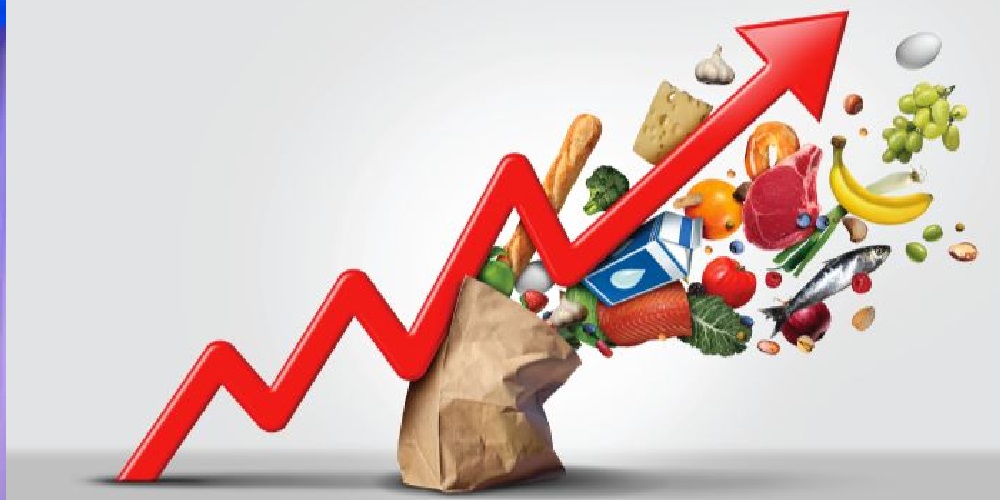
National Bureau of Statistics says food inflation remained above 20 per cent in 11 states in April 2026, even as national food inflation surpassed headline inflation for the first time in eight months, signalling renewed pressure on household purchasing power across the country.
Data from the latest Consumer Price Index report released by the National Bureau of Statistics showed that food inflation rose to 16.06 per cent in April 2026, slightly higher than the headline inflation rate of 15.69 per cent recorded in the same month.
The development marked the first time food inflation exceeded all-item inflation since August 2025, when food inflation stood at 25.30 per cent compared to headline inflation of 23.14 per cent. 
Between September 2025 and March 2026, headline inflation consistently remained higher than food inflation, reflecting broader price pressures beyond food items, including transport, accommodation, energy, and services.
In September 2025, food inflation stood at 20.16 per cent against headline inflation of 20.98 per cent. The gap widened further in January 2026 when food inflation slowed sharply to 8.89 per cent while headline inflation remained elevated at 15.10 per cent.
Food inflation later rebounded steadily from 10.84 per cent in December 2025 to 12.12 per cent in February 2026 and 14.31 per cent in March 2026 before overtaking headline inflation again in April 2026.
The latest figures suggest that food prices are once again becoming the dominant driver of inflationary pressure in the economy after months in which non-food components accounted for a larger share of overall inflation.
The NBS stated that food inflation on a year-on-year basis was highest in Enugu at 32.7 per cent, followed by Kwara at 30.8 per cent and Adamawa at 30.1 per cent.
Other states with food inflation above 20 per cent were Rivers at 26.8 per cent, Delta at 23.9 per cent, Bauchi at 23.7 per cent, Edo at 23.0 per cent, Zamfara at 22.0 per cent, Gombe at 21.6 per cent, Anambra at 20.8 per cent, and Benue at 20.1 per cent.
The bureau said, “Food inflation on a year-on-year basis was highest in Enugu (32.67 per cent), Kwara (30.77 per cent), and Adamawa (30.14 per cent), while Borno (1.67 per cent), Jigawa (6.17 per cent), and Taraba (7.19 per cent) recorded the slowest rise in Food inflation on a year-on-year basis.”
According to the report, the rise in food prices was driven by increases in the average prices of millet, yam flour, fresh ginger, beef, garri, yam tubers, fresh pepper, crayfish, cassava tubers, beans, Irish potatoes, tomatoes, wheat grain, soybeans, guinea corn, plantain, and carrots.
The report also showed worsening month-on-month food inflation pressures in some states. Niger recorded the highest monthly food inflation increase at 8.5 per cent, followed by Bauchi at 6.8 per cent and Kogi at 6.7 per cent. Benue and Plateau also recorded strong monthly increases of 6.6 per cent and 6.2 per cent, respectively.
Conversely, Kebbi recorded the slowest monthly food inflation increase at 0.2 per cent, while Katsina and Bayelsa posted 0.5 per cent and 1.3 per cent, respectively.
At the national level, headline inflation rose marginally to 15.69 per cent in April 2026 from 15.38 per cent in March 2026, representing a 0.31 percentage point increase. The NBS said the Consumer Price Index increased to 138.3 points in April from 135.4 points in March.
However, month-on-month headline inflation slowed to 2.13 per cent in April from 4.18 per cent in March, indicating that the pace of overall price increases moderated compared to the previous month.
The bureau added that rural inflation remained higher than urban inflation, with rural inflation at 16.36 per cent and urban inflation at 15.40 per cent year-on-year. Food and non-alcoholic beverages remained the largest contributor to headline inflation, accounting for 6.40 percentage points of the overall inflation rate.
The worsening food inflation trend also aligns with a new warning by the Famine Early Warning Systems Network, which projected that between 16 million and 16.99 million Nigerians could require urgent humanitarian food assistance by November 2026.
The report placed Nigeria among the countries expected to record the highest number of people in need of food assistance globally, alongside Sudan, the Democratic Republic of Congo, and Yemen.
FEWS NET stated that Nigeria’s projected food assistance needs in November 2026 would be higher than last year’s levels and above the five-year average due to persistent conflict, weak purchasing power, and below-average agricultural production.
According to the report, “In northern Nigeria, needs in November will likely remain elevated despite some seasonal improvements with the September main harvest and declining food prices. However, below-average production, persistent conflict, and constrained purchasing power will continue to limit food access, sustaining widespread Crisis (IPC Phase 3), with some inaccessible areas of North East facing Emergency (IPC Phase 4).”
The report added that Nigeria is expected to account for between five and 10 per cent of total projected global humanitarian food assistance needs across FEWS NET-monitored countries in November 2026.
FEWS NET classifies Crisis, also known as IPC Phase 3, as a condition where households face food consumption gaps or can only meet minimum food needs by depleting essential livelihood assets or adopting crisis-level coping strategies. Emergency, classified as IPC Phase 4, reflects severe food consumption gaps, high acute malnutrition, and excess mortality.
Commenting on the inflation trend, the Chief Executive Officer of the Centre for the Promotion of Private Enterprise, Dr Muda Yusuf, said the latest figures reflected a fragile disinflation process amid persistent pressure from food, transport, and energy costs.
Yusuf noted that although headline inflation rose marginally from 15.38 per cent in March to 15.69 per cent in April, the moderation in month-on-month inflation indicators suggested weakening short-term inflationary momentum.
He said, “Nonetheless, inflation conditions remain severe from a welfare and business cost perspective. Food inflation stood at 16.06 per cent, while core inflation remained elevated at 15.86 per cent. The dominant inflation drivers continue to be food, transportation, energy products, healthcare, and restaurant services, which together accounted for about 87 per cent of the inflation pressure recorded in April.”
According to him, the pressure on essential household spending items was worsening the cost-of-living crisis for many Nigerians, particularly low-income households.
Yusuf also warned that rising geopolitical tensions involving Iran, Israel, and the United States could further worsen inflationary pressures through higher global oil prices and rising domestic energy costs.
He stated, “Rising petrol, diesel and gas prices are fuelling transportation, logistics and production costs across sectors, with significant pass-through effects on food prices and overall consumer inflation.”
The economist argued that Nigeria’s inflation challenge remained largely structural and supply-driven, warning that tighter monetary policy alone would not resolve inflation caused by high energy costs, weak infrastructure, logistics bottlenecks, and food supply disruptions.
He added that further monetary tightening could worsen financing costs for businesses, weaken investment, and constrain productivity growth.
Yusuf called on the Federal Government and state governments to prioritise supply-side reforms aimed at reducing energy and transportation costs, strengthening food supply systems, improving trade facilitation, and boosting domestic productivity.
In an earlier statement, the Director-General of the Lagos Chamber of Commerce and Industry, Dr Chinyere Almona, said the continued rise in food, transportation, energy, and logistics costs was worsening pressure on businesses and households despite signs of moderation in inflation trends.
She noted that inflation continued to erode purchasing power, weaken consumer demand, and compress business margins, particularly for manufacturers, traders, Micro, Small, and Medium Enterprises, and low-income households.
Almona said, “The chamber observes that inflation continues to weigh heavily on manufacturers, MSMEs, traders, and consumers, through rising costs of food, transportation, energy, and logistics.”
She added that the higher rural inflation rate of 16.36 per cent reflected deeper structural challenges, including insecurity in food-producing communities, weak transportation networks, poor storage systems, and persistent supply chain disruptions.
According to her, “The higher rural inflation rate also highlights ongoing supply chain disruptions, insecurity in food-producing areas, and weak distribution infrastructure.”
The LCCI boss stated that although inflation had moderated significantly from the 26.82 per cent recorded in April 2025, many Nigerians were yet to experience meaningful relief due to lingering economic pressures and declining purchasing power.
She called for stronger policy coordination, exchange rate stability, improved energy supply, and deliberate support for local production to sustain the current moderation in inflation.
Almona maintained that long-term price stability would depend on reforms aimed at boosting productivity, improving infrastructure, strengthening food security, and creating a more business-friendly operating environment.
[5/19, 10:36 AM] Emma Agaji: Court orders forfeiture of private jet linked to alleged N23.1bn power fraud
A Federal High Court has ordered the final forfeiture of a private jet allegedly linked to fraud connected to the Maiduguri Emergency Power Project, MEPP, valued at 114.1 million dollars and N23.1 billion.
The development was disclosed in a statement posted on the official page of the Nigeria National Grid.
According to the statement, investigations by the Economic and Financial Crimes Commission, EFCC, allegedly revealed that Abdulsalam Mustapha Kachallah leaked bidding information to China Machinery Engineering Company, CMEC, in exchange for financial kickbacks.
The statement alleged that CMEC later transferred about 2.07 million dollars through Afuwa Integrated Services, identified as a Bureau De Change operator, using what were described as forged invoices to facilitate the purchase of the aircraft for Valiente Jet Limited.
Justice Emeka Nwite reportedly described the transaction as a disguised arrangement linked to fraudulent activities surrounding the project.
“Justice Nwite condemned the disguised transaction, forfeiting the asset to the FG. The court ordered the permanent forfeiture of the aircraft to the Federal Government,” the statement read.