
Economy
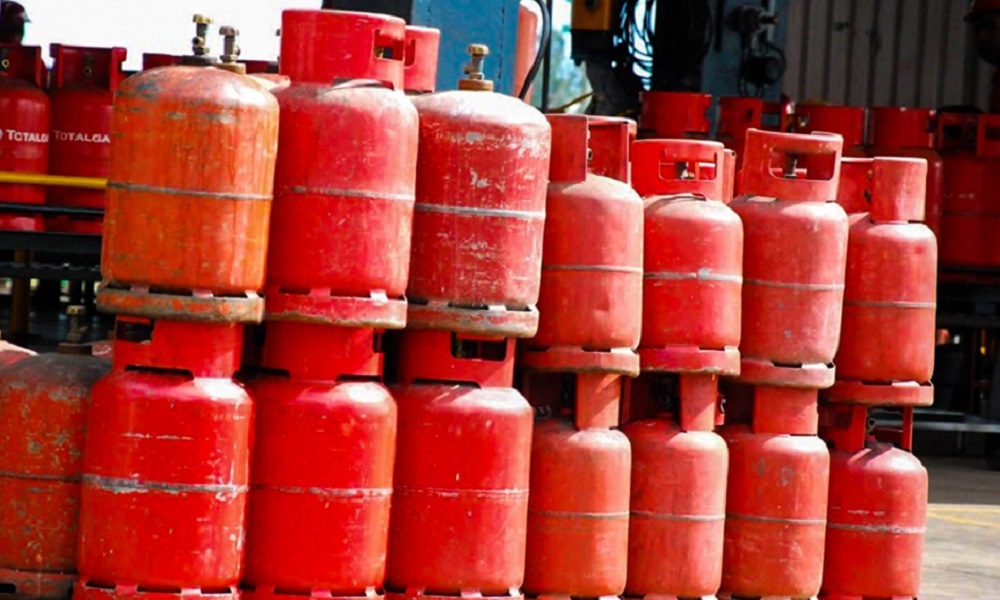
Cooking gas price hits N2,000/kg in Lagos, N1,600 in Abuja as marketers battle supply shortages

- /home/naijuinz/public_html/wp-content/plugins/mvp-social-buttons/mvp-social-buttons.php on line 27
https://naijablitznews.com/wp-content/uploads/2024/02/cooking-gas-cylinders.jpg&description=Cooking gas price hits N2,000/kg in Lagos, N1,600 in Abuja as marketers battle supply shortages', 'pinterestShare', 'width=750,height=350'); return false;" title="Pin This Post">
- Share
- Tweet /home/naijuinz/public_html/wp-content/plugins/mvp-social-buttons/mvp-social-buttons.php on line 72
https://naijablitznews.com/wp-content/uploads/2024/02/cooking-gas-cylinders.jpg&description=Cooking gas price hits N2,000/kg in Lagos, N1,600 in Abuja as marketers battle supply shortages', 'pinterestShare', 'width=750,height=350'); return false;" title="Pin This Post">


Cooking gas prices are surging across parts of Lagos, Ogun, and Abuja amid growing concerns by marketers over worsening supply shortages and mounting operational costs in the liquefied petroleum gas (LPG) sector.
TheCable observed on Monday that prices peaked to N1,400 and N2,000 per kilogramme (KG) across various locations.
In Ikorodu, Lagos, cooking gas was sold for N1,800 per kg, up from N1,300 almost a month ago.
Prices reportedly increased at Afeeze Bus Stop in Ogba to N2,000/kg from N1,500 within the last three weeks.
In Akoka, Yaba, consumers bought the product at N1,500/kg, while the commodity sold for N1,400/kg in Ojota, Lagos.
Consumers in parts of the RCCG camp area in Mowe, Ogun state, also purchased cooking gas at N2,000/kg, while the product is selling for N1,500/kg in Owerri, Imo state.
In the federal capital territory (FCT), prices varied across locations, with residents in Lugbe reporting N1,480/kg, while consumers in Lokogoma paid N1,600/kg.
Reacting to the development, the Nigerian Association of Liquefied Petroleum Gas Marketers (NALPGAM) bemoaned the current LPG supply challenges.
According to NAN, in a joint statement signed by Edu Inyang, president of the association, and Bassey Effiong, executive secretary of NALPGAM, said consumers across the country now purchase cooking gas at more than N1,500 per kg.
The association said operators currently pay between N25.2 million and N26.2 million for a 20-metric-tonne truck of LPG, depending on the location.
The rising cost and erratic supply of cooking gas have imposed severe hardship on households, food vendors, small businesses and low-income earners who depend on LPG for daily cooking,” NALPGAM said.
The group warned that the crisis threatens years of progress by the government and private investors to promote clean cooking energy as an alternative to firewood, charcoal, and kerosene.
NALPGAM also expressed concern over challenges confronting marketers nationwide, including persistent supply shortages, high depot prices, logistics bottlenecks, and rising operational costs.
The association said without urgent intervention, the situation could worsen food inflation, force LPG businesses to shut down, trigger job losses, and undermine Nigeria’s clean energy goals.
We cannot stand by and watch millions of Nigerian families suffer in silence while access to clean cooking energy becomes increasingly unaffordable,” the statement reads.
NALPGAM called on the federal government and industry stakeholders, including the ministry of petroleum resources, the Nigerian Midstream and Downstream Petroleum Regulatory Authority (NMDPRA), NNPC Limited, domestic producers, and terminal operators, to intervene and stabilise the LPG market.
The association also recommended increased domestic gas allocation, improved product availability, transparent distribution systems, reduced importation and storage bottlenecks, and strategic measures to stabilise prices.



The Nigerian naira traded at relatively stable levels against the United States dollar on Tuesday, June 23, 2026, across both the official and parallel foreign exchange markets, as market participants continued to monitor liquidity conditions and foreign exchange demand.
Latest data from the Nigerian Foreign Exchange Market (NFEM) showed that the naira exchanged at approximately ₦1,366.41 per dollar at the official market. The NFEM rate, which is published by the Central Bank of Nigeria, represents the volume-weighted average exchange rate for the day.
The official exchange rate has remained within the ₦1,350-₦1,370 range in recent weeks, supported by improved liquidity and sustained foreign portfolio inflows into local assets.
In the parallel market, also known as the black market, the dollar traded at around ₦1,400 for buying and between ₦1,410 and ₦1,420 for selling, depending on location and dealer quotations.
The spread between the official and parallel market rates remained relatively narrow compared with previous years, reflecting ongoing reforms aimed at improving transparency and efficiency in Nigeria’s foreign exchange market.
Currency traders said demand for dollars from importers, travellers and businesses remained steady, although the naira has benefited from increased confidence in the foreign exchange market and improved dollar supply.
Analysts noted that exchange rates could continue to fluctuate in response to changes in foreign exchange inflows, global oil prices and domestic economic conditions.
As of the prevailing rates, $100 would exchange for about ₦136,641 at the official NFEM window, while the same amount could fetch between ₦141,000 and ₦142,000 in the parallel market.
Foreign exchange rates remain subject to intraday movements and may vary across banks, bureaux de change operators and other market participants.
A total sum of N2.300 trillion, being the May 2026 Federation Account Revenue, has been shared between the federal government, states, and the local government councils.
In a statement on Wednesday by the spokesperson of the Office of the Accountant General of the Federation, Bawa Mokwa, the revenue was shared at the June 2026 Federation Account Allocation Committee FAAC meeting held in Abuja.
The N2.300 trillion total distributable revenue comprised distributable statutory revenue of N1.611 trillion and distributable Value Added Tax (VAT) revenue of N688.785 billion.
A communiqué issued by the Federation Account Allocation Committee (FAAC) indicated that the total gross revenue of N3.395 trillion was available in the month of May 2026. Total deduction for cost of collection was N123.546 billion, while total transfers and refunds were N971.610 billion.
According to the communiqué, gross statutory revenue of N2.651 trillion was received for the month of May 2026. This was higher than the sum of N2.378 trillion received in the preceding month by N273.623 billion.
Gross revenue of N743.668 billion was available from the Value Added Tax (VAT) in May 2026. This was lower than the N806.617 billion available in the month of April 2026 by N62.949 billion.
The communiqué stated that from the N2.300 trillion total distributable revenue, the federal government received a total sum of N818.680 billion, and the state governments received a total sum of N759.141 billion.
The local government council received N534.277 billion, while the sum of N188.132 billion (13% of mineral revenue) was shared with the benefiting state as derivation revenue.
On the N1.611 trillion distributable statutory revenue, the communiqué stated that the federal government received N749.801 billion and the state governments received N380.309 billion.
The local government councils received N293.202 billion, and the sum of N188.132 billion (13% of mineral revenue) was shared with the benefiting states as derivation revenue.
From the N688.785 billion distributable Value Added Tax (VAT) revenue, the federal government received N68.879 billion, the state governments received N378.832 billion, and the local government councils received N241.075 billion.
In May 2026, Companies Income Tax (CIT), CGT, SDT, Petroleum Profit Tax (PPT), Hydrocarbon Tax (HT), and Oil and Gas Royalty increased significantly, while Import Duty, Value Added Tax (VAT), Excise Duty, and CET Levies decreased considerably.
The Federal Government, states and local government councils shared a total sum of N2.257 trillion from the Federation Account in April.
Director, Press and Public Relations, Office of the Accountant General of the Federation, Bawa Mokwa, disclosed this in a statement on Monday.
The revenue was shared at the May 2026 Federation Account Allocation Committee, FAAC, meeting held in Abuja.
The N2.257 trillion total distributable revenue comprised distributable statutory revenue of N1.260 trillion , distributable Value Added Tax, VAT, revenue of N747.088 billion, and augmentation of N250.000 billion.
This indicated that total gross revenue of N3.184 trillion was available in the month of April 2026. The total deduction for cost of collection was N113.756 billion, while total transfers, refunds, and savings were N813.839 billion.
According to the statement, gross statutory revenue of N2.378 trillion was received for the month of April 2026. This was higher than the sum of N1.699 trillion received in the preceding month by N678.224 billion.
Gross revenue of N806.617 billion was available from VAT in April 2026. This was higher than the N664.425 billion available in the month of March 2026 by N142.192 billion.
The communiqué stated that from the N2.257 trillion total distributable revenue, the Federal Government received a total sum of N787.351 billion, and the state governments received a total sum of N772.360 billion.
The local government councils received N540.152 billion, while the sum of N157.254 billion (13% of mineral revenue) was shared with the benefiting states as derivation revenue.
On the N1.260 trillion distributable statutory revenue, the statement stated that the Federal Government received N580.942 billion and the state governments received N294.661 billion.
The local government councils received N227.172 billion, and the sum of N157.254 billion (13% of mineral revenue) was shared with the benefiting states as derivation revenue.
From the N747.088 billion distributable VAT revenue, the Federal Government received N74.709 billion, the state governments received N410.898 billion, and the local government councils received N261.481 billion.
The Federal Government received N131.700 billion of the N250.000 billion, the state governments received N66.800 billion, and the local governments received N51.500 billion.
In April 2026, Companies Income Tax, CIT, CGT, SDT, import duty, oil and gas royalty, and VAT increased significantly, while Petroleum Profit Tax, PPT, and hydrocarbon tax, HT, decreased considerably.
Excise duty and CET levies decreased marginally.

Teenage girl allegedly stabbed parents to de@th, stabbed family dog, sent crime scene photos to friends

SEE Dollar to Naira exchange rate today, June 23, 2026

OGTV broadcaster: Police recover stolen Lexus RX300 as CP vows “no stone unturned” in murder probe




-

 News22 hours ago
DAY 9 of Projects Commissioning in the FCT: Watch moment Wike arrives Karu(Video)
-

 Sports21 hours ago
Egypt’s historic World Cup win over New Zealand, will be remembered for a long time-Sallah
-

 News10 hours ago
Wait for 2027, Presidency Tells Peter Obi Amid Calls for Tinubu’s Resignation
-

 News21 hours ago
SAD! Lassa Fever Kills 214, Fatality Rate Rises To 25% — NCDC
-

 News21 hours ago
Plateau boils again, 25 feared dead as bandits invade community
-

 News10 hours ago
Tinubu Appoints Former UNILAG VC Ogundipe as NUC Governing Board Chairman
-

 Metro10 hours ago
Disaster Averted in Enugu as Rescue Teams Contain Gas Leak After Truck Crash at Ugwuonyeama
-

 News21 hours ago
South Africa deploy security personnel nationwide ahead of anti-migrant deadline