
Opinion
The Sundiata Post Model (3): The Dual Engine Architecture


- /home/naijuinz/public_html/wp-content/plugins/mvp-social-buttons/mvp-social-buttons.php on line 27
https://naijablitznews.com/wp-content/uploads/2026/07/IMG-20260628-WA00132-1000x600.jpg&description=The Sundiata Post Model (3): The Dual Engine Architecture', 'pinterestShare', 'width=750,height=350'); return false;" title="Pin This Post">
- Share
- Tweet /home/naijuinz/public_html/wp-content/plugins/mvp-social-buttons/mvp-social-buttons.php on line 72
https://naijablitznews.com/wp-content/uploads/2026/07/IMG-20260628-WA00132-1000x600.jpg&description=The Sundiata Post Model (3): The Dual Engine Architecture', 'pinterestShare', 'width=750,height=350'); return false;" title="Pin This Post">


By Max Amuchie | The Sunday Stew
In the 7 June 2026 article which marked the formal unveiling of the Decoupling Sovereignty Index (DSI), I articulated a defining institutional proposition. The launch of the DSI was presented not merely as the introduction of a new analytical instrument, but as another milestone in the evolution of Sundiata Post into what I described as a dual engine architectural powerhouse. That statement marked an important transition. It signalled that Sundiata Post was no longer to be understood solely as a digital news platform, but as an institution consciously integrating journalism, strategic intelligence and scholarly research within a single operational framework.
The proposition advanced on that occasion was straightforward. On the front end, Sundiata Post would continue to function as a digital-first, high-velocity news organisation, reporting events, investigating public issues, analysing developments and informing citizens through timely, credible journalism. On the back end, the Sundiata Post Intelligence Unit (SPIU) would operate as a proprietary knowledge engine, generating original research, developing analytical frameworks, curating datasets, publishing working papers and preserving institutional knowledge through globally recognised scholarly repositories.
This series develops that proposition into a formal institutional architecture.
The first part in this series argued that the newsroom of the twenty-first century must evolve beyond the production of daily news to become a knowledge institution. The second situated that proposition within a broader intellectual tradition, demonstrating through the works of Walter Lippmann, Hannah Arendt, Nnamdi Azikiwe and Obafemi Awolowo that journalism has historically served not merely as a conveyor of information but as a builder of public reason, democratic culture and national development.
Having established the philosophical foundations, we now turn to the question of institutional design. Every enduring institution requires more than a compelling vision; it requires an architecture capable of translating principles into sustained practice. Ideas alone do not create institutions. Institutions endure because they are deliberately designed to produce consistent outcomes, preserve organisational memory, adapt to changing environments and outlive their founders.
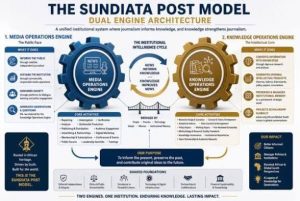
The Sundiata Post Model is therefore built upon what I call the Dual Engine Architecture. Simply stated, the Dual Engine Architecture is an institutional design in which a Media Operations Engine generates public value through journalism while a Knowledge Operations Engine transforms that journalistic enterprise into a permanent system of knowledge production.
The first engine is the Media Operations Engine—the visible newsroom that performs the essential functions of journalism through reporting, verification, investigation, editing, publication and audience engagement. The second is the Knowledge Operations Engine—the institutional infrastructure through which research is conducted, theories are formulated, datasets are curated, policy knowledge is generated and intellectual assets are systematically preserved.
These engines are neither parallel organisations nor competing departments. They are interdependent components of a single institutional system. Journalism supplies the observations, evidence and questions that shape the research agenda. Research, in turn, enriches journalism with deeper context, analytical rigour and conceptual innovation. The output of one continuously strengthens the other, creating an institutional intelligence cycle in which news informs knowledge and knowledge improves news.
The significance of this architecture extends beyond Sundiata Post itself. It offers a framework for reimagining the modern newsroom in an era defined by rapid technological change, information overload and declining public trust. Rather than treating journalism as a transient response to the daily news cycle, the Dual Engine Architecture positions the newsroom as the public-facing component of a broader knowledge enterprise—one that simultaneously informs the present, preserves the past and contributes original ideas to the future.
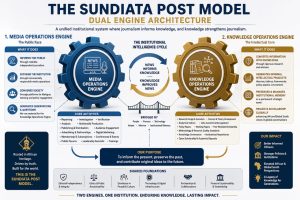
The Media Operations Engine
The first pillar of the Sundiata Post Model is the Media Operations Engine. This is the institution’s public-facing operational system—the visible enterprise through which Sundiata Post fulfils its journalistic, commercial and public engagement responsibilities. It represents the front end of the organisation, integrating editorial excellence with audience development, revenue generation and public-facing institutional activities.
At its core, the Media Operations Engine performs the traditional functions of a professional news organisation. It identifies stories of public importance, deploys reporters to the field, verifies facts through rigorous editorial procedures, produces multimedia content, provides analysis and commentary, and disseminates information across digital platforms. These activities remain the foundation of the institution’s commitment to informing society accurately, independently and responsibly.
Beyond the newsroom, however, the Media Operations Engine encompasses the broader business of media. It includes advertising and brand partnerships, digital marketing, audience growth strategies, subscription and membership initiatives where applicable, commercial publishing, multimedia production, and other revenue-generating activities necessary to sustain editorial independence. Within the Sundiata Post Model, commercial operations are not peripheral to journalism; they are carefully managed institutional functions that provide the financial capacity required for long-term public-interest reporting and knowledge production.
The engine also extends the institution’s public engagement beyond daily news publishing. Conferences, annual lectures, policy dialogues, public forums, media masterclasses, leadership summits and other convening platforms become integral components of the media enterprise. These engagements transform the organisation from a publisher of information into a convener of ideas, creating spaces where journalists, scholars, policymakers, business leaders and citizens can deliberate on issues of national and continental importance. In doing so, the Media Operations Engine strengthens the institution’s civic presence while simultaneously generating new networks, partnerships and editorial opportunities.
Within the Sundiata Post Model, the Media Operations Engine performs an additional function that distinguishes it from conventional news organisations. It serves as the institution’s principal observational system. Every news report, investigative assignment, interview, audience interaction, conference discussion and field observation constitutes more than a discrete media product. Collectively, they generate the empirical evidence, public conversations and emerging questions that feed the institution’s knowledge infrastructure.
In many conventional media organisations, these valuable intellectual assets dissipate with the passing of the news cycle. The Sundiata Post Model rejects this linear conception of journalism. Instead, every verified report, public engagement and editorial initiative is regarded as a potential contribution to a cumulative institutional intelligence system.
Accordingly, the Media Operations Engine performs four interconnected functions. First, it informs the public through credible journalism. Second, it sustains the institution through commercially responsible media operations. Third, it convenes society by creating platforms for dialogue, learning and policy engagement. Fourth, it continuously generates the empirical observations and strategic questions that become the raw material for the Knowledge Operations Engine.
The Media Operations Engine is therefore far more than a newsroom. It is the institution’s interface with society—observing events, engaging audiences, building relationships, generating revenue and producing the empirical foundation upon which the Sundiata Post Model’s broader knowledge enterprise is constructed.
The Knowledge Operations Engine
If the Media Operations Engine is the public face of the Sundiata Post Model, the Knowledge Operations Engine is its intellectual core. It is the institutional infrastructure through which information is transformed into knowledge, knowledge into analytical frameworks, and analytical frameworks into enduring intellectual assets. While the front end responds to the immediacy of events, the back end seeks to understand their underlying structures, causes and long-term implications.
The Knowledge Operations Engine is anchored by the Sundiata Post Intelligence Unit (SPIU), which serves as the institution’s research and strategic intelligence hub. It is responsible for designing and executing research programmes, developing original concepts and theories, constructing analytical indices, curating datasets, producing policy papers, publishing working papers and peer-reviewed scholarship, maintaining institutional standards for methodology, research quality and knowledge governance, and preserving institutional knowledge through globally recognised academic repositories.
In this architecture, research is not an adjunct to journalism but an integral institutional function.
Unlike conventional newsroom research desks, whose work is often confined to supporting daily editorial production, the Knowledge Operations Engine pursues an independent programme of knowledge creation. It identifies recurring patterns across time, interrogates complex governance and security challenges, develops explanatory models, and subjects those models to empirical testing. The objective is not merely to explain individual events but to contribute original intellectual frameworks capable of advancing scholarly and policy debates.
The engine is also responsible for the stewardship of institutional memory. Research datasets, methodological notes, interview archives, conceptual papers, technical documentation and analytical outputs are systematically organised, preserved and made retrievable. Rather than allowing institutional knowledge to disappear with personnel changes or the passing of the news cycle, the Sundiata Post Model treats these materials as strategic assets that accumulate value over time. This commitment to preservation transforms the institution from a producer of content into a custodian of knowledge.
A defining characteristic of the Knowledge Operations Engine is its commitment to openness and scholarly engagement. Where appropriate, research outputs are deposited in recognised academic repositories, enabling scrutiny, replication, citation and further development by the global research community. By exposing its analytical frameworks and datasets to independent examination, the institution embraces the principle that durable knowledge grows stronger through critical evaluation rather than institutional isolation.
The Knowledge Operations Engine therefore performs four interconnected functions. First, it converts empirical observations into structured knowledge through rigorous research and analysis. Second, it generates original intellectual products—including theories, indices, policy frameworks and methodological innovations—that extend beyond the immediate demands of journalism. Third, it preserves and manages the institution’s intellectual capital as a permanent strategic resource. Fourth, it projects African or Global South scholarship into global academic and policy ecosystems, ensuring that ideas developed within the newsroom contribute to international conversations on governance, security, development and media innovation.
The Knowledge Operations Engine is therefore not simply a research department. It is the institutional mechanism through which journalism acquires permanence, evidence is transformed into understanding, and a media organisation evolves into a knowledge-producing institution. Together with the Media Operations Engine, it completes the Dual Engine Architecture that lies at the heart of the Sundiata Post Model.
If the preceding sections explain how the Sundiata Post Model works, an equally important question remains: Is this architecture unique to Sundiata Post, or can it become a framework for journalism more broadly?
Beyond Sundiata Post
The Sundiata Post Model is proposed as a universal institutional framework for twenty-first-century journalism. Although it originated within Sundiata Post, it is not conceived as an organisation-specific model. Rather, it offers a general institutional architecture that can be adapted by news organisations operating in diverse economic, technological, political and cultural environments.
In this formulation, Sundiata Post is not the model; it is the founding implementation and proof of concept—a living institutional demonstration that such an architecture is both practicable and sustainable. The relationship is similar to the Toyota Production System, which began inside a single company but evolved into a global management framework adopted by organisations far beyond the automotive industry. Likewise, the Sundiata Post Model is intended to transcend the organisation in which it was first developed.
Its long-term significance will therefore be determined not solely by its success at Sundiata Post, but by its capacity to be tested, adapted, replicated and refined by media organisations across different societies. The true measure of any institutional model is not that it works for its originator, but that it enables others to build stronger institutions of their own. If the Sundiata Post Model ultimately proves capable of helping news organisations across Africa, the Global South and beyond become enduring knowledge institutions, then its greatest contribution will not be what it achieved for Sundiata Post, but what it made possible for journalism itself.
Trust is sacred. Stay seasoned.
•Dr. Max Amuchie is a Scholar-Journalist, Media CEO, Lead Researcher at the Sundiata Post Intelligence Unit (SPIU), and an Expert Member and Peer Reviewer at ScienceOpen. He is the architect of The Insecurity Triad framework for African security analysis as well as the Trinity of Sovereignty Decay (formerly Trinity of State Decay) theory, and the Decoupling Sovereignty Index (DSI)—original frameworks for understanding, categorising, and measuring conflict, state decay, and sovereignty in the Global South.
X: @MaxAmuchie | Email: [email protected]

By Max Amuchie | The Sunday Stew
In the preceding articles, I have argued that the twenty-first-century newsroom must evolve into a knowledge-producing institution; situated that proposition within a broader intellectual tradition; introduced the Dual Engine Architecture through which journalism and knowledge production become mutually reinforcing; and proposed the Realm of the Long Term together with its Seven Pillars as the institutional foundations of enduring organisations.
A natural question now arises.
How should the success of such an institution be measured?
For decades, the commercial media industry understandably prioritised audience size and print circulation. With the rise of digital journalism, these traditional measures were increasingly supplemented—and in many cases displaced—by page views, unique visitors, click-through rates, impressions, engagement metrics and social media reach. These indicators remain valuable because they reveal important aspects of audience behaviour and commercial performance.
Yet they do not tell the whole story.
A media organisation may attract millions of readers while producing little original knowledge. It may dominate online conversations today yet leave no enduring intellectual contribution tomorrow. It may generate impressive revenue while gradually losing public trust. Conversely, an institution may produce ideas that influence scholarship, public policy and professional practice for decades without ever becoming the largest media organisation in its market.
The central proposition of the Sundiata Post Model (SPM) is therefore straightforward: institutions should ultimately be measured not merely by what they produce, but by what they leave behind.
This requires us to rethink what institutional success actually means.
Four Levels of Institutional Success
The SPM proposes that institutional success exists at four progressively deeper levels: Operational Success, Institutional Success, Civilisational Success and Legacy.
These are not competing categories. They are successive stages in the evolution of an enduring institution.
Operational Success
Operational Success concerns an institution’s ability to perform its immediate responsibilities effectively.
For a newsroom, this includes producing accurate journalism, meeting publication deadlines, maintaining editorial standards, growing audiences, generating sustainable revenue and responding effectively to the daily demands of public communication.
These are indispensable functions. Without operational competence, institutions cannot survive.
Yet Operational Success is also the most immediate form of success. It is measured in days, weeks, months and annual performance reports.
It answers a relatively simple question:
Is the institution performing well today?
Many organisations achieve Operational Success.
Far fewer move beyond it.
Institutional Success
Institutional Success represents a deeper level of achievement.
Here, attention shifts from performance to permanence.
The institution is no longer evaluated solely by today’s output but by its ability to preserve its mission while continuously renewing itself. Leadership succession becomes important. Governance becomes important. Institutional memory becomes important. Financial resilience, knowledge stewardship, innovation, public trust and organisational culture become defining concerns.
This is the Realm of the Long Term introduced in the previous article.
The central question is no longer:
How well are we performing?
Instead, it becomes:
Will this institution remain valuable twenty, fifty or one hundred years from now?
Institutions that reach this level become larger than any individual leader.
Their systems become more important than personalities.
Their mission becomes more enduring than their founders.
This transition requires institutionalisation: the process through which an institution converts individual vision, knowledge and leadership into durable systems, structures, practices and values that can survive changes in personnel and leadership.
An institution is not truly enduring if its most important knowledge exists only in the mind of one person, if its critical relationships depend entirely upon one individual, or if its strategic direction disappears when its founder departs.
Institutionalisation is therefore one of the mechanisms through which Institutional Success becomes possible. It transforms personal capacity into institutional capacity and individual achievement into organisational inheritance.
Civilisational Success
The third level extends beyond the institution itself.
Civilisational Success concerns the institution’s contribution to society’s accumulated stock of knowledge.
It occurs when an institution produces ideas, methods, frameworks, archives, research, public debates and intellectual traditions that continue shaping society long after their immediate circumstances have passed.
At this level, the institution no longer influences only its industry.
It contributes to civilisation itself.
Its ideas become reference points.
Its publications become historical records.
Its methodologies become professional standards.
Its research becomes part of society’s collective memory.
The institution’s greatest contribution is therefore not simply the news it reported, but the knowledge it helped humanity preserve.
The SPM is itself grounded in this proposition. As a model for twenty-first-century journalism, it argues that a newsroom organised as a knowledge-producing institution should be capable of generating original intellectual contributions alongside its daily journalism. The development of The Insecurity Triad, the Trinity of Sovereignty Decay (TSD), and the Decoupling Sovereignty Index (DSI) illustrates this possibility. These frameworks did not emerge from a conventional research institute or university department, but from a newsroom deliberately organised to produce knowledge as well as news. They therefore serve as a proof of concept for one of the Model’s central propositions: journalism, when institutionally designed for long-term knowledge creation, can produce intellectual assets whose influence extends beyond the news cycle.
Yet even Civilisational Success leaves one final question unanswered.
What is the highest measure of institutional success?
The SPM proposes a simple answer:
Legacy
Legacy is often misunderstood. It is commonly associated with longevity, reputation or the accomplishments of exceptional individuals. While these may contribute to legacy, they do not define it.
Institutions can exist for centuries without leaving a meaningful imprint on society. Others achieve widespread recognition during their lifetime yet fade quickly from public memory once circumstances change.
Legacy is something deeper.
It measures Generational Influence—the extent to which an institution’s ideas, values, methods and contributions continue shaping future generations.
Time alone does not create legacy.
Survival should not be mistaken for significance.
The true test of an institution is not simply whether it continues to exist, but whether its existence continues to matter.
Institutions achieve legacy when successive generations continue drawing value from what they have created. Their archives remain useful. Their research continues to be consulted. Their journalism retains historical relevance. Their ideas continue shaping public debate. Their methods become part of professional practice.
Legacy therefore transforms institutional success from a temporary achievement into a continuing public resource.
Every enduring institution eventually confronts the same reality.
Its founders leave. Leadership changes.
Generations pass.
If an institution depends entirely upon the vision or personality of a single individual, succession becomes a moment of vulnerability rather than renewal.
The question, therefore, is not simply whether an institution has a great founder or an exceptional leader. It is whether the institution can transform that individual’s vision into a capacity that belongs to the institution itself.
This is the deeper meaning of institutionalisation.
From Personality to Institution
Institutionalisation requires an organisation to deliberately convert individual capacity into institutional capacity.
It begins with the institutionalisation of mission. The institution’s purpose must be sufficiently clear and durable that it belongs to the organisation rather than to the personality of its founder.
It requires systems and processes that allow critical functions to continue regardless of who occupies a particular position. An institution becomes resilient when essential work can be reproduced through established procedures rather than dependent upon individual memory or improvisation.
It requires institutional memory. Decisions, research, methodologies, archives, lessons, relationships and intellectual work must be captured and preserved. What exists only in the mind of one person is not yet fully institutional knowledge.
It requires deliberate leadership succession. The next generation of leaders cannot be an afterthought. Institutions that intend to endure must cultivate successors before succession becomes necessary.
It requires distributed knowledge and authority. Critical knowledge, relationships and decision-making capacity should not become concentrated in a single individual. The institution must develop multiple centres of competence capable of sustaining its mission.
It requires durable governance. Governing structures, accountability mechanisms and institutional principles must be strong enough to protect the mission through changes in leadership and circumstance.
And it requires an institutional culture that reproduces the values of the organisation. The deepest form of institutionalisation occurs when the institution’s values become embedded in the behaviour of successive generations rather than remaining attached to the personality of its founder.
These seven mechanisms—mission, systems, institutional memory, succession, distributed knowledge and authority, governance, and culture—help transform an institution from a personality-driven organisation into a self-renewing institution.
The test of institutionalisation is therefore straightforward:
Can the institution continue to perform, learn, adapt and create value when the person who built it is no longer there?
If the answer is yes, the institution has begun to transcend personality.
The founder’s greatest achievement, therefore, may not be what he or she accomplishes personally, but what the institution becomes capable of accomplishing without them.
The SPM therefore treats stewardship as one of the defining responsibilities of institutional leadership. Leaders are custodians rather than owners. Their responsibility is not merely to achieve success during their own tenure but to strengthen the institution so that it serves generations they will never meet.
This is also where the distinction between journalism and knowledge production becomes most visible.
Daily reporting serves the immediate needs of society.
Knowledge serves both the present and the future.
Investigations become archives.
Research becomes scholarship.
Editorial judgement becomes institutional memory.
Original frameworks become intellectual assets.
Public records become part of society’s historical inheritance.
Every institution should therefore ask itself one final question:
If this institution ceased to exist tomorrow, what knowledge would disappear with it?
The answer reveals the depth of its institutional contribution.
An institution that merely reports events leaves little behind.
An institution that produces enduring knowledge leaves future generations with resources they would otherwise never have possessed.
That is the difference between activity and inheritance.
Between success and significance.
Between performance and legacy.
Beyond Performance
This distinction matters because institutions frequently confuse activity with achievement.
Publishing thousands of stories is activity.
Building a permanent archive of public knowledge is an achievement.
Generating revenue is an activity.
Creating financial systems that preserve editorial independence across generations is an achievement.
Winning today’s audience is an activity.
Earning public trust that survives decades is an achievement.
The SPM therefore argues that enduring institutions should evaluate themselves not merely by annual outputs but by their cumulative contribution to society.
This shifts institutional thinking from production to legacy.
The Highest Measure of Success
The SPM understands institutional success as a continuum rather than a destination.
Operational Success enables performance.
Institutional Success enables endurance.
Civilisational Success enables enduring contributions to society’s accumulated knowledge.
Legacy enables an institution’s ideas, values and contributions to continue shaping future generations.
Every institution must first learn to perform.
Some will also learn to endure.
Fewer will contribute enduring value to civilisation.
Only the rarest institutions ultimately leave a legacy that continues to enrich society long after those who built them have passed.
Institutions are ultimately remembered not for how much they produced, but for what they enabled humanity to remember, understand and build upon. That is why the highest measure of institutional success is Legacy.
Trust is sacred. Stay seasoned.
•Dr Max Nwabueze Amuchie is an African scholar-practitioner and framework builder whose original intellectual work spans insecurity, sovereignty, institutional development, and journalism as knowledge production. His frameworks include The Insecurity Triad, the Trinity of Sovereignty Decay, the Decoupling Sovereignty Index, and the Sundiata Post Model. A member of the League of Nigerian Columnists (LNC), he is the CEO & Theorist-In-Chief of Sundiata Post, Lead Researcher at the Sundiata Post Intelligence Unit (SPIU), and an Expert Member and Peer Reviewer in Behavioural and Social Sciences at ScienceOpen.


BY BOLAJI AFOLABI
Yearly, the months of July and August are special in the calendar of educational institutions, particularly primary and secondary schools. All the days, excluding Sundays it is common to see parents, patrons, guardians, and friends coalesce at different schools celebrating the academic transitions of their children, wards, and loved ones. A few weeks back, the writer, was in a similar situation – attended the graduation ceremony of the son of a family friend. The event was colourful and classy, as the school and students showcased high-quality performances; from musical rendition to drama presentations, spoken words, and more. Trust Nigerians, as the main event ended, the celebrations moved to the field and other available spaces within the environment, as people settled under carefully arranged canopies. Guests, family members, and many others savoured different eye-popping, and nose-enticing meals; iced-cold beverages and table water; not forgetting give-aways.
Typical of such gatherings, amid the feasting there were handshakes, back-slaps, and chit-chats across every canopy. Discussions, at the initial stage were oscillated from sports to politics and governance. Later, “participants” pumped up the value and volume by shifting the topic to Tinubu’s administration – emphasis on the performances of his appointees. The “jury” unanimously agreed that Nyesom Wike, Dave Umahi, Festus Keyamo, Jumoke Oduwole and a few others were the star-performers among the Ministers – with the FCT boss notches ahead. The rankings of Heads of Agencies were interesting and revealing, with the National Pension Commission, (PENCOM), and Rural Electrification Agency, (REA) getting thumbs-up. Surprisingly, an elderly man disagreed, insisting that the list will not be correct and complete without the Bureau of Public Procurement, (BPP).
While a few people were taken aback by his insistence, some others restrained from openly questioning his judgement – out of respect. Suddenly, three men, took turns corroborating the position of the senior citizen. For almost an hour, they successfully convinced many people about the achievements of the nation’s procurement regulatory agency. One of “our lecturers” declared, “unknown to people, the BPP is doing so much, and positively impacting government expenditure on public procurement by ensuring that the country gets the right value for money spent on every project.” A retired federal bureaucrat confessed that, “though I don’t agree with some policies of the Tinubu administration, but it is doing much more in terms of public expenditure through the BPP, which in the past two years has recorded tremendous achievements in diverse ways.” A middle-aged woman, working in a federal agency but preferred anonymity was emphatic, “the Bureau, through innovative and ingenious approaches has contributed hugely to President Tinubu’s Renewed Hope Agenda.”
With special interests in public policy, corporate governance, and leadership, the writer, enamoured by the persuasive and matter-of-fact deliveries of the previous speakers was somewhat shocked by the concluding parts of the female “lecturer.” Somehow, one concluded that, though many people were convinced about the laudable contributions of the BPP to public procurement and government expenditure, its impact on the present administration’s agenda demands further scrutiny. For weeks, the writer embarked on discreet inquisition of the Bureau’s input to government reforms as it relates to public procurement and expenditure on critical sectors. The robust exercise included the verification of the Bureau’s relevance to the “Renewed Hope Agenda” of President Bola Tinubu.
From available records, the “Renewed Hope Agenda” ((RHA) can be categorized into eight (8) areas – Economic Growth; Infrastructure; Security; Rule of Law/Anti-Corruption; Education; Healthcare; Food Security; and Poverty Eradication. No doubt, these are tangent to the well-being of the people by providing the pathway for national development, and ensuring meaningful transformation. Further analysis reveals that the RHA encompasses critical sectors such as roads and other infrastructures; education; healthcare; water; power; environment; and economy. These are domiciled in some MDAs including Works & Housing; Power; Health & Humanitarian Services; Education; FCTA; Aviation & Aerospace Development.
Findings and reports reveal that the BPP has been contributing largely to purpose-driven and results-yielding public expenditure. More importantly, it has, through inclusive procurement processes directly supported the RHA in key areas. The Bureau, under the leadership of Dr. Adebowale Adedokun has aligned and delivered through Institutional Strengthening and Anti-Corruption – which is core to Renewed Hope, “RH” governance reforms. With the re-branding of its price intelligence and due process unit, over-invoicing is not only being eliminated but MDAs get value for monies expended on public procurements – saving public funds for other RH projects. Also, the External Cooperation Unit, (ECU) which was created to tap global best practices and resources has impacted positively in reducing cases of price variations – hitherto avenue for financial leakages. Similarly, the BPP is deepening regulatory enforcement as MDAs are aligning with procurement standards and ethics which, in the long run will drive performances, service delivery, and good governance.
Deploying effective and efficient mechanisms on project delivery oversight, the BPP ensures that infrastructural projects under the RHA are not inflated, but also meet quality specifications. These are evidenced in critical projects; completed or on-going in Ministries of Works, FCT, Aviation & Aerospace Development, Health, Water Resources, and a few others. Similarly, the Bureau’s monitoring and evaluation framework tracks procurement processes and outcomes, and ensures that public projects under the RHA are delivered on time and complies with budgetary directives. As a major stakeholder in the actualization of the RHA, the Bureau has emplaced procurement processes for supporting MSMEs. Through this initiative – which aligns with the RHAs private sector led approach to economic growth – equitable opportunities are given to women, youths, and people living with disabilities to access and benefit from public procurement expenditures.
The Bureau’s commitment to human capital development as a cornerstone for sustainable national growth and development; which aligns with the RHA has contributed to capacity building and job creation. Through its partnership with the Chartered Institute of Purchasing and Supply (United Kingdom), over 8,000 procurement officers are being trained locally; professionalizing the profession, and creating a globally competitive workforce. Instructively, there are reports that some Nigerians, who benefitted from the BPP/CIPS (UK) training and certification are now employed by reputable global organizations and multinational bodies. Further to Adedokun’s belief that “collaboration in capacity building can be deployed towards ensuring that different strata of the society are prepared for economic growth,” the BPP in partnership with local and foreign organizations have been conducting procurement-linked empowerment programmes for women; impact on the informal sector has been encouraging.
True, the contributions of the BPP to the RHA, and more importantly, economic growth and development cannot be painstakingly discussed in one article. The audacious statement of the middle-aged woman about the BPP needs no disapproval – they are right, true, and spot-on. The Bureau’s laudable contributions in ensuring that public spending on projects are cleaner, cheaper, more inclusive, more professional, and more valuable deserves commendations. That the landmarks were achieved by the Bureau’s present leadership, in about three years is a glowing testament to the capacity, vision, focus, resilience, and unity of purpose of the Director-General, the management staff, and other staff members. Interestingly, Adedokun, at every occasion always confess that, “the fatherly support, belief, and wonderful political will from President Bola Ahmed Tinubu has made it possible for us (BPP) to discharge our (BPP) responsibilities. He deserves all the credit and honour for whatever we (BPP) are doing.”
* BOLAJI AFOLABI, a Development Communications specialist was with the Office of Public Affairs, The Presidency, Abuja.
In an era defined by geopolitical competition, trade wars, sanctions regimes, and shifting alliances, one phrase has migrated from European policy papers to the heart of African diplomacy: “Strategic Autonomy”.
For Nigeria, this is not a new experiment in isolation, nor is it a nostalgic return to Cold War non-alignment. As I outlined in a recent address from the Ministry of Foreign Affairs in Abuja, it is something far more direct and more urgent.
Strategic autonomy is alignment to Nigerian national interest. Once you are clear in what constitutes your national interest, you align with those interests regardless of which party is at the receiving end. That is the foundation. I am aware of scholarly publications that was recently put together by the Nigerian Institute of International Affairs on the subject.
While the Ministry prepares the full concept note charting new fronts in a multi polar world, let me share the preliminary framework guiding Nigeria’s foreign policy under President Bola Ahmed Tinubu.
Our goal is simple: to ensure that Nigeria, and by extension Africa, is not an object of geopolitics, but a subject that defines its own future.
What Strategic Autonomy means for Nigeria and Africa
Strategic autonomy is often misunderstood as withdrawal. It is the opposite. It is engagement on our terms. Today, Nigerian Foreign Policy has shifted. Gone is the era of reactive alignment. The Tinubu 4Ds agenda is anchored on strategies that are clearly designed to bring succor to Nigerians. The deliberate pursuit of Nigeria’s national interest across economic, security, technological, and diplomatic domains, without being locked into any single bloc. Nigeria’s strategic autonomy rests on 5 pillars in a world of continuous alignment. Together, they form the blueprint for how Nigeria engages a world that is no longer unipolar, but contested, transactional, and opportunity-rich.
NATIONAL INTEREST, NIGERIA FIRST
Alignment to Nigerian national interest is the guiding rule. For Nigeria, Foreign Policy begins at home. Every treaty, partnership, and diplomatic gesture is measured against one question: does it deliver jobs, infrastructure, security, defence and dignity for Nigerians?
This principle was tested in the enforcement of the One China Policy. When diplomatic lines were blurred, the Ministry acted decisively: relocating trade missions from Abuja to Lagos, Nigeria’s commercial hub, and reaffirming that Nigeria speaks with one voice. There is no room for diplomatic blunder in Nigeria. The message is clear: Nigeria will be a partner, not a pawn. Strategic autonomy means clarity of position first, and flexibility in tactics second.
ECONOMIC DIVERSIFICATION
AfCFTA + global partnerships like China’s zero-tariff access. Nigeria is done with aid-for-diplomacy. The new model is trade-for-growth. Under President Bola Ahmed Tinubu’s Renewed Hope Agenda, Nigeria is leveraging two levers simultaneously:
1. Continental integration through the African Continental Free Trade Area, to build regional value chains.
2. Global partnerships that open markets. China’s zero-tariff policy for eligible Nigerian exports is a case in point, creating new pathways for agriculture, manufacturing, and solid minerals to reach 1.4 billion consumers.
From the Lagos-Calabar coastal transport system to industrial parks in Ogun and Lekki, Chinese, European, and Gulf investments are being steered toward productive sectors. The goal is not dependency, but diversification: more partners, more markets, more Nigerian-made exports.
SECURITY SOVEREIGNTY
African-led, but open to any partner that delivers results. Nigeria’s security doctrine is rooted in the principle that Africans must lead African solutions. ECOWAS, the AU, and regional counter-terrorism frameworks remain central.
But strategic autonomy also means pragmatism. On terrorism, maritime security in the Gulf of Guinea, and cyber threats, Nigeria is open to cooperation with any partner, East or West that brings intelligence, technology, and capacity without conditions that undermine sovereignty. The benchmark is simple: results for Nigerian communities. Partnerships are judged not by ideology, but by impact on the ground.
TECHNOLOGICAL AGENCY
Build, don’t just buy. Lead in AI and digital infrastructure. The 21st century will be won on data, chips, and talent. Nigeria refuses to be only a consumer. This is the essence of Minister Bosun Tijjani’s reforms in our digital ecosystem. Through partnerships in 5G, fiber optics, and smart cities, Nigeria is negotiating technology transfer, not just procurement. Engagement with the World Artificial Intelligence Organization and related partnerships signal intent: to move from adoption to authorship.
The aim is to build domestic capacity in AI, fintech, and digital governance, so that Nigerian developers, not just foreign vendors, shape the platforms used daily by 200 million Nigerians. Technological agency is sovereignty in the digital age.
DIPLOMATIC FLEXIBILITY
Engage all major powers without being locked into one camp. In a multipolar world, alignment is a choice made per issue, not per decade. Nigeria maintains a Comprehensive Strategic Partnership with China on infrastructure and more. It deepens trade and security ties with the US and EU. It expands South-South cooperation with India, Brazil, and the Gulf. It leads on the continent through AfCFTA and AU reform.
This is not non-alignment. It is multi-alignment: engaging all, belonging to none, and extracting maximum value for Nigeria from each relationship. Strategic autonomy is alignment to Nigerian national interests. Nigeria’s 5 Pillars offer more than a foreign policy. They offer a template for mid-sized and emerging powers navigating great power competition. It is a policy of conviction without rigidity. Of partnership without dependence. Of ambition without illusion.
Nigeria will continue to deepen partnerships that deliver infrastructure, jobs, and technology, but always on Nigerian terms. In 2026, the measure of sovereignty is not who you oppose. It is what you are able to build.
We can no longer afford an economy built only on exporting raw materials to one market and importing finished goods from another. The African Continental Free Trade Area gives us the platform to build regional value chains. At the same time, we must diversify globally. This is why we welcome China’s decision to grant zero-tariff treatment to 53 African countries, while we simultaneously deepen trade with the EU, the US, the Gulf, and our neighbors in ECOWAS. No single partner can meet all our development needs, and we will not be dependent on any one.
The primary duty of any government is the protection of its citizens. That principle must guide our security partnerships. African-led solutions through the AU and ECOWAS remain our first choice. But we will not outsource our judgment. We greatly appreciate the US but if any country says he can help me to wipe out terrorism in Nigeria in the next two weeks, will I say because I’m friend to the US I will not agree? No,”. The safety of Nigerians comes first. Strategic autonomy means we evaluate every security offer by one metric: does it deliver peace, security and stability for our people?
In a multipolar world, we must talk to everyone and be forced to choose no one. This is not duplicity. It is maturity. We have demonstrated this in recent weeks. We condemned Afrophobic attacks in South Africa because the dignity of Nigerians abroad is non-negotiable. We pushed the agenda at the recent ECOWAS Summit in Freetown Sierra Leone where President Tinubu’s voice was clear and unambiguous. At the same time, we are preserving and strengthening the Nigeria-South Africa strategic partnership because both countries benefit from trade, investment, and regional leadership. That is strategic autonomy in practice.
The 4D Agenda meets a fragmenting World
The global shifts make this doctrine necessary today. Today, we have multipolarity. The unipolar moment has passed. Power is diffused across Washington, Beijing, Brussels, New Delhi, Riyadh, and other capitals. Under President Tinubu’s 4D Foreign Policy Agenda: Demography, Development, Diaspora and Democracy — Nigeria’s diplomacy is calibrated to one question: what does this mean for Nigerian citizens? Ideological blocs are secondary to results.
Africa has 60% of the world’s youngest population. By 2050, one in four people on earth will be African. Nigeria will be the third most populated country in the world by 2050. We cannot allow our future to be scripted by others. We must define our own development model, centered on jobs, skills, and innovation. In this context, some analysts have described our approach as “pragmatism devoid of doctrine.” I disagree.
“I don’t agree with that kind of characterization. Everything foreign policy is about national interest,”. What we are doing is giving that age-old principle a modern name and structure. We are drawing from our own history. As one of my lecturers at the University used to say, “ non-alignment is alignment to your national interest.” That remains true. Doctrine without delivery is rhetoric. For strategic autonomy to produce tangible benefits, Africa must take deliberate steps.
We must fully implement AfCFTA to unlock a $3.4 trillion single market. That means reducing tariffs, harmonizing standards, and building cross-border infrastructure. We must invest heavily in energy and infrastructure. No factory runs without power. No trade happens without roads, rail, and ports. Strategic autonomy requires industrial power.
Africa must speak with one voice in global forums — at the UN, G20, and WTO. Africa’s 54 countries carry more weight together than separately. It is time to protect and deepen democratic institutions. Autonomy should never be confused with authoritarianism. The legitimacy of our choices comes from the consent of our people.
Let me be clear. Strategic autonomy is not about turning our backs on partners. It is about choosing partners freely. It is the right to trade with anyone, learn from everyone, and be dominated by no one. The world is fragmenting into blocs. Africa’s best option is not to join a bloc, but to become a bloc ourselves — economically integrated, politically coherent, and diplomatically confident.
Written by Ambassador Sola Enikanolaiye,
Minister of State for Foreign Affairs, Federal Republic of Nigeria

Jonathan warns political parties, judiciary against undermining Africa’s democracy

Popular content creator, Peller publicly calls out dad for being gay

Sad; Katsina United footballer, Ozor, slumps, dies, Gov Radda mourns




-

 News10 hours ago
Former President, Goodluck Jonathan Gets Chieftaincy Title In Bauchi
-

 News11 hours ago
Osun 2026: ‘Trump’s People Have Reached Out’ — Davido
-

 News10 hours ago
Okpebholo Sacks SUBEB Chairman
-

 News11 hours ago
Shehu Sani Reacts As Davido Appeals To Trump Over Osun Election
-

 News10 hours ago
Osun Poll: Adeleke Demands Fadahunsi’s Arrest Over Alleged Killings Threat Against Accord Members
-

 Foreign10 hours ago
Trump Hid In Catering Truck During Secret Plane Swap Over Iran Threat – Report
-

 News10 hours ago
NANS seeks NELFUND access for Nigerians studying abroad
-

 News10 hours ago
ASUU declares indefinite strike in Ondo varsities