Foreign
Trump says UK soldiers in Afghanistan ‘among greatest of all warriors’

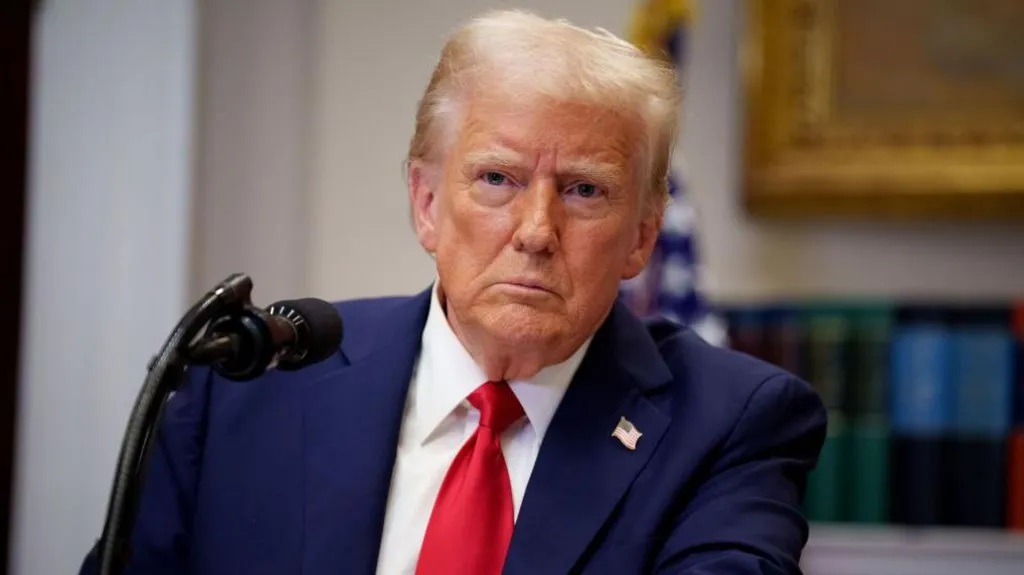


Donald Trump has praised UK soldiers who fought in Afghanistan after his claim that allied forces avoided the front lines prompted criticism from veterans and politicians.
Earlier this week Trump angered US allies by downplaying the role of Nato troops in the war and doubted whether the military alliance would be there for the US “if we ever needed them”.
Trump’s words drew condemnation from international allies, while Sir Keir Starmer called them “insulting and frankly appalling”.
The UK prime minister spoke to Trump on Saturday, after which the US president used his Truth Social platform to praise UK troops as being “among the greatest of all warriors”.
Trump was criticised for remarks he made during an interview with Fox News on Thursday in which the president said of Nato troops: “We’ve never needed them. We have never really asked anything of them.
“They’ll say they sent some troops to Afghanistan… and they did, they stayed a little back, a little off the front lines.”
That triggered a huge backlash from the families of soldiers who served in Afghanistan, as well as veterans and politicians from across the Westminster and international spectrum who called for Trump to apologise.
Prince Harry said the sacrifices of troops needed to be respected as he pointed out Nato’s collective security clause had been invoked once – following the 9/11 attacks.
In October 2001 the US invaded Afghanistan to oust the Taliban, whom they said were harbouring Osama Bin Laden and other al-Qaeda figures linked to the 9/11 attacks the previous month. Nato nations contributed troops and military equipment to the US-led war.
More than 3,500 coalition soldiers died, about two-thirds of them Americans, as of 2021 when the US withdrew from the country. The UK suffered the second-highest number of military deaths in the conflict behind the US, which suffered 2,461 fatalities.
On Saturday, Downing Street said the prime minister and US president spoke about the UK’s involvement alongside US and Nato forces in the conflict.
A spokesperson said: “The prime minister raised the brave and heroic British and American soldiers who fought side by side in Afghanistan, many of whom never returned home. We must never forget their sacrifice”.
Shortly after the conversation, Trump posted fresh comments on his Truth Social platform – appearing to step back from his critical comments but stopping short of directly apologising for the words he used in Thursday’s interview.
He wrote: “The great and very brave soldiers of the United Kingdom will always be with the United States of America.
“In Afghanistan, 457 died, many were badly injured, and they were among the greatest of all warriors.
“It’s a bond too strong to ever be broken. The UK military, with tremendous heart and soul, is second to none (except for the USA). We love you all, and always will!”
Conservative leader Kemi Badenoch said she was pleased Trump had acknowledged the UK’s role in fighting alongside the US and Nato allies in Afghanistan.
“It should never have been questioned in the first place,” she said.
On Friday, the Duke of Sussex released a statement in which he praised the contributions of Nato troops who were in Afghanistan.
“I served there. I made lifelong friends there. And I lost friends there,” the prince said.
“In 2001, Nato invoked Article 5 for the first – and only – time in history. It meant that every allied nation was obliged to stand with the United States in Afghanistan, in pursuit of our shared security. Allies answered that call.
“Thousands of lives were changed forever. Mothers and fathers buried sons and daughters. Children were left without a parent. Families are left carrying the cost.
“Those sacrifices deserve to be spoken about truthfully and with respect, as we all remain united and loyal to the defence of diplomacy and peace.”
Most of the 457 British troops who died serving in Afghanistan over a period of nearly 20 years were killed in Helmand – the scene of the heaviest fighting.
Hundreds more suffered injuries and lost limbs – including Cpl Andy Reid who lost both his legs and his right arm after stepping on an improvised explosive device (IED) in Afghanistan.
“Not a day goes by when we’re not in some kind of pain, physically or mentally reflecting on that conflict,” he told BBC Breakfast on Friday.
Reid recalled working with American soldiers, adding: “If they were on the front line and I was stood next to them, clearly we were on the front line as well.”
Badenoch, Sir Ed Davey and Nigel Farage were among the Westminster leaders to call out the US president for his comments; while outside the UK, ministers from foreign governments also criticised Trump’s remarks.
Canada’s Minister of National Defence David J McGuinty said Canadian “men and women were on the ground from the beginning, not because we had to, but because it was the right thing to do.”
American political and military figures have also expressed their anger and frustration over Trump’s Nato comments.
“I think it’s insulting to those who were fighting alongside of us,” former national security adviser Herbery Raymond McMaster told the BBC.
Trump’s new comments on Saturday did not mention any of the other Nato allies who sent troops into Afghanistan.
Italy’s Prime Minister Giorgia Meloni said her government “was astonished” to hear Trump’s first statement and added “our nation paid a cost that is beyond dispute: 53 Italian soldiers killed and more than 700 wounded”.
She said on X: “For this reason, statements that downplay the contribution of Nato countries in Afghanistan are unacceptable, especially when they come from an allied nation”.
TikTok on Friday agreed to pay Alabama at least $100 million and enact time limits and other restrictions for teen users, avoiding trial with a settlement modelled on Instagram-owner Meta’s recent agreement with US states.
A trial had been set to begin Monday in the southern US state over claims by Alabama that TikTok misled parents about tools meant to shield children from harmful content.
Attorney General Steve Marshall hailed the settlement as “a great day for Alabama parents.”
“Tonight, they can rest easier knowing real protections are in place to shield their children from the dangers of social media addiction,” he said.
Under the settlement, TikTok will send $100 million to Alabama and could possibly pay up to $300 million in total if other states accept similar agreements.
Alabama’s suit was the latest in a wave of litigation targeting social media companies across the United States over the harm their apps allegedly cause young users.
In August, Meta agreed to pay $18 billion to settle a sweeping lawsuit brought by US states accusing it of designing Instagram and Facebook to get children addicted.
TikTok’s settlement with Alabama mirrors safety provisions agreed by Meta, including a two-hour daily time limit for teens, restricted access from midnight to 6:00 am, and suspending notifications during school hours.
It will also strengthen age verification, ban beauty filters for teenagers, and offer young users a non-personalised content feed.
In addition, it includes a conditional restriction that Meta also agreed to: expanding the nighttime shutdown period to 10:00 pm to 7:00 am, if other platforms also commit to do the same.
– More suits pending –
“TikTok’s priority has always been fostering a safe and positive space where people can be creative, discover what they love, and connect with their community,” a company spokesperson told AFP.
“This builds on our commitment and core objective to continually enhance our robust safety tools to protect teens,” the spokesperson added.
More than a dozen other states, including California and New York, still have active suits against TikTok.
The company has previously settled cases against it that were headed for trial, including a Los Angeles lawsuit brought by a young woman and a suit from a Kentucky school district.
Meta, by contrast, has taken its chances in court — with bruising results.
In March, a jury in New Mexico ordered the Facebook and Instagram owner to pay $375 million after finding it had misled the public about the safety of its platforms for children.
That same month, a Los Angeles jury found Meta and Google’s YouTube negligent in the case of a 20-year-old woman who said she became hooked on social media as a child, awarding her $6 million.
Going to trial would have exposed TikTok to unprecedented public scrutiny of how it handles safety internally, with company documents and executive testimony potentially aired in open court.
Alabama originally sued TikTok and its Chinese parent company ByteDance in April 2025, alleging the app was engineered to hook young users “just like a sophisticated gambling machine.”
The state later narrowed its case to claims under Alabama’s Deceptive Trade Practices Act, focusing on whether TikTok misrepresented the effectiveness of features such as “Restricted Mode” and “Kids Mode.”
Despite TikTok’s assurances that users in that mode should not see mature themes, the accounts were quickly served videos about suicide, self-harm, eating disorders, alcohol and sex, according to the filing.
AFP

Iranian airlines are facing mounting international restrictions after new US sanctions disrupted flights to several neighbouring countries, while fresh Houthi missile attacks on Saudi Arabia sent global oil prices sharply higher.
The United Arab Emirates on Thursday suspended all flights operated by Iranian airlines until further notice, citing the impact of new US sanctions targeting Iran’s aviation sector. Oman also moved to restrict Iranian flights, while services to destinations including Georgia, Azerbaijan and Baghdad were reported to have been disrupted.
The measures followed a September 23 deadline set by Washington under which companies and service providers around the world could face sanctions for continuing to do business with Iranian airlines.
The US campaign is aimed at extending sanctions pressure beyond Iran by targeting companies in third countries that continue providing services to Iranian carriers.
Iran’s aviation network has already been affected, although international flights have not been completely halted. Flight-tracking data and airport schedules showed Iranian carriers continuing to operate some routes, including services to countries such as China, Afghanistan and Turkey.
Iran has reacted angrily to the restrictions, warning that countries cooperating with the US campaign could face consequences.
A senior Iranian official threatened that airports in countries blocking Iranian flights could eventually become “unusable”, escalating concerns over the potential impact of the sanctions on regional air travel.
Oil prices surge after Saudi missile attacks
The aviation restrictions came as escalating military tensions in the region continued to unsettle global energy markets.
Oil prices jumped on Thursday after Yemen’s Iran-aligned Houthi movement launched missile and drone attacks against targets in Saudi Arabia.
Saudi authorities said their air defences intercepted six ballistic missiles fired towards Taif and Yanbu, two cities in western Saudi Arabia. The Houthis separately claimed attacks on targets in Riyadh and facilities belonging to Saudi Aramco in Yanbu.
The attacks renewed concerns about possible disruptions to Saudi oil exports and major shipping routes in the region, particularly because Yanbu is an important Red Sea outlet for Saudi crude.
Brent crude futures settled at $106.60 per barrel, up $3.52, or 3.4 per cent, while US West Texas Intermediate crude gained $2.45, or 2.7 per cent, to close at $94.61.
Both benchmarks had risen by about five per cent at their session highs before retreating as reports emerged of possible diplomatic efforts between Washington and Tehran.
Strait of Hormuz remains key to oil markets
The possibility of negotiations between the US and Iran also helped limit the rise in crude prices.
Reports indicated that Washington and Tehran were exploring a possible phased arrangement that could involve reopening the Strait of Hormuz in exchange for a relaxation of some US economic restrictions.
The waterway is one of the world’s most important oil transit routes, making any prolonged disruption a major concern for global energy markets.
Saudi Arabia has also been relying on its East-West pipeline to move crude towards the Red Sea as disruptions affect traditional Gulf shipping routes.
The latest developments have therefore placed oil markets under competing pressures: further military escalation around energy infrastructure and shipping routes could increase supply fears, while progress in US-Iran diplomacy and improved access through the Strait of Hormuz could ease those concerns.
For Iran, meanwhile, the new US measures threaten to further isolate its aviation industry and reduce the country’s already limited international air connections.
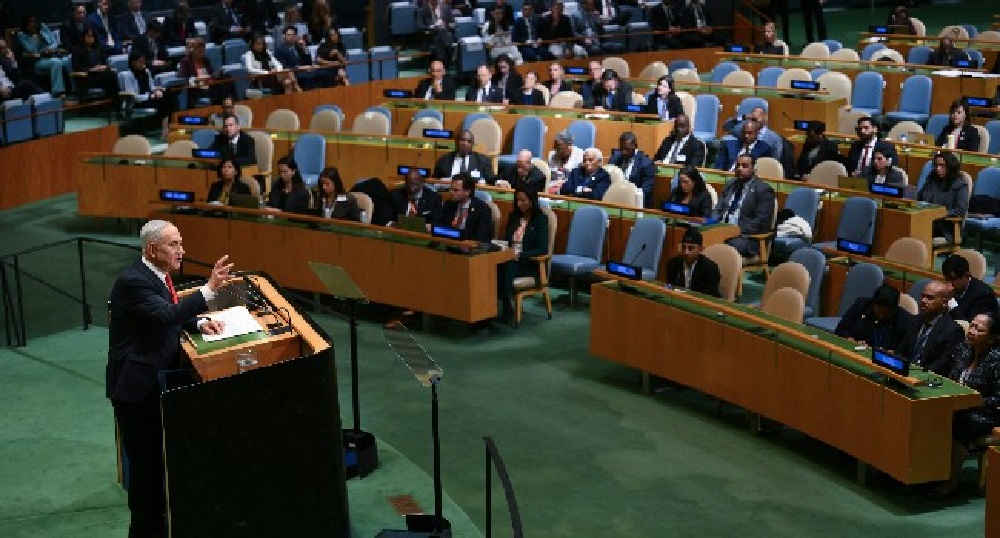
Dozens of envoys from across the world walked out of Prime Minister Benjamin Netanyahu’s speech to the UN on Thursday in protest at the Israeli leader.
Delegates jeered and booed, while Netanyahu’s own team stood and applauded, and the speaker of the session shouted for order.
“If there are any other moral cowards who haven’t left this hall, please do so now,” Netanyahu said.
Some attendees and delegation members walk out as Israel’s Prime Minister Benjamin Netanyahu speaks during the 81st United Nations General Assembly at the United Nations Headquarters in New York, on September 24, 2026. (Photo by TIMOTHY A. CLARY / AFP)
The hall, sparsely filled earlier in the session, gradually filled up before Netanyahu’s speech.
The Palestinian delegation had called in a memo for other missions to join their own act of protest.
Netanyahu called the Israeli youths who target Palestinian communities in the occupied West Bank “juvenile delinquents” during a speech Thursday to the United Nations.
“What (the media) cover is a handful of young juvenile delinquents, about 150 in number, who go or throw stones, who chop down olive trees,” Netanyahu said.
“I can’t stand that. I won’t stand for vigilantism.”
Israeli Prime Minister Benjamin Netanyahu addresses the 81st United Nations General Assembly at UN headquarters in New York on September 24, 2026. (Photo by ANGELA WEISS / AFP)
He called Turkey’s President Recep Tayyip Erdogan a “tyrant” during a speech at the UN on Thursday, accusing Ankara of harboring Hamas militant leaders.
“The latest country to become a super spreader of antisemitic lies (is Turkey)… Erdogan is a tyrant. He also hosts the Hamas terror chiefs,” he said.
The Prime Minister also claimed that “many Jews” no longer feel safe in New York since leftist Mayor Zohran Mamdani’s election.
“Since you were elected mayor of this city, many Jews no longer feel safe in New York,” he said.
“You falsely, repeatedly accuse Israel of genocide.”
AFP

Reforms in NNPCL under Ojulari have increased Nigerians’ trust in current administration – Centre

Group Demands Omosehin’s Removal as NAICOM Chief Over Recapitalisation Allegations

Europe-bound bridegroom excretes 72 wraps of cocaine at Enugu airport(Photos)


-

 News19 hours ago
House of Assembly Candidate, Sanni Urges Unity Among Ekiti ADC Members
-

 Sports11 hours ago
2027: NDC chairmen reject Obi-Kwankwaso structures
-
 News11 hours ago
Police, DSS, ICPC Cleared Me of PFIPC Scam Allegations — Gbajabiamila
-

 News11 hours ago
‘I’m like three women’ — Ivie Atuwatse rules out polygamy for Olu of Warri
-

 Metro11 hours ago
Hisbah arrests eight over homosexuality in Jigawa
-
 News11 hours ago
PHOTOS: Jerry Eze leads thousands in prayer at Man United’s Old Trafford