Foreign
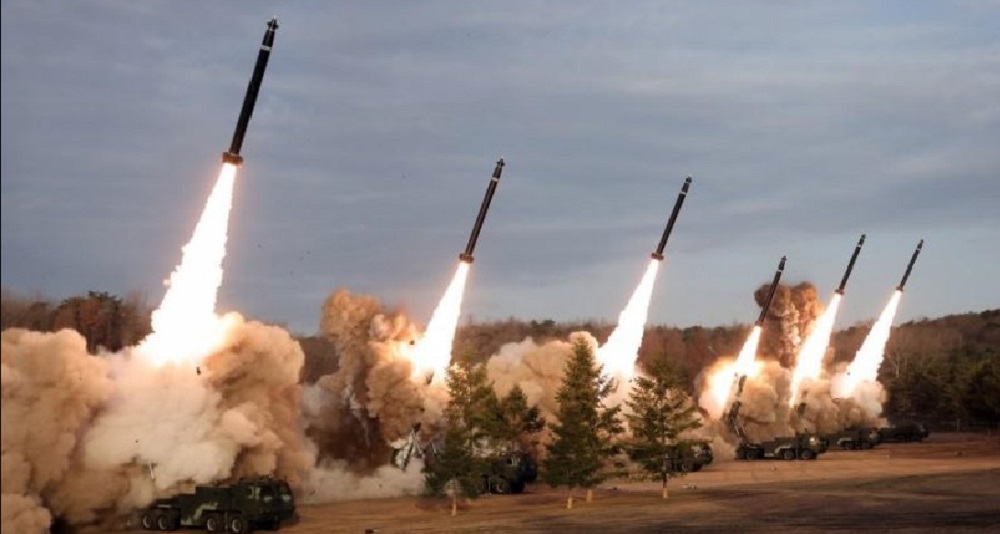
North Korea test-fires 10 missiles as South Korea, U.S. stage war games
North Korea test-fired 10 short-range ballistic missiles into the Sea of Japan at the weekend, five days after South Korea and its U.S. allies kicked off their annual spring war games.

Seoul’s Joint Chiefs of Staff said they detected the launches at around 1:20 p.m.
“Our military maintains a firm readiness posture while closely sharing North Korean ballistic missile information with the U.S. and Japanese sides amid a heightened surveillance posture against additional launches,” Seoul’s Joint Chiefs said, per Yonhap News Agency, in a template statement.

The missiles splashed in the Sea of Japan, east of the peninsula.
For tests of ballistic missiles, Pyongyang follows common global protocols, firing them on a west-east trajectory so the Earth’s rotation grants them extra boost.
Experts say North Korea conducts test firings for two reasons. One is to gather technical data; one is to make political points.
Currently, North Korea is highly likely to be gathering data from live war. Since January, it has been firing tube and rocket artillery from Russia’s Kursk Oblast into Ukraine.
Saturday’s missile shoot followed angry rhetoric aimed at the annual “Freedom Shield” drills by Kim Yo-jong, the sister of North Korean leader Kim Jong-un. Pyongyang insists that the exercises, which Washington calls “defensive in nature,” are actually practice for an invasion.
Ms. Kim warned, in a statement in state media on Tuesday, the day following the drills’ commencement, that they could “lead to terrible consequences that are unimaginable.”
Her fortunes rose in February at the once-every-five-years Workers Party Congress, where she was promoted director of the party’s General Affairs Department.
Though the powerful Ms. Kim, who frequently pens bylined columns on inter-Korean relations, warned that Freedom Shield “will further destroy regional stability,” life in South Korea continues as usual.
The population has long been immunized to North Korean threats, and all three actions — the start of spring military drills by the two allies, followed by the North’s response in the form of barrages of rhetoric and missiles — had been predicted.
Events follow the same course virtually every year, though this spring, the drills take place against the backdrop of an ongoing Israeli-U.S. aerial campaign against Iran.
Indo-Pacific-based U.S. assets — missile interceptors in South Korea and U.S. Marines in Okinawa — are currently redeploying to the Middle East, where Iran’s will to fight remains unbroken.
The redeployments have raised quiet concerns about the U.S. ability to fight a two-front war, and come at a time when a major power shift is underway in the defense of the Korean Peninsula.
The all-domain drills encompass both computer simulations and “Warrior Shield” field exercises. Some 18,000 troops are engaged, with training running from March 9 through March 19.
While the “Allies drill-North Korea responds angrily” scenario was predictable, a new dynamic is animating the war games this year.
The Spring 2026 drills are being used to stress-test South Korea’s domestic capabilities, notably in sophisticated areas such as long-range strike, command and control, and intelligence, reconnaissance and surveillance.
The assessments, made by the U.S. side, are part of the planned conditions-based transfer of wartime operational control of South Korean troops from U.S. to South Korean command.
The Lee Jae-myung administration, which took office in summer 2025, has announced that it wants wartime “OPCON Transfer” to take place by the end of its term, 2030.
The concept has a long history, but current Seoul-Washington policy stances suggest it may, finally, happen.
OPCON transfer was first brokered by the liberal Roh Moo-hyun administration (2003-2008), which sought sovereign control of its own forces.
However, it was subsequently slow-walked by successive conservative administrations in Seoul, who feared it would greenlight reduced U.S. commitments to the peninsula.
As matters stand, Korean troops would fight under the orders of the Combined Forces Command, a joint structure led by an American four-star general, with a South Korean deputy.
Exactly how OPCON transfer — the exact conditions to be met have never been made fully public — would proceed, and what might happen to CFC if and when it does, is unclear. Whether U.S. troops would fight under Seoul’s wartime command is another concern that gives Korean conservatives the vapours.
Regardless, OPCON transfer’s stars are aligning on both sides of the Pacific.
In South Korea, the liberal Mr. Lee occupies the presidential Blue House, while his party comfortably controls the National Assembly. This leaves the conservative opposition largely impotent.
Meanwhile, the Trump administration is pressuring allies worldwide to increase defence spending and upgrade capabilities. It has made clear it wants Seoul to take an increasing share of the conventional defense burden, while sheltering Korea under the U.S. nuclear umbrella.
What is unknown is how far South Korea’s military is proceeding toward satisfying U.S.-set conditions.
“The main thing here is the conditions,” U.S. Forces Commanding General Xavier Brunson said during a webinar organized by the Korea Defense Veterans Association and the Korea-U.S. Alliance Foundation last December. “We cannot say we’re going to slide away from the conditions just so that we can get this done in time.”
Foreign
Trump Calls US Elections “Rigged,” Warns There Could Be No More America
United States President Donald Trump has renewed his criticism of the U.S. electoral system, warning that the country could face serious consequences if election reforms are not introduced.
In a post on his Truth Social platform, he claimed that American elections are “rigged” and have become a global embarrassment, arguing that urgent changes are needed to restore trust in the system.
He called on Republicans to rally behind a proposed electoral overhaul he referred to as the “Save America Act,” which he described as crucial to protecting democracy in the United States. According to him, the bill would strengthen voting integrity through measures such as mandatory voter identification and proof of citizenship.
Trump also proposed restrictions on mail-in voting, saying it should only be allowed in limited cases such as illness, disability, military service, or travel. He argued that mail-in ballots are vulnerable to abuse and compromise election integrity.
He further warned that he would not endorse any Republican who opposed the bill and urged lawmakers to support it regardless of party affiliation. Trump also suggested that opposition to the proposal would be politically damaging in future elections.
Observers note that the proposal is expected to spark debate, particularly given ongoing disagreements in the U.S. over voting rights, election security, and the balance of authority between federal and state governments.
Foreign
White House Shooting Suspect Admits He Planned To ‘Shoot Trump Officials’
The 31-year-old man, Cole Allen, who reportedly opened fire during the White House Correspondents’ Dinner in Washington, D.C., on Saturday night, has told investigators that he deliberately targeted officials of the President Donald Trump administration, according to senior federal law enforcement sources familiar with the case.
Allen allegedly confessed after his arrest on Saturday night that his intention was to “shoot Trump administration officials,” investigators disclosed, according to Fox News.
The incident occurred at the Washington Hilton, where Allen reportedly forced his way through a Secret Service security checkpoint while armed with a shotgun, a handgun, knives, and other weapons.
He subsequently opened fire, hitting a Secret Service officer, whose ballistic vest prevented fatal injuries.
Law enforcement agents at the scene returned fire, but Allen was not struck. Both the injured officer and the suspect were transported to a nearby hospital for treatment.
In the aftermath of the shooting, operatives from the Federal Bureau of Investigation (FBI), alongside local law enforcement, moved swiftly to secure Allen’s residence in Torrance, California.
Officials said efforts were underway to obtain a federal search warrant to examine the property for further evidence.
According to the White House, new details have emerged suggesting that Allen may have communicated his intentions prior to the attack.
His brother reportedly alerted the New London Police Department after receiving what authorities described as a manifesto outlining the suspect’s motives.
Investigators said the document explicitly referenced plans to target members of the Trump administration.
Officials also pointed to Allen’s social media activity, which allegedly contained anti-Trump and anti-Christian sentiments.
Reacting to the development during an interview with Fox News, Trump described the suspect as deeply disturbed.
“The guy is a sick guy,” Trump said. “When you read his manifesto, he hates Christians. That’s one thing for sure.
“He hates Christians, a hatred. And I think his sister or his brother actually was complaining about it. You know, they were even complaining to law enforcement. So he was, he was a very troubled guy.”
Further insight into Allen’s behaviour was provided by his sister, Avriana Allen, who spoke with both the Secret Service and local police in Rockville.
She reportedly told investigators that her brother frequently made extreme statements and spoke about carrying out actions to “fix” societal problems.
She also revealed that Allen had legally purchased firearms, including two handguns and a shotgun, from a dealer identified as Cap Tactical Firearms.
According to her account, the weapons were stored at their parents’ residence without their knowledge.
Avriana added that her brother regularly practised shooting at gun ranges and was associated with a group known as “The Wide Awakes.”
She further disclosed that he had participated in a “No Kings” protest in California at some point prior to the incident.
The shooting has heightened concerns about security at high-profile political events in the United States, particularly those attended by senior government officials and members of the press.
Authorities say investigations are ongoing as they work to piece together the full scope of Allen’s motives and potential affiliations.
Foreign
“Our Girls Are Sleeping With Foreigners, They Must Leave” — Emotional South African Man Sparks Outrage with Xenophobic Rant
A video circulating on social media shows a man in South Africa expressing strong anti-foreigner sentiments, in remarks that have sparked concern over rising xenophobic tensions.
In the footage, the man appears visibly emotional as he complains about the presence of foreigners in the country, claiming that “our girls are sl33ping with foreigners” and insisting that they “have to leave.” He also warns that foreigners “must never think they can control” local communities.
This is coming amid xenophobic raids carried out by South Africans against mainly Black immigrants in the country.
-
News23 hours ago2027: Ogbeide-Ihama Joins Edo South Senatorial Race, Says Upper Chamber Not For Neophytes(Photos)
-
News23 hours agoJUST IN: Tinubu Appoints Bianca Ojukwu Foreign Affairs Minister
-
News23 hours agoMay Day: FG Announces Public Holiday for All Nigerians
-
Sports23 hours agoArsenal Hold Atlético Madrid To 1-1 Draw In UCL Semi-Final
-
News21 hours agoReps probe $4.6bn health grants, demand stricter oversight
-
News17 hours agoWatch moment FCT minister Wike being conferred with title of Abuja Hasken, Light of Abuja by FCT Traditional Council led by Ona of Abaji (Video)
-
News23 hours agoIGP Disu Fires ASP Nuhu Usman From Police Force Over Killing Of Mene Ogidi In Effurun
-
News23 hours agoFG Raises Concern Over Fresh Xenophobic Attacks In South Africa