
Opinion
TINUBU’S DANGEROUS OVERREACH: A STARK WARNING AGAINST INTIMIDATING THE LEGISLATURE, JUDICIARY, AND THE NIGERIAN PEOPLE


- /home/naijuinz/public_html/wp-content/plugins/mvp-social-buttons/mvp-social-buttons.php on line 27
https://naijablitznews.com/wp-content/uploads/2026/03/Bola-Tinubu.jpg&description=TINUBU’S DANGEROUS OVERREACH: A STARK WARNING AGAINST INTIMIDATING THE LEGISLATURE, JUDICIARY, AND THE NIGERIAN PEOPLE', 'pinterestShare', 'width=750,height=350'); return false;" title="Pin This Post">
- Share
- Tweet /home/naijuinz/public_html/wp-content/plugins/mvp-social-buttons/mvp-social-buttons.php on line 72
https://naijablitznews.com/wp-content/uploads/2026/03/Bola-Tinubu.jpg&description=TINUBU’S DANGEROUS OVERREACH: A STARK WARNING AGAINST INTIMIDATING THE LEGISLATURE, JUDICIARY, AND THE NIGERIAN PEOPLE', 'pinterestShare', 'width=750,height=350'); return false;" title="Pin This Post">


By Zakari Mohammed
The resolutions emerging from the Ibadan summit are not routine political statements; they are a direct warning signal about the trajectory of governance under the APC and the administration of Bola Ahmed Tinubu.
What is increasingly evident is a pattern of shrinking democratic space, the weaponization of institutions, and a subtle but dangerous drift toward political uniformity.
No ruling party, regardless of its electoral strength, possesses the constitutional or moral authority to convert victory at the polls into a de facto one-party state. Democracy thrives on competition, dissent, and institutional neutrality; once these are undermined, the entire system begins to weaken.
In this context, the Ibadan Declaration stands out as a necessary and timely intervention a right step in the right direction and a force that must be recognized for what it truly represents: the opposition taking its destiny firmly into its own hands.
It reflects a conscious decision to move beyond fragmentation toward coordinated political action, signaling that the era of disjointed resistance is giving way to structured engagement.
For the APC and its supporters, this is not something to dismiss or trivialize; it is something that must command serious attention and, indeed, concern not because it threatens instability, but because it demonstrates that alternative political forces are organizing with clarity of purpose and a shared resolve to challenge the status quo.
There is a growing concern about incursions into the independence of both the legislature and the judiciary institutions that are meant to serve as guardrails against executive excess.
Any attempt, direct or indirect, to pressure or influence these arms of government strikes at the very foundation of constitutional democracy.
When the legislature is cowed or the judiciary is perceived as compromised, the balance of power collapses, leaving citizens exposed to unchecked authority.
Such a path is not strength; it is a dangerous overreach that history has repeatedly shown to end badly for nations that travel it.
There is a recurring temptation in governance to believe that tightening control guarantees stability.
In reality, the use of an iron fist whether through harassment of opposition figures, manipulation of electoral processes, or intimidation of dissenting voices creates only an illusion of order. Beneath that surface, discontent accumulates. Suppression does not eliminate opposition; it hardens it, broadens its appeal, and deepens public sympathy. When citizens begin to perceive elections as predetermined or institutions as compromised, the legitimacy of governance itself is called into question.
At that point, democracy is no longer strengthened by elections; it is endangered by them.
The Nigerian people themselves must not be treated as subjects to be managed, but as citizens to be respected. Any attempt to silence, intimidate, or sideline the populace whether through policy, rhetoric, or force risks igniting a backlash that no government can fully control. A nation as politically conscious and diverse as Nigeria cannot be subdued indefinitely. When people begin to feel excluded, ignored, and suppressed, the reaction is not passive acceptance but mounting resistance.
It must be clearly understood that state power is not personal or partisan property. Nigeria’s institutions exist to serve the republic, not the interests of any single party. When those institutions are bent to partisan purposes, the damage extends far beyond one administration it weakens public trust in governance itself.
The long-term cost of such erosion is far greater than any short-term political advantage that might be gained through coercion or control.
The path before the ruling party is therefore stark and consequential. It can choose to act as a custodian of democratic principles allowing credible competition and preserving institutional integrity or it can continue down a path that prioritizes dominance over legitimacy.
The latter carries profound risks. Democracy does not collapse suddenly; it is gradually suffocated through a series of decisions that chip away at its foundations. If that process continues unchecked, Nigeria risks reaching a tipping point where institutions lose credibility, elections lose meaning, and governance loses the consent of the governed.
History is unforgiving in its judgment of those who preside over the erosion of democratic systems. The choices made in this moment will not only shape immediate political outcomes but will define how this era is remembered.
A nation of over 200 million people cannot be governed sustainably through pressure, intimidation, or exclusion. The preservation of democracy requires restraint, fairness, and a commitment to principles that transcend party interests. Anything less risks consequences that extend beyond politics into the very stability and future of the nation.
Zakari Mohammed
Spokesman, 7th Assembly
Ibadan, Oyo State
25/04/2026

By Emmanuel Thomas
Democracy is sustained not merely by the physical act of casting a ballot, but by public trust in the institutions tasked with safeguarding the vote.
When the institution mandated to act as an impartial referee repeatedly displays technical opacity, administrative clumsiness, and institutional evasiveness, it ceases to be a guarantor of democratic expression and becomes its greatest threat.
As Nigeria prepares for the 2027 general elections, the Independent National Electoral Commission (INEC) finds itself locked in a crisis of credibility that threatens the survival of the country’s constitutional order.
The latest manifest of this systemic rot was laid bare following the August 15, 2026, Osun State governorship election. Prominent economist, civic leader, and founder of the Anap Foundation, Atedo Peterside, issued a scathing critique targeting the integrity of INEC’s electronic infrastructure.
Peterside raised three fundamental, data-backed questions regarding the operation of the INEC Result Viewing (IReV) portal on election night:
Why did result transmission freeze completely for nearly three hours (between 20:48 hrs and 23:42 hrs), only for an unprecedented dump of 236 polling unit results to hit the server in less than 60 seconds immediately afterward?
Why were 51 polling unit results uploaded only after a winner had already been declared by the returning officer?
Why did 11 polling unit results remain entirely unaccounted for on the IReV portal days after the exercise concluded?
These queries are not mere technical nitpicking; they strike at the heart of the “triangle of compromise” currently eroding Nigerian statehood. Peterside’s observations prove that despite legislative overhauls, billions of naira in budgetary allocations, and repeated institutional promises,
INEC’s technological infrastructure remains vulnerable to unexplained outages that consistently coincide with critical moments of collation.
A Pattern of Institutional Evasion
The technical glitches highlighted in the Osun gubernatorial contest are part of a broader, systemic failure. Rather than operating as an independent body dedicated to transparency, INEC has established a pattern where digital platforms—introduced specifically to eliminate manual rigging—are compromised at crucial junctures.
Electoral integrity is predicated on predictability. When the digital transmission pipeline freezes without explanation, public suspicion fills the void. A sudden dump of 236 results in under a minute following a three-hour blackout suggests manual batching or administrative intervention rather than automated real-time transmission.
Furthermore, declaring an election winner while scores of polling unit results remain offline—or uploading them post-declaration—renders the IReV portal a retrospective archive rather than a real-time verification tool.
This behavior directly fuels voter cynicism. As former INEC officials, civil society organizations, and international observers have repeatedly noted, when citizens believe the referee is compromised, the incentive to participate vanishes.
Elections are reduced to performative rituals where outcomes are perceived to be manufactured in administrative corridors rather than determined at polling stations.
Replicating the Mistakes of the Past
The dangerous trajectory toward 2027 mirrors the institutional failures that damaged public faith during the 2023 general elections.
The non-transmission of presidential election results in real time on the IReV portal shattered public trust and cast a shadow over the judicial petitions that followed. Rather than treating that failure as an emergency requiring radical reform, INEC’s conduct in subsequent off-cycle elections indicates an entrenchment of bad practice.
Civic leaders across the political spectrum have sounded the alarm. The recurring narrative of “technical hitches”—conveniently occurring during the collation of high-stakes results—has transformed INEC from an agent of democratic consolidation into a vector of political instability.
When citizens lose faith in the ballot box, the alternative is often street protests, political apathy, or a slide toward total lawlessness.
The Implication for 2027
Nigeria cannot afford an electoral umpire whose operations invite perpetual litigation and civil unrest.
A general election involves the simultaneous processing of tens of thousands of polling units across 36 states and the Federal Capital Territory. If INEC cannot manage real-time result transmission and full transparency in a single-state off-cycle election like Osun, its capacity to conduct a credible, peaceful, and transparent nationwide election in 2027 is doubtful.
The commission’s persistent refusal to offer transparent forensic logs, clear operational explanations, or account for missing polling unit data reinforces the perception that it operates above public accountability. In a democracy, institutional silence in the face of mathematical and operational anomalies is an admission of failure.
If Nigeria’s democratic experiment is to survive past 2027, INEC must be subjected to immediate, independent technical audits and structural reform.
The electoral body must understand that its primary duty is not to declare winners, but to protect the integrity of the process.
Until INEC provides clear answers to the questions raised by Atedo Peterside and addresses its systemic technological flaws, it remains the single greatest institutional threat to Nigeria’s democracy.
Opinion
8 Years of Service: Akpodiete Foundation Transforms Education, Health, Sports and Security Across Delta
By Amb. Comrade Kpoharor Emmanuel
As the Olotu & Ekuogbe Rowland Akpodiete Foundation prepares to celebrate its 8th year anniversary in August 2026, Executive Director, Dr. Olotu Akpodiete JP, says the organization has remained focused on touching lives through education, security, health, humanitarian aid, and community development across Delta State.
Registered in 2018 to sustain the legacy of the late Chief Dr. Ekuogbe Rowland Akpodiete PhD, the foundation has, over the past eight years, implemented programs that cut across schools, prisons, orphanages, women groups, youths and traditional institutions.
Education and Learning Support
The foundation’s education drive began in 2019 with the distribution of notebooks and learning materials to pupils of Eseorphe Primary School and students of Government College Ughelli. That same year, it presented the Chief Ekuogbe Akpodiete Government Prize to the best student in Government at Government College Ughelli during the APT Awards. Students of Ogbavwe Secondary School in Usiefrun, Ughelli South, also received educational materials, and the school got a water borehole to address scarcity.
In 2020, during COVID-19, safety materials were donated to Government College Ughelli. Later that year, law students of Delta State University, Oleh Campus, received scholarships and grants, an effort that earned Dr. Akpodiete an Award of Excellence from the university provost Prof. Alex Amata.
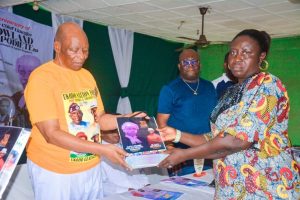
In 2022, the foundation returned to Government College Ughelli to install ceiling fans in the School House Hostel and provide more learning materials. Most recently in 2025, during the 30th remembrance of Chief Ekuogbe Akpodiete, it awarded cash prizes and educational materials to students from over eight schools that took part in a debate competition hosted at Government College Ughelli.
Security, Peacebuilding and Advocacy
Since 2020, the foundation has run a Security and Safety Education Project in government schools. At Government College Ughelli, veteran consultant Mr. Sylvester Obose trained over 50 people including teachers, students and the school security team.
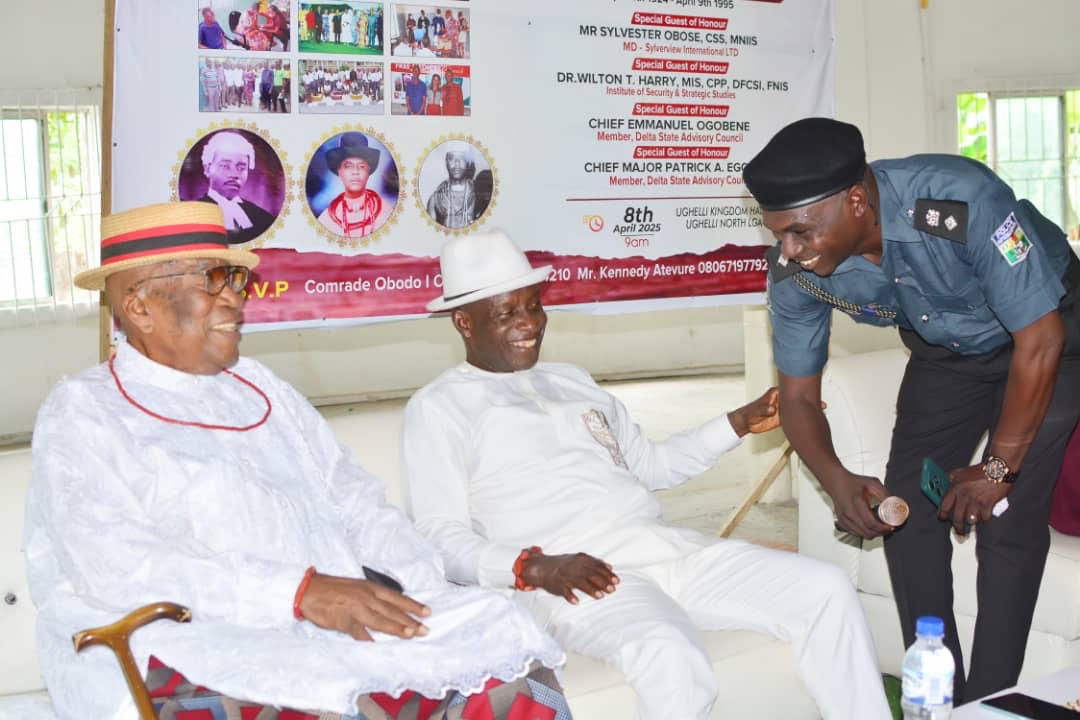
In 2025, two major security programs were held. A Memorial Lecture on Conflict Resolution and Community Security and Safety was organized at Ughelli Kingdom Hall where community leaders from Ughelli North & South including vigilantes were trained, members of the Delta State Advisory Council in attendance as Special Guests of Honour. Security communication gadgets were distributed to communities. Later, during the foundation’s 7th anniversary, another lecture on Conflict Resolution and Neighborhood Watch was held at Unity Hall, Ughelli South LGA Secretariat. Over 100 vigilante leaders and stakeholders attended, and the Divisional Police Officer, CSP Oluwole Oladipupo, commended the initiative. Mobile sound systems and gadgets were also distributed to communities.
In 2025, the foundation also submitted a proposal to the Delta State Government advocating for the creation of a Ministry of Security to strengthen the state’s framework ahead of state policing.
Humanitarian Support for Vulnerable Groups
In 2018, Dr. Akpodiete and the Director, Deacon Ogaga Ohwojero, visited prisons in Sapele and Warri with donations of rice, beans, garri, tissue, bathing and washing soap, plus educational materials. A similar donation was made in Ogwashi-Uku Prison through Barr. Lilian Eserinune. Prison officials including DCP Solomon Airiohuodion and Mr. Okonkwo Frank applauded the gesture.
In 2024, during the 29th remembrance of Chief Ekuogbe Akpodiete, the foundation visited Rose Ilogbo Foundation and Christ Treasured Royal Ministry in Ughelli with foodstuff and cash for orphaned children. Founders Mrs. Rose Ilogbo and Rev. Dr. Abraham Erhuotor expressed gratitude.
Women Empowerment and Social Welfare
The foundation runs yearly support for women and widows in U3. In 2025, during the 30th remembrance, over 50 women from Otor Ihwreko in Ughelli North received business grants and wrappers. Chief Dr. Linda Ikpuri urged them to invest the grants wisely.
In August 2025, more women across Ughelli North, South and Udu received grants and gift items. In 2026, over 100 widows across the three LGAs got cash donations and wrappers.
“Given the harsh economy of the country, we cannot afford to abandon our mothers and widows. This is why we have made it a yearly mandate to support them,” Dr. Akpodiete stated.
Human Capital and Skills Development
In 2018, the foundation held a two-day seminar on the fish farming value chain at Otor Iwhreko Town Hall for over 100 youths and women. In 2019, more than 70 participants were trained on digital skills for wealth creation in Ughelli.
In 2025, it hosted a Youth Empowerment and Leadership Summit in Otor Jeremi and also trained community leaders on conflict resolution to promote grassroots peace.
Water Projects and Sports Development
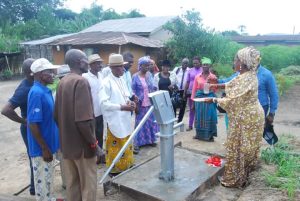
In April 2019, during the 24th remembrance, a borehole was commissioned in Okparabe, Ughelli South. Another borehole was commissioned that same year at Ogbavweni Grammar School.
The foundation has also invested in youth sports. In 2025, a novelty football match between Otor-Ihwreko Community Team and Rovers Football Team ended 1-1, with cash gifts for players and a call on the LGA to upgrade the pitch. In April 2026, another novelty match was held with cash support for players, and a renewed appeal to government to support sportsmen and women.
Healthcare Access
Since 2018, the foundation has prioritized healthcare through medical outreaches, drug distribution and free consultation in Otor Ihwreko, Okparabe and Otor-Udu. It was the first to enroll over 500 residents into health intervention programs across U3 and has pushed medical insurance coverage for indigents and community leaders.
The impact earned Dr. Akpodiete recognition as Health Insurance Ambassador by Governor Rt. Hon. Sheriff Oborevwori in both 2024 and 2025.
Activities lined up for the 8th anniversary include more school outreach, free medical services and expanded programs across U3.
In 2025, the foundation sent a proposal to Delta State government to rename ministry of riverine infrastructure to Ministry of Marine & Blue Economy in order for policy alignment with the federal government and economic diversification beyond oil.
Dr. Akpodiete reaffirmed the foundation’s commitment to partner with government, traditional rulers and communities to promote peace, learning and welfare in Delta.
Summary
The Olotu & Ekuogbe Rowland Akpodiete Foundation is marking 8 years of service in August 2026. Since 2018, it has impacted communities across Delta through education support, scholarships, school infrastructure and debate prizes; security education, community training and a proposal for a State Ministry of Security and Ministry of Marine & Blue Economy; humanitarian aid to prisons and orphanages; annual grants and welfare for women and widows; skills training in fish farming, digital tools and leadership; borehole projects in Okparabe and Ogbavweni; sports development through novelty matches; and major health outreaches that led to 500+ enrollments and two state recognitions for Dr. Akpodiete. The foundation says it will expand outreach during its August 2026 anniversary.
Opinion
Rep OK Chinda and the Parliamentary Gamble: The Politician Seeking to Rewrite Nigeria’s Political Operating System

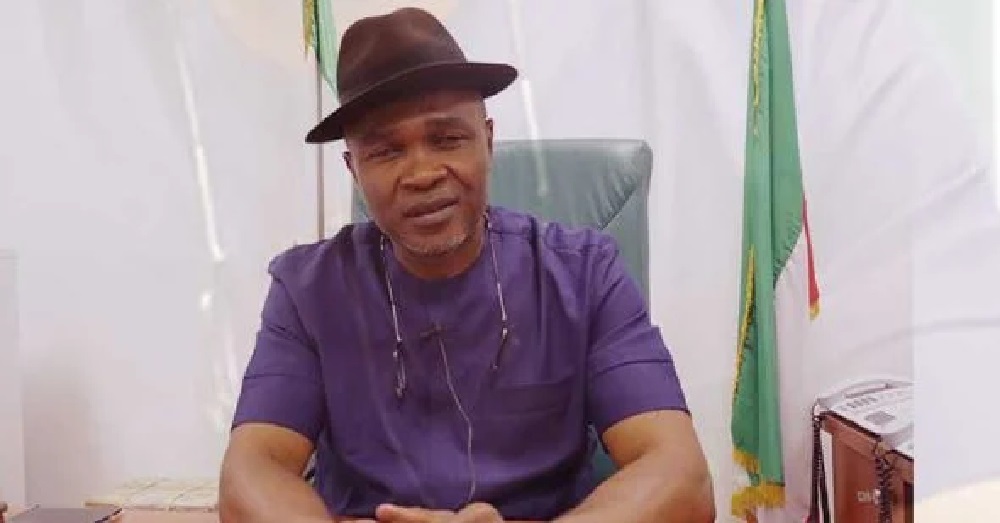
There are politicians who campaign for office by promising to repair a leaking roof, and there are those who ask a more fundamental question: What if the problem is the building itself?
Rep Ogundu Kingsley Chinda appears to belong to the second category.
Long before the 2027 political contest began gathering momentum in Rivers State, Chinda had already ventured into a debate that goes beyond the immediate calculations of elections, political appointments and control of government.
In 2024, while serving as Minority Leader of the House of Representatives, Chinda joined other lawmakers in sponsoring a constitutional amendment initiative aimed at moving Nigeria from its presidential system towards a parliamentary model of government.
At the time, the proposal attracted scepticism in some quarters. To critics, it appeared to be another ambitious constitutional initiative that could generate passionate speeches in the National Assembly without producing meaningful political change.
But Chinda’s argument was broader than a simple demand to replace the office of president with that of prime minister.
He was questioning the architecture of Nigeria’s democracy itself.
Beyond Changing Governments
Nigeria has operated a presidential system since the return to civilian rule in 1979, except for the periods of military intervention, while the country’s First Republic operated a parliamentary system from independence in 1960 until the military coup of January 1966.
The presidential model was restored under the 1979 Constitution and retained in the 1999 Constitution, which continues to define the framework of the Fourth Republic.
For decades, however, complaints about the cost and efficiency of governance have remained constant.
Successive administrations have merged ministries and agencies, proposed reductions in the size of government, reviewed public-sector structures and introduced various reform committees.
Yet many of the underlying complaints have persisted.
For Chinda, this represents a deeper problem.
His argument is that Nigeria has repeatedly attempted to repair the symptoms of governmental dysfunction without sufficiently examining the political structure responsible for producing them.
In his description, the country risks becoming trapped in a cycle of “motion without movement”—a system in which debates, committees, resolutions and reforms generate activity without fundamentally changing outcomes.
Learning From the First Republic
Chinda’s advocacy for parliamentary government is not, by his account, based on nostalgia for the First Republic.
Nigeria’s first experiment with parliamentary democracy ultimately collapsed amid intense political disputes, regional rivalries, electoral controversies and institutional tensions before the military takeover of January 1966.
The lessons from that period therefore remain central to the parliamentary debate.
Chinda has said lawmakers behind the proposed constitutional change deliberately examined the experience of the First Republic, including the reasons for its collapse.
He also recalled an engagement in Kano with Alhaji Dantata, whom he described as the only surviving member of the First Republic, as part of efforts to understand the strengths and weaknesses of the system from someone who experienced it directly.
Among the issues identified were inadequate understanding of parliamentary practice, ethnic and religious divisions, political self-interest, abuse of power and institutional conflicts.
The historical irony is difficult to miss.
Nigeria may have changed constitutions, political parties and political leaders repeatedly since independence, but many of the underlying challenges identified in the First Republic continue to feature in contemporary political discourse.
The personalities have changed.
The institutions have evolved.
But the political tensions have often remained remarkably familiar.
A System Designed for Nigeria?
At the heart of Chinda’s argument is the belief that Nigeria should stop treating foreign political systems as ready-made templates.
The British parliamentary model and the American presidential model emerged from different historical, social and institutional circumstances.
Nigeria, he argues, should therefore develop a system that reflects its own realities.
That position raises one of the most fundamental questions in Nigeria’s constitutional debate: Can a political system imported from another environment deliver the same results when transplanted into a society with a different history, political culture and social structure?
Chinda believes the answer is not necessarily.
Government does not operate in a vacuum. Political institutions function within societies shaped by ethnicity, religion, culture, economic interests, historical experiences and patterns of political behaviour.
Consequently, constitutional provisions that appear neutral on paper can produce different outcomes when applied in different environments.
This becomes particularly important when public officials are granted broad discretionary powers.
In a society where political, ethnic, religious and personal interests can influence public decision-making, discretion may not always be exercised in the same manner as originally envisaged by constitutional designers.
For Chinda, Nigeria therefore cannot continue importing constitutional provisions “hook, line and sinker” and simply expect them to produce foreign outcomes.
The Cost of Governance Question
One of the strongest arguments behind Nigeria’s recurring reform debates has been the cost of running government.
The country maintains a federal structure involving the executive, legislature and judiciary at the federal level, alongside 36 states and the Federal Capital Territory, with local government administration across the federation.
Critics have long argued that the structure is expensive and that substantial public resources are consumed by political administration.
Governments have responded periodically with proposals to reduce the number of ministries, merge agencies, streamline bureaucracy and cut official expenditure.
But Chinda’s argument goes beyond reducing the number of government offices.
His question is whether the political system itself encourages an expensive and highly centralised structure.
Changing ministries or reducing official allowances, in his view, may amount to rearranging furniture while leaving the underlying architecture untouched.
Not Simply Presidential Versus Parliamentary
The parliamentary debate is often reduced to a straightforward question: Should Nigeria have a president or a prime minister?
But the issue is considerably more complicated.
Under a parliamentary system, the executive emerges from the legislature and remains politically accountable to it.
The head of government is generally a prime minister, while the head of state may occupy a separate position depending on the constitutional arrangement.
In Nigeria’s current presidential system, the executive is separately elected, with the president serving as both head of state and head of government.
The two systems therefore create different relationships between the executive and legislature, different mechanisms of accountability and different incentives for political parties and lawmakers.
Chinda’s proposal is particularly significant because he has advocated a homegrown parliamentary model, rather than simply restoring the First Republic’s structure wholesale.
He has also argued for a gradual approach, beginning at the grassroots and expanding upwards to the national level.
That gradualism could prove crucial.
A change in constitutional structure alone cannot guarantee better governance. A parliamentary system can fail where institutions are weak, political parties lack internal democracy and political actors prioritise personal interests over public institutions.
The same is true of a presidential system.
The central issue, therefore, may not be the name of the system but whether the institutions within it are strong enough to enforce accountability.
From Constitutional Advocate to Governorship Candidate
Chinda’s political argument takes on a new dimension as he moves deeper into the contest for political power in Rivers State ahead of the 2027 governorship election.
That transition will inevitably test the practical implications of his philosophy.
As a legislator, it is possible to argue for structural reform from the floor of the National Assembly. As a governorship candidate, however, the questions become much more immediate.
How would the system improve education?
What would it mean for healthcare?
How would it affect employment and investment?
Could it improve security?
Would it reduce the cost of administration?
And, most importantly, would ordinary citizens feel the difference?
These are the questions that constitutional theory eventually has to answer.
Chinda’s advocacy does not automatically establish that a parliamentary system would solve Nigeria’s problems. Nor does his legislative experience guarantee that such a system would succeed.
But it does distinguish him from politicians whose political programmes begin and end with the pursuit of office.
His intervention invites voters to consider not only who should govern, but how Nigeria should be governed.
The Bigger Gamble
Nigeria’s political history is filled with constitutional experiments.
The country moved from the parliamentary system of the First Republic to military rule, then to a presidential arrangement under the Second Republic, another period of military government and eventually the Fourth Republic’s current presidential system.
Each transition was accompanied by expectations that a new political structure would help resolve old problems.
Yet no constitution can, by itself, eliminate political selfishness, ethnic suspicion, institutional weakness or corruption.
That is perhaps the greatest challenge facing Chinda’s proposal.
If Nigeria changes its political system without changing the political culture operating inside it, the country could simply reproduce old problems under a new constitutional arrangement.
That is why the parliamentary debate should not be treated merely as a contest between presidential and parliamentary loyalists.
It should be a national conversation about representation, accountability, political parties.

BINANI Air Moves to Cut Nigeria’s $218m Annual Aircraft Maintenance Outflow

OPay Rubbishes Viral Shutdown Rumour, Warns Against Fake Publication

Zamfara 2027 governorship battle: Group salutes PDP candidate for scaling INEC hurdle, pledges mobilisation support




-
 Politics23 hours ago
Kwara 2027: Zakari Mohammed, Kale Kawu, Speaker Danladi, Apaokagi Make The List As INEC Displays Names, Details Of Guber Candidates
-
 News19 hours ago
Rep Chinda, others make INEC list as gubernatorial candidates for Rivers
-

 News23 hours ago
Power Mystery: FG probes missing 100MW, N120bn revenue loss
-

 News23 hours ago
I Won’t Ever Forgive APC – El-Rufai’s Son
-

 Metro23 hours ago
25 terrorists killed as troops repel attack on Borno community
-

 Metro23 hours ago
Sokoto Hisbah denies imposing restrictions on Christian worship
-

 News22 hours ago
How to apply for FG’s N10bn TETFund research grant
-

 News19 hours ago
BREAKING: Nigerian British heavyweight boxer Itauma carried out on stretcher after being knocked out in world title bout