

Connect with us

News

64 dead in Papua New Guinea tribal violence

Published

on

ADVERTISEMENT
Zoom Ad
ADVERTISEMENT
Zoom Ad

By Francesca Hangeior
At least sixty-four bloodied bodies have been found along a stretch of road in Papua New Guinea’s remote highlands, police said Monday, a gruesome escalation of long-running violence between local warring tribes.

The victims were believed to be tribal fighters who were ambushed by a rival group in the early hours of Sunday.

The incident occurred near the town of Wabag, about 600 kilometres (370 miles) northwest of the capital Port Moresby.

Advertisement

The rugged and lawless area has for years been the scene of tit-for-tat mass killings between rival Sikin, Ambulin, Kaekin and other tribesmen.

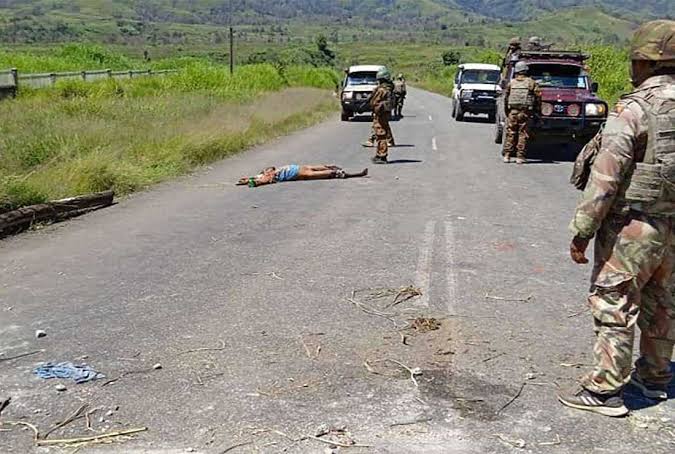
Graphic police images from the scene showed stripped and bloodied bodies lying by the side of the road and piled up on the back of a flatbed truck.

Some men had limbs hacked and were left naked by the road with beer bottles or cans placed on their chests.

Police on Monday said gunfights were ongoing in nearby valleys and bodies were still being recovered from bushland near the road.

Advertisement

“We believe there are still some bodies… out there in the bush,” Assistant Commissioner of Police Samson Kua said.

Clans have fought each other in Papua New Guinea’s highlands for centuries, but an influx of mercenaries and automatic weapons has made clashes more deadly and escalated the cycle of violence.

Kua said the gunmen had used a veritable armoury, including SLR, AK-47, M4, AR15 and M16 rifles, as well as pump-action shotguns and home-made firearms.

The province’s acting police commander Patrick Peka said many of the dead were believed to be mercenaries — men who roam the countryside offering to help tribes settle scores with their rivals.

Advertisement

“The police and government cannot do much when leaders and educated elites supply arms, ammunitions and engage the services of gunmen from other parts of the province,” Peka said.

Papua New Guinea’s government has tried suppression, mediation, gun amnesties and a range of other strategies to control the violence, with little success.

The military had deployed about 100 troops to the area, but their impact has been limited and the security services remain outnumbered and outgunned.

The killings often take place in remote communities, with attackers launching raids or ambushes in revenge for previous attacks.

Advertisement

Civilians, including pregnant women and children, have been targeted in the past.

The murders are often extremely violent, with victims hacked with machetes, burned, mutilated or tortured.

Police privately complain that they do not have the resources to do the job, with officers so badly paid that some of the weapons that end up in the hands of the attackers have come from the police force.

Opponents of Prime Minister James Marape’s government on Monday called for more police to be deployed and for the force’s commissioner to resign.

Advertisement

Papua New Guinea’s population has more than doubled since 1980, placing increasing strain on land and resources and deepening tribal rivalries.

Anthony Albanese, the prime minister of neighbouring Australia, on Monday described the incident as “very disturbing”.

“We are providing considerable support, particularly for training police officers and for security in Papua New Guinea,” he told public broadcaster ABC.

“We remain available to provide whatever support we can.”

Advertisement
Continue Reading
Advertisement

News

Body of States Attorneys-General intervenes in NBA leadership crisis, urges calm

Published

on

By

ADVERTISEMENT
Zoom Ad
ADVERTISEMENT
Zoom Ad

The Body of States Attorneys-General has stepped into the leadership crisis rocking the Nigerian Bar Association (NBA), calling on all parties to exercise restraint and allow ongoing efforts aimed at resolving the dispute through established institutional processes.

In a communiqué issued on Friday, following its meeting, the Body appealed to members of the legal profession and other stakeholders to refrain from making public statements capable of inflaming tensions as moves continue to find a lasting solution to the crisis.

The communiqué, jointly signed by the Chairman of the Body, Dr. Ben Uruchi Odoh, and its Secretary, Senior Ibrahim Sulyman, expressed support for an amicable resolution of the dispute.

The Attorneys-General urged all parties to embrace dialogue in line with existing court directives and work towards resolving the impasse in the interest of preserving the unity, dignity and integrity of the Nigerian Bar Association.

The Body also called for the urgent convening of an emergency meeting of the General Council of the Bar (GCB), the statutory body established under Section 1(1) of the Legal Practitioners Act, Cap. L11, Laws of the Federation of Nigeria 2004, which is responsible for the management of the affairs of the NBA.

According to the communiqué, the emergency meeting would provide the appropriate platform to facilitate an amicable resolution of the issues that have given rise to the current leadership crisis.

Reaffirming its commitment to the rule of law and the independence of the legal profession, the Body stressed the need to preserve the unity and institutional integrity of the NBA.

It expressed confidence that the dispute could be resolved through constructive engagement, mutual respect and strict adherence to the law.

Continue Reading

News

‘Unauthorised Jumu’ah mosques to face sanctions’ – Kano Sharia Commission

Published

on

By

ADVERTISEMENT
Zoom Ad
ADVERTISEMENT
Zoom Ad

The Kano State Sharia Commission has warned that anyone who establishes a Jumu’ah (Friday) mosque without its approval will face sanctions in accordance with the law.

The commission’s Second Commissioner, Sheikh Ali Danabba, gave the warning while addressing journalists in Kano.

According to him, the Commission will no longer recognise or approve any Jumu’ah mosque established outside the prescribed legal process.

“Anyone intending to establish a Jumu’ah mosque must first seek and obtain approval from the Kano State Sharia Commission and fulfil all the prescribed legal and administrative requirements,” Sheikh Danabba said.

He stressed that the Commission was determined to enforce the regulation and ensure that all Friday mosques operate within the provisions of the law.

The commissioner urged individuals, communities and religious organisations to comply with the state’s guidelines on establishing places of worship to promote order and peaceful religious activities across Kano State.

He also assured residents that the Commission would continue to monitor religious affairs to ensure strict compliance with the law.

Continue Reading

News

Alia blames illiteracy, poverty for Nigeria’s insecurity

Published

on

By

ADVERTISEMENT
Zoom Ad
ADVERTISEMENT
Zoom Ad

Benue State Governor, Hyacinth Alia, has identified illiteracy, poverty, unemployment, inequality, weak institutions, ethno-religious tensions, poor governance and declining social values as major factors fueling Nigeria’s persistent insecurity.

The governor made the remarks on Friday while delivering a lecture at the quarterly lecture series of Yakubu Gowon University in Abuja.

Alia said Nigeria had witnessed an unprecedented wave of insecurity in recent decades, citing the Boko Haram insurgency, banditry, terrorism, kidnapping and recurring herders-farmers clashes, which he said have claimed thousands of lives, destroyed property and posed serious threats to national security.

According to him, the Boko Haram insurgency represents a direct attack on Western education, underscoring the need for governments to strengthen the country’s education system as part of efforts to address insecurity.

The governor stressed that building an efficient public service and strengthening institutions remain critical to tackling the country’s growing security challenges, noting that the public service plays a central role in delivering essential services and meeting the needs of citizens.

He said effective public service delivery would help build stronger and more resilient communities, stimulate economic growth and promote social cohesion.

“Through efficient and effective public service delivery, we can build stronger and more resilient communities, foster economic growth, and promote social cohesion,” he said.

Alia also called for greater investment in inclusive, equitable and quality education, lifelong learning opportunities, technical and vocational skills development, teacher capacity building and safe learning environments across all levels of education.
He argued that education remains one of the most sustainable approaches to addressing the root causes of insecurity, including illiteracy, ignorance, poverty, religious extremism and unemployment.

According to him, when deliberately deployed as a national development strategy, education can reduce vulnerability to violent extremism, promote tolerance and empower citizens with the knowledge and skills needed for productive livelihoods.

The governor maintained that rather than relying solely on military action or threats, Nigeria should prioritise accessible, compulsory and functional education capable of fostering social cohesion, religious tolerance and economic empowerment.

He added that strengthening the education sector would not only improve human capital development but also contribute significantly to building a more peaceful, stable and secure society.

Continue Reading

Trending

Copyright © 2024 Naija Blitz News