Economy
Despite FG’s Clampdown: Dollar Hits N1,900; Pound, N2,250
The naira Tuesday slid further at the parallel market in spite of the clampdown the federal government ordered on foreign exchange market speculators.

Bureau De Change (BDC) hubs were raided in Abuja, Lagos and Kano and some operators were arrested.
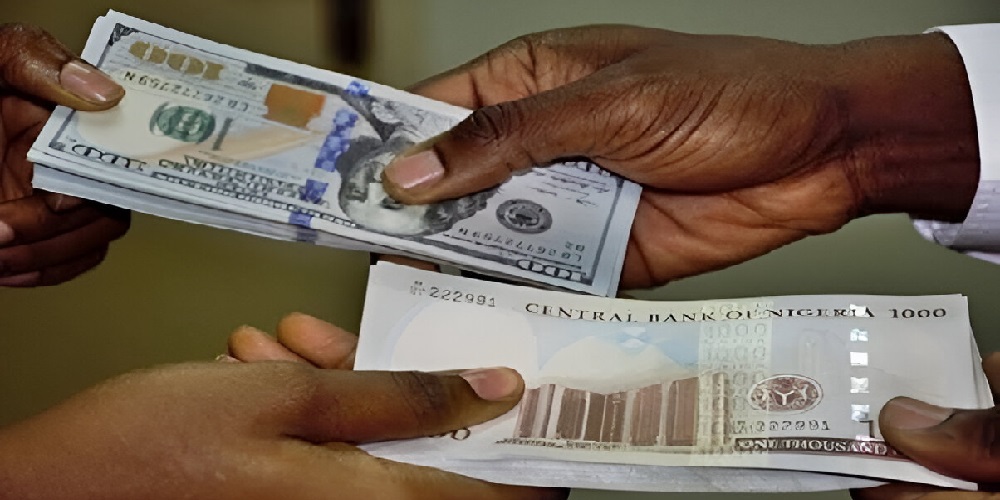
Despite the raids, however, the naira plunged further with a dollar exchanging for 1,900 in Abuja and Kano, and N1,800 in Lagos; while the British Pound was exchanged for N2,250.

However, at the official market, the naira recorded a marginal gain closing at N1,551.24 as against the earlier N1,574.62, according to the Nigerian Autonomous Foreign Exchange Market (NAFEM).
NSA’s clampdown
Daily Trust reports that the National Security Adviser, Nuhu Ribadu, had earlier yesterday directed operatives of the Nigeria Police Force, the Economic and Financial Crimes Commission (EFCC), the Nigeria Customs Service (NCS) and the Nigeria Financial Intelligence Unit (NFIU) to clamp down on forex market speculators.
This, he said, was a concerted effort to safeguard Nigeria’s foreign exchange market and combat the activities of speculators, both domestic and international, operating through various channels.
Ribadu, in a statement by Zakari Mijinyawa, Head, Strategic Communications in the Office of the NSA, said the office had to wade in at this time because some individuals and organisations had continued to undermine proactive measures of the Central Bank of Nigeria to stabilise the foreign exchange market and stimulate economic activities.
But some experts who spoke to Daily Trust described the move as faulty, saying there are better ways to address the volatility.
The statement from Ribadu said, “The CBN’s proactive measures to stabilize the foreign exchange market and stimulate economic activities have been commendable.
“However, the effectiveness of these initiatives is being undermined by the activities of speculators, both domestic and international, operating through various channels, thereby exacerbating the depreciation of the Nigerian Naira and contributing to inflation and economic instability.
“To reduce the pressure on the naira, the EFCC raised a 7,000-man special task force across its 14 zonal commands to clamp down on dollar racketeers.
“Yet, recent intelligence reports have highlighted continued illicit activities within the Nigerian foreign exchange market. The ONSA and CBN are therefore embarking on this collaborative approach to tackle these infractions.
“This partnership will involve a coordinated effort with key law enforcement agencies, including the Nigeria Police Force, the EFCC, the Nigeria Customs Service and the Nigeria Financial Intelligence Unit (NFIU).
“The primary objective of this alliance is to systematically identify, thoroughly investigate and appropriately penalize individuals and organizations involved in wrongful activities within the FX market,” the official said.
The NSA said by leveraging the expertise of those four security agencies, the government aimed at deterring what he described as “malicious practices”, in order to protect investors’ interests and promote sustainable economic growth.
Acting on the NSA’s directive, the security operatives swooped on the streets of Lagos, Abuja and Kano yesterday to raid unlicensed BDC operators.
At the popular Allen Avenue in Lagos, about five BDC operators were reportedly arrested when the EFCC operatives stormed the area around 10am.
Many of the unlicensed operators transacting by the road fled on sighting the security operatives.
An operator said: “They came to our place today; they said we are the ones responsible for the hike in foreign exchange. All of us had to take to our heels for fear of arrest.”
Another said five of his colleagues were arrested during the raid, adding, “Many of us have run away now and we are monitoring the situation.”
Dollar sells for N1,870 in Kano
A dollar was exchanged for N1,870 at the popular Wapa Bureau de Change market on Tuesday.
An operator, Ammar Aminu, said though no EFCC operative visited the market for a clampdown on forex speculators, the price of the dollar kept going up.
He said, “Today, the dollar has risen to N1,870 from N1,750 it was sold on Monday.”
Normal trading activities were ongoing when our correspondent visited the area.
Bureau De Change operators in Abuja confirmed that EFCC operatives raided the popular Zone 4 business area.
Some of the operators, who spoke to Daily Trust, said the operatives came in their numbers on Monday.
A BDC operator, Gidado Muktar, said: “We were just on our own when we saw operatives of the EFCC in their numbers in over three Hilux vans storm our vicinity at Zone 4 and the next thing we saw was that they started arresting some of our members. They put them in their vans and drove off.
“What I was told later was that they were acting on a tipoff that some people were hoarding dollars and that was why they came and effected arrests.”
Another operator, Mustapha Ibrahim said: “The way and manner the EFCC came was shocking; as if the BDCs were the ones responsible for the naira’s fall.”
Raid not way to go – Economist
An economist, Dr Oluseye Ajuwon, in an interview with Daily Trust yesterday, said clamping down on BDC operators was not the solution to the foreign exchange crisis.
Ajuwon, a lecturer at the Department of Economics, University of Lagos, said the raid was like compounding the problem.
“There are some kinds of forex demands that you cannot go to banks to do. You have to resort to all these BDCs. The way they (the government) are going about it now is like pushing them into a darker place.
“The implication of that is that it would now become more expensive. I don’t see it solving any problem. Rather, it would compound the problem.
“What will create hoarding is if there is scarcity. If you can’t remove scarcity, there will be hoarding. If we really want to solve the problem, just remove the scarcity.
“Everything they (government) are doing now is a short-time measure. What they are doing now is trial and error and the way they are going about it is wrong.”
‘How to stabilize forex market’
An Abuja-based think tank, Agora Policy, in a report titled ‘Steadying Nigeria’s Fledgling Foreign Exchange Reform’, through its financial analyst, Wale Thompson, said it was high time the government embraced a new policy to stabilise the market.
According to the analyst, mere FX adjustments to adapt to reality “may lead to short-lived gains, followed by a return to previous practices.”
He said, “To avoid this cycle, forex and monetary policies should be part of a comprehensive economic plan where the exchange rate serves as a tool for export diversification and for attracting capital flows to foster overall development. Successful fixed-to-floating transitions are characterized by certain key features.
“The long-stated objective of Nigeria’s policymakers is to diversify its export base which, given Nigeria’s labour abundance, distils to ensuring that industrial activity is geared towards the production of exportable goods that use a lot of low-skilled labour that is abundant in Nigeria.
“To ensure export competitiveness of these non-oil exports, exchange rate policies must look to deliver an extra layer of competitiveness to export prices in a form that favours domestic industries,” the analyst added.
NACCIMA wants dollar pegged at N850
The President of the Nigerian Association of Chambers of Commerce, Industry, Mines and Agriculture (NACCIMA), Dele Kelvin Oye, in separate letters to the CBN Governor, Olayemi Cardoso and the Minister of Industry, Trade and Investment, Doris Nkiruka Uzoka-Anite, yesterday, urged that the dollar be pegged at between N750 and N850 from March 21.
In the letter to Cardoso titled ‘NACCIMA’s Suggestions for Addressing the Continuous Depreciation of our Currency,” Oye called for enforcement of currency regulations, transparent communication, official transactions, remittance oversight as well as monitoring and compliance.
He asked the CBN to also enforce stricter regulations on currency transactions, including hefty fines, prosecution of breach of laws and confiscation of funds involved in transactions that violate a specified exchange rate band, such as the 15 per cent maximum difference from the official rate.
“The government should consistently communicate its policy intentions and economic measures to the public to strengthen confidence in the nation’s economic management.
“All government agencies, at every level, should be mandated to conduct their transactions at the official rate, and severe penalties should be imposed for violations,” he said.
See us as partners – BDC operators
The Association of Bureau De Change Operators of Nigeria (ABCON), while speaking on the raid yesterday, decried the activities of unlicensed operators who have no record of customers they were dealing with.
The president of ABCON, Aminu Gwadabe, in a chat with Daily Trust, asked the government to partner with his members to address currency volatility.
He said his members were duly licensed to transact forex business in their offices.
“The activities of those unlicensed are what the EFCC and security agencies are not happy about. So, you can’t see a BDC outside and call him a BDC operator without an office. One of the requirements to operate as a BDC is that you must have an office.
“On our part, we are coming up with solutions that would automate the entire retail exchange where we make it simpler for even the ones that want to operate under the Bureau de Change so that their activities can be monitored because most of them are operating where the security agencies and the CBN don’t have reports of their transactions.
“So, we are putting a solution which we believe would be to the credit of the government, that can come and automate, digitize, liberalise, democratize the entire retail sector in the country,” he said.
According to him, almost all licensed operators have gone into extinction because the resources to operate are not there.
He said through partnership with the BDC, the government can boost liquidity in the market and address the current forex hike.
(Daily Trust)
Economy
CBN sets 18 as minimum age for BVN registration
The Central Bank of Nigeria (CBN) has set 18 years as the minimum age for Bank Verification Number (BVN) registration, as part of new measures aimed at strengthening identity verification and improving security in the Nigerian banking system.
The directive forms part of a set of circulars issued by the apex bank to banks, other financial institutions and payment service providers on March 12, 2026.
Under the new rule, only individuals who are 18 years and above will be allowed to enrol for a BVN. The CBN said the decision is intended to strengthen customer identification processes and reduce the risk of misuse of bank accounts for fraudulent activities.
The bank also introduced new controls within the BVN system to tighten monitoring of suspicious financial transactions across the banking industry.
According to the circular, financial institutions are now required to create a temporary watchlist for BVNs linked to suspected fraudulent transactions. A BVN may remain on the watchlist for a period of up to 24 hours while the affected customer is contacted to clarify the transaction in question.
The CBN explained that the measure will allow banks respond quickly to suspicious activities while still giving customers the opportunity to explain legitimate transactions.
In another change to BVN operations, the apex bank placed restrictions on modifications to phone numbers linked to BVN records.
Under the new directive, customers will only be allowed to change the phone number associated with their BVN once. The CBN said the measure is intended to prevent fraudsters from repeatedly altering phone numbers in order to bypass security checks.
The bank also stated that access to the BVN database will remain strictly limited to financial institutions licensed by the regulator. However, the CBN noted that it may grant access in special circumstances in accordance with existing laws. The new BVN rules are scheduled to take effect from May 1, 2026.
Alongside the BVN reforms, the apex bank also introduced new security measures for instant payment services used for electronic money transfers across Nigerian banks.
The CBN directed all financial institutions offering instant payment services to introduce additional safety features that will allow customers control how their accounts are used for electronic transfers.
Under the new arrangement, customers will be able to voluntarily opt out of instant transfer services if they wish to temporarily stop online transfers from their accounts.
The CBN said once the opt-out option is activated, the customer will not be able to carry out electronic transfers either within the same bank or to other banks.
However, the account holder will still be able to visit a bank branch physically to carry out a transfer.
The apex bank explained that the opt-in and opt-out process must be protected by multi-factor authentication to ensure that only the account owner can activate the feature.
Customers will also be allowed to set their own transfer limits for instant payments. While the existing maximum limits of N25 million for individuals and N250 million for corporate accounts remain unchanged, customers may decide to set lower limits to reduce their exposure to fraud.
According to the circular, any change to transaction limits must pass through enhanced verification procedures and risk assessment by the financial institution.
The CBN also instructed banks to deploy enterprise fraud monitoring systems capable of tracking both incoming and outgoing transactions in real time to detect suspicious activities quickly.
In addition, banks must strengthen identity checks when customers open accounts online or attempt to reactivate inactive accounts.
The apex bank said accounts opened online must undergo liveliness checks, while customer details must be validated immediately against the BVN and National Identity Number databases.
Enhanced authentication tools such as biometric verification, soft tokens and hard tokens are also expected to be used during online account reactivation. The regulator further directed banks to tighten security around mobile banking applications.
Under the new rules, a mobile banking app will only be allowed to operate on one device at a time, meaning customers will not be able to use the same banking application simultaneously on multiple phones.
When a customer switches to a new device, the application will require fresh authentication before it becomes active.
The CBN also introduced temporary transaction limits for newly activated mobile banking applications.
For the first 24 hours after activation, the maximum amount that can be transferred will not exceed N20,000, whether the account is new or an existing account being accessed on a new device.
Similarly, customers accessing internet banking on a new device for the first time will be required to complete additional authentication steps. The instant payment rules will take effect from July 1, 2026.
In a separate circular, the CBN also reviewed guidelines on the management of dormant bank accounts and unclaimed balances in the banking sector.
The apex bank said banks will now be allowed to accept requests for the reactivation of dormant accounts through alternative channels instead of insisting only on physical visits to bank branches.
Financial institutions may adopt these alternative channels provided they put in place strong identity verification measures to ensure that the request is coming from the rightful account owner.
The CBN also removed the requirement for customers to provide an affidavit when reactivating dormant accounts, provided the funds in the account have not yet been transferred to the Unclaimed Balances Trust Fund Pool Account.
However, the bank clarified that affidavits will still be required when customers are reclaiming funds that have already been transferred to the trust fund pool account.
The regulator also directed banks and other financial institutions to improve transparency by publishing information about dormant accounts and unclaimed balances.
Under the directive, banks must display certain details on their official websites, including the name of the account holder, the type of account, the name of the bank and the branch where the account is domiciled.
Financial institutions without operational websites are expected to publish the information on the websites of their industry associations.
Banks are also required to publish the list of dormant accounts once every year in at least two national daily newspapers.
Where the list is very long, the CBN said the bank may publish a short notice directing customers to a section of its website where the full details are available.
State and unit microfinance banks are not required to publish the information in newspapers but must display the details at their business locations.
The apex bank explained that the publication of such information does not violate the Nigeria Data Protection Act 2023 because the law allows personal data to be processed when it is necessary to comply with legal obligations.
The CBN added that its authority to issue the directive is supported by provisions of the Banks and Other Financial Institutions Act 2020, which empowers the regulator to issue guidelines on the management of unclaimed funds held by financial institutions.
The circular on dormant accounts takes immediate effect and replaces an earlier directive issued in February 2025.
Economy
Naira Strengthens To N1,363.5/$ At Official FX Market
Nigeria’s currency recorded a notable recovery at the official foreign exchange market on Friday, closing at ₦1,363.5 against the United States dollar after weakening earlier in the week.
Data obtained from the website of the Central Bank of Nigeria showed that the naira had opened the week under pressure before gradually regaining strength in subsequent trading sessions.
At the start of the week, the local currency depreciated to ₦1,425 per dollar on Monday, compared with ₦1,398 per dollar recorded the previous Friday.
The decline represented the weakest closing level for the naira since January 12, 2026, when it previously traded at the same rate.
Market conditions, however, improved the following day as the currency appreciated to ₦1,390.5 per dollar on Tuesday.
Additional gains were recorded on Wednesday when the naira strengthened further to ₦1,373.5 against the dollar.
The upward movement continued on Thursday, with the exchange rate improving to ₦1,370 per dollar at the official market.
By Friday, the currency extended its recovery, settling at ₦1,363.5 per dollar after gaining more than ₦60 within four trading days.
Officials of the Central Bank said the country’s improving external reserve position could help shield the naira from sustained pressure in the foreign exchange market.
According to the apex bank, Nigeria’s net foreign exchange reserves increased to about $34.80 billion by the end of 2025, reflecting stronger external liquidity.
The Governor of the Central Bank, Olayemi Cardoso, explained that ongoing monetary and foreign exchange reforms are designed to boost market confidence and enhance liquidity in the financial system.
Economy
Oil tops $100 as Iran vows to keep Hormuz closed
Oil prices soared above $100 and stock markets extended losses as Iran’s new supreme leader ordered the Strait of Hormuz to be kept closed.
Concerns about a long, drawn out conflict were not assuaged by US President Donald Trump saying that stopping the Islamic republic’s “evil empire” was more important than crude prices.
Global markets have been roiled since the United States and Israel launched attacks on Iran. Tehran’s retaliatory strikes on shipping and Gulf neighbours have nearly cut off maritime traffic through the Strait of Hormuz, through which pass around a fifth of the world’s oil and liquefied natural gas.
“Oil prices are up by double-digit percentages again today, as the realisation sinks in that the US is not about to either end the war or institute some kind of convoy system in the region,” said analyst Chris Beauchamp at IG trading and investment platform.
Energy Secretary Chris Wright acknowledged the US military was currently “not ready” to escort tankers through the critical Strait of Hormuz.
Brent North Sea crude, the international benchmark contract peaked at $101.59 per barrel on Thursday.
At $100 per barrel, Brent is up around 38 percent from the eve of the conflict, which began on February 28 when the United States and Israel launched airstrikes against Iran. It is up nearly two-thirds from the start of the year.
Iran’s new supreme leader Mojtaba Khamenei called on Thursday for using “the lever of blocking the Strait of Hormuz”, which the country’s Revolutionary Guards vowed to carry out.
The call followed fresh attacks against Gulf energy targets: an attack on two oil tankers off Iraq killed at least one crew member, while a cargo ship caught fire after being hit by shrapnel.
Oil prices pared their gains after Iran’s deputy foreign minister said that Tehran had allowed ships from some countries to cross the Strait of Hormuz.
The International Energy Agency said the Mideast war “is creating the largest supply disruption in the history of the global oil market”, a day after its member countries agreed to unlock 400 million barrels of oil from their reserves — their largest release ever.
Analyst David Morrison at Trade Nation said that if the announcements of the release of oil from strategic reserves “were supposed to cap prices, then they failed dismally”.
The moves may have “suggested some panic as hostilities across the Middle East intensified”, he added.
The rise in energy prices could cause prices to rise throughout the economy.
“The longer the oil price remains elevated, the more damaging and long lasting the inflation shock will be for the global economy,” noted Kathleen Brooks, research director at trading group XTB.
Wall Street’s main stock indices were down more than one percent in early afternoon trading.
Europe’s leading equity markets closed lower, as did most Asian markets.
eToro US investment analyst Bret Kenwell said that while US equities had held up rather well to date, a long conflict would have a profound impact on businesses.
“If oil doesn’t retreat meaningfully, the pressure won’t just be felt at the pump — it will bleed into margins, spending, and potentially quarters of softer growth,” he said.
The dollar rose further against major rival currencies.
“The dollar has strengthened, driven by safe-haven demand, fears of inflation, and higher-for-longer interest rate expectations,” said Victoria Scholar, head of investment at Interactive Investor.
– Key figures at around 1630 GMT –
Brent North Sea Crude: UP 8.6 percent at $99.88 per barrel
West Texas Intermediate: UP 9.3 percent at $95.38 per barrel
New York – Dow: DOWN 1.2 percent at 46,871.01 points
New York – S&P 500: DOWN 1.2 percent at 6,698.16
New York – Nasdaq Composite: DOWN 1.4 percent at 22,389.89
London – FTSE 100: DOWN 0.5 percent at 10,305.15 (close)
Paris – CAC 40: DOWN 0.8 percent at 7,978.98 (close)
Frankfurt – DAX: DOWN 0.2 percent at 23,589.65 (close)
Tokyo – Nikkei 225: DOWN 1.0 percent at 54,452.96 (close)
Hong Kong – Hang Seng Index: DOWN 0.7 percent at 25,716.76 (close)
Shanghai – Composite: DOWN 0.1 percent at 4,129.10 (close)
Euro/dollar: DOWN at $1.1525 from $1.1574 on Wednesday
Pound/dollar: DOWN at $1.3355 from $1.3419
Dollar/yen: UP at 159.20 yen from 158.92 yen
Euro/pound: UP at 86.31 pence from 86.25 pence
-
News23 hours ago2027: Gov of Bauchi reportedly planning to abandon PDP for APC this week
-
News23 hours agoUK-bound 74-year-old grandad arrested at Abuja airport with 11kg cocaine in balloons+Photos
-
News23 hours agoWatch how NDLEA operatives politely educate grandpa nabbed with cocaine (Video)
-
News20 hours agoMidnight fire engulfs Jos main market destroying ten shops
-
News6 hours agoUK releases programme for President Tinubu’s State visit
-
News22 hours agoNPA wins Champions Newspaper’s “Outstanding Agency of the Year Award 2025”
-
News22 hours agoJournalists are professionals deserving Respect- IGP Disu
-
News6 hours agoPope Leo decries ‘atrocious violence’ in Iran war, urges ceasefire