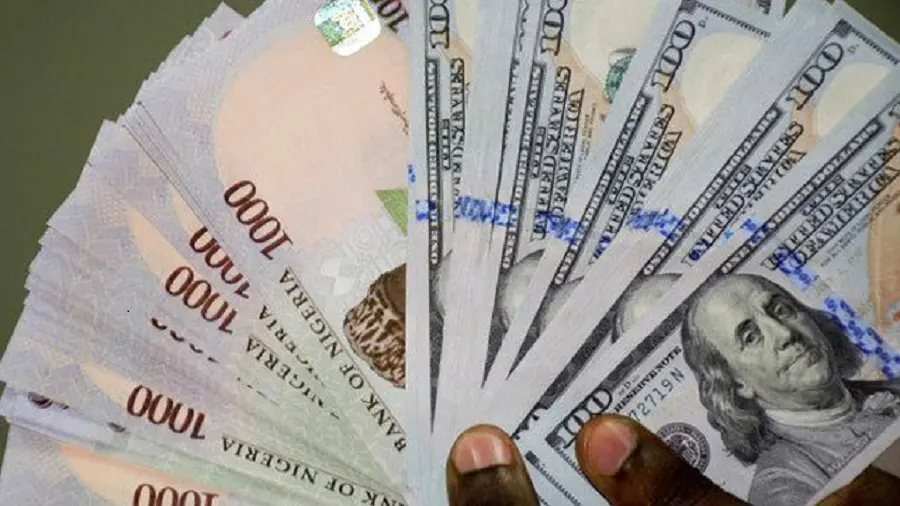
Since the harmonisation of the foreign currency market segments in Nigeria one year ago, the naira has depreciated by about 214.64 per cent against the dollar.
At the close of trade on Friday, the naira stood at N1482.72 to a dollar, compared to the N471/$ it was a year before.
The statement from the CBN abolishing the segmentation of the FX market into different windows partly read, “All transactions will now be done through the Investors and Exporters window, where the exchange rate will be determined by market forces. Applications for medicals, school fees, BTA/PTA, and SMEs would continue to be processed through deposit money banks.” 
The CBN also announced reintroducing the ‘willing buyer, willing seller’ model at the I&E window, which allows eligible transactions to access foreign exchange based on the guidelines outlined in the circular dated April 21, 2017.
Since the floating of the Nigerian currency, it has remained unstable despite spirited efforts by the CBN under Dr Olayemi Cardoso to stabilise it.
At the end of 2023, the naira closed at 911/$, signalling a significant drop in six months.
In a commentary in February, Fitch Ratings put the drop in the value of the naira at about 40 per cent, saying, “The Nigerian naira was recently devalued sharply (end-2023: 899/USD; 13 February: 1,516/USD; about 40 per cent devaluation), exceeding our expectations of a more moderate depreciation in 2024. The large devaluation is the second within a year (70 per cent devaluation since end-2022) and has converged the official exchange rate with the parallel market rate.”
In the New Year, the local currency recorded high volatility, depreciating to almost 2,000/$, which raised claims that activities on peer-to-peer trading platforms were impacting the value of the naira.
The currency also went from being the top-performing currency in March to the worst-performing currency in the world in April, according to a Bloomberg report.
Amid all of this, the CBN has issued draft circulars and taken steps to stabilise the naira and boost forex supply.
Commenting on the status of the naira, one year after the major reform, economist and the Chief Executive Officer of Economic Associates, Ayo Teriba, applauded the Olayemi Cardoso-led CBN for its handling of the fallouts of the FX market harmonisation.
He said that compared to the fuel subsidy removal bit, the FX market had done better.
“I will say that the naira has done better than the pump price of the petroleum product. They were both policies hurriedly embarked upon without adequate preparation. But in the case of the foreign exchange market, the necessary reforms have been done post-liberalisation and you have to commend the central bank governor and his team.
“He (Cardoso) was appointed three months after the harmonisation. He has tried to resolve the issue of lack of transparency in the market. There is more transparency and he has been very forthright about the arrears that he had inherited at the time, very open about how much they were repaying until they repaid everything, and the portion of it that was fraudulent.
“He has also opened the market to foster more inclusiveness. You have to applaud the current regime; they have abolished the ban on the 43 items, admitted Bureau De Change operators, and licensed International Money Transfer operators. Everyone deserves a seat at the table and it is not surprising that the rates have converged.”
Teriba, however, expressed concern about the persistent volatility in the market but expressed optimism that the CBN and the monetary policy committee would be able to get a handle on it.
“The only persistent concern with the FX is the volatility, which the central bank and the monetary policy committee are trying their best to deal with and will eventually be able to deal with. You cannot say that with the fuel subsidy removal reform,” he asserted.
A former Chief Economist for Zenith Bank, Marcel Okeke, described the floating of the naira as a calamity.
“It is one of the wrong policy initiatives of the government, especially coming so close to the removal of the fuel subsidy. The impact of the two policies has brought the economy to where we are today where we cannot see any light at the end of the tunnel.
“Floating the naira in June 2023 was like putting the naira in a wrestling ring with other currencies of the world like dollars, Pounds Sterling and others, it lost value and strength so much that it was almost on a tailspin,” he posited.
A Relationship Manager Of Corporate Banking at FSDH Merchant Bank Limited, Ayodele Akinwunmi, stated that some of the objectives of the reform had been achieved, which included the convergence of the segments of the market.
“The gap between the official and parallel market rates is now very narrow if not almost the same, so there is no roundtripping from one segment of the market to the other, which was one of the objectives.
“Also, there has been improved confidence from foreign investors in bringing money to the country. They have invested a lot in fixed-income securities and they have also tested the market to see whether they can exit the market after making a profit, and yes, they have been able to do that successfully.
“So, they have the confidence that if they bring in their money into the country, they are able to exit when they want to, which was one of the objectives of the reform,” he stated.
According to Akinwumi, it is to increase supply in the forex market.
“We need as a nation to grow our economy, to enable us to export more, not only for oil but also from non-oil sectors. We have solid minerals, agriculture, and manufacturing products, and we can add more value to the agricultural produce than the raw materials that we sell today. We need to make the economy more competitive, and security in the nation must improve, so that we do not import the things we can produce locally.
“With Dangote promising to supply PMS from next month, that means the import bill for petrol will drop significantly and if we can supply crude significantly, which I don’t think we should be able to,” he noted.
He stated that the project could meet local demand and even supply the West African market and some parts of Europe.
“He has been supplying fertilizer to America, Brazil, the Caribbean and parts of Europe and when you supply such, you are bringing in foreign exchange. What do we need to optimise the plant? Gas, which we have in abundance, is being flared. Whatever the government needs to do to make that project work, they need to do it,” he explained.
Meanwhile, the Economist Intelligence Unit has projected a stronger dollar this year and 2025, which may add to naira woes.
In its latest report titled ‘A stronger dollar for longer, predicting the effects on emerging markets’ the EIU said, “The dollar’s dominant role in international trade and finance prompts us to ask, how long can the global economy withstand above-average strength in the US dollar?
“In terms of financial crisis risk, emerging markets are more vulnerable, owing to a frequent dependence on external funding in major global reserve currencies–most often the US dollar–to finance public expenditure and plug shortfalls in the balance of payments. A stronger US dollar raises the local currency burden of repayments, compounding the impact of higher rates on the cost of borrowing.
“Moreover, these effects often play out against a backdrop of private sectors that are squeezed by tighter financing conditions; domestic central banks are obliged to keep local rates high amid tight US policy, and foreign investment is instead directed towards developed markets with higher returns. These trends serve to further undermine economic growth and government tax revenues.”