News
Finally, Russia releases US journalist, other Americans, dissidents in massive 24-person prisoner swap
- /home/naijuinz/public_html/wp-content/plugins/mvp-social-buttons/mvp-social-buttons.php on line 27
https://naijablitznews.com/wp-content/uploads/2024/08/Screenshot_20240801-213947.png&description=Finally, Russia releases US journalist, other Americans, dissidents in massive 24-person prisoner swap', 'pinterestShare', 'width=750,height=350'); return false;" title="Pin This Post">
- Share
- Tweet /home/naijuinz/public_html/wp-content/plugins/mvp-social-buttons/mvp-social-buttons.php on line 72
https://naijablitznews.com/wp-content/uploads/2024/08/Screenshot_20240801-213947.png&description=Finally, Russia releases US journalist, other Americans, dissidents in massive 24-person prisoner swap', 'pinterestShare', 'width=750,height=350'); return false;" title="Pin This Post">
By Kayode Sanni-Arewa

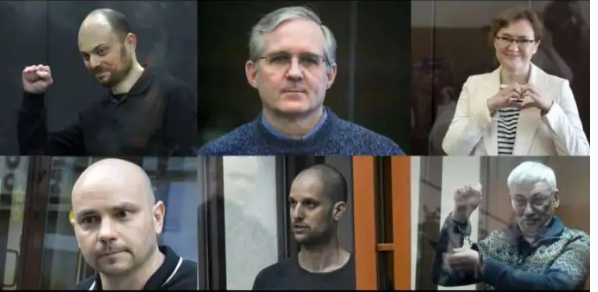
The United States and Russia completed their biggest prisoner swap in post-Soviet history on Thursday, with Moscow releasing journalist Evan Gershkovich and fellow American Paul Whelan, along with dissidents including Vladimir Kara-Murza, in a multinational deal that set two dozen people free, officials said.
The trade followed years of secretive back-channel negotiations despite relations between Washington and Moscow being at their lowest point since the Cold War after Russian President Vladimir Putin’s February 2022 invasion of Ukraine.

The sprawling deal, the latest in a series of prisoner swaps negotiated between Russia and the U.S. in the last two years but the first to require significant concessions from other countries, was heralded by President Joe Biden as a diplomatic achievement in the final months of his administration. But the release of Americans has come at a price: Russia has secured the freedom of its own nationals convicted of serious crimes in the West by trading them for journalists, dissidents and other Westerners convicted and sentenced in a highly politicized legal system on charges the U.S. considers bogus.
Under the deal, Russia released Gershkovich, a reporter for The Wall Street Journal who was jailed in 2023 and convicted in July of espionage charges that he and the U.S. vehemently denied and called baseless; Whelan, a Michigan corporate security executive jailed since 2018 also on espionage charges he and Washington have denied; and Radio Free Europe/Radio Liberty journalist Alsu Kurmasheva, a dual U.S.-Russian citizen convicted in July of spreading false information about the Russian military, accusations her family and employer have rejected.
The dissidents released included Kara-Murza, a Kremlin critic and Pulitzer Prize-winning writer serving 25 years on charges of treason widely seen as politically motivated, 11 political prisoners being held in Russia, including associates of the late Russian opposition leader Alexei Navalny, and a German national arrested in Belarus.
The Russian side got Vadim Krasikov, who was convicted in Germany in 2021 of killing a former Chechen rebel in a Berlin park two years earlier, apparently on the orders of Moscow’s security services.
Russia also received two alleged sleeper agents who were jailed in Slovenia, as well as three men charged by federal authorities in the U.S., including Roman Seleznev, a convicted computer hacker and the son of a Russian lawmaker and Vadim Konoshchenok, a suspected Russian intelligence operative accused of providing American-made electronics and ammunition to the Russian military. Norway returned an academic arrested on suspicions of being a Russian spy, and Poland also sent back a man it detained.
Thursday’s swap of 24 prisoners surpassed a deal involving 14 people that was struck in 2010. In that exchange, Washington freed 10 Russians living in the U.S. as sleepers, while Moscow deported four Russians living in their homeland, including Sergei Skripal, a double agent working with British intelligence. He and his daughter in 2018 were nearly killed by nerve agent poisoning blamed on Russian agents.
Speculation had mounted for weeks that a swap was near because of a confluence of unusual developments, including a startingly quick trial and conviction for Gershkovich that Washington regarded as a sham. He was sentenced to 16 years in a maximum-security prison.
In a trial that concluded in two days in secrecy in the same week as Gershkovich’s, Kurmasheva was convicted on charges of spreading false information about the Russian military that her family, employer and U.S. officials rejected.
Also in recent days, several other figures imprisoned in Russia for speaking out against the war in Ukraine or over their work with Navalny were moved from prison to unknown locations.
Gershkovich was arrested March 29, 2023, while on a reporting trip to the Ural Mountains city of Yekaterinburg. Authorities claimed, without offering any evidence, that he was gathering secret information for the U.S. The son of Soviet emigres who settled in New Jersey, he moved to the country in 2017 to work for The Moscow Times newspaper before being hired by the Journal in 2022.
He had more than a dozen closed hearings over the extension of his pretrial detention or appeals for his release. He was taken to the courthouse in handcuffs and appeared in the defendants’ cage, often smiling for the many cameras.
U.S. officials last year made an offer to swap Gershkovich that was rejected by Russia, and Biden’s Democratic administration had not made public any possible deals since then.
Gershkovich was designated as wrongfully detained, as was Whelan, who was detained in December 2018 after traveling to Russia for a wedding. Whelan was convicted of espionage charges, which he and the U.S. have also said were false and trumped up, and he was serving a 16-year prison sentence.
Whelan had been excluded from prior high-profile deals involving Russia, including the April 2022 swap by Moscow of imprisoned Marine veteran Trevor Reed for Konstantin Yaroshenko, a Russian pilot convicted in a drug trafficking conspiracy. That December, the U.S. released notorious arms trafficker Viktor Bout in exchange for getting back WNBA star Brittney Griner, who’d been jailed on drug charges.
News
SAD: FRSC Enugu Sector Commander Is Dead
The Federal Road Safety Corps (FRSC) has announced the death of its Enugu State Sector Commander, Corps Commander Franklin Agbakoba.
Agbakoba passed away on Thursday, July 30, while receiving medical treatment at the Niger Foundation Hospital in Enugu, bringing an end to his service with the road safety agency.
The sad development was confirmed in a statement issued on Friday by the Deputy Corps Commander in charge of Operations in Enugu State, Kyrian Okolo.
“The FRSC Enugu State Sector Command received the sad news of the demise of Corps Commander Franklin Agbakoba on Thursday, 30 July,” the statement read.
According to the FRSC, the late sector commander’s remains have been deposited at the Eastern Medical Centre in Enugu.News
The agency, however, did not disclose the nature of the illness that led to his death or provide further details surrounding the circumstances of his passing.
Until his death, Agbakoba was widely recognised for his commitment to improving road safety and strengthening collaboration among security, emergency response and other relevant agencies operating in Enugu State.
During his tenure, he championed initiatives aimed at enhancing inter-agency cooperation, reducing road traffic crashes and promoting public awareness on road safety regulations.
The FRSC also credited him with fostering strategic partnerships that contributed to the advancement of road safety campaigns and the effective delivery of its mandate across the state.
His death has been described as a significant loss to the Corps, colleagues and stakeholders in the transportation and emergency response sectors who worked closely with him during his time in office.
Further announcements regarding funeral arrangements are expected to be made by the family and the Federal Road Safety Corps in due course.
News
INEC Rejects PDP’s Submission Of Jonathan As 2027 Presidential Candidate
The Independent National Electoral Commission (INEC) has dismissed claims by the Kabiru Turaki-led faction of the Peoples Democratic Party (PDP) that it manually submitted its list of candidates for the 2027 general elections, including the nomination of former President Goodluck Jonathan as its presidential candidate.Executive Branch
The electoral body reiterated that political parties are required to submit the names of their candidates exclusively through its designated electronic nomination portal, casting doubt on the faction’s assertion that it resorted to manual submission after allegedly being denied access to the system.
INEC’s Director of Voter Education and Publicity, Victoria Ita-Messi, made the clarification in an interview with Leadership in Abuja on Friday while responding to the claims made by the PDP faction.
Although she declined to confirm whether any documents had been received from the group, Ita-Messi stressed that the commission has a clearly defined procedure for the submission of candidates’ names.
“I am not in a position to confirm that to you, but can only tell you that there are procedures for submitting the names of political parties’ candidates to the INEC portal,” she said.
She also questioned the consistency of the faction’s claims, noting that it was contradictory to allege being denied access to the electronic platform while simultaneously claiming to have successfully submitted a list of candidates.
“If the faction claimed that they were denied access to the code, how did they submit the list of their candidates to the commission?” Ita-Messi asked.
INEC’s response comes a day after the Kabiru Turaki-led faction held a press conference in Abuja, where it announced that it had submitted its list of candidates for the 2027 general elections.
The faction claimed the list included former President Goodluck Jonathan as its presidential candidate, alongside nominees for governorship, National Assembly and state House of Assembly positions.
According to the group, it adopted the manual submission process after the commission allegedly refused to provide the access codes required to upload candidates through INEC’s electronic portal.
The faction’s National Publicity Secretary, Ini Ememobong, maintained that the manual submission complied with the provisions of the Electoral Act 2026 despite the alleged denial of access to the online platform.
Ememobong also accused INEC of failing to remain neutral in the ongoing leadership dispute within the PDP, alleging that the commission had ignored relevant facts and judicial decisions relating to the party’s internal crisis.
The leadership tussle within the PDP has produced rival groups laying claim to the party’s national structure, with both sides seeking recognition from the electoral commission ahead of preparations for the 2027 general elections.
INEC, however, has consistently maintained that political parties must comply with its established guidelines and statutory procedures for the nomination and submission of candidates.
News
How Prison Inmate on D*ath Row Livestreamed On TikTok, Earned Money From Ogun Prison
A death-row inmate at the Ibara Custodial Centre in Abeokuta, Ogun State, has allegedly maintained multiple TikTok accounts, participated in livestreams and received money from supporters despite serving a sentence for the murder of a university student.
The inmate, Elijah Oyebode, was sentenced to death by hanging in 2019 for the killing of Rofiat Adebisi, a final-year student of Osun State University, Ipetu Ijesha campus.Death & Tragedy
An investigation by Premium Times revealed that Oyebode had access to smartphones and the internet inside the custodial facility, allowing him to interact with thousands of social media users and solicit financial assistance.
The Nigerian Correctional Service (NCS) acknowledged that compromised officers could facilitate the movement of prohibited devices into custodial centres but said evidence would be required to identify and sanction those involved.
According to a Certified True Copy of proceedings in Suit No. HIK/6C/2017 before the Osun State High Court, Oyebode conspired to kill Adebisi on December 22, 2016.
The court records showed that the student was waiting by the roadside for transportation to Osogbo when Oyebode picked her up in his vehicle.Geographic Reference
During investigations, the convict reportedly gave conflicting accounts of what happened.
In one statement, he claimed that he took Adebisi to his apartment after they reached an agreement and later found her unresponsive.
In another statement, he alleged that he used a charm provided by a herbalist to hypnotise her before taking her to a shrine.
Oyebode later repudiated the statements during trial and denied participating in the crime.
The court rejected his denial, relying on medical and other evidence presented by the prosecution.
-
News24 hours agoDoctors Perform First Successful Manhood Transplant on 43-Year-Old Man
-
News22 hours agoWatch moment FCT minister Wike led security operatives to criminals hideout in Kukwaba
-
News21 hours agoPhotos: Wike orders demolition of suspected criminal hideout in Abuja
-
Economy23 hours agoSEE Black Market Dollar To Naira Exchange Rate Today 31st July 2026
-
News20 hours agoBan on sale of sachet alcoholic drinks remains – NAFDAC
-
Entertainment20 hours agoPortable, Okocha set for celebrity boxing battle today
-
News23 hours agoSad: Gunmen kill Miyetti Allah chairman two sons
-
News19 hours agoCatholic Priest lifeless body found in Kogi

Warning: Undefined variable $user_ID in /home/naijuinz/public_html/wp-content/themes/zox-news/comments.php on line 49
You must be logged in to post a comment Login