Connect with us

News

Kekere-Ekun Set To Emerge Nigeria’s Second Female CJN

Published

on

ADVERTISEMENT
Zoom Ad
ADVERTISEMENT
Zoom Ad

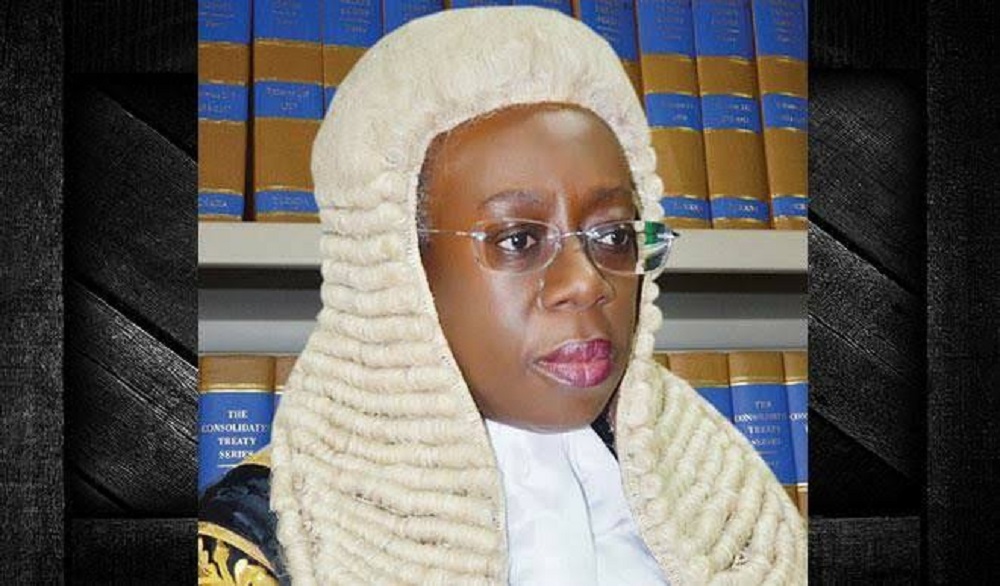
Barring any last-minute change, Justice Kudirat Kekere-Ekun of the Supreme Court is set to emerge as the next chief justice of Nigeria (CJN).


If she assumes the office, Kekere-Ekun would become the second female justice in Nigeria to hold the exalted position after Mariam Aloma Mukhtar, who was CJN between July 2012 and November 2014, spending 28 months in office.

The current occupant of the office, Justice Olukayode Ariwoola, who assumed office on June 27, 2022, will formally bow out on Thursday, August 22, 2024, after attaining the mandatory retirement age of 70 years.

As the most senior justice of the Supreme Court after Ariwoola, Justice Kekere-Ekun is favoured to clinch the position.

Advertisement

The incoming CJN, who is 66 years old, may stay up to four years compared to the average of two years most of her predecessors held the position.

After 11 years at the Supreme Court, Justice Kekere-Ekun will not only become the next CJN but also head the National Judicial Council (NJC), which oversees the appointment, promotion, and discipline of judges across the country.

Justice Kekere-Ekun was born on May 7, 1958 and obtained her LL. B in 1980 from the University of Lagos and LL.M from the London School of Economics and Political Science in November 1983. She was called to the Nigerian Bar on 10th July, 1981.

From 1985 to 1989, she was in private practice and was later appointed a Senior Magistrate Grade II, Lagos State Judiciary in December 1989. She was appointed a judge of the High Court of Lagos State on July 19, 1996. She served as the chairman of the Robbery and Firearms Tribunal, Zone II, Ikeja, Lagos, from November 1996 to May 1999.

Advertisement

Kekere-Ekun was elevated to the Court of Appeal on 22nd September, 2004, where she served in various Divisions and as the presiding justice of two Divisions of the appellate court (Makurdi and Aku) in 2011 and 2012, respectively.

She was elevated to the Supreme Court of Nigeria as the fifth female justice of the apex court and sworn in on Monday, July 8, 2013.

She has attended numerous courses and seminars within and outside Nigeria and received several merit awards.

Justice Kekere-Ekun is also a life Bencher, a member of the International Association of Women Judges and its president.

Advertisement

LEADERSHIP Sunday reports that the judiciary has been in the eye of the storm, notably since the country returned to democratic rule in 1999.

With Justice Kekere-Ekun assuming office in the next few weeks, the succession battle in the Supreme Court may be rancour-free for the first time in five years.

Justice Walter Onnoghen, who served as CJN between 7th March, 2017 and 25th January 2019, left controversially after he was accused of failing to declare his assets.

His successor, Justice Tanko Muhammad, who assumed office on 25th January, 2019, followed almost the same pattern after his fellow justices accused him of unfair treatment, particularly in the area of their welfare. He voluntarily resigned on the grounds of ill-health on 27th June, 2022.

Advertisement

The CJN is the head of the government’s judicial arm. He presides over the country’s Supreme Court and the National Judicial Council.

The outgoing CJN (Ariwoola) was appointed acting CJN on 27th June, 2022 upon Justice Tanko Muhammad’s resignation and was confirmed by the Nigerian Senate on 21st September, 2022.

The Supreme Court of Nigeria is the highest, and its decisions are final. The president nominates the CJN upon the recommendation by the NJC, and is subject to confirmation by the Senate.

The CJN holds office at the pleasure of the Nigerian constitution and can only be removed from office due to death or on attainment of age 70, whichever comes first, or by impeachment by the Senate of the Federal Republic of Nigeria, which requires a super majority of the Senate members.

Advertisement

Short Stay In Office Based On Rules – Senior lawyers

In the last 15 years, seven CJNs have presided over the affairs of the nation’s judiciary, which is about an average of two years each for the occupants of that office.

Lawyers have, however, lamented the short stay in office of the CJNs.

According to them, an average of two years in office is not enough to bring about the needed reforms in the country’s judiciary.

Advertisement

However, some senior lawyers who spoke to LEADERSHIP Sunday were quick to assert that the CJN’s office is not a political appointment.

According to them, it is regulated by law.

A former attorney-general and commissioner for justice in Imo state, Chief Chukwuma-Machukwu Ume (SAN), said the apex court is not a political party whose programmes and policies are personal.

According to him, the CJN is an administrator and is not expected to bring his agenda to run the court.

Advertisement

“The court is regulated by law, and the law is the law; there is nothing you can do about it. The Supreme Court is not a political party where one man is expected to bring his agenda to the table after winning election,” he said.

Another lawyer, Barrister Abdul Balogun, said rules for succession to the CJN’s office have already been laid down.

“Laws and rules guide the judiciary, and any attempt to deviate from them is a call to lawlessness, which will negatively impact the country’s judiciary.

“In the judiciary as a whole, it is a laid down rule that the most senior assumes office upon a vacancy in the leadership of any court from the customary court to the Supreme Court. So, any attempt to deviate from that is a call for chaos in the system,” he said

Advertisement

In the last 15 years, the country has produced seven CJNs. While some of them left an indelible mark in office and in the minds of Nigerians with their policies and reforms to the country’s judiciary, others had their tenures characterised by controversies.

Aloysius Iyorgyer Katsina-Alu (2009- 2011)

From his very first day in office, there was controversy after he was sworn in by his predecessor. He was the first CJN to be sworn in by his predecessor, Justice Idris Legbo Kutigi (rtd), due to the unavailability of the then ailing President Umaru Yar’Adua, who did not hand over powers to then Vice President Goodluck Jonathan.

Yar’Adua never returned to the country until his death. Justice Katsina-Alu’s tenure as the CJN was also marked by his controversial battle with the then President of the Court of Appeal, Justice Isa Ayo Salami (rtd), who the NJC later suspended.

Advertisement

Dahiru Musdapher (2011-2012)

His tenure as CJN was crisis-free; rather, he brought some reforms that impacted positively on the judiciary. Some of his reforms are still being implemented today. The Jigawa State-born Musdapher was appointed Chief Justice Nigeria on August 27, 2011, and sworn in by former President Goodluck Jonathan on August 29, 2011.

He served as Chief Judge of Kano State between 1979 and 1985.

Musdapher, a native of Babura town, served as a member of the Court of Appeal between 1985 and 2003 and later joined the Supreme Court.

Advertisement

During his tenure, he admitted that the judiciary needed radical surgical reforms and called on all Nigerian judges to rise above the daunting challenges by restoring hope and confidence in the judicial system.

MARIAM ALOMA MUKHTAR (2012 – 2014)

Justice Mukhtar could be described as a judge who came, who saw and, to an extent, reinvigorated the fervor to stamp out the burden of corruption that has, in no small measure, weighed down the scale of justice in Nigeria.

She spent barely 28 months in office. She took over from Justice Dahiru Musdapher on July 15, 2012.

Advertisement

Undisputedly, no administration in the judiciary ever attempted to fight corruption like Mukhtar, during whose short regime about seven judges were sacked.

Remarkably, no woman had attained that position since 1963, when the Federal Republic of Nigeria was proclaimed, and Dr Nnamdi Azikiwe became its first President.

The situation deteriorated to the extent that an ex-CJN and a sitting president of the Court of Appeal publicly poked themselves over an alleged plan to subvert justice in a gubernatorial dispute involving Sokoto State.

Consequently, on July 11, 2012, while answering questions from the Nigerian Senate, Justice Mukhtar admitted the presence of bad eggs at the top echelon of the judicial arm of government, even as she vowed to fight and expose such persons before her exit from office.

Advertisement

A few days after she assumed duties, Justice Mukhtar reviewed 337 petitions filed against judicial officers before the NJC.

Hence, it was not surprising that seven justices were sacked within two years of her tenure.

MAHMUD MOHAMMED (2014 – 2016)

Justice Mohammed was also less controversial in his about two years in office as CJN.

Advertisement

He was born on November 10, 1946, in Jalingo, Taraba State.

He studied for his Bachelor’s degree in Law (LL.B) at Ahmadu Bello University, Zaria, graduating in 1970. After that, he attended the Nigerian Law School in Lagos and was subsequently called to the Bar in 1971.

He began his career in the public service with the Ministry of Justice of the defunct North-eastern and Gongola States and served on the Gongola Bench.

WALTER ONNOGHEN (2017 – 2019)

Advertisement

Justice Onnoghen began his tenure as CJN on a controversial note and ended it on the same note. When he was appointed in acting capacity, it appeared that former President Muhammadu Buhari never wanted him to become the substantive CJN as it took him several months to confirm his appointment.

In fact, it was Professor Yemi Osinbajo (SAN), the former vice president who acted as president when Buhari was away on a medical trip, that confirmed Onnoghen’s appointment.

Midway into his tenure as CJN, he was accused of corruption and removed from office after he was asked to resign.

His resignation from office followed the recommendation of the NJC for his early retirement. The recommendation was sent to Buhari, who readily accepted it.

Advertisement

Justice Onnoghen faced trial at the Code of Conduct Tribunal over allegations of false declaration of assets.

The Economic and Financial Crimes Commission (EFCC) also accused the former CJN of receiving illicit payments and bribes from lawyers. He denied all the allegations.

Not a few Nigerians read political undertone in his tribulation, especially as the 2019 general elections were fast approaching.

IBRAHIM TANKO MUHAMMAD (2019 – 2022)

Advertisement

Like his predecessor, Justice Tanko Muhammad assumed office on a controversial note and also exited under questionable circumstances.

After Justice Onnoghen was eased out, many believed it was to prepare Justice Muhammad to become the CJN. Some believed the former president tainted Onnoghen with a corruption tag to make way for Muhammad, also a northerner.

Like Onnoghen, he could not finish his tenure, but due to ill health.

There was confusion in the media over his resignation. However, after many weeks of denial and confusion, it was later confirmed that he resigned as CJN on health grounds.

Advertisement

Shortly before his resignation, he officially reacted to the allegations of uncaring attitude levelled against him by his fellow justices in the apex court.

In his first official reaction, he admitted that the Supreme Court, like any other establishment in the country, had been hit by a devastating economic crunch and the court’s leadership under him could no longer meet some of its obligations to the justices, especially in welfare.

OLUKAYODE ARIWOOLA (2022 -2024)

Justice Ariwoola took the oath of office as the acting CJN at the Presidential Villa in Abuja on June 27, 2022.

Advertisement

He is, arguably, one of the finest CJNs the country has produced with his policies and programmes for the judiciary. However, like some of his predecessors, his tenure is fraught with controversies, especially as the judiciary under him came to be seen as being in the pockets of the political class.

In fact, retiring Supreme Court justices in his tenure used their valedictory speeches to lampoon the judiciary under his watch and so many Nigerians have lamented that the present judiciary dispenses judgement rather than justice.

Whoever takes the mantle after Ariwoola will have a herculean task repairing the battered image of the judiciary in order to restore the confidence of the people in that arm of government.

Credit: LEADERSHIP

Advertisement
Continue Reading
Advertisement
Click to comment

Warning: Undefined variable $user_ID in /home/naijuinz/public_html/wp-content/themes/zox-news/comments.php on line 49

You must be logged in to post a comment Login

Leave a Reply

News

Airforce deploys surveillance aircraft to track abducted Oyo school children, teachers

Published

on

ADVERTISEMENT
Zoom Ad
ADVERTISEMENT
Zoom Ad

The Nigerian Air Force (NAF) has continued to provide aerial surveillance support to ongoing efforts aimed at rescuing teachers and pupils abducted from Yawota and Ahoro-Esinele communities in Oriire Local Government Area of Oyo State.

In a statement by NAF’s spokesman, Air Commodore Ehimen Ejodame, Oyo State Governor Seyi Makinde disclosed this during a courtesy visit by the representative of the Chief of the Air Staff (CAS), Air Marshal Sunday Kelvin Aneke, and the Air Officer Commanding (AOC) Logistics Command, Air Vice Marshal Abubakar Suleh, on 5 June 2026.

According to the statement, Makinde revealed that the NAF promptly deployed an aerial surveillance platform immediately after the abduction was reported, providing critical intelligence to support search-and-rescue operations.

The governor said intelligence generated from the surveillance missions had continued to assist security agencies in tracking developments and coordinating efforts towards securing the safe release of the victims.

Advertisement

NAF said Makinde appealed for patience and support from residents, assuring them that all necessary resources are being deployed to ensure the successful resolution of the situation.

He commended the CAS and the NAF for their swift response and sustained support, noting that the Air Force made the surveillance platform available while Oyo State’s newly acquired aerial assets are still being assembled at the NAF Base, Lagos.

“Makinde further explained that the state acquired the platforms following consultations with the NAF to ensure access to maintenance support, engineering expertise and pilot training.

“He expressed confidence that the assets would significantly enhance security operations across Oyo State and neighbouring states once fully operational,” the statement released on Sunday partly read.

Advertisement

Speaking on behalf of the CAS, Air Vice Marshal Suleh conveyed the solidarity of the NAF with the government and people of Oyo State and reaffirmed the Service’s commitment to supporting ongoing efforts to secure the safe return of the abducted victims.

He also commended the government for its continued support towards NAF projects and infrastructure development within the state.

“The NAF remains committed to working closely with other security agencies and relevant stakeholders to safeguard lives and property while supporting efforts to address security challenges across the country,” it added.

The pupils and teachers of the Baptist Nursery and Primary School (Yawota), Community Grammar School (Esiele), and L.A. Primary School were kidnapped on May 15 during a fatal attack by bandits.

Advertisement

One of the teachers was also killed in captivity by the terrorists.

The incident sparked protests by teachers nationwide and civil society groups in Ibadan, demanding urgent action to rescue the victims.

Last week, the House of Representatives called on the federal Government and security agencies to bring the abducted students and teachers back alive.

Following the abduction, President Bola Tinubu approved the appointment of 1,000 forest guards and the deployment of a special rescue team following the abduction of teachers and students in the state.

Advertisement
Continue Reading

News

12 Years On: Suswam’s ₦3.1bn Scam Trial Stalls as Defence Yet to Open Case

Published

on

ADVERTISEMENT
Zoom Ad
ADVERTISEMENT
Zoom Ad

The long-running trial of ex- Benue State Governor, Gabriel Suswam, over allegations of diverting ₦3.1 billion in public funds has entered its 12th year, with court proceedings yet to reach the defence stage despite the prosecution having concluded its case.

Suswam and his former Commissioner for Finance, Omodachi Oklobia, have been facing prosecution by the Economic and Financial Crimes Commission (EFCC) since November 2015 over allegations bordering on money laundering and the alleged diversion of proceeds from the sale of Benue State Government shares in Dangote Cement Plc.

According to the anti-corruption agency, the funds in question, amounting to approximately ₦3.1 billion, were realised from the sale of state-owned shares in the cement company but were allegedly diverted for personal purposes rather than being remitted to government coffers. Both defendants have consistently denied wrongdoing and pleaded not guilty to the charges.

Court Orders Defendants to Open Defence

Advertisement

After years of legal arguments, procedural delays and changes in judicial handling of the matter, the case appeared to be approaching a decisive phase in July 2025 when Justice Peter Lifu of the Federal High Court in Abuja dismissed a no-case submission filed by the defendants.

In his ruling delivered on July 23, 2025, the judge held that the prosecution had presented sufficient evidence to establish a prima facie case against the defendants, requiring them to enter a defence.

The ruling was widely viewed as a significant milestone in a case that had already spent nearly a decade in the judicial system.

However, despite the court’s directive, defence proceedings have yet to commence almost one year later.

Advertisement

Series of Adjournments Prolong Trial

The court initially scheduled September 25, 2025, for Suswam and Oklobia to begin presenting their defence. However, proceedings failed to move forward as expected.

The matter was subsequently adjourned to January 20, 2026, for the adoption of final written addresses before being shifted again to May 29, 2026.

When the matter came up in May, the hearing could not proceed because the court was not sitting, resulting in another postponement.

Advertisement

Justice Lifu thereafter fixed July 17, 2026, as the new date for the continuation of proceedings.

The repeated adjournments have further extended a case that has already spent more than a decade within Nigeria’s criminal justice system.

Trial Marked by Judicial Changes

Since its commencement, the case has experienced several disruptions arising from judicial transfers, appeals and allegations affecting the presiding judges.

Advertisement

Justice Ahmed Mohammed initially handled the matter after the defendants were arraigned in 2015. However, he stepped aside in 2016 following media reports that questioned his impartiality in the case.

Although he later resumed proceedings, he withdrew again in 2019 after another publication raised similar concerns regarding his continued handling of the trial.

Following his withdrawal, the matter was reassigned to Justice Okon Abang, who proceeded with parts of the prosecution’s case and heard testimonies from some witnesses.

However, the legal battle took another turn when the Court of Appeal ruled that the case file should be returned to Justice Mohammed after an appeal filed by Suswam.

Advertisement

Fresh delays emerged in 2023 when Justice Mohammed was elevated to the Court of Appeal, making it impossible for him to continue handling the matter. The case was subsequently reassigned to Justice Peter Lifu.

EFCC Calls Nine Witnesses

The EFCC eventually closed its case after presenting nine witnesses before the court.

Among those who testified were investigators, officials from the Benue State Ministry of Finance, representatives of stockbroking firms involved in the share transaction and a bureau de change operator.

Advertisement

The prosecution relied on documentary and oral evidence in an effort to establish its allegations that proceeds from the sale of government-owned shares were unlawfully diverted.

Following the close of the prosecution’s case, the defendants sought to have the charges dismissed through a no-case submission. However, the court ruled that sufficient evidence existed to warrant a defence.

Queries Over Delayed Justice

The prolonged nature of the proceedings has continued to attract public attention, particularly because the case remains unresolved more than 11 years after it was first filed.

Advertisement

Legal observers have pointed to the repeated adjournments, judicial reassignments and procedural setbacks as factors contributing to the slow pace of the trial.

Meanwhile, Suswam, who governed Benue State between 2007 and 2015 and later served as a senator, has remained active in Nigeria’s political landscape and is reportedly considering another electoral contest while the criminal case remains pending.Politics

With the next hearing scheduled for July 17, 2026, attention will once again focus on whether the defence will finally begin presenting its case in one of Nigeria’s longest-running high-profile corruption trials.

Advertisement
Continue Reading

News

Faleke Urges Civil Servants to Uphold Integrity, Hails Retiring National Assembly Clerk

Published

on

ADVERTISEMENT
Zoom Ad
ADVERTISEMENT
Zoom Ad

By Gloria Ikibah

The Chairman House of Representatives Committee on Finance, Rep. James Faleke, has called on civil servants across the country to uphold integrity, professionalism and due process in the discharge of their duties, describing the public service as a critical pillar of national development.

Faleke made the call in Abuja during the launch of a book titled “The Nigerian Legislature: A Practical Guide for Lawmakers”, written by the retiring Clerk of the House Committee on Finance, Mr Oscar Okoro, as part of activities marking his 60th birthday and retirement from service.

The lawmaker praised Okoro’s dedication, commitment and work ethic, describing him as a model civil servant whose career should serve as an inspiration to younger generations entering public service.

Advertisement

According to Faleke, civil servants occupy a strategic position in governance and have a responsibility to ensure that government processes are carried out in accordance with established rules and procedures.

He said: “The civil service mainly, they build the country. They are the technocrats. They are the people that we, politicians rely on.
“And if the civil servant decide to get this done properly, I think the country will better off. Even when the politician says let us do it the other way and he says no, let us follow the rules. I think Nigeria will better off.

“It is about dedication to the development of Nigeria, when you trust and believe in the country, you will want to see the success of the country.

“Okoro is a very, very hardworking guy, unlike others, he is not money conscious, he just wants to see things accordingly and appreciably.

Advertisement

“And for every time I push him hard, he works harder; I believe he’ is going to succeed very well in his retirement, so I wish him luck, and I pray that the family would not get the better of him”.

Faleke noted that Nigeria will benefit greatly if public servants remained committed to professionalism and resisted pressures to circumvent established procedures.

Also speaking at the event, Deputy Chairman of the House Committee on Finance, Rep. Abubakar Saidu, said his relationship with Okoro had grown beyond official duties and evolved into a family bond over the years.

He described the retiring clerk as a consummate professional whose conduct and dedication to service should serve as a guide for younger public servants.
According to him:

Advertisement

“He is very dedicated, very patient, he is a professional, excellent and committed as well as exemplary when it comes to the job,” he said.

Saidu added that future generations of civil servants will have much to learn from Okoro’s approach to public service and his commitment to excellence.

In his remarks, House Spokesman, Rep. Akin Rotimi, described Okoro as an outstanding public servant whose contributions to the National Assembly and the country would not be forgotten.

Rotimi commended him for what he described as years of meritorious service and dedication to legislative administration.

Advertisement

“My encouragement to people in service is that, this is the kind of person to model and pattern their careers after, people that have integrity and diligence their watch word,” he said.

Rotimi said that though the system has inbuilt mentorship and leadership recruitment processes, Okoro’ wealth of experience and expertise will be greatly missed.

Responding, Okoro attributed his success in life to God Almighty saying that life itself is very difficult and cautious journey.

“You have to know your onions, be hardworking, be patient, humble and respectful; if these are lacking, you are bound to fail either in the National Assembly or anywhere in life,” he said.

Advertisement

Okoro said that he would return to legal practice, consultancy and dedicate the rest of his life to mentorship of younger generations and service to God.

Earlier, the book reviewer, Prof. Kabir Danladi of the Department of Public Law, Ahmadu Bello University (ABU) said that the book is a demonstration of hardwork and dedication to service exhibited by the author in the 27 years service to the nation.

He said that the book provides a practical and institutional guide for the Nigerians legislature with focus on the National Assembly.

The professor said that the books covers the constitutional foundation of National Assembly, internal structure, legislative procedure, oversight functions and its relationship with other arms of government.

Advertisement

Danladi said that the 335 pages book is structured acrossed nine chapters, each addressing a distinct legislative life from historical foundation, constitutional law to practical step-by-step guidance on legislative procedure.

He said that there is alternative to reading especially for those who want to grasp the knowledge therein saying that reading is a command for human development and progress.

The professor recommended the book for all lawmakers, politicians and for all Nigerians to read and enhance the understanding of the legislature.

The event drew lawmakers, parliamentary staff, family members and associates who gathered to celebrate Okoro’s retirement and the launch of his book, which offers practical insights into legislative procedures and the workings of Nigeria’s parliament.

Advertisement

Many of the speakers described the book as a valuable resource for lawmakers, legislative aides and students seeking a deeper understanding of parliamentary practice in Nigeria.

Continue Reading

Trending

Copyright © 2024 Naija Blitz News