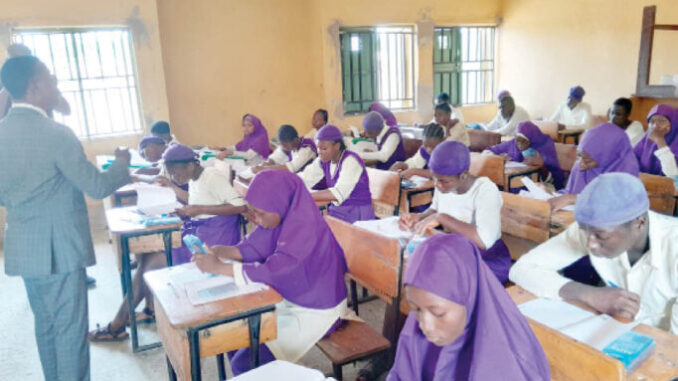
The Federal Government’s decision to prohibit under-18 candidates from taking the West African Senior School Certificate Examination and the National Examination Council has led to conflicting reactions from stakeholders.


The Minister of Education, Tahir Mamman, announced on Channels Television’s ‘Sunday Politics’ programme that the Federal Government had instituted a new age policy for secondary school leaving examinations, setting the minimum age at 18.
This means that underage candidates will no longer be able to take the West African Senior School Certificate Examination or the Senior School Certificate Examination, both of which are required for admission to tertiary education. 
The directive also affects the West African Examinations Council, which administers the WASSCE, and the National Examinations Council, which is responsible for the SSCE.
The minister said, “It is 18 (years). What we did at the meeting that we had with JAMB (in July) was to allow this year and for it to serve as a kind of notice for parents that this year, JAMB will admit students who are below that age, but from next year, JAMB is going to insist that anybody applying to go to university in Nigeria meets the required age, which is 18.”
While the Academic Staff Union of Universities (ASUU) supports the policy, the Nigeria Union of Teachers (NUT) and many other stakeholders have condemned it, claiming that the age ban is unrealistic and may lead to legal challenges.
The NUT said that changes in society, like early enrolment in crèches due to economic pressures, made it unrealistic to restrict learning based on age.
The NUT, through its Secretary-General, Mike Ene, argued that exceptional students who might be younger but academically advanced were not considered in the policy.
The union also pointed out that the policy may not be realistic, given the economic pressures that lead to early enrolment in crèches.
The NUT said, “The only way this policy could work is if it’s implemented from the foundation. By that, I mean starting at the primary school level. In the past, before a child was allowed to start school, they had to pass a basic test—like reaching their hand over their head to touch the opposite ear. If they couldn’t, they were sent back home.
“However, things have changed. Nowadays, due to economic pressures, parents enroll their children in crèches early, which means both parents have to work.
“Teachers at these crèches begin to educate the children, and they start learning quickly. You can’t stop them from learning because the brain is structured to keep developing—once learning stops, the brain stagnates.
“You also have to consider exceptional students. Some students are 16 years old in SS3. Is the minister taking these scenarios into account? What are these students supposed to do? Wait two more years? I see this as a policy that could lead to numerous legal challenges. The government needs to rethink this thoroughly. It is poorly conceived.”
The Academic Staff Union of Polytechnics (ASUP) National President, Shammah Kpanja, also said that the decision to allow students under the age of 18 to sit for exams should be based on their abilities, stating that gifted students may not need to spend the full school year.
The ASUP called on the government to focus on critical issues like providing functional equipment in schools, addressing infrastructure deficits, and improving teachers’ welfare, rather than on exam age restrictions.
The ASUP stated, “One issue with policy is that if it’s not realistic, it can lead to distorted information. The decision of whether a student should be 18 or younger to sit for exams should depend on the student’s abilities. Some students are exceptionally gifted and don’t need to spend all those years in school if they demonstrate a high level of intelligence.
“What we need is for the government to ensure that basic schools are equipped with functional facilities. In some villages around Abuja, you’ll find children sitting on the ground in schools, with many buildings lacking roofs. These are the real issues that need addressing. The welfare of teachers and the availability of functional libraries in most public secondary schools are also lacking. These should be the government’s targets—addressing infrastructure deficits instead of focusing on mundane matters.”
The polytechnic lecturer also questioned the government’s priorities, pointing out inconsistencies, such as allowing child marriages in the North while restricting younger students from taking WAEC.
“Did their children sit for WASSCE at 18 years? You allow young girls to marry at 12 in the North, but they can’t take WAEC at 16? What are the government’s priorities?”
On the other hand, ASUU supported the policy, stating that children should follow the standard academic progression: six years in primary school, six years in secondary school, and then move on to university at the age of 18.
The ASUU also questioned the rush to enter university, stating that adulthood begins at 18, and children should be allowed to rest and mature before entering university.
The ASUU National President, Emmanuel Osodeke, stated, “Why are we focusing on university at such a young age? How many years do you spend in the university? For most courses, it’s four years; for medicine, it’s five. We can’t reduce these durations.
“They should allow the system to function as intended and give their children time to rest. Adulthood begins at 18, so why force a child to go to university or rent an apartment at 15? We need to consider the well-being of these children.”