Connect with us

News

Constitution Review: Women Empowerment Necessary, Strategic For Economic Growth – Speaker Abbas

Published

on

ADVERTISEMENT
Zoom Ad
ADVERTISEMENT
Zoom Ad
…as First Lady say Nigerian women struggling to find their place in governance, politics
By Gloria Ikibah
The Speaker of the House of Representatives, Rep. Abbas Tajudeen, has said that the demand for increased representation of women is not a luxury but a necessity.
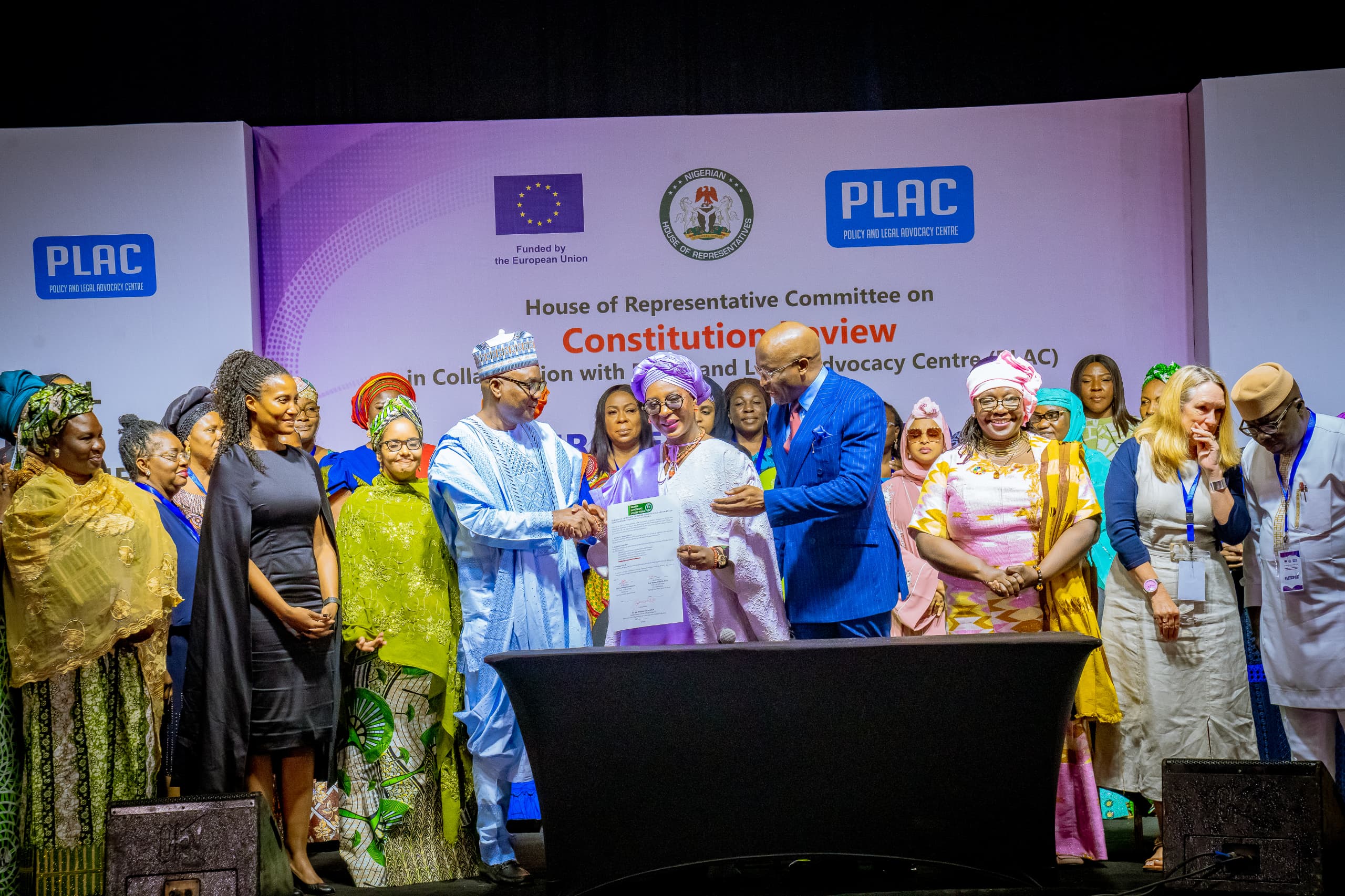
The Speaker stated this while giving his keynote address at the International Legislative Dialogue on Women and the Constitution Amendment Process in Nigeria, which was organised by the House Committee on Constitution Review with support from the Policy and Legal Advocacy Center (PLAC) and funded by the European Union in Abuja on Monday.
Abbas who urged everyone to dismantle institutional barriers, stressed the need to empower women, noting that it is a necessary, and strategic move for economic growth.
According to him, it is disheartening that females are low in numbers at the National Assembly, even as he noted that the dialogue was not for rhetoric but to establish a clear and actionable path toward meaningful reform.
He said: “Today represents a meaningful step forward in our collective commitment to inclusive governance and national progress.
“Our goal is to ensure that Nigerian women, an essential part of our nation’s social and economic fabric, secure their rightful place within our governance framework. Empowering women is not only a moral and democratic imperative but also a strategic economic necessity.”
The Speaker said that researches from global institutions, like the United Nations, World Economic Forum, reveals that organisations and countries benefit from better decision-making, stronger economic growth, and enhanced social well-being when women hold leadership roles.
“Women bring unique perspectives influencing vital issues, from healthcare to economic policy, creating legislation that resonates with millions. McKinsey estimates that closing gender gaps could add $12 trillion to the global GDP by 2025, underscoring the immense untapped potential of women’s inclusion. Thus, increased representation of women is not a luxury but a necessity for sustainable national development and stability.
“Around the world, and particularly in Africa, we see encouraging examples of gender inclusion. Rwanda, with over 60 percent women representation in its parliament, has shown us that robust, intentional policies work. South Africa, Namibia, and Senegal have all taken significant strides toward inclusivity, reshaping their political landscapes in ways Nigeria can learn from. These countries have demonstrated the profound impact of women’s perspectives on governance and development.
“For Nigeria, the current numbers are disheartening. Since 1999, women’s representation in our National Assembly has remained disappointingly low. Despite notable contributions from Nigerian women across various sectors, only 20 of the 469 seats in our National Assembly are occupied by women. This stark gap speaks not of a lack of capable women, but of institutional barriers we must dismantle.”
He emphasised that some see increased women’s representation as a threat to the status quo, and noted that “inclusion is not displacement—it is partnership.”
Abbas added that the presence of women complements the contributions of men, enriching the policymaking process.
“If we trust women to shape our homes, nurture our families, and educate our children, we must trust them to contribute to shaping our nation’s future,” he stressed.
He pointing out that affirmative action policies to increase women’s representation are not undemocratic, on the contrary are deeply aligned with democratic principles.
“As lawmakers, we are responsible for advancing policies that reflect the values of fairness and equity. I am proud to state that this 10th House has prioritised inclusivity in our Legislative Agenda. I have directed the Constitution Review Committee to focus on reforms that promote gender equity and provide additional or reserved seats for women in our legislative bodies.
“We must work towards joint ticketing in elections, reserved seats, and conferring equal citizenship rights to foreigners married to Nigerian women. However, reform is a collective responsibility, and we cannot simply issue communiqués or promises. We must translate today’s dialogue into real, actionable outcomes.”
Nigeria’s First Lady, Senator Oluremi Tinubu in her remarks decried that, Nigerian women are still battling to get their place in politics and governance as a result of sustained policies that put them at a disadvantage.
Senator Tinubu who was represented by First Lady of Kwara State, Prof. Olufolake Abdulrazaq, who is also the Chairperson, Nigeria Governors Spouses Forum, said, while some gains have been made, it was however  disheartening that, in the National Assembly only few women were elected into its two chambers.
She lamented that, while women contribute a lot in the electoral process, their participation is being curtailed as they are denied equal participation in governance and politics.
According to her, progress has been slow in having sustainable process that fast track women participation through robust, wider policies for the girl child and educated, intelligent and potential women leaders in the country.
The First Lady said, there are many things that Nigeria needs to work on especially some socio-cultural inhibitions limiting national growth through women exclusion.
She therefore noted that, there is need for more to gender responsive policies and legislations that will encourage women participation and affirmative initiatives.
Earlier in his opening remarks, Deputy Speaker and Chairman, House Committee on Constitution Amendment, Benjamin Kalu said that, as Nigeria confront the realities that restrict women’s political participation, it is essential to understand the scale and urgency of the issue.
He said, “Data from the recent 2023 general elections highlights the scope of this challenge: 18 political parties fielded a staggering 15,307 candidates.
“However, of these candidates, only 1,552 were women. This sharp contrast is not just a statistic; it is a stark reminder of the societal, structural, and political barriers that continue to inhibit women’s full participation in our democracy.
“Indeed, inclusive governance is not merely an equity issue; it is a strategic imperative. Countries that have successfully integrated women into decision-making roles experience gains in innovation, collaboration across sectors, and, notably, economic growth”.

Continue Reading
Advertisement
Click to comment

Warning: Undefined variable $user_ID in /home/naijuinz/public_html/wp-content/themes/zox-news/comments.php on line 49

You must be logged in to post a comment Login

Leave a Reply

News

Stone Age lost Atlantis about 8,500 years discovered beneath the waters of Denmark

Published

on

ADVERTISEMENT
Zoom Ad
ADVERTISEMENT
Zoom Ad

By Ojomah Austin.


The mystery of Atlantis has created a city-sized gap in our grasp of history, with archaeologists searching the oceans for any trace of this submerged civilisation.

A prominent theory suggests that Atlantis never actually existed. Nevertheless, as we’re now aware, the notion of a coastal settlement being consumed by the ocean is entirely plausible.

Advertisement

Subsequently, archaeologists in Europe believed they’d discovered the missing piece of the puzzle. You wouldn’t necessarily expect Denmark to be the maritime location of an exotic lost metropolis from ancient times, yet this is precisely where archaeologists unearthed the most compelling proof of Atlantis, according to Global News.

“Europe’s Atlantis”, stretching back to the Stone Age, was discovered beneath the waters of Denmark’s Bay of Aarhus. Researchers unearthed numerous artefacts that paint a picture of a civilised community that inhabited the area nearly 8,500 years ago.

These included stone implements, arrowheads, animal remains, and even fragments of timber that appeared to be rudimentary tools.

Researchers plunged 26 feet beneath the surface of Denmark’s second-largest city, employing specialised suction apparatus, to retrieve the remains of Europe’s Atlantis.

Advertisement

The location dates back to the conclusion of the last Ice Age, when climbing sea levels submerged entire coastal communities, forcing Stone Age hunter-gatherer societies inland.

Because the artefacts have remained underwater for millennia, they are significantly better preserved than they would be inland. “What we actually tried to find out here is how life was at a coastal settlement 8,500 years ago,” archaeologist Peter Moe said.

He added: “Here, we actually have an old coastline. We have a settlement that was positioned directly at the coastline. What we actually try to find out here is how was life at a coastal settlement.

“It’s like a time capsule. When sea level rose, everything was preserved in an oxygen-free environment … time just stops. We find completely well-preserved wood. We find hazelnut. … Everything is well preserved.

Advertisement

“We can say very precisely when these trees died at the coastlines,” Moesgaard Museum dendrochronologist Jonas Ogdal Jensen, according to Fortune.


The specialist explained how this remarkable find has shed considerable light on how sea levels have shifted throughout history.

Stone Age lost Atlantis found is Denmark

He said: “It’s hard to answer exactly what it meant to people,” Moe Astrup said. “But it clearly had a huge impact in the long run because it completely changed the landscape.”

Researchers are keen to press ahead with investigations at a further site off the German coastline, with ambitions to examine locations in the notoriously unforgiving North Sea also in the pipeline.

Advertisement

Yet this is not the first occasion archaeologists have drawn comparisons between a site and Atlantis. Doggerland was a landmass that once extended between Britain, Denmark, and the Netherlands, linking the corners of Europe.

In 1931, evidence of this lost territory began to emerge after a Dutch fishing vessel retrieved artefacts from the seabed. A portrait of a hunter-gatherer community thousands of years old began to take shape. Yet, some 8,200 years ago, rising sea levels and a catastrophic tsunami ultimately swallowed this civilisation whole.

A colossal underwater landslide set off a chain of unstoppable natural disasters that plunged the landmass beneath the waves. Today, all that remains of this lost world lies buried under the North Sea.

Advertisement
Continue Reading

News

Amnesty International condemns attack on Abuja protesters as Sowore lands in hospital

Published

on

ADVERTISEMENT
Zoom Ad
ADVERTISEMENT
Zoom Ad

By Kayode Sanni-Arewa

Condemns his alleged “deliberate targeting”

Amnesty International has condemned what it described as a “reckless attack on peaceful protesters” during a Democracy Day demonstration in Abuja, where activist and African Action Congress 2027 presidential candidate, Omoyele Sowore, reportedly collapsed after security operatives allegedly fired teargas.

In a statement released on Friday, the rights organisation said Sowore was “subsequently taken to a hospital” following the incident at Unity Fountain, Abuja, and called for an immediate investigation into what it described as his “deliberate targeting.”

Advertisement

The Nigerian authorities are clearly using violence to crack down on human rights, including the rights to freedom of expression and peaceful assembly,” the statement said.

Amnesty International also warned that targeting activists for participating in peaceful demonstrations amounted to unlawful conduct and a breach of fundamental rights.

“Such targeting of activists solely for exercising freedom of assembly is unlawful and shows utter disregard for the rule of law,” it said.

The organisation further accused the authorities of failing to demonstrate commitment to constitutional and international human rights obligations, alleging a continued crackdown on civic freedoms under President Bola Tinubu’s administration.

Advertisement

Sowore’s collapse reportedly occurred during a protest in Abuja where security operatives allegedly dispersed demonstrators with teargas in front of the Force Headquarters.

Videos shared online showed him on the ground amid confusion as protesters attempted to assist him.

The protest was part of a nationwide mobilisation by a coalition of civic groups, labour activists, youth organisations and social movements, which had declared June 12 a day of mass action over insecurity, economic hardship and worsening living conditions. (Text, excluding headline:

(The PUNCH)

Advertisement
Continue Reading

News

Falana, Falz lead protest over kidnappings, hardship

Published

on

ADVERTISEMENT
Zoom Ad
ADVERTISEMENT
Zoom Ad

By Kayode Sanni-Arewa

Activist lawyer, Mr Femi Falana (SAN), his son – afrobeats singer, Mr Folarin Falana, popularly known as Falz, alongside civil society organisations, youth groups, among others, on Friday staged a protest in Lagos.

They demanded urgent action to address worsening insecurity and economic hardship in the country.

The protest came as Nigeria marked Democracy Day, set aside in remembrance of the June 12, 1993 presidential election, widely acclaimed to have been won by late Chief MKO Abiola.

Advertisement

The election, though regarded as the freest and fairest in the nation’s history, was annuled by the then military government.

Chanting, the protesters converged on the Ikeja Under Bridge, carrying placards with inscriptions such as “No Democracy Without Security,” End Bad Governance,” and “End Insecurity and Kidnapping.”

Others include, “End Hunger,” “Free All Captives Now,”End all anti-people policies now,”

The demonstration was aimed at drawing attention to rising insecurity, economic hardship and policies affecting ordinary Nigerians.

Advertisement

Speaking during the protest, Falana called for the immediate release of abducted pupils and teachers in Oyo State, expressing concern over their welfare in captivity.

According to him, the protest is not only about demanding the rescue of the abducted victims but also about highlighting broader issues of injustice, insecurity and poverty confronting Nigerians.

“We are protesting the kidnapping of our children in Oyo State. We are also protesting injustice in our country, a situation whereby innocent school children in Oyo and Borno states have been in the custody of criminals for several weeks now.

“We are also protesting injustice meted out to young people who are regularly arrested on the highways by the police.

Advertisement

“We are protesting hunger and poverty in the land, and we are calling on the government to address these challenges,” he said.

Falana, a human rights advocate, lamented the condition of the abducted children and teachers, and regretted the killing of one of the latter.

He called on the authorities to intensify efforts to secure the release of the remaining victims.

Also addressing the protesters, Falz bemoaned what he described as worsening insecurity and economic hardship across the country.

Advertisement

The entertainer and activist said Nigeria was grappling with increasing cases of kidnappings and killings, urging the government to do more in its responsibility of protecting the citizens.

“Everybody can see the worsening insecurity. It is becoming unbearable,” he said.

Falz cited recent abductions in different parts of the country, including the kidnapping of students and the abduction of a relative of a former minister in Oyo State.

“Every Nigerian life matters and must be protected at all costs,” he stated.

Advertisement

He said that the repeated abduction of students had heightened public frustration and anxiety.

Also speaking, human rights activist, Mr Olumide Ogunsanwo, popularly known as Seaking, called for stronger government action to tackle insecurity across the country.

He said Nigerians were demanding better governance and an end to the growing wave of killings, kidnappings and other violent crimes.

“We say no to insecurity. Insecurity has to end,” he said.

Advertisement

Ogunsanwo urged the Federal Government to intensify efforts against bandits, insisting that decisive action, rather than rhetoric, was needed to end the insecurity.

Security operatives maintained presence around the protest venue and monitored activities throughout the demonstration.

(NAN)

Advertisement
Continue Reading

Trending

Copyright © 2024 Naija Blitz News