News
Our collective resolve tested by ongoing Poverty, unemployment – Northern governors
- /home/naijuinz/public_html/wp-content/plugins/mvp-social-buttons/mvp-social-buttons.php on line 27
https://naijablitznews.com/wp-content/uploads/2024/10/images-2024-10-28T195446.436-1.jpeg&description=Our collective resolve tested by ongoing Poverty, unemployment – Northern governors', 'pinterestShare', 'width=750,height=350'); return false;" title="Pin This Post">
- Share
- Tweet /home/naijuinz/public_html/wp-content/plugins/mvp-social-buttons/mvp-social-buttons.php on line 72
https://naijablitznews.com/wp-content/uploads/2024/10/images-2024-10-28T195446.436-1.jpeg&description=Our collective resolve tested by ongoing Poverty, unemployment – Northern governors', 'pinterestShare', 'width=750,height=350'); return false;" title="Pin This Post">
By Francesca Hangeior

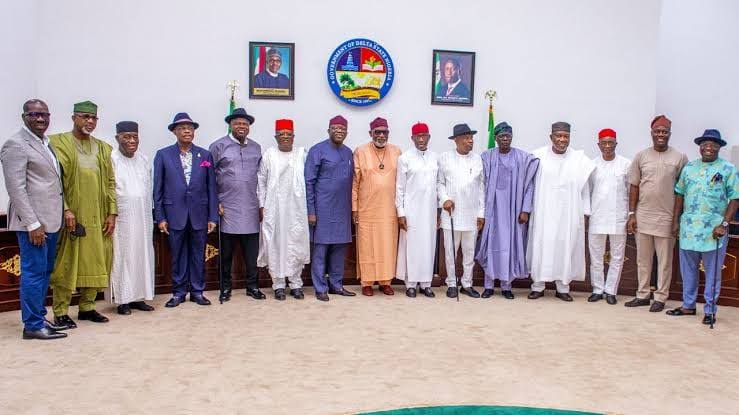
The 19 Northern Governors, traditional rulers from the North led by the Sultan of Sokoto and other critical stakeholders have converged on the Sir Kashim Ibrahim House Kaduna on Monday, to deliberate on issues affecting the region.
Speaking at the opening ceremony of the meeting which had in attendance the Chief of Defence Staff, General Christopher Gwabin Musa and other military officers, Governor Muhammadu Inuwa Yahaya of Gombe State and Chairman Northern States Governors’ Forum ( NSGF), said their collective resolve was being tested by the ongoing challenges faced by the Northern region.

According to the Governor, ” It is with a deep sense of responsibility that I address this combined meeting of the Northern States Governors’ Forum and the Northern Traditional Rulers Council. This gathering represents the two supreme institutions charged with the political and moral responsibility to transform the social and economic landscape of northern Nigeria.”
“Let me begin by extending our deepest sympathies to the victims of the recent flood disasters in Maiduguri and other parts of the North, as well as to the families affected by the tragic tanker explosion in Jigawa State. I equally commiserate with other victims of terrorism, banditry and other criminal activities in the North and Nigeria at large. We stand in solidarity with them during these difficult times. We must continue to work with the Federal Government and relevant agencies to provide the necessary support and relief to those affected.”
“As we gather today, our collective resolve is being tested by the ongoing challenges that we face. These include but are not limited to terrorism, banditry, kidnap-for-ransom, farmer-herder clashes, drug abuse, the menace of Almajiri and out-of-school children, poverty and unemployment. However, our unity and commitment to the prosperity of the people remain our greatest source of strength that will enable us to overcome those challenges.”
“While security remains a top priority for the region, we must acknowledge the recent gains made against criminals, especially the elimination of bandits and terror leaders. However, we cannot afford complacency. We must sustain these gains to ensure lasting peace and stability. We recently received the report of the Coalition of Northern Group’s Security Committee, and we are going to carefully study and implement their recommendations. Our engagements with security agencies and civil society groups must continue to chart a sustainable path for peace and stability in northern Nigeria.”
“The recent “End Bad Governance” protests that took place in August serve as a wake-up call for all northern leaders. Youth restiveness is a growing concern, driven by illiteracy, poverty, and lack of economic opportunities. Our young people are calling out for change, and it is our responsibility to listen and act. We must scale up efforts to tackle the root causes of youth restiveness by investing in education, skills development, and job creation. Let us focus on creating pathways for the youth to channel their energy into productive ventures, thereby reducing their vulnerability to crime and social vices.”
“The economic hardship faced by many Nigerians today is undeniable, and considering the North-South disparity in economic inequality, it is even more pronounced in northern Nigeria. This calls for urgent intervention. It is essential that we, as leaders, adopt measures to alleviate the suffering, such as targeted social welfare programs, support for small and medium enterprises, and policies that attract investment to our states. At the same time, we must work with the Federal Government to ensure that fiscal policies are sensitive to the realities of the day.
As we speak today, most of our Northern states are in darkness due to the vandalization of electricity transmission infrastructure. This not only underscores the vulnerability of critical infrastructure but also the need to build additional transmission lines and diversify our energy supply so as to better connect our region and improve our energy resilience.”
“Northern Nigeria holds immense agricultural potential, which, if fully harnessed, can significantly alleviate hunger and boost economic growth. To achieve this, we must provide adequate support to our farmers, including access to financing, modern farming techniques, and infrastructure such as roads and irrigation systems. Furthermore, ensuring the security of rural areas is crucial so that farmers can return to their fields without fear. Agriculture should not only be seen as a means to feed our people but also as a catalyst for industrialization and job creation across the region.
That can be achieved through re-industrialisation of the North, especially by reviving the textile value chain and development of other agro-allied industries.”
“On the environment, the recent flood incidents in many parts of the North serve as a sobering reminder of the urgent need to implement effective mitigation measures. We must adopt policies that promote environmental conservation, sustainable agricultural practices, and responsible resource management. Moreover, the deterioration of our environment exacerbates communal conflicts, particularly between farmers and herders, further threatening the stability of our communities.
‘’Addressing this issue holistically is crucial to not only preserving our natural resources but also ensuring social harmony. To achieve this, we must partner with the Federal Government and other stakeholders to build irrigation infrastructure like canals and waterways to divert excess water and channel them towards irrigation activities, thus enhancing rural livelihoods and safeguarding food security.”

News
Ooni welcomes baby girl with Olori Oluwatosin
The Ooni of Ife, Oba Adeyeye Enitan Ogunwusi, has welcomed the birth of a baby girl with his wife, Olori Oluwatosin Ogunwusi.
This is contained in a statement on Sunday in Ile-Ife by the Ooni’s Senior Media Officer, Mr Sodiq Lawal, on behalf of the Director of Media and Public Affairs, Mr Moses Olafare.
Olafere expressed gratitude to God for the safe delivery, describing the newborn as a divine blessing to the House of Oduduwa.
According to him, the Ooni thanked Almighty Olodumare for His grace and faithfulness, which made the successful delivery possible.
“The Royal Father prayed that the newborn princess will grow in wisdom, grace, honour and divine favour throughout her lifetime.”
He added that both Olori Oluwatosin and the baby princess were in excellent health.
He quoted the Ooni as further praying for God’s continued protection over the royal family and for enduring peace, prosperity and abundant grace for the House of Oduduwa.
The Ooni wished the newborn princess a purposeful, honourable and fulfilled life under God’s guidance.
News
10th Senate processed over 1,000 bills in three years – Plang
Chairman of the Senate Committee on Labour, Employment and Productivity, Diket Plang, has said the 10th Senate has processed more than 1,000 bills in its first three years in office, with over 200 already signed into law by President Bola Tinubu.
Plang, who represents Plateau Central Senatorial District, said the upper chamber had also adopted several resolutions through motions and carried out extensive oversight of Ministries, Departments and Agencies (MDAs), describing the period as one of the most productive in Nigeria’s legislative history.
Speaking in an interview to mark the third anniversary of the 10th Senate, the lawmaker said the chamber’s committee system had also enabled lawmakers to closely monitor government performance and budget implementation.
“At the moment, the Senate has had over 1,000 bills. About 900 have passed either second or third reading, and we have over 200 bills that have been signed into law,” he said.
“So, for me, there is a lot of achievement in terms of making laws. We have had very important motions with beautiful resolutions and sufficient oversight functions as far as the first three years of the Senate are concerned.”
“Each of the ministries, departments and agencies brings its proposals during budget defence, and you go back to find out what has been achieved and what has not been achieved. It helps us know what government has been able to do,” he said.
On the recently passed State Police Bill, Plang commended President Bola Tinubu for supporting what he described as one of Nigeria’s most difficult but necessary constitutional reforms.
He argued that creating state police would strengthen intelligence gathering because officers recruited from local communities understand the language, culture and terrain better than officers deployed from other parts of the country.
“The locals know the language, they know the terrain, they know the culture of where they are policing. Information gathering and rapid response to criminality will improve significantly,” he said.
The senator also dismissed fears that governors would abuse state police, insisting that constitutional safeguards and oversight by the National Police Council, National Assembly and State Houses of Assembly would prevent excesses.
“No governor will employ people from his community and ask them to oppress their own people. There are oversight mechanisms that will check abuse,” he said.
He explained that although the bill had passed both chambers of the National Assembly, it still requires approval by at least 24 State Houses of Assembly before it can be transmitted to the President for assent as part of the constitutional amendment process.
Plang added that the reform would improve Nigeria’s police-to-population ratio through fresh recruitment across the states while creating employment opportunities for thousands of young Nigerians.
Commenting on the recent xenophobic attacks against Nigerians in South Africa, Plang urged both governments to pursue diplomacy rather than retaliation.
He said, “It is unfortunate that brothers are turning against one another. There should be immediate engagement between the Nigerian and South African governments. Rather than retaliation, both countries should sit down and resolve these issues as brothers.”
News
Tinubu’s Remarks On Flyovers Not Directed At Oborevwori – Waive
Member representing Ughelli North, Ughelli South and Udu Federal Constituency in the House of Representatives, Rt. Hon. (Revd.) Francis Ejiroghene Waive, has said President Bola Tinubu’s recent remarks cautioning state governments against constructing unnecessary flyovers were not directed at Delta State Governor, Rt. Hon. Sheriff Oborevwori.
Waive, in a statement, argued that the flyovers completed and those under construction in Delta State were necessitated by persistent traffic congestion in their respective locations, adding that the projects were undertaken after due consideration of the state’s infrastructure needs.
According to him, the Federal Government had, on several occasions, acknowledged Delta State’s strides in road infrastructure and flyover construction, alongside other developmental achievements, before similar projects gained momentum in other states.
He maintained that Governor Oborevwori had pursued infrastructure development without neglecting key sectors of the state’s economy, insisting that the administration had continued to invest in roads, bridges, healthcare, education and social welfare programmes.
“The flyovers constructed and those currently under construction by Governor Sheriff Oborevwori are absolutely necessary. Deltans can testify that they are all located in areas where severe traffic gridlock is a regular occurrence,” Waive said.
The lawmaker dismissed criticisms of the projects by opposition figures, describing them as politically motivated and disconnected from the realities on the ground.
He expressed confidence that the governor’s performance would earn him another term in office, saying residents of the state remained committed to the continuation of the administration’s M.O.R.E. Agenda in synergy with President Tinubu’s Renewed Hope Agenda.
Waive urged Governor Oborevwori to sustain the pace of infrastructure development through the construction of more roads, bridges and flyovers, while expanding social investment programmes aimed at improving the welfare of the people.
He also congratulated the governor in advance on what he described as his expected victory in the 2027 governorship election, expressing optimism that the administration would continue to deliver democratic dividends across the state.
-
News17 hours agoTroops rescue 34 abductees, nab ISWAP informant, recover arms
-
News17 hours agoJoint military task force rescue kidnapped Lt Col, civilian after 10-day search operation
-
News22 hours agoPhotos: NDLEA nabs notorious drug dealer in Rivers Island, bandits’ supplier in Zamfara
-
Crime22 hours agoHappening now: Bandits storm Kwara community, kill woman, kidnap resident, villagers flee
-
Metro6 hours agoGunmen abduct Catholic seminarian, six others in Enugu
-
News6 hours agoState Police: Sharia council warns FG against rushed constitutional amendment
-
Opinion19 hours agoWhy continuity in the National Assembly leadership could benefit Nigeria
-
News18 hours agoJUST IN: Fire engulfs Lagos airport’s Terminal 2

Warning: Undefined variable $user_ID in /home/naijuinz/public_html/wp-content/themes/zox-news/comments.php on line 49
You must be logged in to post a comment Login