Connect with us

Foreign

Rwanda-backed rebels seize towns in Congo

Published

on

ADVERTISEMENT
Zoom Ad
ADVERTISEMENT
Zoom Ad

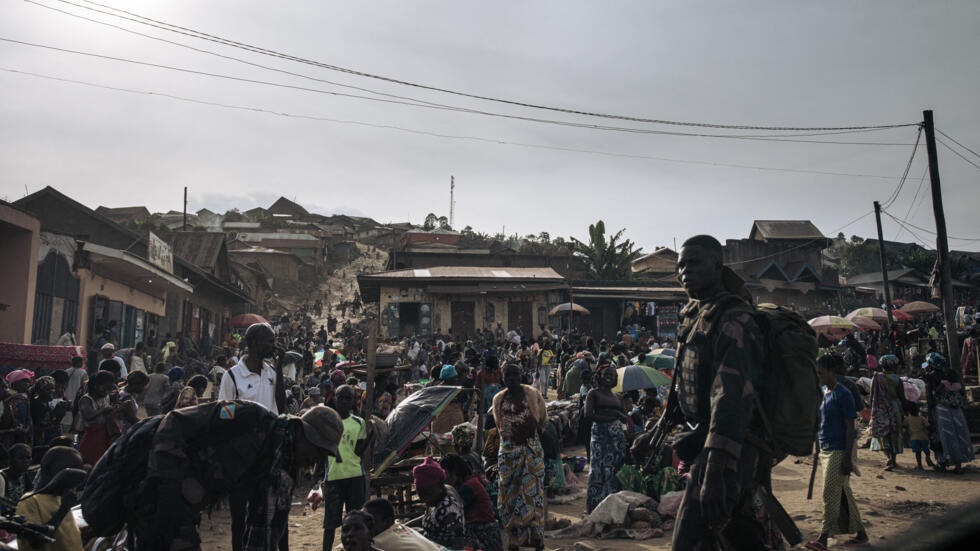
Rebel forces backed by Rwanda have captured the town of Masisi in the east of the Democratic Republic of Congo, according to various reports.


This is the second town seized by the M23 group in as many days in the mineral-rich North Kivu province.

The group has taken control of vast swathes of eastern DR Congo since 2021, forcing hundreds of thousands of people to flee their homes.

Angola has been attempting to mediate talks between President Félix Tshisekedi and his Rwandan counterpart, Paul Kagame. But these broke down last month.

Advertisement

“It is with dismay that we learn of the capture of Masisi centre by the M23,” Alexis Bahunga, a member of North Kivu provincial assembly, told the AFP news agency.

He said this “plunges the territory into a serious humanitarian crisis” and urged the government to strengthen the capacity of the army in the region.

One resident told AFP that the M23 had held a meeting of the town’s inhabitants, saying they had “come to liberate the country”.

The Congolese authorities have not yet commented on the loss of the town.

Advertisement

Masisi, which has a population of about 40,000, is the capital of the territory of the same name.

It is about 80km (50 miles) north of the North Kivu provincial capital Goma, which the M23 briefly occupied in 2012.

On Friday, the M23 captured the nearby town of Katale.

Last year, there were fears that the M23 would once again march on Goma, a city of about two million people.

Advertisement

However, there was then a lull in fighting until early December when fighting resumed.

In July, Rwanda did not deny a UN report saying it had about 4,000 soldiers fighting alongside the M23 in DR Congo.

It accused the Congolese government of not doing enough to tackle decades of conflict in the east of the country. Rwanda has previously said the authorities in DR Congo were working with some of those responsible for the 1994 Rwandan genocide against ethnic Tutsis and moderate Hutus.

The M23, formed as an offshoot of another rebel group, began operating in 2012 ostensibly to protect the Tutsi population in the east of DR Congo which had long complained of persecution and discrimination.

Advertisement

However, Rwanda’s critics accuse it of using the M23 to loot eastern DR Congo’s minerals such as gold, cobalt and tantalum, which are used to make mobile phones and batteries for electric cars.

Last month, DR Congo said it was suing Apple over the use of such “blood minerals”, prompting the tech giant to say it had stopped getting supplies from both countries.
Foreign

Trump Says Iran Agrees To Hand Over Nuclear Dust Amid Strait of Hormuz Blockade

Published

on

By

ADVERTISEMENT
Zoom Ad
ADVERTISEMENT
Zoom Ad

United States President Donald Trump has claimed that Iran has agreed to hand over its remaining stockpile of enriched uranium and abandon ambitions for a nuclear weapon, describing negotiations as being on the verge of a major breakthrough.

Speaking to reporters at the White House on Thursday before departing for Las Vegas, Trump said: “We’re very close to making a deal with Iran. We had to make sure that Iran never gets a nuclear weapon… They’ve totally agreed to that. They’ve agreed to almost everything.”

He added that Iran had consented to return its enriched uranium, which he has repeatedly called “nuclear dust”, material believed to be buried deep underground following earlier U.S. and Israeli strikes on Iranian nuclear facilities.

“They’ve agreed to give us back the nuclear dust,” Trump stated. He also suggested that the next round of talks could take place over the weekend and expressed uncertainty about whether the current fragile ceasefire would need extension.

Advertisement

The comments come amid efforts to end six weeks of conflict in the Middle East that has disrupted global energy supplies and raised fears over the Strait of Hormuz, a vital chokepoint for oil exports.

However, Iran has not publicly confirmed Trump’s assertions. Multiple reports indicate that Tehran has previously pushed back against similar claims, describing them as exaggerated.

Recent direct talks in Islamabad on April 11-12 collapsed without agreement, with core disputes remaining over the future of uranium enrichment inside Iran and the removal of existing stockpiles.

The White House has been discussing a possible second round of negotiations in Pakistan, with officials expressing optimism.

Advertisement

A U.S. naval blockade of Iranian ports remains in place, adding pressure on Tehran.

Analysts caution that any final deal would require strict verification mechanisms, especially given the deeply buried nature of the material in question.

For Nigeria and other oil-producing nations, progress toward de-escalation could help stabilise crude prices, which have spiked due to fears of prolonged disruption in the Strait of Hormuz.

A lasting agreement might also open the door for sanctions relief on Iran, potentially shifting global energy dynamics.

Advertisement

Trump has maintained that preventing Iran from acquiring nuclear weapons is a non-negotiable red line, while offering the prospect of broader regional stability in return for Iranian concessions.

No immediate reaction from Iranian officials was available as of press time. Further developments are expected in the coming days as diplomatic channels continue.

Continue Reading

Foreign

Second Tragedy in Two Days: Student Gunman Kills Four at Middle School

Published

on

By

ADVERTISEMENT
Zoom Ad
ADVERTISEMENT
Zoom Ad

A devastating shooting at a middle school in southeastern Turkey on Wednesday has left at least four people dead and 20 others wounded. The incident, which occurred in the province of Kahramanmaras, marks a harrowing second day of educational violence in the region, an anomaly in a country where school shootings are exceedingly rare.

The local governor, Mukerrem Unluer, confirmed to reporters that the fatalities included three pupils and one teacher. The perpetrator, identified as an eighth-grade student at the school, also died during the attack.

According to Governor Unluer, the assailant, typically aged 13 or 14 arrived at the institution concealing an arsenal within his backpack. The weapons, which authorities believe belonged to his father, a retired police officer, included five firearms and seven ammunition magazines.

“An eighth-grade student entered two classrooms occupied by fifth-grade students and opened fire indiscriminately,” Governor Unluer stated. The victims in the fifth grade are generally between the ages of 10 and 11.

Advertisement

The Governor further disclosed that four of the wounded are currently in critical condition and are undergoing emergency surgery.

Television footage from the site depicted a harrowing scene as police cordoned off the school gates while frantic crowds gathered nearby. Ambulances were seen transporting at least two victims from the premises as emergency services worked to stabilise the survivors.

The Justice Minister, Akin Gurlek, announced via the social media platform X that a formal investigation has been launched into the circumstances surrounding the massacre. Authorities are expected to scrutinise how the minor gained access to his father’s service weapons.

This tragedy follows a similar incident on Tuesday in the neighbouring province of Sanliurfa, where a former student opened fire at a school, wounding 16 individuals including staff and pupils before taking his own life.

Advertisement

The back-to-back attacks have sent shockwaves through the Turkish nation, prompting urgent discussions regarding firearm security and the safety of academic environments.

Continue Reading

Foreign

Magyar slams Orbán for shunning Hungarians, calls Russia ‘security risk’

Published

on

By

ADVERTISEMENT
Zoom Ad
ADVERTISEMENT
Zoom Ad

Prime Minister of Hungary Péter Magyar on Monday scolded Viktor Orbán for not paying attention to the problems affecting Hungarians while focusing on issues in other countries.

In a speech after the electoral victory, Magyar assured his administration would refrain from interfering in the domestic affairs of other nations, urging foreign governments to do the same.

The prime minister noted that Orbán played a five-dimensional chess game, saying the attitude was probably one of the reasons for his defeat at the polls.

According to Magyar, his predecessor often talked about Ukraine, Russia, Iran, the Iranian Shah, the Iranian Ayatollah, and the United States presidential election.

Advertisement

“If he had been woken from his sleep, he would have said that he won the US presidential election, not Donald Trump,” the PM mocked.

Magyar criticized the Kremlin and advised Europe to prepare to protect itself. “The Russian state is a security risk,” he declared, recalling Hungary “felt the Russian bear before.”

The leader vowed his government will do “everything for diversification” of Hungary and Russia, but clarified that Budapest will not “decouple” relations with Moscow.

The PM, however, expressed opposition to Ukraine’s accelerated accession to the EU: “It is absolutely absurd for a country at war to be admitted to the European Union.”

Advertisement

Magyar also said he will not initiate a phone conversation with President Donald Trump and President Vladimir Putin but will respond if the leaders or their officials reach out.

Russian Foreign Minister Sergey Lavrov on Monday declined a detailed response to Magyar’s comment that he will not engage in negotiations with Russia

“We are ready to build relations with the new government,” the diplomat told reporters. “Much will depend on how it defines and pursues its national interests.”

Advertisement
Continue Reading

Trending

Copyright © 2024 Naija Blitz News