Connect with us

News

Tinubu Exhausted N9.74bn Supplying Rice, Beans Palliatives To Nigerians In 2024 – Report

Published

on

ADVERTISEMENT
Zoom Ad
ADVERTISEMENT
Zoom Ad

By Kayode Sanni-Arewa

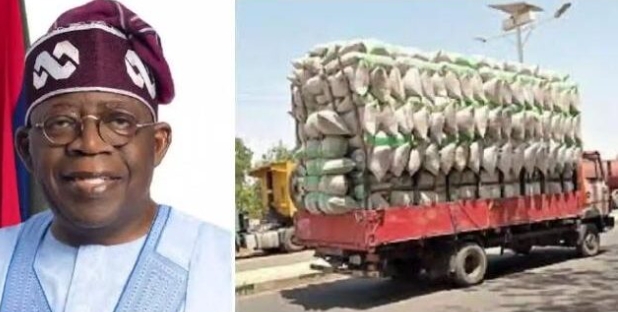
The President Bola Tinubu-led Nigerian government reportedly spent a total of N9.74billion for the procurement and distribution of food items as part of its efforts to mitigate the nationwide food crisis in 2024.

This was revealed by BudgIT on its platform, GovSpend, a civic-tech organisation advocating for transparency and accountability.

According to the report, a large portion of the funds was dedicated to supplying essential food staples such as rice, beans, maize, and other commodities.

Advertisement

The report showed that the Federal Ministry of Agriculture and Food Security led the initiatives, making multiple payments to contractors responsible for the emergency supply of palliative foodstuffs to various federal constituencies.

Key transactions included payments for the delivery of rice, beans, and garri to help alleviate hunger in vulnerable communities.
Payments, averaging around N85.45 million per constituency, were made between February and November 2024 across different regions.

Data from the platform reportedly indicate that N85,454,545.46 was spent on each constituency in states including Kano, Ogun, Osun, Akwa Ibom, Cross River, Adamawa, Kaduna, Jigawa, Ekiti, Oyo, Lagos, Bauchi, Rivers, Borno, Sokoto, and Enugu, bringing the total expenditure to N9.74 billion.

However, despite the significant financial outlay, there are concerns about the programme’s effectiveness in addressing the root causes of food insecurity.

Advertisement

Shedrach Israel, an economist at Lotus Beta Analytics, argued that food palliatives alone cannot solve Nigeria’s food crisis, according to PUNCH.

“While food palliatives are essential for addressing immediate hunger, they fail to address the underlying systemic issues, such as inflation and the deficiencies in the agricultural sector,” Israel said.

Israel added, “We need long-term economic policies focused on boosting local agricultural productivity and improving distribution networks to reduce dependence on external food aid.”
Israel further said that the N9.74 billion spent on palliatives could have been better invested in agricultural innovation and infrastructure development, which would provide sustainable solutions to food insecurity.
Also, La’ah Dauda, an agricultural economist based in Kaduna, emphasised the need for a more comprehensive approach to addressing the food crisis.

“The government’s reliance on palliatives is a short-term fix to a deeper agricultural crisis. While necessary, these measures do not tackle critical issues like inadequate irrigation, poor storage facilities, and limited market access, all of which continue to impede agricultural productivity across the country,” he said.

Advertisement

News

Iran Seizes Two Ships attempting to cross Strait of Hormuz

Published

on

ADVERTISEMENT
Zoom Ad
ADVERTISEMENT
Zoom Ad

Iran’s Revolutionary Guards said on Wednesday that their naval forces stopped two ships attempting to cross the Strait of Hormuz and directed them to the territorial waters of the Islamic Republic.

“The Islamic Revolutionary Guard Corps naval force this morning identified and stopped in the Strait of Hormuz two violating ships,” the Guards said in a statement.

“The two offending ships… were seized by the IRGC’s naval forces and directed to the Iranian coast.”

They identified one ship as “MSC-FRANCESCA”, which they said belonged “to the Zionist regime” in reference to Israel, and the other as “EPAMINONDAS”, which they said was “tampering with navigation systems and jeopardising maritime security.”

Advertisement

The Guards further warned against any action against the regulations imposed by the Islamic republic in the strait “as well as activities contrary to the safe passage” through the waterway.

Tehran has said vessels must seek permission to leave of enter the Gulf through Hormuz, through a route that in peacetime accounts for a fifth of the world’s oil and gas exports along with other vital commodities.

Source: AFP

Advertisement
Continue Reading

News

Gumi wants Nigerian government to consider dialogue in tackling terrorism

Published

on

ADVERTISEMENT
Zoom Ad
ADVERTISEMENT
Zoom Ad

Islamic cleric Sheikh Ahmad Gumi has advised the Nigerian government to rethink its stance on refusing to negotiate with terrorists, saying dialogue may be key to ending the country’s long-running violence.

In a Facebook post on Wednesday, the Kaduna-based cleric argued that Nigeria is being influenced by a “Western slogan” that does not always reflect reality.

He stressed that talks, rather than force alone, could help break the cycle of attacks affecting many parts of the country.

Gumi also warned that weak border control is worsening insecurity, allowing weapons and criminal elements to move freely.

Advertisement

According to him, this has made it more difficult to defeat terrorism and protect citizens.

He pointed to ongoing tensions involving the United States and Iran, saying even powerful nations engage in negotiations despite public positions against it. He urged Nigeria to draw lessons from such situations.

He said: “We should not be misled by the Western slogan, ‘We don’t negotiate with terrorists.’”

Gumi added that violence often leads to more suffering for civilians, as both terrorist attacks and military operations tend to harm innocent people.

Advertisement

He further explained: “As long as Nigeria’s borders remain porous, the cycle of violence will persist.”

The cleric emphasised that understanding the root causes of terrorism is crucial to finding lasting solutions, warning that force alone cannot resolve the crisis.

In his words: “The lesson is clear: lasting solutions require realism, dialogue, and strategic understanding, not just force.”

Gumi suggested that Nigeria may need a neutral mediator to help open dialogue and reduce tensions, similar to efforts seen in other conflict zones.

Advertisement
Continue Reading

News

Kano Gov nominates Garo as deputy

Published

on

ADVERTISEMENT
Zoom Ad
ADVERTISEMENT
Zoom Ad

Governor of Kano State, Abba Yusuf, has nominated and forwarded Murtala Garo to the State House of Assembly for screening and confirmation as the new deputy governor of the State.

This is contained in a statement by the Chief Press Secretary to the governor, Mustapha Muhammad, late Tuesday night.

According to the statement: “The nomination is in line with Section 191(3) of the 1999 Constitution (as amended), which empowers the Governor to nominate a Deputy Governor where a vacancy exists.”

Recall that the position of the deputy governor became vacant after the resignation of Abdussalam Gwarzo on March 27, 2026.

Advertisement

“Following wide consultations with key stakeholders, the Governor has requested the Assembly to grant the necessary approval for Garo’s nomination,” the statement added.

Continue Reading

Trending

Copyright © 2024 Naija Blitz News