


Connect with us

News

Reps Advance Tax Reform Bills Amid Unanimous Support

Published

on

ADVERTISEMENT
Zoom Ad
ADVERTISEMENT
Zoom Ad

…as legislators overcome initial opposition to move key revenue laws forward

…back tax reforms, call for clarity on key provisions

…weigh concerns over VAT, multiple taxation, Economic Impact

 
By Gloria Ikibah
 

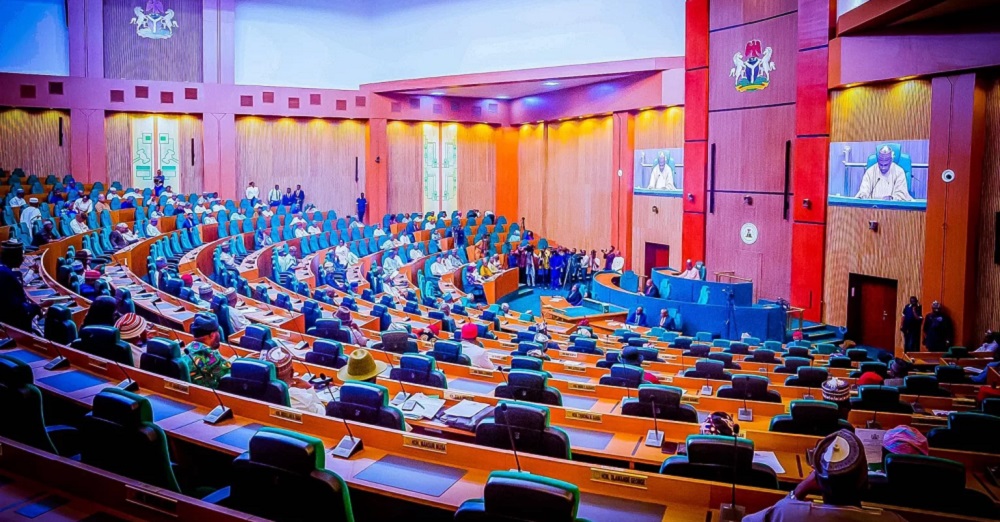
The House of Representatives on Wednesday passed through second reading the four tax reform bills submitted by the President, with no opposition from lawmakers.

The proposed laws include the Nigeria Revenue Service (Establishment) Bill, the Nigeria Tax Bill, the Nigeria Tax Administration Bill, and the Joint Revenue Board (Establishment) Bill.

Originally introduced on October 8, 2024, deliberations on the bills were delayed due to concerns raised by northern leaders and the Nigerian Governors Forum, particularly over the Nigeria Tax Administration Bill, but Speaker Tajudeen Abbas had urged members to consult widely with their constituents before debating the proposals.

Naijablitznews.com reports that ahead of plenary on Wednesday, the four bills were merged into a single document for debate. Despite highlighting potential conflicts with certain constitutional provisions and a few contentious clauses, lawmakers overwhelmingly supported moving the bills forward.

Advertisement

House Minority Leader, Rep. Kingsley Chinda (PDP Rivers, representing minority voices, acknowledged broad support for the reforms but pointed out concerns regarding specific provisions. He emphasized that while the bills aim to restructure the tax system for better revenue generation, the interpretation of certain provisions requires careful review.

He said: “we have all agreed that the spirit behind the four bills is good. But we have issues with some of the letters of the bills. Why we oppose some letters of the bills, we support the spirit and want to assure Nigerians that we will watch those letters and at the appropriate time, we will ensure that the letters are corrected in the interest of Nigerians”.

The House of Representatives, on Wednesday, continued deliberations on the tax reform bills, with lawmakers expressing mixed reactions to various provisions, including proposed changes to Value Added Tax (VAT) and streamlining of multiple taxes.

Leade of the House, Rep. Julius Ihonvbere commended the President for initiating the reforms, and stated that the bills aim to modernize Nigeria’s tax system, eliminate multiple taxation, enhance revenue collection, and boost economic diversification. He acknowledged opposition to the bills but noted that differing perspectives had strengthened the final proposals.

Ihonvbere highlighted key benefits, including incentives for small businesses, improved revenue generation, and the reduction of tax burdens on low-income earners. He revealed that the reform would consolidate over 60 different taxes into just nine, ensuring quicker resolution of tax disputes within 14 days.

Advertisement

Minority Whip, Rep. Ali Isa (PDP, Gombe) raised concerns over Clause 146 of the Nigeria Tax Bill, which proposes a gradual VAT increase from 7.5% to 10% and later 15%, and cautioned that higher VAT could worsen economic hardship and urged the House to address areas requiring adjustments.

Chairman House Committee on Public Accounts, Rep. Bamidele Salam (PDP, Osun), emphasised that while tax reforms can be challenging, they are necessary for national development. He criticized Nigeria’s complex and duplicative tax laws, arguing that they deter investors and hinder economic growth.

Rep. Stanley Olajide (PDP, Oyo) pointed out that the House regularly establishes new agencies that require funding, making tax reform essential for sustaining government institutions.

Deputy Chief Whip, Rep. Isiaka Ibrahim Ayokunle (APC, Ogun) described the bills as a major step toward tax harmonization but stressed the need for penalties not only for taxpayers who default but also for government agencies failing to implement tax laws effectively.

Advertisement

In his submission, Rep. Sada Soli (APC, Katsina) raised constitutional concerns, particularly regarding Section 141 of the Tax Administration Law, which he said conflicts with existing legislation and creates jurisdictional overlaps. He also criticized ambiguities in VAT and fiscal policies that could overburden taxpayers.

Rep. Babajimi Benson (APC, Lagos) praised the bills for promoting fairness and increasing revenue for states. He also backed the decision to retain key agencies like TETFund, NITDA, and NASENI, stating, “I commend the President for having the guts to push these reforms now.”

Rep. Gboyega Nasiru Isiaka (APC, Ogun) reinforced the House’s commitment to reforms, stating, “From day one, we promised Nigerians a tax overhaul. Our system is outdated, and this is the change we need.”

The debate, which lasted over three hours, showcased a broad consensus on the need for tax reform while highlighting critical areas requiring fine-tuning before the final passage.

Advertisement
“Our tax to GDP is the lowest in the entire Africa and we need to enhance our tax return. Our budget is low and deficit is increasing. There she so many underground economies. That we need to reach out to”.

During deliberations on the tax reform bills, Rep. Marian Onuoha (APC, Imo) emphasized that the proposed laws aim to create a fairer tax system by placing a heavier burden on high-income earners.

Rep. Abubakar Hassan Fulata raised concerns over the absence of an interpretation clause in three of the four bills, warning that without clear definitions, the laws could be misapplied or exploited by those enforcing them.

Rep. Ademorin Kuye (APC, Lagos) stressed that Nigeria must reform its tax laws to remain globally competitive, while Rep. Leke Abejide (ADP, Kogi) praised President Tinubu for taking decisive steps to rescue the economy from collapse.

Addressing the derivation principle, which had been a contentious issue, Rep. Ahmed Jaha (APC, Borno) insisted that the law must clearly define the specific type of derivation it refers to in order to avoid ambiguity.

Advertisement

Rep. Donald Ojogo (APC, Ondo) highlighted the importance of integrating modern technology into tax administration to curb revenue leakages and boost collection efficiency.

Former House Leader, Rep. Alhassan Ado Doguwa commended lawmakers for their patriotism and Speaker Abbas Tajudeen for allowing thorough consultations before proceeding with the bills. He also praised the President for respecting the legislative process, particularly in retaining key government agencies.

Former Deputy Speaker Rep. Ahmed Idris Wase recalled how the tax reform debate initially caused divisions within the House but credited the Speaker’s diplomacy for maintaining unity. He welcomed the retention of TETFund, arguing that removing it would have harmed the education sector.

In a unanimous decision, the House passed the bills for second reading via a resounding voice vote, with no opposition. The bills have now been referred to the House Committee on Finance, which will conduct a public hearing for further scrutiny and stakeholder engagement.


Advertisement


News

Just in: Police finally handover 16-year-old Jennifer to parents after alleged forced conversion to Islam

Published

on

ADVERTISEMENT
Zoom Ad
ADVERTISEMENT
Zoom Ad


The Bauchi State Police Command has released 16-year-old Jennifer Joseph, a Christian teenager from Adamawa State, to her parents following weeks of controversy over her custody and disputed religious identity.

Jennifer was released to her parents on Monday after extensive deliberations at the Bauchi State Police Command, SaharaReporters has learnt.

The development followed sustained public attention and extensive reporting by SaharaReporters on the circumstances surrounding the teenager, who became the centre of a dispute involving her parents, the Bishara Dole Christian Ministry and an Islamic Da’awah group in Bauchi.

Advertisement

Reverend Mohammed Mohammed of The Gospel of Christ Must Be Preach International Ministry, popularly known as Bishara Dole, confirmed Jennifer’s release to SaharaReporters on Tuesday.

Mohammed, however, disclosed that the police had detained Rev. Badamasi, a staff member of the Bishara Dole ministry, over an allegation that he molested Jennifer while transporting her from her family home in Adamawa State to the ministry in Bauchi.

He described the allegation as unfounded and “laughable,” while insisting that the matter should be investigated properly.

Jennifer’s release comes after a series of controversial developments that had left her parents stranded in Bauchi while seeking to regain custody of their daughter.

Advertisement

The latest development has now introduced another layer to the controversy following the detention of Rev. Badamasi.

According to Reverend Mohammed, the Bishara Dole staff member was detained over an allegation that he molested Jennifer while accompanying her from Adamawa to Bauchi in a commercial bus.

Mohammed rejected the allegation, describing it as “laughable” and insisting that the ministry would not be deterred by what he considered attempts to discredit its members.

SaharaReporters could not independently establish the circumstances surrounding Badamasi’s detention or the allegation against him.

Advertisement

The development is also significant because earlier reports had documented claims by Bishara Dole that allegations of child molestation had been made against the ministry as part of what Mohammed described as an attempt to discredit the Christian organisation.

The ministry had called for an independent investigation into all allegations rather than allowing competing religious interests to determine Jennifer’s custody.

With Jennifer now released to her parents, attention is expected to shift to the circumstances surrounding the teenager’s custody, the competing claims over her religious identity and the allegations that emerged during the dispute.

Advertisement
Continue Reading

News

To be defeated, drug barons must lose their wealth, Marwa declares at Cambridge

Published

on

ADVERTISEMENT
Zoom Ad
ADVERTISEMENT
Zoom Ad

. Tells global audience of experts how NDLEA uses asset recovery strategy in fight against drug trafficking

The Chairman/Chief Executive of the National Drug Law Enforcement Agency (NDLEA), Brig. Gen. Mohamed Buba Marwa (Rtd), has told an international gathering of judges, law enforcement chiefs, financial intelligence experts and academics that the war against drug trafficking cannot be won by arrests alone, but must be matched by an equally aggressive pursuit of the proceeds of crime.
Marwa made this declaration while delivering a presentation titled “Criminal Property and the Criminal Process: How Can We Make It More Effective?” at the ongoing 43rd Cambridge International Symposium on Economic Crime, organised by the Centre for Geopolitics, University of Cambridge, United Kingdom.

According to him, the effectiveness of the criminal process should not be measured only by the number of convictions secured. It should also be measured by whether crime is made unprofitable. A trafficker who loses his liberty but retains his fortune has not truly been defeated. His wealth can finance another operation, support his associates and sustain the criminal enterprise.

“The ultimate objective must therefore be to deny criminals the proceeds of their crime, promptly, and lawfully while preserving the value of the property. Nigeria, through the National Drug Law Enforcement Agency, will continue to strengthen this approach.”

Advertisement

Addressing the session chaired by the Honourable Judge Wendy Tien, the NDLEA boss said arresting a trafficker without dismantling his fortune was like “pruning a weed at the stem while leaving its roots undisturbed,” warning that such wealth simply resurfaces “under a different name, through a different front company, in a different jurisdiction.”
He outlined six practical strategies the NDLEA has deployed to strengthen asset recovery, anchored on the National Drug Law Enforcement Agency Act 2004, the Proceeds of Crime (Recovery and Management) Act 2022, and the Money Laundering (Prevention and Prohibition) Act 2022.

He cited the forfeiture of the Hook Hotel, a property linked to a fugitive drug suspect, which was recovered through non-conviction-based forfeiture and sold for $4.2 million, with proceeds paid into the Federal Government’s forfeited assets account domiciled with the Central Bank of Nigeria; proof, he said, that a fugitive “cannot simply outrun the process and retain the benefit of his crime.”
Marwa also disclosed that NDLEA investigators and prosecutors are now embedded together from the inception of cases, a reform that has shortened the interval between arrest and the securing of restraint orders. He revealed that last month alone, the Agency froze bank accounts worth over $7 million and secured interim forfeiture orders covering multibillion-naira assets, including filling stations, multi-storey buildings and exotic vehicles linked to a fugitive methamphetamine syndicate.

On the landmark case of Nigerian billionaire and suspected drug baron Amadi Simon, arrested in Switzerland through a joint operation involving NDLEA, the U.S. Drug Enforcement Administration (DEA), and authorities in Switzerland, Greece and France, Marwa explained that three hotels linked to the suspect were placed under professional asset managers rather than shut down, to preserve their value as going concerns pending the outcome of trial.

He further highlighted the Agency’s use of provisions on unexplained wealth and living beyond one’s legitimate means as a powerful investigative trigger, and the interlocutory sale of perishable and depreciating assets to protect their value ahead of final judgment.
He noted that these efforts have now been institutionalised within Nigeria’s National Drug Control Master Plan 2026–2030, ensuring that financial disruption of drug cartels remains a sustained national priority rather than a series of isolated cases.
Distilling these experiences into three guiding principles: speed over sequence, preservation of value, and institutionalization, Marwa acknowledged that challenges remain, particularly around delays in mutual legal assistance, limited forensic accounting capacity, and the need to balance the rights of accused persons with the State’s duty to preserve assets pending trial. He called for faster international cooperation mechanisms and stronger cross-border recognition of non-conviction-based forfeiture orders.
He thanked the Centre for Geopolitics, the organisers of the Symposium, and Judge Tien for the platform, and reaffirmed NDLEA’s readiness to deepen partnerships with jurisdictions and institutions committed to dismantling the financial architecture of drug trafficking.

Advertisement
Continue Reading

News

Sad! Catholic Priest Commits Su!cide Over Transfer To Another Parish

Published

on

ADVERTISEMENT
Zoom Ad
ADVERTISEMENT
Zoom Ad

In Italy, a 75-year-old Roman Catholic priest took his own life after it was announced that he will be transferred from the parish where he had served for nearly 25 years.

On August 12, the body of 75-year-old Catholic priest Lino Zatelli was found in the Italian city of Trento.

Shortly before his de@th, he had learned of his transfer from the parish where he had served for nearly 25 years, reports Tribune Chrétienne.

That morning, the priest was supposed to celebrate Mass at the Church of San Carlo Borromeo, but he did not appear for the service. The sacristan then went to his home and discovered his body.

Advertisement

Shortly before the tragedy, Zatelli was informed that, as part of a diocesan reorganization, he was required to leave the parish to which he had devoted nearly a quarter of a century.

The priest was deeply distressed by this decision and openly told his parishioners: “I never asked to leave.”

A campaign was even organized to demand he stay at San Carlo, with a petition gathering several hundred signatures.

This tragedy also raises the question of the loneliness and suffering of elederly priests, in Italy as well as in France.

Advertisement

Catholic authors note that for a clergyman, leaving a parish after decades of service means not merely a change of ministry but a break the community that had actually become his family and primary social circle.

At the same time, the authors of the publication emphasize that it is impossible to definitively establish the transfer as the direct cause of the su!cide.

The tragedy has, however, once again drawn attention to the issues of isolation, emotional exhaustion, and lack of support among Catholic clergy.

Advertisement
Continue Reading

Trending

Copyright © 2024 Naija Blitz News