
News
TCN envisages seven-hour blackout in parts of Abuja

- /home/naijuinz/public_html/wp-content/plugins/mvp-social-buttons/mvp-social-buttons.php on line 27
https://naijablitznews.com/wp-content/uploads/2025/02/Screenshot_20250221-155849.jpg&description=TCN envisages seven-hour blackout in parts of Abuja', 'pinterestShare', 'width=750,height=350'); return false;" title="Pin This Post">
- Share
- Tweet /home/naijuinz/public_html/wp-content/plugins/mvp-social-buttons/mvp-social-buttons.php on line 72
https://naijablitznews.com/wp-content/uploads/2025/02/Screenshot_20250221-155849.jpg&description=TCN envisages seven-hour blackout in parts of Abuja', 'pinterestShare', 'width=750,height=350'); return false;" title="Pin This Post">


By Kayode Sanni-Arewa
The Transmission Company of Nigeria (TCN) says there will be a seven-hour power outage in some parts of the Federal Capital Territory (FCT).
In a statement, TCN’s General Manager of Public Affairs, Ndidi Mbah, said the affected areas will experience blackout on Saturday, February 22, and Sunday, February 23, 2025, from 9:00 am to 4:00 pm each day.
She attributed the action to scheduled annual preventive maintenance on two transformers.
“The Transmission Company of Nigeria informs the public that its maintenance crew will conduct annual preventive maintenance on the 2x100MVA, TR3 & TR4 transformers at the Apo 132/33kV Transmission Substation in Abuja,” the statement read.
“The planned power interruptions are unavoidable, as Abuja DisCo will be unable to receive bulk power supply from the transformers during the maintenance period. Power supply will be restored to the affected areas upon completion of the maintenance exercise.”
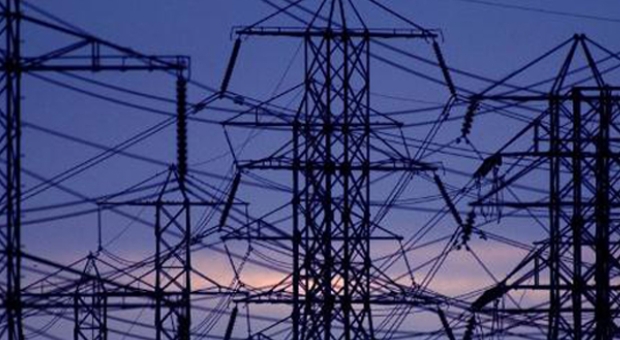
Transmission Line Tower – TCN
Mbah explained that on Saturday, February 22, the power disruptions will affect the National Hospital, G2 Injection Station, Garki, Area 1, and Asokoro for seven hours.
According to the statement, areas including Apo Legislative Quarters, Apo Resettlement, Gudu, Apo Mechanic, and surrounding areas will also experience a seven-hour power outage.
Mbah explained that the interruption is necessary as Abuja Electricity Distribution Company will be unable to receive bulk power supply from the affected transformers during the maintenance period.
TCN apologised for any inconvenience caused to the affected customers during this time.
“Power supply will be restored once the maintenance exercise is completed. We apologise for any inconvenience this may cause the affected electricity customers,” the company said.








News
GOC 3 Div reaffirms strategic partnership as CBN Man O’War delegation pays courtesy visit (Photos)

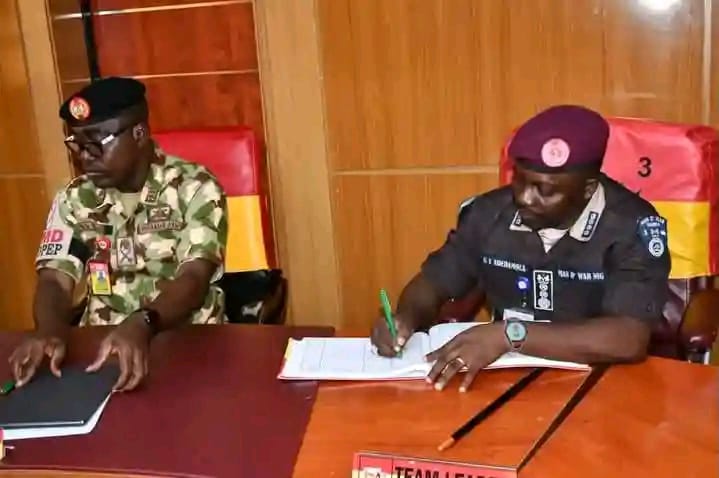
The General Officer Commanding (GOC) 3 Division Nigerian Army and Commander, Operation ENDURING PEACE (OPEP), Major General Maxwell Dangana, has reaffirmed the Division’s commitment to strengthening strategic partnership and fostering relationships that contribute to institutional development, security and community engagement.
The GOC stated this on Tuesday, 11 August 2026, while receiving separate courtesy visits from the Controller, Central Bank of Nigeria (CBN), Jos Branch, Mr Akwashiki Nathaniel Aya, and the National Commander, Man O’ War Nigeria, NC Adedamola Gbenga, at the Headquarters 3 Division, Maxwell Khobe Cantonment, Jos.
 I
I
Receiving the CBN delegation led by the Controller, Jos Branch, Mr Akwashiki Nathaniel Aya, Major General Dangana appreciated the management of the apex bank for the visit and expressed his readiness to sustain the cordial relationship between the Nigerian Army and CBN.
Earlier in his remarks, the CBN Controller congratulated Major General Dangana on his appointment as the GOC 3 Division and Commander OPEP. He explained that the visit was aimed at paying respect to the new GOC, strengthening the existing relationship between the two institutions and identifying areas of mutual interest that could further enhance collaboration.
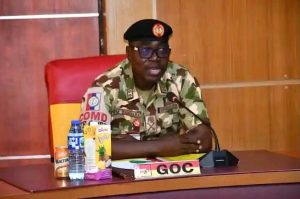
In a similar engagement, the GOC also received a delegation from Man O’ War Nigeria led by its National Commander, NC Adedamola Gbenga. The visit was also aimed at congratulating the GOC on his appointment and exploring areas of collaboration between the organisation and the Nigerian Army.
Welcoming the Man O’ War delegation, Major General Dangana expressed appreciation for the visit, describing it as both timely and significant. He particularly acknowledged the presence of the National Commander and a member of his delegation, the National Coordinator for Financing Safe Schools under the Federal Ministry of Finance in Nigeria, Hajiya Iliya Ibrahim, noting the importance of the organisation’s contribution to youth development and community security.
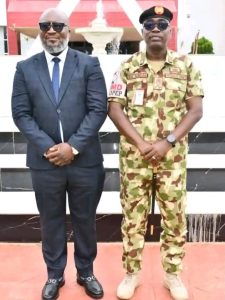
The GOC reaffirmed the Nigerian Army’s commitment to supporting initiatives that promote the development, empowerment and security of young people across the country. He noted that organisations such as Man O’ War Nigeria, with their youth-focused programmes and basic security training, have an important role to play in complementing the efforts of government security agencies.
Major General Dangana therefore called for stronger collaboration among relevant stakeholders, stressing that a whole-of-society approach remains essential to building a safer, more peaceful and secure nation.
Speaking on behalf of the delegation, the National Commander, NC Adedamola Gbenga, said the engagement was intended to strengthen inter-agency cooperation and consolidate the existing relationship between Man O’ War Nigeria and the Nigerian Army. He also solicited the support of 3 Division in the area of security for the successful conduct of the organisation’s 4th National Campaign Exercise.
The separate engagements further underscored the importance of sustained institutional partnerships in advancing shared objectives in security, youth development and community engagement.
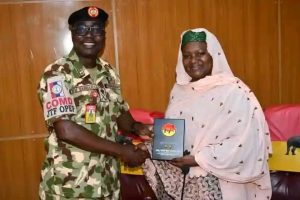
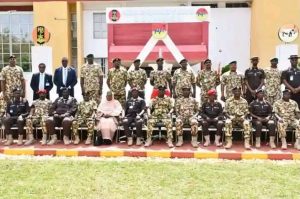
Highlights of the visits were the presentation of souvenirs and group photographs.
The Independent National Electoral Commission (INEC) on Thursday began the distribution of reprinted ballot papers and result sheets to agents of all participating political parties across the 30 Local Government Areas (LGAs) of Osun State ahead of Saturday’s governorship election.
The exercise commenced at the Commission’s state office in Osogbo on Thursday night, following INEC’s compliance with a Federal High Court judgment ordering the inclusion of the Social Democratic Party (SDP) governorship candidate, Dr. Francis Olugbenga Ajala, and his running mate, Faseke Babajimi Oladipo, in the election.
The Federal High Court, Abuja, had on July 22, 2026, delivered judgment in Suit No. FHC/ABJ/CS/344/2026, directing INEC to recognise, accept, upload, process and publish Ajala’s candidature for the August 15 governorship election.
INEC complied with the judgment on Wednesday, August 12, 2026, leading to the reproduction of the ballot papers and relevant result sheets to reflect the inclusion of the SDP candidates.
The reprinted materials were subsequently moved to the Osun State INEC office in Osogbo, where agents of the participating political parties gathered on Thursday night to witness the distribution process.
Addressing journalists at the venue, the Osun State Resident Electoral Commissioner, Mrs. Oluwatoyin O. Babalola, explained that the exercise would commence with the signing of the result sheets by the party agents before the distribution of the materials to the respective Local Government Areas.
Babalola said the materials had already been customised according to the polling units for which they were intended, with the names of the polling units clearly indicated on the documents.
“Everything is going to be customised. Believe it. All the results, they already have the name of the polling units on them,” the REC told journalists.
She explained that the customisation was intended to ensure that the materials could be properly identified and matched with their designated polling units during the electoral process.
According to her, the signing by party agents was an important part of the documentation process preceding the distribution of the materials.
“If you are signing, you see what happened,” she said, while explaining the procedure to the agents and journalists at the venue.
The REC also indicated that the materials had been prepared in a manner that would allow the Commission and the political parties to keep track of the documents allocated to the various areas.
The exercise was not, however, a distribution of the materials directly to polling units.
Rather, the reprinted ballot papers and result sheets were being distributed to agents of the participating political parties for the respective 30 Local Government Areas of Osun State.
The party agents were present at the INEC office to witness the process, beginning with the signing of the result sheets before the materials were handed over for the respective Local Government Areas.

The Independent National Electoral Commission (INEC) has disclosed that 1,906,390 Permanent Voter Cards (PVCs) have been collected ahead of Saturday’s governorship election in Osun State.
The figure represents 81.50 per cent of the 2,339,233 registered voters in the state, according to a statement issued on Thursday by INEC National Commissioner and Chairman of the Information and Voter Education Committee, Mohammed Haruna.
Haruna said the remaining 426,842 PVCs, representing 18.50 per cent of the registered voter population, had been securely deposited with the Central Bank of Nigeria (CBN), in line with the Commission’s established procedure.
INEC also disclosed that 6,101 voters whose PVCs were damaged, defaced or lost applied for replacement and subsequently printed downloadable copies of their voter cards.
The Commission said it had published a polling-unit-by-polling-unit breakdown of the collected PVCs on its official website.
INEC further assured political parties, civil society organisations, the media and residents of Osun State of its preparedness to conduct a free, fair, credible, transparent and inclusive election on Saturday, August 15, 2026.
Police deploy thousands for election security
Meanwhile, security agencies have intensified preparations for the governorship election, with the Nigeria Police Force deploying thousands of personnel across the state’s 30 local government areas.
Police sources and official statements indicate that at least four police officers will be deployed to each of the 3,673 polling units across the state.
The deployment, however, excludes personnel from other sister security agencies expected to participate in the election security operation.
With the election just hours away, political parties and candidates are making final preparations while voters await the outcome of what is expected to be a closely watched governorship contest.

GOC 3 Div reaffirms strategic partnership as CBN Man O’War delegation pays courtesy visit (Photos)

Osun DECIDES:INEC starts distribution of reprinted ballot papers to party agents in 30 LGAs

Osun election: INEC records 1.9million PVC collections




-
 News20 hours ago
Osun 2026: CCLCA berates INEC over poor mock accreditation, demands arrest of Fadahunsi
-
 News15 hours ago
Igbere Traditional Rulers Back Deputy Speaker, Kalu’s Bid for Another Term, Describe His Legislative Service as Outstanding
-
 News4 hours ago
APC Women Leader Allegedly Shares Salt, ₦1000 Cash To Osun Residents Days Before Governorship Election
-
 News18 hours ago
Fadahunsi, Osun and the Price of Political Rhetoric
-
 News4 hours ago
Customs Busts Wildlife Syndicate At Abuja Airport, Rescues Two Rare Lion Cubs Bound For Congo
-

 News4 hours ago
Fire guts hostel at St Louis College, Jos
-
 Sports22 hours ago
Cameroon shock Morocco via penalties to reach WAFCON final
-
 News14 hours ago
Osun guber poll: Amnesty demands immediate action against Senator Fadahunsi
Warning: Undefined variable $user_ID in /home/naijuinz/public_html/wp-content/themes/zox-news/comments.php on line 49
You must be logged in to post a comment Login