Connect with us

News

REVEALED ! Why Adamawa govt strips Atiku of Waziri title over indigeneship policy

Published

on

ADVERTISEMENT
Zoom Ad
ADVERTISEMENT
Zoom Ad

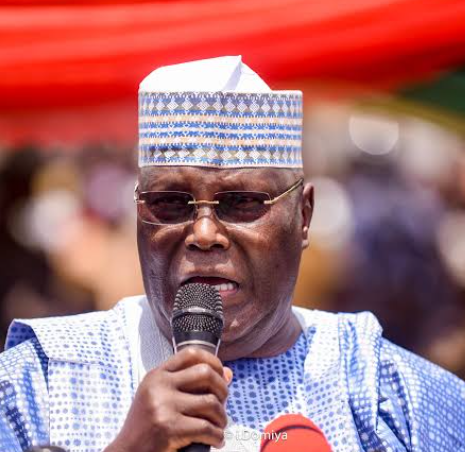
Ex-Vice President Atiku Abubakar has been stripped of his traditional title as the Waziri Adamawa, following a directive by the Adamawa State government mandating that all kingmakers and council members of emirate and traditional councils must be indigenes of their respective chiefdoms.


Atiku, who was turbaned as the seventh Waziri of the Adamawa Emirate in November 2018 by the Lamido of Adamawa, Muhammadu Barkindo, is originally from Jada in Ganye Emirate and not the Adamawa Emirate.

The Waziri title placed him next in rank to the Lamido and made him a key member of the emirate’s council.

However, a circular dated June 19 and signed by Adama Felicity Mamman, the Permanent Secretary of the Department of Chieftaincy Affairs, directed all traditional councils to immediately relieve any kingmaker or council member who is not an indigene of the relevant emirate or chiefdom.

Advertisement

“Following the creation of new Chiefdoms in the State by the Executive Governor of Adamawa State, Rt. Hon. Ahmadu Umaru Fintiri, I am directed to inform you that all Kingmakers and Council members in the state must be indigenes of their Chiefdoms,” the circular read in part.

For example, all Kingmakers and Council members from Adamawa Emirate Council must be indigenes of Yola South, Yola North, Girei, Mayo-Belwa, Song, and Zumo districts, while those of Mubi Emirate Council must be indigenes of Mubi South and Mubi North.”

The directive added that while individuals conferred with purely honorary traditional titles could retain them regardless of their local government origin, those holding functional roles such as kingmakers or council members must be indigenes.

“With the content of this circular, all Kingmakers and Council members who are not indigenes of the Chiefdoms have been relieved of their appointments,” the document stated.

Advertisement

Councils were also instructed to submit new lists of nominated kingmakers and council members to the governor for approval.

When reached for clarification on how the directive would affect the former vice president, Chief Press Secretary to Governor Fintiri, Humwashi Wonosikou, said only the Lamido of Adamawa could determine Atiku’s indigene status.

“Alhaji Atiku Abubakar lives in Yola and is a registered voter there, so only the Lamido can determine his indigeneship status,” Wonosikou said.

He also noted that the policy was not a new one but was now being implemented through the circular. “The governor gave the directive when he presented the staff of office to the emirs and chiefs of the newly created emirates and chiefdoms earlier this year,” he explained.

Advertisement

According to him, the move was intended to ensure loyalty and cultural alignment within traditional institutions.

“The government felt it may create doubts about loyalty for a kingmaker (and council member) who is not an indigene of the traditional council of which he is a member,” he said.

Governor Fintiri’s administration created seven new emirates and chiefdoms in December 2024 after the state House of Assembly passed the “Adamawa State Chiefs (Appointment and Deposition) and Matters Incidental Thereto” law on December 10. This increased the number of traditional councils in the state to 14.

Despite the directive’s implication on Atiku, the governor’s spokesperson dismissed speculation that the move signaled a political rift. “There is no rift between them,” he said, referring to Governor Fintiri and the former vice president.

Advertisement

On the ongoing internal crisis within the Peoples Democratic Party (PDP), Wonosikou noted that Governor Fintiri remained aligned with the PDP Governors’ Forum. “He is committed to the forum’s positions on the crisis,” he stated.

When contacted on Tuesday night, Atiku’s media adviser, Paul Ibe, said he was not aware of the policy or its implications on his principal’s title.
Continue Reading
Advertisement
Click to comment

Warning: Undefined variable $user_ID in /home/naijuinz/public_html/wp-content/themes/zox-news/comments.php on line 49

You must be logged in to post a comment Login

Leave a Reply

News

Tinubu signs executive order to regulate cryptocurrency, virtual assets

Published

on

By

ADVERTISEMENT
Zoom Ad
ADVERTISEMENT
Zoom Ad

President Bola Tinubu has signed a new executive order establishing a coordinated regulatory framework for virtual assets in Nigeria, with the Central Bank of Nigeria (CBN), the Nigeria Revenue Service (NRS) and the Securities and Exchange Commission (SEC) taking the lead in overseeing the sector.

The Presidency announced on Friday that the Presidential Executive Order on Virtual Assets Coordination, 2026, takes immediate effect.

In a statement issued by the Special Adviser to the President on Information and Strategy, Bayo Onanuga, the government said the directive is aimed at harmonising the regulation of virtual assets, strengthening collaboration among financial regulators, protecting Nigerians from fraud and encouraging responsible innovation.

According to the statement, the executive order became necessary because the rapid evolution of virtual assets has blurred “the traditional boundaries between currencies, money, commodities and securities”, creating regulatory overlaps and gaps.

Advertisement

The Presidency noted that weak coordination among regulatory agencies has left the country vulnerable to money laundering, terrorism financing, cybercrime, fraud and revenue leakages.

“Too often, unregistered and fraudulent operators have exploited these gaps to prey on unsuspecting Nigerians, costing families their savings,” the statement said.

To address these concerns, the executive order establishes a Virtual Asset Council chaired by the CBN, while the NRS and SEC will serve as vice-chairs.

Other members of the council include the Nigerian Financial Intelligence Unit (NFIU) and the Office of the National Security Adviser (ONSA).

Advertisement

Onanuga said the council will provide policy direction, strengthen cooperation among participating agencies and work with the Attorney-General of the Federation to develop a harmonised legal and institutional framework for regulating virtual assets.

The order also creates a Virtual Asset Office, which will be domiciled at the CBN to coordinate information sharing, applications and reporting among relevant agencies.

The presidential spokesman stressed that the new framework does not create another regulator or diminish the statutory responsibilities of existing institutions.

“Significantly, the Order does not create a new regulator or transfer powers between agencies. Each institution retains its full statutory mandate and independence, and the framework coordinates their work rather than replacing it,” the statement added.

Advertisement

Under the new framework, the SEC will continue to regulate virtual assets classified as securities, while the CBN will supervise payment, settlement, custody and other services involving non-security virtual assets. Where regulatory jurisdiction is unclear, the Virtual Asset Council will determine the appropriate supervising agency.

The Presidency also disclosed that the CBN is moving ahead with plans to establish a regulatory sandbox for the virtual assets industry.

According to Onanuga, the sandbox will enable qualified operators to test virtual asset products, blockchain-based services and other innovations under regulatory supervision before they are introduced to the wider market.

“It will help ensure that innovations that reach Nigerians have been properly examined and supervised,” the spokesperson said.

Advertisement

Further details of the sandbox are expected to be announced by the apex bank.

The statement added that the Nigeria Revenue Service will also introduce a tax policy specifically for the virtual assets sector to clarify how existing tax laws apply and improve voluntary compliance.

In addition, the Federal Government is finalising a Virtual Assets White Paper that will outline Nigeria’s long-term policy direction for the industry.

The newly established Virtual Asset Council has also been directed to develop a harmonised implementation framework within 30 days to facilitate the execution of the presidential order.

Advertisement
Continue Reading

News

Turaki-led PDP to appeal Federal High Court judgement on suit against INEC

Published

on

By

ADVERTISEMENT
Zoom Ad
ADVERTISEMENT
Zoom Ad

The Tanimu Turaki-led faction of the Peoples Democratic Party (PDP) said it will appeal the judgement of the Federal High Court in Abuja, which struck out the suit filed against the Independent National Electoral Commission (INEC) seeking recognition for them.

The suit was filed by the Senator Adolphus Wabara-led Board of Trustees, asking the Court to interpret the Supreme Court’s judgement and direct INEC to list the names of the Turaki-led Interim National Working Committee on its website as the party’s genuine leadership.

National Publicity Secretary of the group, Comrade Ini Ememobong, said in a statement that while they respect the court’s judgement, they have briefed their legal team to appeal it.

The judgement is a setback for the faction, which was hoping to present former President Goodluck Jonathan as its presidential candidate for the 2027 presidential election.

Advertisement

The statement read, “Today, the Federal High Court, Abuja Division, presided over by Justice Salim Olasupo Ibrahim, upheld the Preliminary Objection of the defendants and struck out the case filed by the Board of Trustees and some founding leaders of the Party, seeking, among other reliefs, the recognition of the Kabiru Turaki-led Interim National Working Committee.

“The court held that the subject matter of the suit is the leadership of the Peoples Democratic Party and is an internal affair of the party- a matter over which the court’s jurisdiction has been ousted.

“While we respect the judgment of the trial court, we respectfully consider that it is against the extant judgments of the Appeal and apex courts, leaving the plaintiffs with no option but to appeal the judgment and the rulings therein.”

“The plaintiffs have accordingly instructed their lawyers to take immediate steps to appeal the rulings and the judgment.

Advertisement

“We are hopeful that as we climb the ladder of the law, the victory of truth over lies, principles over compromise, and the survival of true opposition and multi-party democracy will be assured.

“The politics of power, money and greed may last for a while, but we are certain that though our victory may be postponed, as the struggle continues, we will eventually attain it.”

Continue Reading

News

Federal High Court Dismisses Wabara-Led Suit Against INEC Over PDP Leadership

Published

on

By

ADVERTISEMENT
Zoom Ad
ADVERTISEMENT
Zoom Ad

A Federal High Court in Abuja has struck out a suit seeking to compel the Independent National Electoral Commission, INEC, to recognise and publish the names of the Kabiru Turaki-led Interim National Working Committee of the Peoples Democratic Party (PDP)

Justice Salim Ibrahim, in a judgement delivered on Friday, held that the plaintiffs, led by the Chairman of the PDP Board of Trustees, Senator Adolphus Wabara, lacked the legal standing to institute the suit and consequently struck it out for want of jurisdiction.

The court upheld the preliminary objection filed by INEC and sustained similar objections raised by parties seeking to be joined in the suit, ruling that the plaintiffs failed to establish that INEC had recognised the purported Interim National Working Committee or that they had the authority to sue on behalf of the PDP.

Continue Reading

Trending

Copyright © 2024 Naija Blitz News