News
Killing of colleagues in Gaza must stop -African Journalists warn Israel
- /home/naijuinz/public_html/wp-content/plugins/mvp-social-buttons/mvp-social-buttons.php on line 27
https://naijablitznews.com/wp-content/uploads/2025/08/Screenshot_20250821-103806.jpg&description=Killing of colleagues in Gaza must stop -African Journalists warn Israel', 'pinterestShare', 'width=750,height=350'); return false;" title="Pin This Post">
- Share
- Tweet /home/naijuinz/public_html/wp-content/plugins/mvp-social-buttons/mvp-social-buttons.php on line 72
https://naijablitznews.com/wp-content/uploads/2025/08/Screenshot_20250821-103806.jpg&description=Killing of colleagues in Gaza must stop -African Journalists warn Israel', 'pinterestShare', 'width=750,height=350'); return false;" title="Pin This Post">
By Kayode Sanni-Arewa and Prosper Olayiwola

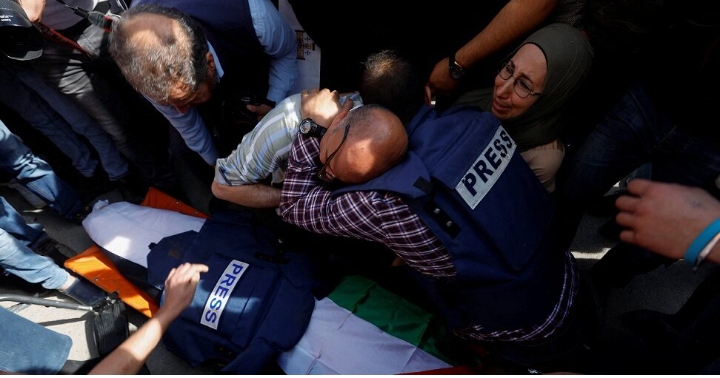
African journalists, under the coalition African Journalists Against Genocide (AJAG), have strongly condemned the killing of their Palestinian colleagues in Gaza, describing it as intentional and deliberate targeting by Israel.
This condemnation comes amidst widespread international outcry and reports of a significant number of journalist fatalities in the region.

AJAG, founded by Nigerian broadcast journalist Ireti Bakare-Yusuf and comprising media personnel from over 20 African countries, stated that over 250 journalists have been killed in Gaza since October 2023, making it the deadliest period for journalists in the 21st century.
This figure is higher than reports from other organizations, with UNESCO reporting at least 62 journalists and media workers killed in the line of duty in Palestine since October 2023, excluding deaths unrelated to their work, while the OHCHR reports at least 242 Palestinian journalists killed in the same timeframe.
Other sources indicate that Israel has killed more than 190 journalists since October 7, 2023, with the Committee to Protect Journalists (CPJ) believing that at least 26 of them were deliberately targeted.
The coalition accused Israel of preventing almost all international journalists from entering Gaza, forcing the world to rely on Palestinian journalists for information on the humanitarian situation. AJAG views the targeting of these journalists as a clear strategy by the Israeli state to suppress the truth and silence media.
They emphasize that reporting on alleged war crimes is not a crime, but the killing of journalists is, and demand accountability under international law, calling for sanctions against Israel similar to those applied to apartheid South Africa.
The United Nations Educational, Scientific and Cultural Organization (UNESCO) has also condemned the killing of journalists in Palestine, specifically highlighting the targeted killing of six journalists by an Israeli drone on August 10.
UNESCO Director-General Audrey Azoulay called for a thorough and transparent investigation into these deaths. Five of the six journalists worked for Al Jazeera, and they were reportedly killed by an Israeli attack on a media tent near Al-Shifa Hospital in Gaza City.
Israel has alleged that one of the killed journalists, Anas Al-Sharif, was a Hamas operative, a claim strongly denied by Al Jazeera, which described the attack as an “assassination” and a “blatant and premeditated attack on press freedom”.
UN Human Rights Council-appointed independent experts have denounced Israeli military spokespersons’ threats and accusations against Al-Sharif as an attempt to endanger his life and silence his reporting.
Journalists and activists worldwide have held protests and vigils in solidarity with Palestinian journalists.These demonstrations, held in cities like Cape Town, Manila, London, and Tel Aviv, call for international media access to Gaza and an end to the conflict.
South African journalists, in particular, have drawn parallels between the current situation and the apartheid era, with some condemning local publications for perceived biased narratives. The deliberate targeting of journalists, who are civilians under international law, is considered a war crime.

News
CBN Opens Applications for Second Cohort Of Regulatory Sandbox Programme
The Central Bank of Nigeria has commenced applications for the second cohort of its regulatory sandbox programme, inviting innovators, financial institutions, virtual asset service providers, fintechs and technology companies to submit proposals for supervised testing of new financial products and services.
The application window opened on August 12, 2026, and will close on August 31, 2026, according to a statement signed by the acting Director of Corporate Communications and Investor Relations Department, Hakama Sidi-Ali.
The CBN said the second cohort builds on its efforts to promote responsible innovation within Nigeria’s financial system while maintaining consumer protection, financial stability and market integrity.
Under Cohort 2, the programme will operate through two dedicated testing tracks.
The first is the virtual asset service provider track, which is designed to support innovative solutions involving virtual assets, stablecoins, payments, settlement, custody, wallets and related financial infrastructure that require supervised live testing.
The second is the data-enabled financial services track, which will support innovations that use secure digital infrastructure and permission-based data sharing to improve financial inclusion, payments, credit, risk management, operational efficiency and consumer outcomes.
The CBN explained that its regulatory sandbox provides a controlled environment where eligible participants can test innovative financial products, services, business models and enabling technologies under the supervision of the apex bank.
According to the bank, the arrangement allows regulators and innovators to engage throughout the testing process, enabling the CBN to better understand emerging technologies while allowing companies to test their solutions within clearly defined regulatory parameters.
The apex bank said the launch of the second cohort reflects its commitment to developing a transparent, proportionate and risk-based regulatory framework capable of encouraging innovation without compromising monetary and financial stability.
It added that lessons gathered from supervised testing would contribute to the development of regulatory and supervisory frameworks for Nigeria’s evolving digital financial ecosystem.
Eligible applicants will be assessed based on several criteria, including the level of innovation, readiness for controlled live testing, potential benefits to consumers or the market, governance structures, risk management capacity and the suitability of their proposed testing plans.
Successful participants will conduct supervised testing within parameters agreed with the CBN.
The bank said the testing process would include safeguards covering consumer protection, operational resilience, cybersecurity and regulatory reporting.
However, the CBN stressed that participation in the regulatory sandbox should not be interpreted as a licence or approval to operate outside the specific testing parameters approved by the bank.
It said the programme is intended to facilitate responsible experimentation, strengthen engagement between regulators and innovators, and support evidence-based policymaking in accordance with the CBN’s statutory mandate.
Interested organisations are required to submit their applications through the CBN regulatory sandbox portal before the August 31 deadline.
The latest initiative comes as Nigeria’s financial sector continues to see rapid development in digital payments, fintech services, virtual assets and data-driven financial products, increasing the need for regulatory frameworks that can accommodate emerging technologies while managing associated risks.
News
Just in: Finally, after years of litigations, Cross River, again becomes oil producing state
Finally, Cross River State has recorded a significant breakthrough in its long-running quest for recognition as an oil-producing state, following the emergence of its onshore petroleum assets within the Nigerian Upstream Petroleum Regulatory Commission’s (NUPRC) 2025 Licensing .
This development has opened a new chapter in oil and gas exploration in the state, with three petroleum blocks in the Calabar Flank—PPL 2A61, PPL 2A62 and PPL 2A45—included in the licensing process. The NUPRC has described the Calabar Flank as a historically underexplored geological province with significant potential for future petroleum discoveries.
The development is particularly significant for the Ikang, Calabar and Odukpani–Mbiabo petroleum corridors, where previous exploration activities produced wells, including Ikang-1 and the Calabar wells, as well as long-documented capped and abandoned wells around Mbiabo Ikot Offiong. With the latest licensing cycle, these historical petroleum frontiers could now be subjected to modern seismic interpretation, subsurface modelling, exploratory drilling and contemporary oil and gas technologies.
At the NUPRC commercial bid conference held on July 21, 2026, 31 companies emerged winners of 37 oil and gas blocks. Saratoga emerged as the successful bidder for PPL 2A45, Clinton Oil Field for PPL 2A62, while Nikstallis won PPL 2A61.
Final awards have been made, while payment of the applicable signature bonuses is ongoing and said to be nearing completion in line with the provisions of the Petroleum Industry Act.
The successful companies are also processing their entry into Cross River State.
The development represents more than another licensing exercise for Cross River. It signals a shift in the state’s petroleum narrative from historical evidence and political agitation towards regulated investment, exploration and potential commercial production.
The participation of new investors in the Calabar Flank indicates that the area is increasingly being recognised within Nigeria’s upstream petroleum architecture as a legitimate frontier for oil and gas exploration.Geographic Reference The development is also being viewed as a significant milestone for Governor Bassey Edet Otu, whose administration has consistently pushed for recognition of Cross River’s oil-producing status and greater participation in Nigeria’s petroleum economy.
Governor Otu’s administration has continued to place the state’s petroleum claims within the national policy and development conversation, helping sustain pressure for recognition based on geological, technical and documentary evidence.
The latest development shifts the central question from whether Cross River possesses petroleum potential to how the state can responsibly develop those resources and convert them into revenue, investment, employment and sustainable development.
From Oil Status to an Oil Economy
The next challenge for Cross River will go beyond securing recognition as an oil-producing state.
The state will need to develop the institutional and economic structures required to capture value across the petroleum chain, including exploration, drilling, production, gas development, infrastructure, local content, technical skills, host-community development, environmental protection and petroleum-linked industrial investment. The Ikang–Calabar–Odukpani–Mbiabo corridor could become an important component of this emerging energy economy.
From Petitions to Regulatory Validation Cross River’s campaign for oil-producing-state recognition predates the current licensing round. The state government has made a sustained series of petitions and representations to the President of Nigeria, backed by documentary, geological and technical evidence relating to onshore and offshore oil wells and derivation interests.
The state’s position has consistently been that its petroleum resources and verified well locations deserve appropriate recognition within Nigeria’s derivation and upstream regulatory framework.Geographic Reference The emergence of Cross River’s onshore petroleum potential within the NUPRC licensing architecture therefore represents a major milestone in that long-running campaign. It also strengthens the state’s position as it pursues the next stage of its petroleum claim—offshore recognition.
Offshore Frontier Remains Attention is now expected to shift towards the offshore component of Cross River’s petroleum claim. According to the state’s technical position, more than 119 offshore well coordinates have been verified and are awaiting presidential consideration and approval. If approved and formally incorporated into the relevant national petroleum and derivation framework, the offshore recognition could further strengthen Cross River’s position in Nigeria’s petroleum economy and potentially improve its revenue prospects. The strategic implication is significant: while onshore validation provides an important foundation, offshore accreditation could complete a broader petroleum recognition being pursued by the state.
Cross River will therefore need to consolidate the current momentum through a coordinated petroleum investment and development strategy that links exploration with infrastructure, community development, local enterprise, technical manpower and long-term economic planning. The wells of yesterday may have been capped, but Cross River’s petroleum future is being reopened. The ultimate objective, however, should go beyond crude oil and gas production. The state must ensure that its petroleum resources translate into broad-based economic prosperity, sustainable development and improved opportunities for its people.
News
See Dollar to Naira exchange rate today, August 12, 2026
The naira remained broadly stable against the United States dollar on Wednesday, August 12, 2026, with the official Nigerian Foreign Exchange Market (NFEM) rate trading around the mid-₦1,360 band while the parallel market hovered in the low-₦1,400 range.
Data from the Central Bank of Nigeria’s NFEM platform showed the official exchange rate at about ₦1,364 per dollar, reflecting only marginal movement from recent sessions. The official rate is derived from the volume-weighted average of trades executed on the market and serves as Nigeria’s benchmark exchange rate.
Currency dealers in Lagos said the parallel market (black market) traded at approximately ₦1,405 per dollar for buying and ₦1,415 per dollar for selling on Wednesday morning, keeping the spread between the official and unofficial markets relatively narrow compared with the sharp gaps recorded in 2024 and early 2025. Recent market trackers have shown street-market quotes clustering around the ₦1,410 region.
At the prevailing official rate, $100 exchanged for roughly ₦136,400, while $1,000 was worth about ₦1.364 million. In the parallel market, the same amounts were valued at about ₦141,500 for $100 and ₦1.415 million for $1,000.
Market participants attributed the relative calm to continued liquidity management by the Central Bank of Nigeria and steady foreign-exchange supply through the formal market. Analysts also noted that importer demand has remained moderate, helping the naira hold within a relatively tight range in recent weeks.
Reuters reported that traders expect the naira to remain broadly stable in the near term, supported by the CBN’s presence in the market and efforts to ease demand pressure for dollars. The report placed recent official-market trading around the ₦1,360 level and street trading near ₦1,425 per dollar.
The official market has traded mostly between ₦1,362 and ₦1,370 per dollar in recent sessions, according to market data compiled by Proshare, underscoring the currency’s recent consolidation around the ₦1,360 range.
For Nigerians monitoring exchange rates for travel, school fees, imports, or international payments, the key levels to watch today are about ₦1,364/$ at the official NFEM window and ₦1,415/$ in the parallel market.
-
News13 hours agoFormer President, Goodluck Jonathan Gets Chieftaincy Title In Bauchi
-
News13 hours agoOsun 2026: ‘Trump’s People Have Reached Out’ — Davido
-
News12 hours agoOkpebholo Sacks SUBEB Chairman
-
News13 hours agoShehu Sani Reacts As Davido Appeals To Trump Over Osun Election
-
News13 hours agoOsun Poll: Adeleke Demands Fadahunsi’s Arrest Over Alleged Killings Threat Against Accord Members
-
Foreign12 hours agoTrump Hid In Catering Truck During Secret Plane Swap Over Iran Threat – Report
-
News12 hours agoKatsina deploys 23 APCs, drones, 200 patrol vans against banditry
-
News12 hours agoASUU declares indefinite strike in Ondo varsities

Warning: Undefined variable $user_ID in /home/naijuinz/public_html/wp-content/themes/zox-news/comments.php on line 49
You must be logged in to post a comment Login