News
FG bars consultants, corps members from federal personnel payroll
- /home/naijuinz/public_html/wp-content/plugins/mvp-social-buttons/mvp-social-buttons.php on line 27
https://naijablitznews.com/wp-content/uploads/2025/01/Federal-Government-FG.jpg&description=FG bars consultants, corps members from federal personnel payroll', 'pinterestShare', 'width=750,height=350'); return false;" title="Pin This Post">
- Share
- Tweet /home/naijuinz/public_html/wp-content/plugins/mvp-social-buttons/mvp-social-buttons.php on line 72
https://naijablitznews.com/wp-content/uploads/2025/01/Federal-Government-FG.jpg&description=FG bars consultants, corps members from federal personnel payroll', 'pinterestShare', 'width=750,height=350'); return false;" title="Pin This Post">
The Federal Government has directed ministries, departments, and agencies to exclude consultants, corps members, and other non-permanent workers from their personnel payroll in the 2026 budget. This directive was contained in the 2026 Personnel Cost Budget Call Circular issued by the Budget Office of the Federation.

The circular, dated July 7, 2025, was signed by the Director-General of the Budget Office, Tanimu Yakubu, and addressed to ministers, service chiefs, permanent secretaries, and heads of parastatals. According to the circular, obtained by Sunday PUNCH on Saturday, only legitimate employees of the Federal Government are to be reflected in the personnel cost budget.
It warned that “any unauthorised payments from the personnel cost budget will attract appropriate sanctions.” The Budget Office stressed that corps members’ allowances would be centrally captured under the National Youth Service Corps budget, while any additional stipends payable by host MDAs must come from overhead provisions.

It noted, “Consultants, contract staff, youth corpers, industrial attaches, outsourced service providers, legionnaires and such like should not be included in MDAs’ nominal roll and/or Additional Information template as they are not permanent/pensionable staff of the Federal Government.”
The circular also barred ministries and agencies from budgeting for anticipatory promotions, insisting that only promotions duly approved and implemented should be reflected in the 2026 personnel budget.
To strengthen oversight, the government announced the introduction of a Personnel Cost Monitoring Dashboard linked to the Integrated Payroll and Personnel Information System and the Government Integrated Financial Management Information System. The tool, it explained, would enable real-time tracking of personnel expenditure against budgetary provisions.
It added, “BOF will deploy a centralised Personnel Cost Monitoring Dashboard linked to IPPIS and GIFMIS. MDAs shall use this tool to compare actual expenditures with budget provisions in real-time.”
The circular further outlined strict deadlines, directing all MDAs to submit both hard and soft copies of their personnel budget proposals no later than July 15, 2025. They are also expected to submit a third-quarter personnel budget performance review report by September 30, 2025.
Yakubu noted that the 2026–2028 Medium-Term Expenditure Framework and Fiscal Strategy Paper would be concluded in July in line with the Fiscal Responsibility Act, 2007. This, he said, would facilitate the submission of the 2026 national budget to the National Assembly by September 2025.
Earlier, the Federal Government said it would release the long-awaited Budget Performance Report for 2024 by the end of September 2025, alongside outstanding reports for the first and second quarters of 2025, in a move aimed at restoring compliance with fiscal reporting requirements.
In a statement on Friday, the Budget Office of the Federation admitted that the publication of Budget Implementation Reports had been delayed since the second quarter of 2024, but assured Nigerians that the setback was temporary and would not derail its commitment to transparency and accountability.
The Office explained that the delays were caused by verification missions and reconciliations with implementing agencies, as well as Nigeria’s transition to a new extended fiscal framework.
“The delay should not be seen as backsliding, but as a reflection of the care taken to ensure accuracy and credibility in Nigeria’s fiscal reporting during an exceptional budget cycle,” the statement noted.
According to the Budget Office, issuing reports on the old budget cycle would have created confusion once policy discussions began pointing towards an extended horizon.
“Issuing reports on the old cycle, only to have them overtaken by a revised implementation framework, would have created conflicting datasets and misled stakeholders,” it said.
To address the gap, the Office announced a provisional plan. “By the end of September 2025, we will publish the full-year 2024 Budget Performance Report alongside the outstanding Q1–Q2 2025 reports, after which quarterly releases will resume on schedule,” it pledged. The Budget Office stressed that the Fiscal Responsibility Act mandates it to publish quarterly BIRs, and reaffirmed its statutory obligation.
News
Large quantity of opioids intercepted in Taraba as NDLEA nabs 75-year-old in Ebonyi(Photos)
. Arrests four notorious female dealers in sweeps across Edo, Imo, Kano, Gombe
Large consignments of various opioids and illicit substances concealed in building materials have been intercepted by operatives of the National Drug Law Enforcement Agency (NDLEA) in a relentless nationwide offensive against drug cartels leading to the arrest of a 75-year-old grandpa in Ebonyi, and four notorious female drug dealers in Edo, Imo, Kano, and Gombe states.

A major blow was dealt to opioid trafficking networks in Taraba state on Saturday 6th June 2026 following credible intelligence which led to the interception of a truck conveying building materials from Onitsha, Anambra state to Jalingo. A thorough search of the vehicle by NDLEA operatives at the Nukkai Timber Shade, Jalingo, led to the discovery of a massive drug stash concealed beneath the cargo, while a 22-year-old suspect, Buhari Abdullahi, was promptly arrested.
Recovered from the truck include: 320,840 capsules of tramadol; 600 ampoules of pentazocine injection; 4,500 pills of rohypnol; and 299 bottles of codeine-based cough syrup.
Demonstrating that age is no barrier to the enforcement of the law, NDLEA operatives in Ebonyi State tracked down and arrested a 75-year-old grandpa, Okebe Samuel, at Okposi. The septuagenarian was found in possession of 300 grams of skunk, which he sells in retail sachets to the youth in his community.

In Imo state, NDLEA officers successfully raided a known drug enclave at Umulolo, Orlu. The raid resulted in the arrest of a notorious female dealer, 32-year-old Chioma Okeke, and the recovery of 8 kilograms of skunk.
Meanwhile, in Edo state, an intense sweep of notorious drug hotspots within Benin City by NDLEA operatives on Tuesday, 2nd June 2026, yielded the arrest of four key traffickers, including three females.
At Uyosa, Benin City, two female suspects, Chioma Igba (24) and Precious Ozomah (22), were nabbed with a cocktail of illicit substances including 176 grams of skunk, 65 grams of Loud, and 5 grams of Methamphetamine. Along Agbor road in Benin City, another female suspect, 21-year-old Anita Abraham, was apprehended with 95 grams of Scottish Loud and 329 grams of regular Loud. At Upper Mission, Benin City, a male suspect, Henry Okey (43), was arrested with a diverse cache of psychotropic substances consisting of Loud, Colorado, Swinol, and Methamphetamine.
A swift operation by operatives in Kano State on Thursday, 4th June 2026, led to the arrest of a 19-year-old suspect, Saifullahi Lawan at the Kafi area of Madobi, with 40 blocks of skunk weighing a total of 38 kilograms.

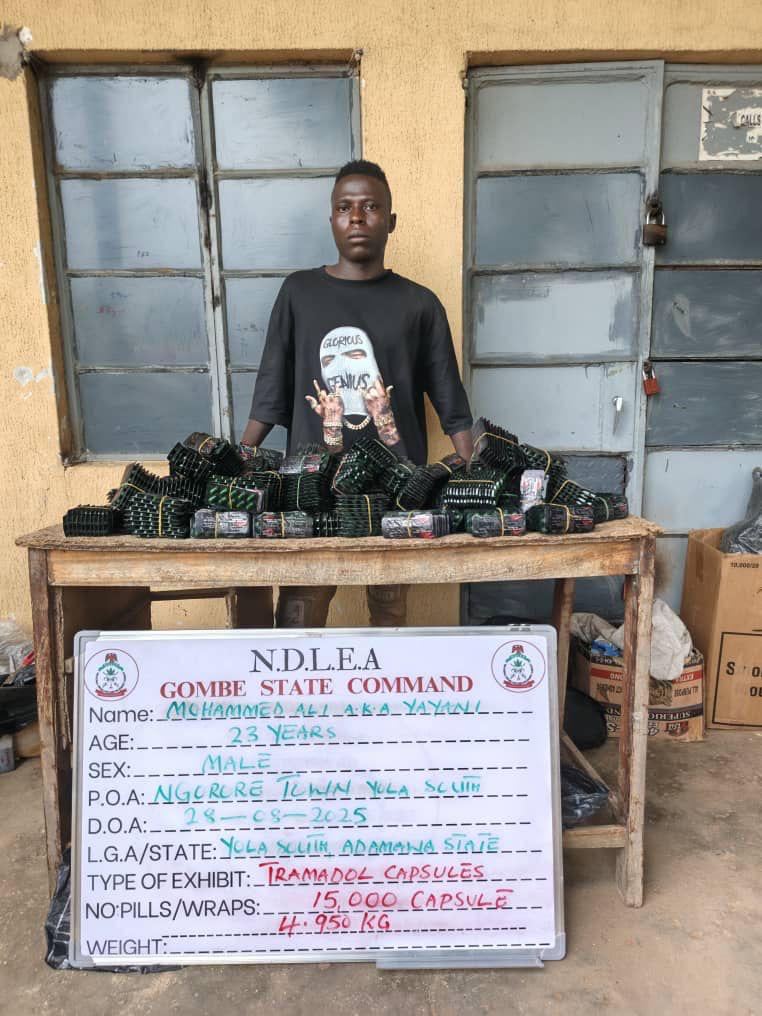
In a related development, operatives in Gombe State on Monday, 1st June intercepted 28-year-old Ugwu Sabastine Ifebuchi near the Dantiti Plaza in the Tumfure area of Gombe. The suspect was caught with 15,000 capsules of tramadol.
The War Against Drug Abuse (WADA) social advocacy activities by NDLEA Commands and formations equally continued across the country in the past week.
Some of them include: WADA sensitization lecture delivered to students and staff of Holiness Foundation Primary School, Saki, Oyo state; Dorras High School, Ibeju Lekki, Lagos; Ado Girls Secondary School, Onitsha, Anambra; and Army Day Secondary School, Kano state; among others.
Reacting to the string of successful operations, Chairman/Chief Executive Officer of NDLEA, Brig. Gen. Mohamed Buba Marwa (Rtd) commended the officers, men and women of the Taraba, Ebonyi, Imo, Edo, Kano, and Gombe commands for their resilience and vigilance. He also praised their counterparts in all the commands across the country for pursuing a fair balance between their drug supply reduction and drug demand reduction efforts. He re-emphasized that the agency remains fully committed to dismantling drug supply chains and will continue to target traffickers regardless of age, gender, or concealment methods.
News
Real reason why we banned night vigils – MFM
The Mountain of Fire and Miracles Ministries (MFM) has placed an indefinite ban on overnight vigils and ordered all church programmes to end by 8 p.m. daily, citing rising security concerns nationwide.
The new directive was contained in a circular dated June 5, 2026, sent to Regional Overseers and branch pastors. It takes effect immediately.
According to the memo, all services, meetings, and programmes at every level of the church must now close by 8 p.m. “for the foreseeable future.” Overnight vigils and late-night prayer meetings have been suspended indefinitely.
Where such gatherings are considered necessary, leaders are to restructure them into evening prayer sessions that must still wrap up by 8 p.m. at the latest.
The circular was signed by Temitope A. Olawale, Director of Administration at MFM International Headquarters and Nigeria. He said the decision is a safety measure based on the current state of security in the country.
“The directives are purely precautionary and aimed at safeguarding the lives and well-being of our members in the face of the current security situation in the country,” the statement read.
MFM is known for its marathon prayer sessions and overnight programmes. The new rule marks a major shift for the church as insecurity continues to impact religious gatherings across Nigeria.
News
CBN Imposes N100M Penalty On Inadequate Processing Of Forex Documents
The Central Bank of Nigeria (CBN) has introduced stricter sanctions for banks that process foreign exchange transactions without proper documentation, imposing penalties that could run into hundreds of millions of naira.
Under the revised foreign exchange regulatory framework, authorised dealer banks found to have completed forex transactions with insufficient supporting documents will pay a N100 million fine. They will also incur an additional N10 million penalty for each affected transaction.
The sanctions are contained in the fourth edition of the Foreign Exchange Manual released by the apex bank. The document serves as the operational guide for participants in Nigeria’s foreign exchange market.
According to the CBN, the updated manual is designed to strengthen regulatory compliance, improve transparency and reinforce confidence in the country’s foreign exchange system.
The regulator classified the offence as the execution of foreign exchange transactions without adequate documentation. It stated that any authorised dealer found culpable would be liable to the prescribed penalties.
The revised guidelines place greater emphasis on documentation requirements for all categories of foreign exchange transactions. These include spot transactions, forward contracts, swap arrangements, imports and export-related dealings.
Banks are now required to obtain, verify and retain all relevant supporting documents before foreign currency can be released to customers. Similar requirements apply to forward and swap transactions, where evidence of the underlying trade or obligation must be available before settlement.
The manual also retains existing documentation requirements for imports. Importers are expected to provide Form M, invoices, certificates of origin, packing lists and shipping documents, among other mandatory records.
In addition, importers must submit Exchange Control Documents within 90 days after negotiating shipping documents through overseas correspondent banks.
Failure to comply with the documentation requirements attracts progressively stiffer sanctions.
A first violation will result in a 90-day suspension from foreign exchange transactions. A second offence carries a 180-day restriction, while a third attracts a one-year suspension.
The CBN warned that a fourth violation could lead to a complete prohibition from participating in foreign exchange transactions.
Banks that fail to report cases of default to the regulator will also face sanctions under the new framework.
The apex bank further tightened reporting obligations for authorised dealers. Institutions that fail to submit required daily or monthly returns will be fined N500,000 for late submission.
Where returns are not rendered at all, the offending institution will pay a minimum penalty of N5 million. An additional N500,000 daily fine will apply until the breach is corrected.
The revised manual also strengthens oversight of banks’ foreign currency exposure levels.
Financial institutions that exceed approved Net Open Position limits will receive a warning for the first offence. A second violation will attract a 10-working-day suspension from the Nigerian Foreign Exchange Market.
A third breach will result in a 90-day suspension from market activities.
The CBN also imposed sanctions on unauthorised reallocation of foreign exchange funds. Any bank found engaging in such practices will pay N10 million for each transaction involved.
Beyond the monetary penalty, affected institutions may be referred to the Bankers’ Committee ethics framework for further disciplinary action.
The central bank said the new measures form part of ongoing efforts to deepen transparency, promote market discipline and establish a more rules-based foreign exchange regime.
According to the regulator, stronger compliance standards and stricter enforcement will help improve market integrity, reduce abuses and enhance investor confidence in Nigeria’s foreign exchange market.
-
News18 hours agoLEADERSHIP AND INFRASTRUCTURE DEVELOPMENT IN NIGERIA: LESSONS FOR FUTURE LEADERS
-
News22 hours agoFinally, Iranian Footballers Granted Visas For 2026 World Cup
-
News24 hours agoLady Drags Husband To Court For Hiring Out Her Bedroom
-
News23 hours agoPHOTOS: Dutiful wife of FCT minister Wike, adjusting her husband’s cap at ongoing UNIPORT Convocation lecture
-
Sports22 hours agoLamine Yamal leads list of most valuable footballers [Top 10] for 2026 World Cup
-
News24 hours agoTroops Intercept Arms Courier, Recover Over 1,000 Ammunition in Zamfara Operation
-
News14 hours agoBreaking: Finally police rescue Adelabu’s sister, her twins
-
Metro8 hours agoISIS Bride And Her Mother Charged After They Helped Dad Buy 15-Year-Old S£x Slave For £7,500 For Purposes Of R@ping

Warning: Undefined variable $user_ID in /home/naijuinz/public_html/wp-content/themes/zox-news/comments.php on line 49
You must be logged in to post a comment Login