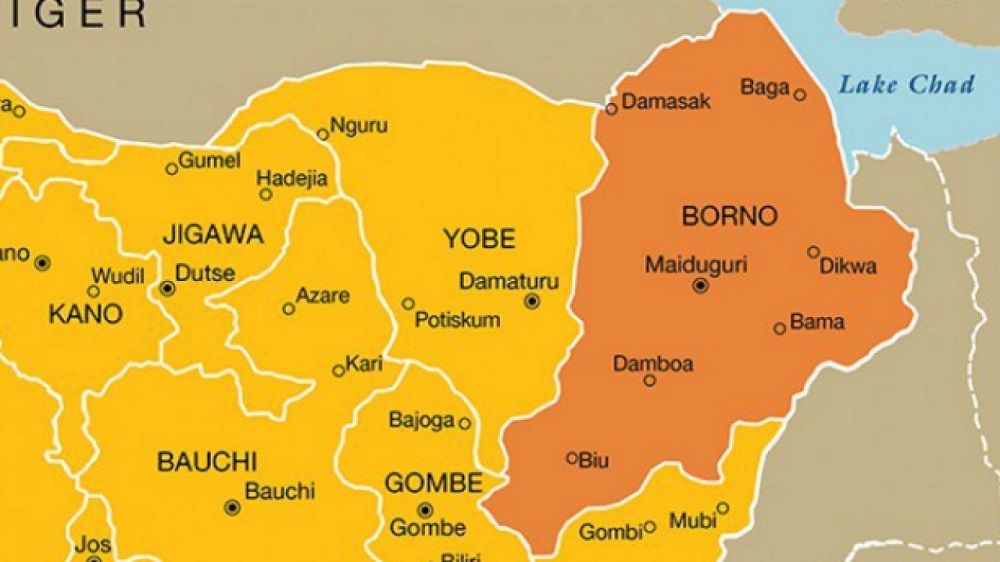
More than 5,000 residents of Kirawa, a strategic border community in Borno State, have fled into neighbouring Cameroon after Boko Haram insurgents launched a violent overnight assault, burning military facilities, homes, and the palace of the district head.


Local officials and community leaders told reporters that the attack, which occurred late Thursday, left the town largely deserted.
District Head Abdulrahman Abubakar confirmed that he was forced to abandon his palace, which was set ablaze alongside a military barracks. 
“I was left with no option but to flee to Cameroon,” he told journalists. “Residents boarded trucks to seek refuge across the border, while others ran to Maiduguri, the state capital.”
According to footage released by Boko Haram, insurgents were seen torching a military base while chanting ‘victory belongs to God’. Survivors confirmed that Kirawa is now under militant control.
“Boko Haram is in control,” said Dauda Hassan, who fled to Pulka, a nearby town where Nigerian troops remain stationed.
The mass displacement highlights the devastating consequences for border communities that have repeatedly been left exposed to insurgent advances.
The raid on Kirawa came less than two weeks after Boko Haram fighters stormed Banki, another border settlement, overrunning a military barracks, seizing weapons, and forcing troops to retreat.
Local leader Yakubu Mabba Ali Kirawa, head of the town’s development group, called for urgent military reinforcements, noting that only vigilantes and a handful of residents remained to defend Kirawa after a multinational task force withdrew in August following a separate attack.
Analysts warn that both Boko Haram and its splinter faction, the Islamic State West Africa Province (ISWAP), have significantly escalated operations in recent months, exploiting weakened local security arrangements.
Since January 2025, insurgents have launched a string of assaults on army bases, border towns, and rural villages in Borno, temporarily occupying them before retreating as reinforcements arrive.
Boko Haram, founded in Borno State in the early 2000s, became globally notorious after its founder, Mohammed Yusuf, was killed in 2009, sparking a radical shift into insurgency. Over the years, the group has carried out mass abductions, suicide bombings, and large-scale raids against civilians and security forces.
Despite repeated military offensives and claims of territorial recovery, the insurgency continues to displace tens of thousands, destabilise Nigeria’s northeast, and undermine regional stability.
For the displaced residents of Kirawa, the crisis is yet another reminder that Borno’s war is far from over.