Connect with us

News

Senate okays 14-year jail term for s3xual harassment

Published

on

ADVERTISEMENT
Zoom Ad
ADVERTISEMENT
Zoom Ad

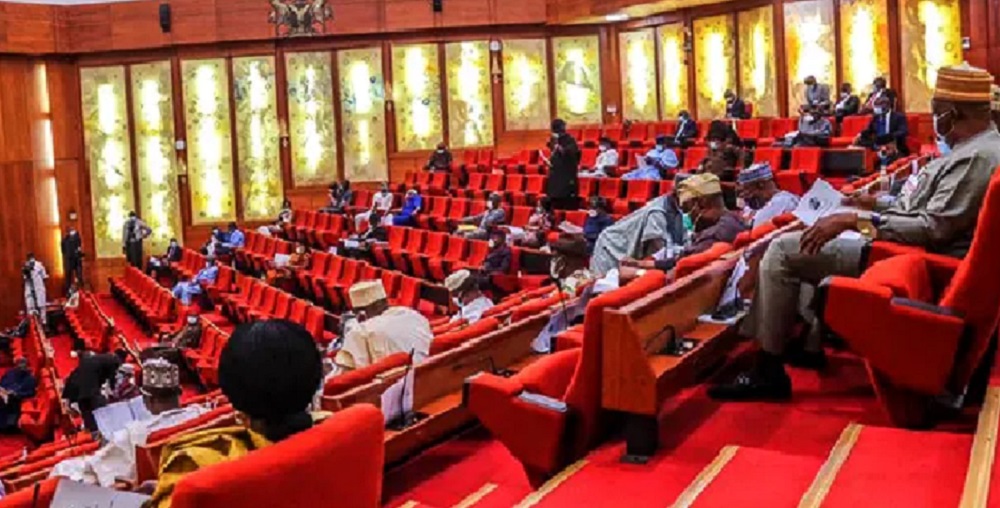
The Senate yesterday passed a bill prescribing up to 14 years imprisonment for lecturers and other educators convicted of s3xually harassing students in tertiary institutions across the country.

The concurrence Bill, titled: “S3xual Harassment of Students (Prevention and Prohibition) Bill, 2025 (HB.1597),” seeks to curb a persistent pattern of exploitation in Nigerian campuses, where students, especially women, are coerced into s3xual relationships in exchange for grades, admission, or other academic favours.

The bill, presented for concurrence by the Senate Leader Opeyemi Bamidele (APC, Ekiti Central), established clear legal standards to punish offenders and protect students from all forms of s3xual misconduct in schools.

Bamidele, who was represented by his deputy, Oyelola Ashiru, said the legislation aims to “promote ethical conduct, preserve the sanctity of the educator-student relationship, and uphold respect for human dignity in academic environments.”

Advertisement

Under the new law, any educator convicted of the offences specified in Clause 4 (1–3) will face imprisonment of between five and 14 years, without an option of a fine.

Those found guilty under Clause 4 (4–6) risk two to five years in jail, also without an option of a fine.

The proposed law also allows victims or their representatives to file civil actions for breach of fiduciary duty, with the standard of proof consistent with civil proceedings.

The offences specified in the Bill include: “Demanding or receiving s3xual favours to grant academic benefits;

Advertisement

Making unwelcome s3xual advances or gestures; inducing others to commit harassment; and unwanted physical contact or conduct of a s3xual nature.

The bill stipulates that marriage between the educator and the student is the only valid defence, and that consent cannot be used as a defence where an educator–student relationship exists.

It further provides that s3xual harassment complaints may be lodged by the victim, relatives, guardians, or any concerned party to the Police or Attorney-General, with copies forwarded to the institution’s Independent S3xual Harassment Prohibition Committee.

During debate, Senator Adams Oshiomhole (APC, Edo North) urged the Senate to expand the scope of the law to cover workplaces and other sectors, arguing that harassment was not limited to schools.

Advertisement

“There is no need to restrict s3xual harassment issues to students. We should craft this law in a way that gives it universal application,” he said.

However, Deputy Senate President Barau Jibrin, who presided over plenary, explained that the bill was already passed by the House of Representatives and was before the Senate only for concurrence.

He added that existing laws already address harassment in workplace settings.

The bill was thereafter adopted and passed for third reading.

Advertisement

The passage comes amid a series of s3xual harassment scandals reported in universities across Lagos, Port Harcourt, Ilorin, Nsukka, Kano, Benin and Abuja, which have often gone unpunished due to fear of victimisation, stigma, and opaque internal disciplinary systems.

Rights groups have hailed the move as a significant step toward ending impunity for s3xual abuse in academic institutions and empowering victims to seek justice without fear.


Continue Reading
Advertisement

News

DAY 13 of Projects Commissioning in the FCT

Published

on

ADVERTISEMENT
Zoom Ad
ADVERTISEMENT
Zoom Ad

President Tinubu Will Commission Roads 01 and 02 Linking Mabushi Bus Terminal and Ahmadu Bello Way Today

#FCTRenewedHope
#FCTProjectsCommissioning

Continue Reading

News

BEWARE: FG warns 26 States of flood, places, Bayelsa, Delta, Lagos, Adamawa, Benue, others as critical risk areas

Published

on

ADVERTISEMENT
Zoom Ad
ADVERTISEMENT
Zoom Ad

The Federal Government has alerted residents of 26 states and the Federal Capital Territory (FCT) to the possibility of flooding between June 22 and July 5, 2026, following forecasts of heavy rainfall in different parts of the country.

The warning was issued by the Federal Ministry of Environment through the National Flood Early Warning Centre under its Erosion, Flood and Coastal Zone Management Department.

The ministry said several communities across the country have been identified as areas that could face serious flood threats during the period.

According to the forecast released on June 22, heavy rainfall is expected in many locations, raising concerns about possible flooding in vulnerable communities.

Advertisement

States placed under the critical-risk category include Abia, Adamawa, Akwa Ibom, Anambra, Bayelsa, Benue, Cross River, Delta, Ebonyi, Edo, Ekiti, Enugu, Imo, Kogi, Kwara, Lagos, Niger, Ogun, Ondo, Osun, Oyo and Rivers.

In Abia State, the affected communities include Aba, Arochukwu and Umuahia. In Adamawa, the ministry listed Jimeta and Numan, while Eket, Oron and Uyo were named in Akwa Ibom. In Anambra, Onitsha Inland Town and Awka Urban Drainage Corridors were identified as vulnerable locations.

Bayelsa communities such as Yenagoa, Brass and Nembe Town were also listed among areas that could be affected by flooding.

Other locations mentioned include Makurdi, Gboko and Katsina-Ala in Benue State; Calabar Metropolis and Creek Town in Cross River State; Asaba, Warri and Sapele in Delta State; and Abakaliki, Afikpo and Onueke in Ebonyi State.

Advertisement

The ministry also identified Benin City Urban Core and Auchi in Edo State, Ado-Ekiti and Ikere-Ekiti in Ekiti State, as well as Enugu, Nsukka and Oji River Town in Enugu State.

In Imo State, Owerri, Orlu and Okigwe were listed, while Lokoja and Ajaokuta were named in Kogi State. Communities such as Ilorin, Jebba and Pategi in Kwara State were also included in the warning.

Several parts of Lagos State were equally listed among the areas at risk.

These include Agege, Alimosho, Apapa, Badagry, Ikeja, Ikorodu, Lagos Island, Lekki and Surulere.

Advertisement

In Niger State, Bida, Minna, Mokwa, Suleja and Kontagora were identified, while Abeokuta, Ota and Sagamu were listed in Ogun State.

The flood alert further covered Akure, Owo and Okitipupa in Ondo State; Oshogbo, Ile-Ife and Ilesa in Osun State; Ibadan, Ogbomoso and Oyo in Oyo State; as well as Port Harcourt Urban Core, Bonny, Ahoada and Omoku in Rivers State.

Apart from the states under the critical-risk category, the ministry also placed parts of Adamawa, the FCT, Kebbi, Kogi, Nasarawa, Plateau and Taraba states under a high-risk category.

Communities listed in this group include Yola North, Yola South, Mubi and Gurin in Adamawa State; Abuja Municipal, Gwagwalada, Kubwa, Nyanya and Wuse in the FCT; Birnin Kebbi and Argungu in Kebbi State; Bako in Kogi State; and Keffi, Lafia, Karu and Toto in Nasarawa State.

Advertisement

The warning also covered Jos and Jos North in Plateau State, as well as Jalingo, Wukari, Takum, Serti and Karim Lamido in Taraba State.

Continue Reading

News

Finally, INEC confirms suspension of staff linked to Emeka Ike’s voter data leak

Published

on

ADVERTISEMENT
Zoom Ad
ADVERTISEMENT
Zoom Ad

Finally, the Independent National Electoral Commission, INEC, has confirmed suspended an electoral officer allegedly involved in the voter data leak concerning Nollywood actor and politician, Emeka Ike.

The Commission disclosed that investigations by security agencies and data protection regulators are still ongoing.

INEC National Commissioner and Chairman of the Information and Voter Education Committee, Mohammed Haruna, made the disclosure during a fireside chat organised by the Peering Advocacy and Advancement Centre in Africa, PAACA, in Abuja.

The suspension came against the backdrop of a controversy that arose after the voter registration details of actor and politician, Emeka Ike, surfaced online during a dispute linked to a political party primary election in the Federal Capital Territory.

Advertisement

The electoral body said preliminary findings showed there was no external breach of its ICT infrastructure or compromise of its voter register.

Rather, according to the Commission, the data was allegedly accessed using valid credentials assigned to officials involved in the ongoing CVR exercise and subsequently disclosed without authorisation.

INEC said its audit trail enabled investigators to identify the specific user account used to access the voter record, leading to the questioning of personnel with access to the system.

Advertisement
Continue Reading

Trending

Copyright © 2024 Naija Blitz News