News
Guinea-Bissau Military Takeover Is ‘Ceremonial Coup’ – Jonathan
- /home/naijuinz/public_html/wp-content/plugins/mvp-social-buttons/mvp-social-buttons.php on line 27
https://naijablitznews.com/wp-content/uploads/2025/03/Screenshot_20250119-173415.jpg&description=Guinea-Bissau Military Takeover Is ‘Ceremonial Coup’ – Jonathan', 'pinterestShare', 'width=750,height=350'); return false;" title="Pin This Post">
- Share
- Tweet /home/naijuinz/public_html/wp-content/plugins/mvp-social-buttons/mvp-social-buttons.php on line 72
https://naijablitznews.com/wp-content/uploads/2025/03/Screenshot_20250119-173415.jpg&description=Guinea-Bissau Military Takeover Is ‘Ceremonial Coup’ – Jonathan', 'pinterestShare', 'width=750,height=350'); return false;" title="Pin This Post">
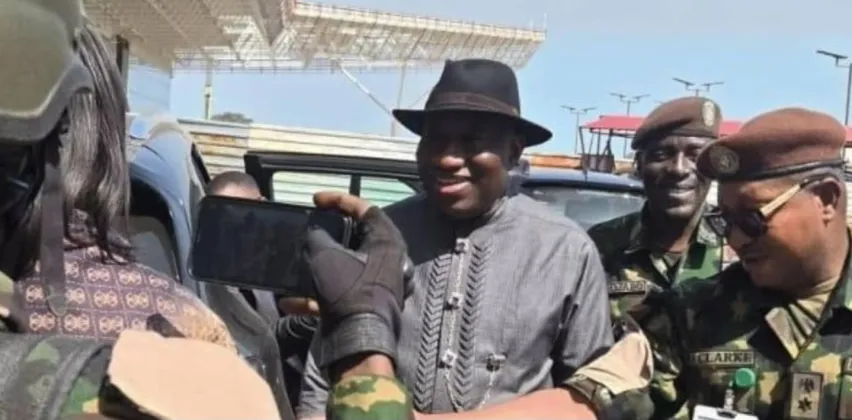
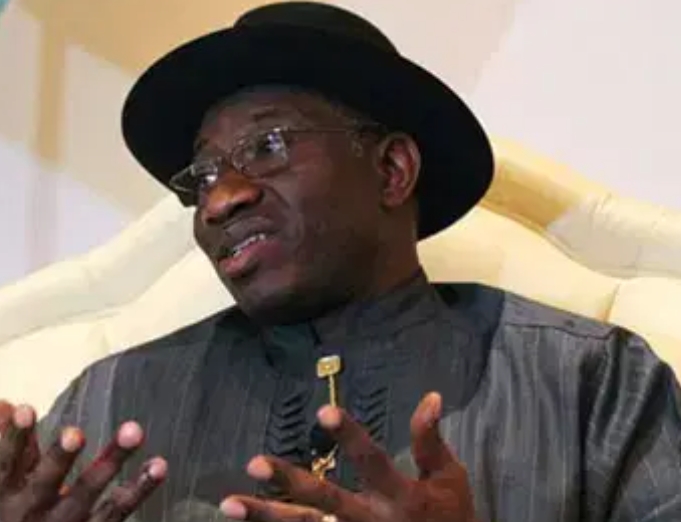
Former President Goodluck Jonathan has insisted that the recent military coup in Guinea-Bissau “was not a coup” and described it as “maybe a ceremonial coup.”

Gunfire had erupted around key government institutions in Bissau on Wednesday as soldiers claimed to have “total control” of the country.
President Umaro Sissoco Embaló also said he was arrested in his office at the presidential palace, sparking panic and prompting the military to impose a curfew, suspend the electoral process, close borders, and detain senior officials, including top military and interior ministry figures.

The Federal Government condemned the development as “a serious threat to democracy and regional stability,” and confirmed that Jonathan, who was in the country as head of the West African Elders Forum Election Observation Mission, was safely evacuated by a special flight alongside members of his delegation.
In an interview with Symfoni posted on YouTube on Friday, Jonathan said he was compelled to speak to the media to thank Nigerians for their concern during the crisis and to clarify the situation.
“You know, since I left office, I’ve always been scared of talking to the media. But in this particular case, I decided to speak… first and foremost, to thank Nigerians for the show of empathy, the encouragement,” he said.
He explained that during the so-called coup, Guinea-Bissau’s President, Embaló himself announced that he had been arrested before the military made any public declaration.
“I wouldn’t call it a coup. It was not a coup. I would just say, for want of a better word, maybe it was a ceremonial coup. Because for two things: It is the president, President Embaló, who announced the coup. Later, the military men came up to address the world that they were in charge of everywhere.
“Then Embaló had already announced the coup, which is strange. Not only announcing the coup, but Embaló, while the coup took place, was using his phone and addressing media organisations across the world that he had been arrested,” Jonathan said.
The former president expressed disbelief at the manner in which the incident unfolded, comparing it to other military takeovers in West Africa.
“I’m a Nigerian close to 70, and I know how they keep heads of state when a coup takes place. Recently, I was a mediator in Mali. And within that period, we had a military coup.
“The military doesn’t take over governments, and the sitting president that they overthrew would be allowed to be addressing press conferences and announcing that he has been arrested. Why does this happen? Who is fooling whom?” he asked.
Jonathan also called on ECOWAS and the African Union to ensure the timely announcement of election results, stressing that the military should not interfere with the democratic process.
“Basically, what happened in Guinea-Bissau is quite disturbing to me, who believes in democracy. They have the results because AU and ECOWAS officials were in all the regions when the results were collated. They cannot change those results.
“They should tally all those results and announce them. They cannot force the military out. They must announce and let the world know who won that election. Let the world know who won that election,” he said.
He further recalled his experience overseeing elections in Côte d’Ivoire, emphasising that election outcomes must be respected.
“A similar thing happened in Côte d’Ivoire when I was the Chair of the Authority of Heads of State and Government of ECOWAS. “When we had elections in Côte d’Ivoire in 2010, Laurent Gbagbo was the sitting president. In the first round, Gbagbo got forty-something per cent of the votes, and Alassane Ouattara got thirty-something per cent of the votes.
“And their law, you must get 50 per cent of the votes plus one, at least. Democracy is about the majority. You must get a simple majority to be the president, so they had to go for a second round.
“When they went for the second round, all those other candidates that lost now supported Ouattara, and Ouattara then got more votes than Gbagbo. And Gbagbo said he was not going, that he won the election, and that Ouattara and somebody who had something could not come and defeat him. But that is their law.
“Then all the observers in the international community said Ouattara won the election. And we in ECOWAS said, well, you are our colleague, but you have to go. If the observers, everybody, say Ouattara won the election, Ouattara must be sworn in as the president of Côte d’Ivoire. I stood my ground as the Chair of the Authority of Heads of State and Government of ECOWAS, and Ouattara was sworn in,” he said.
News
Association of Medical, Dental Academics in Nigeria gives FG three week ultimatum or face strike
The Nigerian Association of Medical and Dental Academics (NAMDA) has given the Federal Government a three-week extension to conclude negotiations over its outstanding demands, warning that failure to reach an agreement could trigger a three-day warning strike.
The association issued the ultimatum in a communiqué released to journalists in Uyo on Friday, following its Emergency National Executive Council (E-NEC) meeting.
The communiqué, endorsed by the President, Nosa Orhue, and the Acting Secretary-General, Aniekan Peter, said the extension would run until August 31, 2026.
It stated, “A three-week timeline extension was adopted for a possible further consideration. E-NEC further resolved that the extension period should be utilised by government to resolve all outstanding issues.
“Failure to achieve meaningful resolution at the expiration of the period ending on the 31st of August 2026 shall result in the declaration of a three-day warning strike to be announced by NOC.”
NAMDA also directed all its branches nationwide to engage their members through congresses and sensitisation programmes at least twice during the extension period.
The branches are expected to submit evidence and reports of the mobilisation activities to the National Executive Council through the secretariat, indicating their level of preparedness for possible strike action.
The association expressed concern over what it described as the government’s reluctance to conclude negotiations, while commending the Department of State Services (DSS) and other stakeholders for their interventions in the process.
NAMDA also appreciated its members for their patience and cooperation in maintaining stability within the university system.
The association further lamented the alleged neglect of medical education and training amid the shortage of medical and dental doctors and the increasing migration of professionals, popularly known as the “Japa” syndrome.
It reaffirmed its commitment to pursuing the full implementation of all approved benefits for medical and dental lecturers and urged its members to comply with all directives and decisions reached at the meeting.
News
Why FCT can’t have state police — Senate
The Senate has explained why the Federal Capital Territory will not be included in the proposed state police structure, saying Abuja lacks the constitutional institutions required to operate one.
Chairman of the Senate Committee on Media and Publicity, Yemi Adaramodu, said the FCT has no governor or State House of Assembly and remains directly under the control of the Federal Government.
Adaramodu said the territory is administered by a minister who takes directives from the Federal Executive Council, while the National Assembly performs legislative functions for the FCT.
“I have heard many people raise a lot of questions on why the Federal Capital Territory is not among the plan for state police. The FCT issue is different. It is under the Federal Government,” he said.
He added that because Abuja does not have a governor or state legislature, it cannot operate under the same policing arrangement being proposed for the 36 states.
“The federal capital does not have an assembly. It is the National Assembly that legislates for the FCT. This is why it can’t be different from what the Federal Government does. Therefore, the federal police are in charge,” Adaramodu said.
The clarification comes as the Federal Government pushes ahead with plans for a new policing structure amid mounting calls for decentralised security across the country.
President Bola Tinubu is expected to receive the draft Executive National Policing Bill on September 3 as part of efforts to provide an operational framework for the proposed system.
Chief of Staff to the President and Chairman of the Presidential Working Group on the National Policing Bill, Femi Gbajabiamila, had also unveiled a public information portal through which Nigerians can submit memoranda and position papers on the proposal.
Under the constitutional amendments being considered, state Houses of Assembly would have powers to legislate on the establishment, administration, funding and oversight of state police.
States would bear the primary responsibility for funding their police formations, although the Federal Government could provide grants or assistance on the recommendation of the National Police Council and subject to approval by the National Assembly.
The FCT, however, would remain under the federal policing structure because of its unique constitutional status and direct administration by the Federal Government.
News
Gov Abiodun Commends Army, Police, DSS, Others for Intelligence-led Rescue of 5 Kidnapped Poly Students, 2 Others
Governor Dapo Abiodun of Ogun State has lauded the Department of State Services (DSS), the Nigerian Army, the Nigerian Police, as well as Civil Defence Corps (NSCDC), for rescuing five kidnapped students of Gateway ICT Polytechnic, Saapade, in Remo North Local Government Area of the state.
The students, who were abducted by suspected kidnappers earlier this week, were rescued in the early hours of Friday, in an intelligence-led operation around Alamala community, off Ayetoro Road Roundabout, of the state capital. Also rescued were two non-students.
The governor described the rescue as a major breakthrough in its fight against kidnapping, even as he reaffirmed his administration’s unwavering commitment to ensuring that kidnappers and other criminal elements have no hiding place in the state.
He described the operation, which included members of the State Security Network Agency (Amotekun Corps), local vigilantes and hunters, as a demonstration of the success that can be achieved when security agencies work together.
“One of the victims sustained a gunshot injury during the incident and was immediately evacuated for medical attention. The student has since been stabilised.
“This operation is still ongoing, and I wish to assure the good people of Ogun State that our security agencies remain on the trail of every individual connected with this criminal enterprise,” said the governor.
“Our resolve is very clear. Ogun State will remain hostile to criminality and safe for every law-abiding citizen, resident and investor,” the Governor declared, stressing that
According to him, recent joint security initiatives, particularly Operation Kò S’Áyé, have demonstrated the effectiveness of intelligence sharing, inter-agency collaboration and sustained operational pressure against criminal elements.
The governor also commended President Bola Ahmed Tinubu for his administration’s commitment to combating banditry, terrorism and kidnapping across the country, noting that the recent rescue of 308 abducted victims by Nigerian security forces underscores the growing effectiveness of coordinated security operations nationwide. (Reuters)
“At this juncture, I must acknowledge the purposeful leadership of President Bola Ahmed Tinubu, whose administration has placed the restoration of peace and security at the centre of Nigeria’s development agenda through sustained investment in the operational capacity of the Armed Forces and other security agencies.
“The strengthening of intelligence coordination, the acquisition of modern security assets and his deliberate reforms have continued to deepen inter-agency collaboration,” he said.
The governor further noted that the Federal Government has continued to strengthen the nation’s security architecture, adding that the recent approval of a substantial salary increase for officers and men of the Armed Forces would further boost personnel welfare and morale.
“One of the kidnapped victims sustained a gunshot injuries during the operation and was immediately evacuated for medical attention and has since been stabilised.” disclosed a security source.
-
Politics19 hours agoAccord party demands removal of EFCC chairman immediately
-
News19 hours agoReps Minority Caucus Fault Tinubu Over Osun Accounts, Allege Plot to Intimidate Opposition
-
Crime19 hours agoSAD: Teenager kills grandparents, six others in Thailand
-
News5 hours agoPhotos: Yusuf, Sanusi unite 1,500 couples in Kano mass wedding
-
News5 hours agoFresh Court Document Reveals EFCC Secured Order Freezing Three Osun Govt Accounts, Not One
-
Economy4 hours agoEquities market records N235bn gain
-
News18 hours agoEx-VP Atiku raises alarm over strange payment into his account
-
News5 hours agoI Will Involve Trump Over Osun Election If… – Davido Warns