Connect with us

News

Bomb Blast Rocks Borno Community, Kills Four

Published

on

ADVERTISEMENT
Zoom Ad
ADVERTISEMENT
Zoom Ad

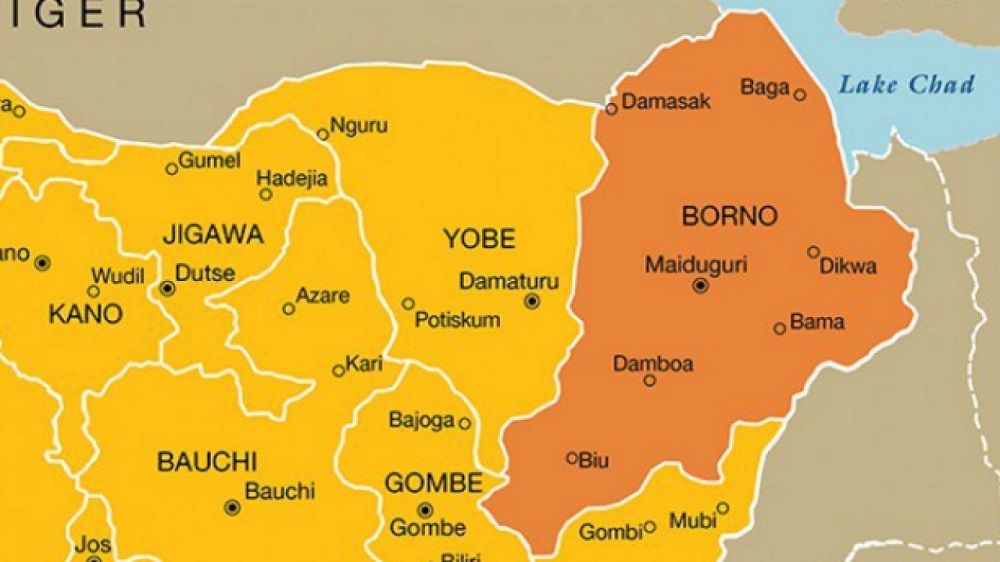
A tragic bomb explosion shattered the fragile calm in Banki, a border community in Bama Local Government Area of Borno State, on Friday, leaving four young boys dead and another seriously injured.


The incident, which occurred in the Bayan Tasha area of the insurgency-ravaged town, has once again drawn attention to the lingering dangers posed by unexploded improvised explosive devices (IEDs) scattered across parts of the North-East.

According to the Borno State Police Command, the explosion was triggered by an IED the boys had picked up two days earlier on the outskirts of Banki, mistaking it for scrap metal. The victims—identified as 15-year-old Awana Mustapha, 14-year-old Malum Modu, and two 12-year-olds, Lawan Ibrahim and Modu Abacha—were all killed instantly when the device detonated inside a small room where they had gathered.

A fifth boy, 12-year-old Mustapha Tijja, miraculously survived the blast but sustained severe injuries from metal fragments. He was immediately transported to the FHI 360 NGO Clinic in Banki for emergency treatment and is, according to police, responding to medical care.

Advertisement

In a statement confirming the incident, the spokesperson for the Borno State Police Command, ASP Nahum Kenneth Daso, described the circumstances as heartbreaking and avoidable. “The 12-year-old boy, one Mustapha Tijja, sustained serious injuries from the IED fragments and was rushed to the FHI 360 NGO Clinic, Banki, for medical treatment, where he is currently responding to treatment,” Daso said.

Local sources disclosed to journalists that the boys were believed to be scavengers who often searched through abandoned sites for items they could sell as scrap. Two days before the explosion, they found the metallic object near the outskirts of Banki town and brought it home, unaware that it contained explosives.

A security operative familiar with the investigation revealed that the parents of the boys had actually warned them to return the object, but the children stubbornly refused, fascinated by its appearance and potential monetary value.

“Our investigation shows that two days ago, the boys, between the ages of 12 and 15, picked the explosive device from the outskirts and brought it into their home, mistaking it as scrap metal,” the source said. “Their parents confirmed that they saw it and asked them to return it but they refused. They were trying to dismantle it when the bomb went up and killed four of them inside the room.”

Advertisement

The source added that the force of the explosion completely destroyed the room, burning down clothing, food supplies, and other belongings belonging to the displaced families who had been living there.

Tragically, all four boys came from families already displaced by the Boko Haram insurgency. Two of the victims were siblings, another was their cousin, while the fourth boy was the child of a neighbour. Their families, like thousands of others in Bama and surrounding towns, were living as internally displaced persons (IDPs) in an abandoned church building that had been converted into temporary shelter.

Residents in Banki say the incident has thrown the entire community into mourning, as the victims were well-known and their families had endured years of hardship due to violent extremism in the region.

“We have suffered too much already,” one resident lamented. “These children survived Boko Haram attacks, only to die because of leftover explosives they mistook for scrap. It is painful.”

Advertisement

Borno State, the epicentre of Nigeria’s battle against Boko Haram and Islamic State West Africa Province (ISWAP), is littered with explosive remnants of war—landmines, IEDs, and abandoned ordnance. Humanitarian agencies have repeatedly warned that unexploded devices remain a daily threat to farmers, herders, travellers, and especially children, who sometimes mistake strange objects for toys or valuable scrap.

Banki, located near the Cameroon border, has been a hotspot of insurgent activity and military operations for years. As displaced families gradually return or settle in semi-permanent shelters, the risk of encountering explosive materials has increased, particularly in rural outskirts where battles once occurred.

Human rights groups say Friday’s incident underscores the urgent need for intensified demining activities and public awareness campaigns in conflict-affected communities.

Following the tragic explosion, the Commissioner of Police extended condolences to the bereaved families and urged residents to be more cautious in handling unfamiliar items found in their environment.

Advertisement

In the formal advisory issued by the police command, residents were strongly warned not to pick up, tamper with, or store strange objects—metallic or otherwise—no matter how harmless they may appear.

He also called for greater cooperation between residents and law enforcement authorities. He urged the public “to promptly report any suspected items sighted at the nearest police station.”

As news of the deaths spread across Banki, hundreds of residents gathered around the charred remains of the boys’ dwelling, struggling to come to terms with the tragedy. For many, the deaths are a painful reminder of the long-term consequences of a conflict that has persisted for over a decade.

Local elders say the incident has renewed calls for international organizations and government agencies to launch more robust sensitization programs targeting children—especially scavengers—who face heightened risk due to poverty and lack of formal education.

Advertisement

Meanwhile, humanitarian workers in Banki say they are monitoring the condition of the lone survivor, Mustapha Tijja, and providing psychological support to the grieving families.

As the community buries its young victims, the tragedy adds yet another chapter to the unending toll of the insurgency, reminding all that long after the gunfire stops, the remnants of war continue to claim innocent lives.

Continue Reading
Advertisement

News

Stone Age lost Atlantis about 8,500 years discovered beneath the waters of Denmark

Published

on

ADVERTISEMENT
Zoom Ad
ADVERTISEMENT
Zoom Ad

By Ojomah Austin.


The mystery of Atlantis has created a city-sized gap in our grasp of history, with archaeologists searching the oceans for any trace of this submerged civilisation.

A prominent theory suggests that Atlantis never actually existed. Nevertheless, as we’re now aware, the notion of a coastal settlement being consumed by the ocean is entirely plausible.

Advertisement

Subsequently, archaeologists in Europe believed they’d discovered the missing piece of the puzzle. You wouldn’t necessarily expect Denmark to be the maritime location of an exotic lost metropolis from ancient times, yet this is precisely where archaeologists unearthed the most compelling proof of Atlantis, according to Global News.

“Europe’s Atlantis”, stretching back to the Stone Age, was discovered beneath the waters of Denmark’s Bay of Aarhus. Researchers unearthed numerous artefacts that paint a picture of a civilised community that inhabited the area nearly 8,500 years ago.

These included stone implements, arrowheads, animal remains, and even fragments of timber that appeared to be rudimentary tools.

Researchers plunged 26 feet beneath the surface of Denmark’s second-largest city, employing specialised suction apparatus, to retrieve the remains of Europe’s Atlantis.

Advertisement

The location dates back to the conclusion of the last Ice Age, when climbing sea levels submerged entire coastal communities, forcing Stone Age hunter-gatherer societies inland.

Because the artefacts have remained underwater for millennia, they are significantly better preserved than they would be inland. “What we actually tried to find out here is how life was at a coastal settlement 8,500 years ago,” archaeologist Peter Moe said.

He added: “Here, we actually have an old coastline. We have a settlement that was positioned directly at the coastline. What we actually try to find out here is how was life at a coastal settlement.

“It’s like a time capsule. When sea level rose, everything was preserved in an oxygen-free environment … time just stops. We find completely well-preserved wood. We find hazelnut. … Everything is well preserved.

Advertisement

“We can say very precisely when these trees died at the coastlines,” Moesgaard Museum dendrochronologist Jonas Ogdal Jensen, according to Fortune.


The specialist explained how this remarkable find has shed considerable light on how sea levels have shifted throughout history.

Stone Age lost Atlantis found is Denmark

He said: “It’s hard to answer exactly what it meant to people,” Moe Astrup said. “But it clearly had a huge impact in the long run because it completely changed the landscape.”

Researchers are keen to press ahead with investigations at a further site off the German coastline, with ambitions to examine locations in the notoriously unforgiving North Sea also in the pipeline.

Advertisement

Yet this is not the first occasion archaeologists have drawn comparisons between a site and Atlantis. Doggerland was a landmass that once extended between Britain, Denmark, and the Netherlands, linking the corners of Europe.

In 1931, evidence of this lost territory began to emerge after a Dutch fishing vessel retrieved artefacts from the seabed. A portrait of a hunter-gatherer community thousands of years old began to take shape. Yet, some 8,200 years ago, rising sea levels and a catastrophic tsunami ultimately swallowed this civilisation whole.

A colossal underwater landslide set off a chain of unstoppable natural disasters that plunged the landmass beneath the waves. Today, all that remains of this lost world lies buried under the North Sea.

Advertisement
Continue Reading

News

Amnesty International condemns attack on Abuja protesters as Sowore lands in hospital

Published

on

ADVERTISEMENT
Zoom Ad
ADVERTISEMENT
Zoom Ad

By Kayode Sanni-Arewa

Condemns his alleged “deliberate targeting”

Amnesty International has condemned what it described as a “reckless attack on peaceful protesters” during a Democracy Day demonstration in Abuja, where activist and African Action Congress 2027 presidential candidate, Omoyele Sowore, reportedly collapsed after security operatives allegedly fired teargas.

In a statement released on Friday, the rights organisation said Sowore was “subsequently taken to a hospital” following the incident at Unity Fountain, Abuja, and called for an immediate investigation into what it described as his “deliberate targeting.”

Advertisement

The Nigerian authorities are clearly using violence to crack down on human rights, including the rights to freedom of expression and peaceful assembly,” the statement said.

Amnesty International also warned that targeting activists for participating in peaceful demonstrations amounted to unlawful conduct and a breach of fundamental rights.

“Such targeting of activists solely for exercising freedom of assembly is unlawful and shows utter disregard for the rule of law,” it said.

The organisation further accused the authorities of failing to demonstrate commitment to constitutional and international human rights obligations, alleging a continued crackdown on civic freedoms under President Bola Tinubu’s administration.

Advertisement

Sowore’s collapse reportedly occurred during a protest in Abuja where security operatives allegedly dispersed demonstrators with teargas in front of the Force Headquarters.

Videos shared online showed him on the ground amid confusion as protesters attempted to assist him.

The protest was part of a nationwide mobilisation by a coalition of civic groups, labour activists, youth organisations and social movements, which had declared June 12 a day of mass action over insecurity, economic hardship and worsening living conditions. (Text, excluding headline:

(The PUNCH)

Advertisement
Continue Reading

News

Falana, Falz lead protest over kidnappings, hardship

Published

on

ADVERTISEMENT
Zoom Ad
ADVERTISEMENT
Zoom Ad

By Kayode Sanni-Arewa

Activist lawyer, Mr Femi Falana (SAN), his son – afrobeats singer, Mr Folarin Falana, popularly known as Falz, alongside civil society organisations, youth groups, among others, on Friday staged a protest in Lagos.

They demanded urgent action to address worsening insecurity and economic hardship in the country.

The protest came as Nigeria marked Democracy Day, set aside in remembrance of the June 12, 1993 presidential election, widely acclaimed to have been won by late Chief MKO Abiola.

Advertisement

The election, though regarded as the freest and fairest in the nation’s history, was annuled by the then military government.

Chanting, the protesters converged on the Ikeja Under Bridge, carrying placards with inscriptions such as “No Democracy Without Security,” End Bad Governance,” and “End Insecurity and Kidnapping.”

Others include, “End Hunger,” “Free All Captives Now,”End all anti-people policies now,”

The demonstration was aimed at drawing attention to rising insecurity, economic hardship and policies affecting ordinary Nigerians.

Advertisement

Speaking during the protest, Falana called for the immediate release of abducted pupils and teachers in Oyo State, expressing concern over their welfare in captivity.

According to him, the protest is not only about demanding the rescue of the abducted victims but also about highlighting broader issues of injustice, insecurity and poverty confronting Nigerians.

“We are protesting the kidnapping of our children in Oyo State. We are also protesting injustice in our country, a situation whereby innocent school children in Oyo and Borno states have been in the custody of criminals for several weeks now.

“We are also protesting injustice meted out to young people who are regularly arrested on the highways by the police.

Advertisement

“We are protesting hunger and poverty in the land, and we are calling on the government to address these challenges,” he said.

Falana, a human rights advocate, lamented the condition of the abducted children and teachers, and regretted the killing of one of the latter.

He called on the authorities to intensify efforts to secure the release of the remaining victims.

Also addressing the protesters, Falz bemoaned what he described as worsening insecurity and economic hardship across the country.

Advertisement

The entertainer and activist said Nigeria was grappling with increasing cases of kidnappings and killings, urging the government to do more in its responsibility of protecting the citizens.

“Everybody can see the worsening insecurity. It is becoming unbearable,” he said.

Falz cited recent abductions in different parts of the country, including the kidnapping of students and the abduction of a relative of a former minister in Oyo State.

“Every Nigerian life matters and must be protected at all costs,” he stated.

Advertisement

He said that the repeated abduction of students had heightened public frustration and anxiety.

Also speaking, human rights activist, Mr Olumide Ogunsanwo, popularly known as Seaking, called for stronger government action to tackle insecurity across the country.

He said Nigerians were demanding better governance and an end to the growing wave of killings, kidnappings and other violent crimes.

“We say no to insecurity. Insecurity has to end,” he said.

Advertisement

Ogunsanwo urged the Federal Government to intensify efforts against bandits, insisting that decisive action, rather than rhetoric, was needed to end the insecurity.

Security operatives maintained presence around the protest venue and monitored activities throughout the demonstration.

(NAN)

Advertisement
Continue Reading

Trending

Copyright © 2024 Naija Blitz News