Opinion
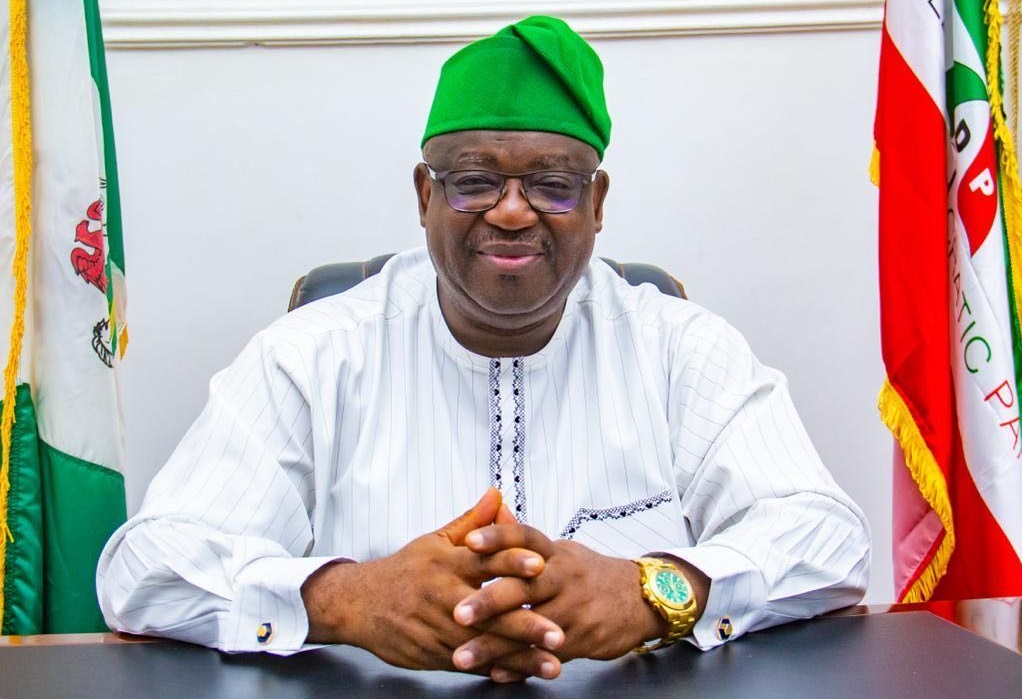
A compass pointing to progress: The Ernest Umakhihe momentum, By Sufuyan Ojeifo
- /home/naijuinz/public_html/wp-content/plugins/mvp-social-buttons/mvp-social-buttons.php on line 27
https://naijablitznews.com/wp-content/uploads/2026/03/32a9ede2-1293-435e-aa2f-7e07cf0d6e96-928x600.jpeg&description=A compass pointing to progress: The Ernest Umakhihe momentum, By Sufuyan Ojeifo', 'pinterestShare', 'width=750,height=350'); return false;" title="Pin This Post">
- Share
- Tweet /home/naijuinz/public_html/wp-content/plugins/mvp-social-buttons/mvp-social-buttons.php on line 72
https://naijablitznews.com/wp-content/uploads/2026/03/32a9ede2-1293-435e-aa2f-7e07cf0d6e96-928x600.jpeg&description=A compass pointing to progress: The Ernest Umakhihe momentum, By Sufuyan Ojeifo', 'pinterestShare', 'width=750,height=350'); return false;" title="Pin This Post">
There are moments in the life of a people when something unusual appears on the horizon. Not the familiar politician whose promises arrive with great fanfare and depart with suspicious speed, but something steadier. Something that does not merely announce itself but offers direction.

It seems the people of Owan Federal Constituency in Edo State are now at such a moment.
I am inclined to avoid grand metaphors that shine brightly but explain very little. What is required here is not fleeting spectacle. It is reliable orientation.

Call it a compass.
The name of that compass, in this instance, is Dr Ernest Afolabi Umakhihe.
Now, before the choir gathers to sing the usual election hymns, a measure of restraint is in order. Nigerian politics has trained even the most optimistic among us to approach glowing profiles with a certain suspicion. We have heard the speeches. We have seen the posters. And so we have mastered the art of clapping politely while quietly asking a far more important question.
What exactly has this person done previously before stepping forward to offer himself as a possible candidate to represent his people?
It is a simple question. It is also the one that separates serious candidates from enthusiastic storytellers.
In Umakhihe’s case, to his credit, the answer does not require imaginative reconstruction. It sits plainly in the public record. This is a man who has operated at the highest levels of Nigeria’s public service, particularly within the Ministries of Foreign Affairs, Defence, Budget and National Planning, Works and Agriculture and the broader architecture of food security. Not as a commentator. Not as an observer peering in from the outside. But as Permanent Secretary [in Budget and National Planning, Works and Agriculture and Food Security respectively], the point at which policy stops being theory and begins the difficult journey towards implementation.
That distinction matters more than campaign rhetoric ever will.
For a constituency like Owan, where agriculture is not a talking point but a way of life, the difference between theory and implementation is the difference between potential and prosperity. Land alone does not produce wealth. Labour alone does not guarantee success. What bridges the gap is access. Access to programmes, to funding, to infrastructure, to the quiet decisions made in offices far removed from the farms they affect.
This is where the Umakhihe proposition begins to make practical sense.
A man who had sat at the centre of that system does not approach it as a stranger. He understands its rhythms, its bottlenecks, and its possibilities. He knows which programmes have substance and which exist mainly in policy documents. He knows the difference between an announcement and an outcome.
And perhaps most importantly, he knows where the levers are.
Every discerning Nigerian knows that the country’s development challenges are not always the result of a lack of ideas. More often, they stem from a lack of connection between those who need support and the systems designed to provide it. Somewhere between policy formulation and local reality, things have a habit of getting lost.
Occasionally, someone comes along who understands both ends of that journey.
Consider what this could mean in concrete terms. Farmland supported not merely by seasonal enthusiasm but by structured programmes that improve yields. Storage facilities that reduce the quiet tragedy of post harvest losses. Rural infrastructure that ensures produce does not perish on its way to market. Irrigation systems that make farming less dependent on the generosity of the weather.
These are not abstract ambitions. They are the practical outcomes of effective representation linked to relevant experience.
Then there is the question of inclusion, a word that appears frequently in policy discussions but is less frequently translated into action. Umakhihe’s recognition as a gender-friendly permanent secretary is not an ornamental detail. It suggests a track record of ensuring that women who form a significant portion of the agricultural workforce are not treated as an afterthought in the design and delivery of programmes.
In places like Owan, where women carry a substantial share of the burden of food production, that orientation is not merely progressive. It is necessary.
Of course, competence alone is not sufficient. Nigerian politics has produced no shortage of capable individuals who, upon entering elective office, develop an unfortunate allergy to accessibility. The higher they rise, the more distant they become until constituents are left communicating with their representatives through layers of intermediaries who filter both information and intention.
Here, again, the reputation that trails Umakhihe offers a different picture. Accounts of his engagement with communities, his responsiveness to ordinary people, and his consistent support for those in need suggest a style of leadership that does not rely on distance for authority.
I will resist the temptation to canonise any candidate. Experience has taught us that political sainthood is a title best avoided. What can be said, however, is that proximity matters. A representative who listens is more likely to understand. A representative who understands is more likely to act.
Which brings us, inevitably, to the broader political question.
Elections are often framed as contests of popularity, as though governance were a popularity competition conducted at scale. In reality, they are choices about capacity. About who is most likely to convert opportunity into tangible outcomes.
For Owan Federal Constituency, the choice is not between perfection and imperfection. Such options do not exist in politics. The choice is between familiarity and function, between rhetoric and record, between promise and preparation.
Dr Ernest Afolabi Umakhihe presents himself as a candidate whose preparation aligns closely with the needs of his constituency. A background rooted in agriculture and rural development. Experience at the highest levels of policy implementation. A demonstrated concern for inclusion. A reputation for accessibility.
These are not guarantees. Nothing in politics ever is. But they are indicators. In a system where voters must often make decisions with imperfect information, credible indicators are valuable.
A constituency does not require spectacle. It requires direction. It requires a steady hand on the wheel, someone who understands both the terrain and the machinery needed to navigate it.
The opportunity before Owan, then, is not merely to be impressed. It is to be deliberate in the choice of a representative.
Because in the end, constituencies do not develop on the strength of applause. They develop on the strength of choices. And every so often, a choice presents itself that is less about hope and more about alignment between experience and need.
This may well be one of those rare moments. And, Dr Ernest Afolabi Umakhihe, by preparation and by record, presents himself as a compass pointing towards progress.
■ Sufuyan Ojeifo is the publisher/Editor-in-Chief of THE CONCLAVE online newspaper.
Opinion
‘To Keep It Coming’: Reflections on Framework Building, Idea Formation and Scholarly Reception
By Max Amuchie | The Sunday Stew
There is a specific kind of validation that academia confers and another that the world confers. The academy signals acceptance through citation, peer review, and the slow machinery of scholarly publication. The world signals it differently — through use. When a scholar picks up your framework not merely to interrogate it, but to build with it, something important has shifted. That is not endorsement. That is adoption.
That is what happened when Dr. Omoniyi Ibietan — Secretary General of the African Public Relations Association (APRA) and a Fellow of the Nigerian Institute of Public Relations (NIPR)—reached for The Insecurity Triad to anchor the theoretical foundations of his paper on crisis communication in the Agatu conflict. He did not cite it as a curiosity. More importantly for this discourse, Ibietan is a member of doctoral faculty at Rome Business School’s DBA programme.
He used it as a load-bearing wall.
His words, addressed to Premium Times editorial page editor Ololade Bamidele, are worth sitting with: the framework took him back to Mbembe, offered fresh insight into, and — and then did something rarer. It shaped what he was about to write. “So compelling was it,” Ibietan noted, “that it shaped my theoretical framing for a new paper I just submitted.”
Ibietan’s message to Bamidele was in response to last week’s edition of The Sunday Stew entiteld: ‘The Insecurity Triad: Azikiwe, Awolowo, and Chinweizu — Nigeria’s Elite Class of Framework Builders’.
Dr Ibietan’s words: “Thank you Ololade Bamidele. Please tell Dr. Amuchie to keep it coming. The first part of this took me back to Mbembe (one of Africa’s leading representation of activistic scholarship). Amuchie offered me a refreshing, lovely insight of the works of (Ali) Mazrui, (Claude) Ake, (Jean-François) Bayart, (William) Reno, especially his treatise on the ‘Relocation of Authority’ and of course Mbembe. It was a meta-analytical enterprise. So, compelling was it that it shaped my theoretical framing for a new paper I just submitted on Crisis Communication in the Agatu Crisis. Needless to say this is also beautiful.”
This is not simply a compliment from a respected scholar. It is evidence of intellectual utility. Scholars are exposed to thousands of ideas during their careers. Very few are incorporated into ongoing research. Fewer still alter the theoretical architecture of work already in development. When an established academic changes the lens through which he interprets a conflict because of a framework he has encountered, that framework has crossed an important threshold. It has moved from proposition to application.
What makes Ibietan’s validation particularly significant is his position within African scholarly and professional networks. He occupies a rare intersection of communication studies, governance research, public policy, and professional practice. His adoption therefore functions as more than an individual scholarly decision. It is an early signal that the Insecurity Triad possesses interdisciplinary reach. A framework developed primarily to explain insecurity and conflict dynamics has proven capable of informing crisis communication research. That is not a small achievement. It suggests conceptual elasticity without sacrificing analytical precision.
What makes this moment even more consequential is that the Insecurity Triad was never designed as a self-contained theoretical exercise. It was built to travel. Its three pillars — Money, Land, and Mind — were deliberately constructed to be analytically portable across conflict environments, governance challenges, and security ecosystems. Ibietan applied it to the Agatu crisis, a deeply localised conflict in Benue State with its own history of farmer-herder tensions, displacement, and contested narratives. The framework held. It supplied categories capable of explaining not only the drivers of insecurity but also the communicative environment surrounding conflict.
That portability is often what separates enduring frameworks from temporary concepts. Many theories explain a single case. The most influential frameworks explain multiple cases without losing explanatory power. They move across disciplines. They generate new questions. They create intellectual bridges between fields that previously appeared unrelated. The early evidence suggests that the Insecurity Triad possesses precisely these qualities.
There is also a broader significance to this moment. African intellectual production has long suffered from a structural asymmetry. Frameworks generated in Europe and North America routinely become the default lenses through which African realities are interpreted, while concepts generated from African experience often struggle to achieve comparable visibility. As a result, African scholars frequently find themselves applying imported theories to indigenous problems rather than exporting indigenous theories to the wider world.
The Insecurity Triad represents an attempt to reverse that flow. It is a framework theorised from Nigerian and Sahelian realities, derived from empirical observations of conflict, governance failures, criminal economies, and social fragmentation. Its ambition is not merely to describe Africa but to contribute to the global vocabulary of security studies.
That is why Ibietan’s engagement matters. Validation from a scholar of his standing demonstrates that the framework is not circulating solely because of media visibility or public debate. It is entering scholarly workflows. It is influencing research design. It is becoming part of the knowledge-production process itself.
His comparison to Mbembe is instructive. Achille Mbembe’s concept of necropolitics did not become influential because people admired it. It became influential because scholars found it useful. It provided explanatory power where existing frameworks fell short. Researchers adopted it, tested it, extended it, and applied it across contexts far removed from its original formulation.
The Insecurity Triad is not Mbembe, nor should it be measured against the trajectory of a mature global theory. But the comparison illuminates an important principle: intellectual influence begins when a framework starts solving analytical problems for other scholars. Ibietan’s adoption suggests that this process may already be underway.
The Agatu application is therefore more than a citation. It is proof of concept. It demonstrates that the framework can survive contact with a different discipline, a different methodology, and a different research question. In academic terms, that is often the first indication that a concept has genuine staying power.
What the scholarly community should watch is not whether the Insecurity Triad receives more praise — praise is abundant and often fleeting — but whether it continues to be used. Frameworks earn their place in the canon not through applause but through repeated deployment. They become influential when researchers begin treating them as tools rather than subjects.
Ibietan’s paper carries the architecture of the Triad into the literature on public relations, crisis communication, and conflict management. Tomorrow another scholar may apply it to political economy, peacebuilding, migration, state legitimacy, or violent extremism. Each application expands the framework’s reach. Each successful application increases its explanatory credibility.
That is how ideas compound. That is how indigenous theories become established traditions. That is how a framework moves from being an author’s insight to becoming part of a field’s intellectual infrastructure.
The Insecurity Triad is now in motion. The significance of Ibietan’s validation lies not simply in who endorsed it, but in what he did with it. He built upon it. He carried it into new terrain. He demonstrated that it travels.
The question is no longer whether the framework can move beyond its point of origin. It already has.
The question now is how far it will travel.
Unveiling the DSI in The Sunday Stew
As an undergraduate at the University of Calabar, one of the first sets of books to catch my attention was The Open Society and Its Enemies, Karl Popper’s landmark two-volume 1945 work of political philosophy. In it, he passionately defended liberal democracy and mounted a fierce critique of totalitarianism. The other book of his I picked up was The Poverty of Historicism published in 1957, where he attacked the intellectual and logical validity of authoritarian teleology. While The Poverty of Historicism targeted the foundational logic, The Open Society dismantled the devastating political consequences of totalitarian rule.
However, long before he turned his sights on totalitarianism, the Austrian-British philosopher had already revolutionised western epistemology. In his groundbreaking 1934 book, The Logic of Scientific Discovery (Logik der Forschung), Popper introduced the concept of falsifiability as a solution to the demarcation problem—the question of how to distinguish between genuine science and non-science (such as pseudoscience, metaphysics, or myth). At its core, the concept insists that for a theory to be considered scientific, it must be falsifiable. This means there must be at least one logically possible observation, metric, or experiment that could prove the theory wrong. A theory that explains everything, explains nothing.
For three consecutive weeks in this column beginning on April 26, I laid bare the Trinity of State Decay (TSD)—a macro-diagnostic theory mapping how nations fracture into dual or competing sovereignties. I analysed how this structural deterioration plays out in Nigeria and across the wider Sahelian context. Yet, the theory is fundamentally scalable; it applies to all contexts and geographies where the devastating conditions of the Insecurity Triad take root, from the fault lines of Latin America to the fragile corridors of Southeast Asia.
But to save the Trinity of State Decay from the graveyard of mere political commentary or fluid narrative, it must meet Popper’s uncompromising standard. It must be measurable. It must be testable. It must expose itself to empirical refutation.
By anchoring the theoretical formulation to quantitative metrics, I provide international organisations and the global scholarly, policymaking and intelligence communities with a verifiable yardstick. If the state’s legal authority and empirical reality remain tightly bound, the index will prove it; if they are violently drifting apart, the index will map the velocity of that separation.
Next week, therefore, I cross that scientific Rubicon. I will unveil the Decoupling Sovereignty Index (DSI).
I am moving from description to diagnosis.
Trust is sacred. Stay seasoned.
•Dr. Max Amuchie is the CEO of Sundiata Post and architect of The Insecurity Triad and Trinity of State Decay. He writes The Sunday Stew, a weekly syndicated column on faith, character, and the forces that shape society, with a focus on Nigeria and Africa in a global context.
X — @MaxAmuchie | Email: max.a@sundiatapost.com | Tel: +234(0)8053069436
Opinion
Gov Mbah’s $30 Billion Bet: Turns Enugu Investors’ Magnet In 3 Years
A Spotlight By Nnolim Nnaji, Member House Of Representatives
As Nigeria marks Democracy Day, Enugu State has quietly emerged as one of Nigeria’s safest and fastest-growing economy under Governor Peter Mbah. Three years in, the administration’s narrative is shifting from laying foundations to scaling transformation, anchored on an audacious goal: a $30 billion economy by 2031.
The numbers back the ambition. Enugu’s 2026 budget stands at ₦1.62 trillion, a 66.5% jump from 2025. What’s striking isn’t just the size, but the structure. 80% of the budget, ₦1.296 trillion, is allocated to capital projects, breaking the recurrent-heavy spending pattern that has trapped most Nigerian states. The shift is powered by a surge in internally generated revenue. IGR contributes 51% of the 2026 budget, roughly ₦825.9 billion, cutting the state’s overdependence on federal allocations and giving Enugu more fiscal autonomy to execute its plans.
Security was the first wall Mbah’s team had to break. By tackling insecurity head-on, Enugu has become one of the safest states in the country, a prerequisite for investment. Phase 2 of the state’s surveillance system, budgeted at ₦11 billion, will deploy CCTV and searchlights at bus stops, junctions, and highways, all linked to a central command center. That sense of security has translated directly into investors confidence. In the last three years, Enugu secured over £500 million in foreign direct investment, with another £2 billion in the pipeline. The pitch to investors is simple: internal rate of return projections of 25-40% making Enugu one of the most competitive emerging-market destinations in Nigeria. The result is visible in the rankings, with the state climbing from 36th to 6th in Nigeria’s ease of doing business index. With the proposed coal power generation plant set to come on stream, more FDI inflows are expected.
Infrastructure has been the most visible proof point. The administration is pushing legacy road projects like the 40km Owo–Ubahu–Amankanu–Neke–Ikem Dual Carriageway, the Abakpa Nike–Ugwogo Nike–Ekwegbe–Opi–Nsukka Road, the Amodu–Akpugo–Akpawfu–Amagunze Road, and upgrades of Enugu–Abakaliki Expressway. The 2026 plan targets 1,200 urban roads and numerous rural roads, ensuring every LGA gets a major project. The goal is to eliminate the rural-urban connectivity gap that has stifled trade and access for decades.
Human capital and basic services are getting the same treatment. The 260 Smart Green Primary Schools and 260 Type-2 Primary Health Centers, one per ward, are nearing completion. Water supply is being revamped through the 9th Mile 24/7 Scheme, Ajali, and Oji River projects. These sit alongside a 10,000-hectare smart city development as a mixed-use commercial and residential hub. If delivered, the schools, health centers, and roads address two of Enugu’s longest-standing pain points: education access and connectivity.
The abandoned International Conference Center and the presidential hotel have been completed to position the state as a hub for regional and national events, tourism, and business summits. At the same time, construction of a state-of-the-art specialist hospital is underway to raise the standard of healthcare delivery and reduce medical tourism out of the state. These projects signal a push to build the kind of infrastructure that attracts investors, skilled professionals, and high-value events.
A less discussed but critical pillar is the revamp of ailing state-owned companies. For years, Enugu’s public enterprises existed mostly on paper, draining resources without delivering value. The Mbah administration is restructuring them for commercial viability and private sector participation, turning dormant assets into revenue-generating ventures, creating jobs, and reducing the burden on the state treasury. This aligns with the broader strategy of mobilizing private capital to complement public spending and accelerate GDP growth from the current ∼$4 billion toward the $30 billion target.
The administration’s boldest signal to the world is Enugu Air. Launched to position Enugu as a regional aviation and logistics hub, the airline plans to grow its fleet to 20 aircraft and expand operations beyond Nigeria by the end of 2026. It already connects the South to the North with daily flights between Enugu and Kano. Enugu is no longer content being a transit point. It has become a destination.
Three years in, the Mbah model is clear: spend on capital, not overhead; secure the state, then market it; and use data-driven incentives like high IRR projections to attract private capital. The risk is execution. Delivering 1,200 roads, functional smart schools, a modern hospital, a completed conference center, revived industries, and a functioning airline in one term is a heavy lift. But if even half of it lands, Enugu will have redefined what subnational governance can achieve in Nigeria.
A Spotlight on Enugu State by Nnolim Nnaji, A member of the House of Representatives
Opinion
ONDO SOUTH SENATE: A NEW CHAPTER BECKONS FOR DR. D.I KEKEMEKE
BY BOLAJI AFOLABI
In the last three to four weeks, the political barometer across the country was charged, as many politicians jostled for various elective positions. Across the major and minor parties, the quest to emerge candidates for states Houses of Assemblies; House of Representatives; Senate; and Governorship brought some frenzy to the political space. As weeks rolled into days, there were clear demarcations and categorization of the aspirants – the serious contenders; the ‘also ran’ group; the ‘coupon’ players; and the outright jokers. Fact is that, each of these were noticeable in all the political parties. From the ruling party, All Progressives Congress, (APC) to the Peoples Democratic Party, (PDP); Social Democratic Party, (SDP); Labour Party, (LP); African Democratic Congress, (ADC); and the newbies Nigerian Democratic Congress, (NDC), politicians of varied persuasion and leanings, with rational and irrational thoughts, as well as sincere and insincere reasons dominated national discussions. All angling for the same thing – candidacies!
At the end of primary elections in virtually all the parties, the dust is clearer, and the cacophony of drama, theatrics has given way to some order in the polity. Away from the buzzing sounds and nuzzling noise, the wheat has been separated from the chaff. To a large extent, there are certainties as to who runs for what in the forthcoming general elections. As expected, the struggle was more fierce in the APC than any other party. Given the peculiarities of our political system, and the mindsets of many politicians, the gravitation towards the APC was readily foretold. With Governors, members of the National Assembly, and some other notable politicians swarming into the ruling party in droves, one cannot expect the contrary during primaries.
Being a beautiful bride, the APC primaries threw up aspirants of varied shapes and sizes. However, at the end of the processes, popular names, not so popular, and fresh faces emerged as the party’s flag bearers for different elective positions in the 2027 polls. From the North to the South, East and West, it was the same. While some outgoing Governors cleared the way for their successors, others emerged as candidates for the Senate – which has become the retirement haven for states chief executives. Also, some preferred choices were railroaded into changing nomenclatures from aspirants to candidates for other elective positions. Though this trend was prevalent in many states, there were few exceptions; where true democratic contests took place.
The APC primaries for Ondo South Senatorial District was one. The list of aspirants who jostled for the ticket included some notable politicians – whose respective resumes are intimidating. Former and present federal legislators, senior party executives, top officials in the state and federal agencies, and some other personalities threw their hats in the ring. For those who understand the place, position, and present status of Ondo South, the number and calibre of aspirants that pushed to be the candidate of the APC was not a misnomer. Variously described as the ‘maritime hub’ and the untapped ‘blue economy wealth’ of the “Sunshine State” the realities of developmental decays and infrastructural deficits that pervade the partly riverine Senatorial District remain painful and pitiable. At the end of the primaries, Dr. I.D Kekemeke emerged the winner with 35, 835 votes – other aspirants including Hon. Akinfolarin Mayowa Samuel, and Hon. Morayo Lebi scored 6,435 and 1,845 respectively.
Considering the tendencies of Nigerian politics, the writer sought for details about the Ondo South Senatorial primaries. The inquisition was driven by one reason. Sometime in October 2025, one was invited to a get-together in honour of Kekemeke by one of his loyal, reliable, and trusted friends; Architect Stephen Adamu, the Principal Partner and Chief Executive of Pine Projects Limited – one of Abuja’s flourishing architectural firms. By the way, the occasion was to celebrate the Ondo-born politician’s academic feat of earning a Doctorate degree in Law. Kekemeke came across as an unusual personality, uncommon politician, who is outrightly frank, disarmingly humble and altruistic in thought and practice. Fortunately, his participation in the primaries provided an opportunity to authenticate or otherwise these attributes from a few of one’s friends and colleagues – though not politicians – but are bonafide indigenes of the District.
Comrade Adebari Ijadola, a civil rights activist described Kekemeke as, “a well grounded politician whose integrity has never been in doubt, a resourceful networker and bridge-builder whose relational capacities will drive good governance and benefit Ondo South.” A paramilitary service officer who pleaded anonymity said, “he is the best person to address unemployment, youth restivness, and infrastructural decay in Ondo South.” He will leverage on his broad experiences in politics and public service for the general well-being and development of our people and district.” Mr. Tubosun Ayodeji, a serial entrepreneur believes that, “without sounding immodest, Kekemeke’s credibility, integrity, accessibility, and acceptance by many people across the State sets him apart from candidates of other parties.” Corroborating, Ms. Morenikeji Ademola, an educationist averred that, “unlike other politicians, he has always used his positions, both past and present to positively touch the lives of people and contributed to the development of the state.”
While R. Buckminster Fuller, a renowned philosopher said, “integrity is the essence of everything successful,” the legendary boxer, Muhammed Ali declared that, “service to others is the rent you pay for your room here on earth,” and an unnamed sociologist concludes that, “the greatest gift of all is the gift of service to humanity.” Indeed, further checks on Duerimini Isaac Kekemeke, widely called “D.I Kekemeke” or “Frank” is an encapsulation of these timeless words. His political career and public service odysseys are framed, driven by service to the people. He does this with unrestrained passion, unequivocal commitment, and unmistakable fervor. Making people the fulcrum of every engagement, he, at different levels and times, has always emerged as the compass for selfless service and purposeful leadership.
As the Minority Leader of the old Ondo State House of Assembly during the aborted Third Republic between 1992 and 1993, Kekemeke, as a young legislator provided the necessary leadership for the opposition caucus through robust advocacy, people-focussed initiatives, and the promotion of welfarist ideals which was the vision of his party. His records of service did not go unnoticed as he was appointed Member, Constitution Drafting Committee of the Peoples Democratic Party, (PDP) in 1998. As the pioneer Board Chairman of the National Examinations Council, (NECO), between 2001 and 2004, he worked assiduously for national and international certifications of the agency’s examinations; standardization, credibility, and integrity of the examinations; established institutional stabilization, financial and administrative procedures, as well as curbing malpractices.
Further, Kekemeke was Attorney General & Commissioner for Justice; Commissioner for Works, Lands, Housing & Transport; as well as the Secretary to the Ondo State Government between 2003 and 2009. He among other things contributed to physical planning, building of housing estates, construction of over 1,000 km of roads, and the delivery of other infrastructures. He established the Office of the Public Defender which provided free legal services to indigent citizens; embarked on comprehensive justice reform and administration; alternative dispute resolution framework. As the “engine room” of the state government, he provided functional and efficient governance through policy ideation, coordination and execution.
Aside from Kekemeke’s legislative and executive experiences, he is proficient in political administration occupying positions that are critical to party development. He was the pioneer Chairman, Ondo State chapter of the APC; National Vice Chairman (South West), APC; re-elected into the same position in 2025. Given the near-total endorsement of his aspiration within and outside the party and across the state, Kekemeke’s chances of being a Senator at the end of the January 23, 2027 general elections look promising. How well he meets the expectations of his constituents thereafter, remains in the belly of time. Like the legendary Jimmy Cliff sang, “Time Will Tell!”
* BOLAJI AFOLABI, a Development Communications specialist was with the Office of Public Affairs, The Presidency, Abuja.
-
News24 hours agoRead words on marble from FCT minister Wike’s media chat ongoing
-
News24 hours agoWike–Yesufu face-off takes fresh twist as his aide calls her ‘idoti’
-
News22 hours agoWike: Rural Roads, Water Projects Cutting Insecurity in FCT Communities
-
News21 hours agoWike Faults Opposition Parties, Says Crises From Primaries Exposed Their Fake ‘Messiah’ Claims
-
Metro19 hours agoSad: Gunmen kill two police officers returning from duty in Anambra
-
News21 hours agoRead snippets from Wike’s ongoing monthly media chat below
-
Economy19 hours agoSee Exchange Rate Naira To The Dollar, Today June 1
-
News19 hours agoMiddle East conflict: US, Iran exchange fire as negotiations stall