Connect with us

News

Warning! Nigeria faces high Ebola importation risk amid DRC, Uganda outbreaks — NCDC

Published

on

ADVERTISEMENT
Zoom Ad
ADVERTISEMENT
Zoom Ad

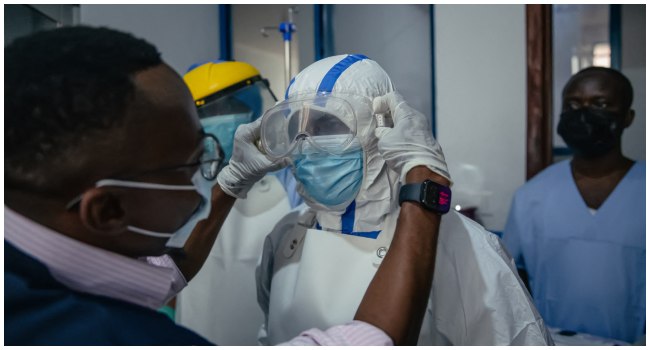
The Nigeria Centre for Disease Control and Prevention (NCDC) has warned that Nigeria faces a high risk of importing the Ebola virus disease (EVD) due to ongoing outbreaks in the Democratic Republic of Congo (DRC) and Uganda.


Despite the absence of any confirmed case in the country, the agency said heightened regional transmission, increased international travel, and cross-border population movement have raised concerns over the possibility of the disease spreading into Nigeria.

In a statement issued on Sunday, the Director-General of the NCDC, Jide Idris, said the agency’s latest risk assessment classified the threat level as high.

“This assessment estimated the risk of Ebola importation into Nigeria as high due to the ongoing transmission in the DRC and Uganda, international travel and population movement, uncertainty regarding the full magnitude of the outbreak, and the potential for delayed recognition because symptoms may overlap with endemic diseases such as malaria and Lassa fever,” the statement read.

Advertisement

The agency disclosed that several states have already been identified as vulnerable because of their proximity to land borders, major transport corridors, and international entry points.

According to the NCDC, response efforts are currently ongoing in the affected countries, including surveillance, contact tracing, laboratory testing, infection prevention and control measures, as well as public sensitisation campaigns.

“However, we are aware of the ongoing Ebola outbreak in the Democratic Republic of the Congo (DRC) and recent reports of a confirmed imported case in Uganda linked to the outbreak in DRC,” the agency stated.

As part of preparedness measures, the NCDC said Nigeria’s national Emergency Operations Centre (EOC) has been placed on alert mode, while the incident management system has also been activated to strengthen national coordination and outbreak response capacity.

Advertisement

The agency added that Nigeria still retains critical structures and expertise developed from previous responses to Ebola and other viral haemorrhagic diseases.

“It also must be noted that Nigeria maintains important response capacities, including laboratory capability, trained rapid response teams, functional emergency operations centres (EOCs), established Viral haemorrhagic fever preparedness structures, and prior experience in successfully responding to Ebola and other viral haemorrhagic fever outbreaks,” the statement added.
“Epidemiologists and rapid response teams (RRTs) are also on alert for rapid deployment to any affected state, if required.”

The NCDC further said laboratories located in states with international points of entry have been placed on standby, while sample collection and transportation systems are being strengthened to support quick diagnosis of suspected infections.

The agency also said it has intensified public communication campaigns to combat misinformation and false claims surrounding Ebola.
“NCDC is strengthening public awareness and risk communication activities, intensifying social listening and rumour management systems, and working with media organizations, healthcare professionals, community leaders, and digital platforms to amplify credible information and promote responsible public discourse,” the statement said.
“NCDC has also developed and disseminated Ebola Myths and Facts materials to address misinformation and false claims circulating online.”
Advertisement
Continue Reading
Advertisement

News

See Naira to Dollar Exchange rate today, July 8, 2026

Published

on

ADVERTISEMENT
Zoom Ad
ADVERTISEMENT
Zoom Ad


The Naira yesterday depreciated to N1,405 per dollar in the parallel market from N1,400 per dollar on Monday.

Likewise, the naira depreciated to N1,379 per dollar in the Nigerian Foreign Exchange Market, NFEM.

Data from the Central Bank of Nigeria,

Advertisement

CBN, showed that the indicative exchange rate for the market rose slightly to N1,379 per dollar from N1,371 per dollar on Monday, indicating N8 depreciation for the naira.

Consequently, the margin between the parallel and official markets narrowed to N26 per dollar from N29 per dollar on Monday. The interbank turnover at NFEM fell by 24.4 percent to N41.7 million yesterday from N54.2 million on Monday.

Continue Reading

News

ICPC arrests El-Rufai’s doctor over alleged abuse of court approved medical visit

Published

on

By

ADVERTISEMENT
Zoom Ad
ADVERTISEMENT
Zoom Ad

The Independent Corrupt Practices and Other Related Offences Commission (ICPC) has arrested Prof. Bello Abubakar, personal physician to former Kaduna State governor Nasir El-Rufai, over alleged abuse of a court-approved medical visit.

The commission’s spokesperson, John Odey, announced this in a statement on Tuesday in Abuja.

Mr Odey said Mr El-Rufai’s personal physician was arrested for allegedly making false statements in connection with a court-approved medical visit.

He said the visit was granted to Mr El-Rufai at the private wing of the National Hospital, Abuja, with the understanding that he was to receive medical attention.

Advertisement

”However, photos later posted online by a political associate, Isa Kudan, showed El-Rufai meeting with Prof. Abubakar and others at the same time.”

He said this indicated the medical visit was used for activities outside the scope approved by the court, which the ICPC described as an abuse of its goodwill and a violation of the court order.

He explained that the Kaduna State High Court had fixed July 6, 7 and 8 for accelerated hearing of criminal charges pending against Mr El-Rufai, who is currently in the commission’s custody.

”However, on the first day of the hearing, the former governor did not appear before the court.

Advertisement

”The prosecution told the court that El-Rufai refused to be conveyed, insisting he wanted to see his personal doctor.

”The prosecution further stated that no prior request for medical consultation was made to the Commission. When asked by the ICPC medical doctor, El-Rufai reportedly said he had no immediate complaint,” he said.

He allegedly said his wife, Asia El-Rufai, who is also one of his lawyers, requested that he see Mr Abubakar, his personal physician.

According to him, following arguments by counsel, the court adjourned proceedings to July 15.

Advertisement

”The adjournment was to hear an application for the trial judge’s recusal and to await the chief judge’s directive on a transfer petition.

”In spite of this, the ICPC facilitated the medical visit in compliance with court directives and its obligation to respect the rights and welfare of persons in custody.

“The hospital visit took place on Tuesday, July 7, 2026, at the private wing of the National Hospital, FCT. ICPC’s medical and security team conducted themselves professionally and respected the defendant’s privacy,” he said.

Mr Odey said at the family’s request, the ICPC officers remained outside the consultation room, while the attending oncologist was supposedly examining El-Rufai.

Advertisement

”The commission was later confronted with Facebook photos posted at 2:00 pm by Isa Ashiru Kudan, a political associate of El-Rufai, showing a meeting with the former governor.

”The pictures showed Prof. Abubakar, Isa Kudan and three others with El-Rufai at the same time he was supposed to be having a medical consultation.

”The images indicated the medical visit was used for activities outside the scope approved by the court and the Commission, describing it as a clear violation of the court order,” he said.

While noting that the commission had remained patient, professional and courteous in handling Mr El-Rufai and other suspects, Mr Odey warned that such courtesies had been abused and the commission will no longer tolerate it.

Advertisement

He added that Mr Abubakar had been taken into custody for making false statements and for further investigation.

He said the commission would bring the alleged disobedience to the attention of the court and reiterated its commitment to operating within the law.

(NAN)

Advertisement
Continue Reading

News

EFCC transfers over 1,440 recovered assets to education ministry

Published

on

By

ADVERTISEMENT
Zoom Ad
ADVERTISEMENT
Zoom Ad

The Federal Government has redirected more than 1,440 assets recovered by the Economic and Financial Crimes Commission (EFCC) to the education sector, in a move aimed at transforming proceeds of corruption into investments that enhance teaching and learning across the country.

The assets, comprising 501 double-decker bed frames, 939 mattresses and 12 wooden beds with mattresses, were formally handed over to the Federal Ministry of Education during a restitution ceremony in Abuja.

Speaking at the ceremony, the Minister of Education, Dr Tunji Alausa, said the deployment of recovered assets to the education sector reflects President Bola Tinubu’s determination to ensure that resources reclaimed on behalf of Nigerians are channelled into projects that have a direct impact on citizens, especially children and young people.

Dr Alausa said education remains at the heart of the President’s ambition to build a $1 trillion economy through sustained investment in human capital. He explained that redirecting assets recovered from corrupt practices to schools is part of a deliberate policy to convert the proceeds of crime into opportunities that enhance learning, improve educational outcomes and secure a brighter future for Nigerian students.

Advertisement

The Minister noted that education has emerged as one of the major beneficiaries of the Federal Government’s asset recovery programme. He recalled that President Tinubu had previously approved the conversion of a forfeited university facility into the Federal University of Applied Sciences, Kachia, instead of disposing of the property through sale.

According to him, the institution has already enrolled more than 3,000 students in programmes covering applied sciences, engineering, nursing, health sciences and other strategic fields, thereby expanding access to quality education and equipping young Nigerians with skills required for national development.

Alausa added that the latest tranche of recovered assets would substantially improve student accommodation and welfare in colleges and other educational institutions nationwide.

He also hailed the EFCC Chairman, Ola Olukoyede, for enhancing public confidence in the Commission through professionalism, adherence to the rule of law and sustained efforts to tackle corruption, procurement fraud and cybercrime.

Advertisement

The transfer of the recovered assets was formalised through the signing of a Deed of Release by representatives of the EFCC and the Federal Ministry of Education, including the Ministry’s Permanent Secretary, Abel Enitan.

The recovered assets will be deployed to educational institutions across the country to improve student accommodation and strengthen learning infrastructure.

Alausa assured Nigerians that the recovered assets would be deployed transparently and equitably to Unity Schools across the country where they would directly improve student welfare, strengthen learning infrastructure and support the Federal Government’s commitment to providing accessible, inclusive and quality education for every Nigerian child.

Earlier, the anti-graft Chairman, Olukoyede, said the assets were recovered during Operation Eagle Flush, one of the largest cybercrime operations undertaken by the Commission.

Advertisement

He explained that the operation, conducted towards the end of 2024, led to the arrest of about 792 suspects, including foreign nationals, who were investigated, prosecuted, convicted and repatriated after serving their prison terms.

According to him, the restitution was carried out in line with the provisions of the Proceeds of Crime Act and the Federal Government’s commitment to ensuring that recovered assets are transparently deployed for national development.

Olukoyede said children and young people are among the greatest victims of corruption and financial crimes, making it appropriate that they should also benefit from assets recovered from criminal activities.

The EFCC Chairman also highlighted previous interventions in the education sector, including the transfer of the forfeited university facility that now operates as the Federal University of Applied Sciences, Kachia, and the deployment of recovered proceeds of crime to provide part of the seed funding for the Nigerian Education Loan Fund.

Advertisement

According to him, about 1.4 million students have already benefited from the education loan programme through tuition support and monthly upkeep allowances, easing financial burdens that often expose vulnerable young people to cybercrime and other financial offences.

Continue Reading

Trending

Copyright © 2024 Naija Blitz News