News
Deputy Speaker Urges International Relations Students to Build Careers on Patriotism

- /home/naijuinz/public_html/wp-content/plugins/mvp-social-buttons/mvp-social-buttons.php on line 27
https://naijablitznews.com/wp-content/uploads/2026/06/IMG-20260608-WA0016-1000x600.jpg&description=Deputy Speaker Urges International Relations Students to Build Careers on Patriotism', 'pinterestShare', 'width=750,height=350'); return false;" title="Pin This Post">
- Share
- Tweet /home/naijuinz/public_html/wp-content/plugins/mvp-social-buttons/mvp-social-buttons.php on line 72
https://naijablitznews.com/wp-content/uploads/2026/06/IMG-20260608-WA0016-1000x600.jpg&description=Deputy Speaker Urges International Relations Students to Build Careers on Patriotism', 'pinterestShare', 'width=750,height=350'); return false;" title="Pin This Post">
Deputy Speaker Urges International Relations Students to Build Careers on Patriotism

By Gloria Ikibah
Deputy Speaker of the House of Representatives, Rt. Hon. Benjamin Okezie Kalu, has challenged young Nigerians aspiring to careers in diplomacy and international. relations to cultivate a deep love for their country before seeking to represent it on the global stage.

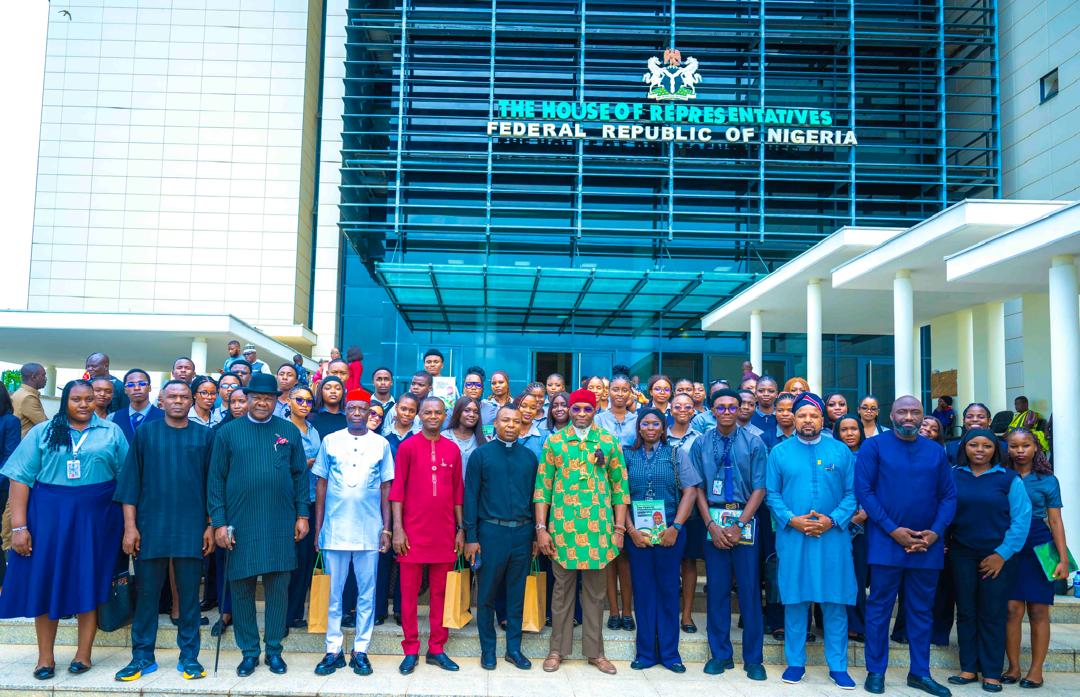
Kalu gave the advice while receiving students of the Department of International Relations, Madonna University, Okija Campus, during an educational visit to the National Assembly over the weekend.
The excursion formed part of the students’ academic programme aimed at exposing them to the practical workings of governance, diplomacy and Nigeria’s foreign relations architecture.
Addressing the students, the Deputy Speaker stressed that effective representation of a country begins with patriotism, noting that genuine diplomacy is driven by commitment to national interests and love for one’s homeland.
He said:
He said: “I understand most of you are from the Department of International Relations. You are going to be Ambassadors tomorrow. You are going to champion the image of the country out there. But you must understand your country first before you represent your country outside. So, your representation starts from patriotism. The spirit of patriotism, your love for Nigeria is what is going to drive you to stand and represent Nigeria tomorrow. So, if you want to a representative of Nigeria outside the shores of Nigeria, the best way to start is by loving your country”.
Kalu acknowledged that Nigeria faces numerous challenges but maintained that no other country could replace one’s homeland, regardless of opportunities abroad.
Drawing inspiration from the founder of Madonna University, Rev. Father Emmanuel Mathew Edeh, he said nation-building is only possible when citizens are motivated by genuine love for their country.
According to him: “I know we have so many challenges but I tell you I have been around the world and I can assure you there is no place like home.
“So, when we finally send out in the coming years to become ambassadors, you are going to live there. But you will go and come back and the only thing that will bring you back is the love you have for our great nation. If Rev. Father Edeh didn’t love our country, he will not build that citadel of learning that is producing champions and captains. It is because he first loved Nigeria.
“Do you love Nigeria? That is where it starts. You can’t represent what you don’t love. What you love is what you represent because if you represent what you love, you do it passionately without anybody telling you what to do. I congratulate you on coming to the People’s House. I pray that your dreams will become a reality”.
Earlier, Kalu, through his Chief of Staff, Mr Sam Hart, delivered a lecture titled “The Legislature and Nigeria’s External Relations in the Fourth Republic”, where he highlighted the increasingly important role of the National Assembly in advancing Nigeria’s foreign policy objectives.
He explained that while the President remains the chief architect of Nigeria’s foreign policy, Parliament plays a vital supporting role through legislation, oversight and diplomatic engagements.
According to the lecture: “While the President remains the chief architect of foreign policy, the Constitution assigns Parliament specific duties to assist in making those policies work at home and abroad. Foreign policy is not made only in presidential palaces and ministries; it is increasingly shaped in parliaments where the voices of the people meet the interests of the nation.
“One of the most significant developments in international relations over the past three decades has been the rise of Parliamentary Diplomacy.
“Parliamentary diplomacy refers to the engagement of legislators with foreign governments, international organisations, and global parliamentary bodies to advance national interests. Today, many diplomatic breakthroughs occur not only through executive negotiations but also through legislative interactions.
“The National Assembly has emerged as a vital pillar of Nigeria’s engagement with the world. Through legislation, oversight, treaty domestication, parliamentary diplomacy, economic reforms, and regional cooperation, Parliament continues to shape Nigeria’s place in the international system.
“As students of International Relations, you stand at the threshold of a profession that will define the future of nations. The world you are preparing to enter is increasingly interconnected, complex, and competitive. Nigeria needs young leaders who can think globally, act strategically, and serve patriotically”.
The visit provided the students with a firsthand understanding of the workings of Nigeria’s legislature and its role in shaping both domestic governance and international engagement.
The Deputy Speaker encouraged the students to remain focused on their studies and prepare themselves for leadership roles in diplomacy, governance and public service, stressing that patriotism, integrity and competence would remain essential qualities for future representatives of Nigeria on the world stage.
News
NUT suspends strike, directs Oyo teachers to resume Thursday
The Nigeria Union of Teachers (NUT) has suspended its industrial action across public primary and secondary schools in Oyo State, directing members to resume work on Thursday, July 2, 2026.
The decision followed fresh engagements with the Oyo State government and assurances on measures to improve security after the abduction of teachers and learners in Oriire Local Government Area.
In a statement jointly signed by the Oyo State Chairman of the union, Comrade Hassan Ajibola Fatai, and the State Secretary, Comrade Olukayode Salami, the union said the suspension was approved by its national leadership after reviewing the prevailing security situation and considering appeals by the state government and other stakeholders.
According to the statement, the strike, which was declared in protest against the kidnapping of teachers and students in the Oriire Local Government Area, was suspended in the interest of teachers, learners, and the general public.
“The Nigeria Union of Teachers hereby directs all public primary and secondary school teachers in Oyo State to resume official duties on Thursday, July 2, 2026,” the statement read.
The union said the state government had assured it of sustained efforts to secure the safe release of the abducted victims while strengthening security around schools and vulnerable communities across the state.
It noted that the government had committed to intensified rescue operations for the abducted teachers and learners, the establishment of a well-equipped Joint Security Task Force to patrol vulnerable schools and access roads, continuous engagement with affected families, psychosocial support and rehabilitation for rescued victims, and payment of gratuities and other entitlements to the families of deceased teachers.
Other commitments, according to the union, include strengthening the Safe School Initiative through public sensitisation and improved early warning systems, enhancing emergency response mechanisms, dismantling criminal hideouts, upgrading school infrastructure, tackling illegal mining and open grazing in forest reserves, improving community intelligence gathering, ensuring the speedy prosecution of criminal suspects, improving the welfare of security personnel, and deploying technology to improve school security.
The union commended its members for their discipline and solidarity throughout the industrial action while also appreciating the support of the All Nigeria Confederation of Principals of Secondary Schools (ANCOPSS) and the Association of Primary School Head Teachers of Nigeria (AOPSHON).
“We sincerely appreciate all our members, ANCOPSS, AOPSHON, and other stakeholders for their discipline, solidarity, and unwavering support during this period. Your cooperation has once again demonstrated our collective commitment to the welfare and safety of teachers and learners,” the statement added.
While directing teachers to return to the classroom, the union urged members to remain vigilant and report any security threats to the appropriate authorities.
“We urge all teachers to remain vigilant, law-abiding and promptly report any suspicious activities or security threats within their schools and communities to the relevant authorities. Together, we can build safer schools for our children and educators,” it stated.
The union reaffirmed its commitment to protecting the welfare and security of teachers, saying it would continue to engage the government until all outstanding concerns regarding the safety of teachers and learners are fully addressed.
“Our resolve to safeguard the lives, welfare and dignity of teachers remains unwavering. We shall continue constructive engagement with the government until every concern relating to the security of our members and learners is adequately addressed,” the statement said.
News
Citizen Patience and Collaborative Efforts: A Pathway to Greatness for Tinubu’s Government, By Hajia Hansatu Zannah*
Nation-building is never the sole responsibility of government; it is a shared endeavor that requires the active participation, patience, and collaboration of citizens. In Nigeria today, President Bola Ahmed Tinubu’s administration faces the daunting task of steering the country toward economic stability, social cohesion, and sustainable development. While policies and reforms are critical, their success ultimately depends on the willingness of citizens to remain patient and supportive during the often difficult process of implementation.
Transformational leadership demands bold decisions—structural reforms, economic adjustments, and institutional restructuring—that may not yield immediate results. In such circumstances, patience becomes a vital national asset. By resisting the urge for instant gratification and allowing time for reforms to mature, Nigerians can help create an environment where government initiatives are given the opportunity to succeed.
Every nation, regardless of its stage of development, grapples with challenges—economic struggles, political transitions, social tensions, and infrastructural gaps. These realities test the resilience of both leaders and citizens. In moments of strain, the attitude of the people toward their country becomes a powerful determinant of progress. Constructive criticism is healthy and necessary for accountability, but outright condemnation and vitriolic attacks against one’s nation can be deeply counterproductive.
Words shape perception, and perception influences reality. When citizens consistently speak negatively about their country, they reinforce hopelessness and despair. This weakens national morale and discourages foreign investors, partners, and allies who rely on the confidence of citizens as a measure of stability. By contrast, balanced and solution-oriented dialogue strengthens Nigeria’s image and inspires collective action.
Collaboration, however, goes beyond compliance—it requires active engagement. Citizens can contribute meaningfully to nation-building by supporting reforms through constructive dialogue rather than resistance, participating in civic duties such as voting, community service, and public consultations. These actions serve as catalysts for greater national progress. At the same time, holding leaders accountable in a respectful and lawful manner is essential. While harsh and divisive criticism may be insidious, patriotism calls for promoting unity across ethnic, religious, and political divides to strengthen national cohesion.
If citizens embrace patience and collaboration, Tinubu’s government stands a better chance of achieving greatness. Economic reforms can stabilize markets, infrastructural projects can transform communities, and social policies can uplift vulnerable populations. Greatness, in this context, is not merely about political success but about building a Nigeria where prosperity, justice, and peace are attainable for all.
Citizens are not passive observers; they are active participants in governance. By engaging in respectful dialogue, supporting reforms, and holding leaders accountable through lawful means, they contribute to the nation’s growth. Patriotism does not mean blind loyalty—it means believing in the possibility of progress and working toward it.
A nation is like a family; disagreements are inevitable, but condemnation destroys trust. Citizens must rise above destructive criticism and embrace constructive engagement. By doing so, they preserve the dignity of their country and create an atmosphere where greatness can flourish. The path to national transformation lies not in tearing down but in building up—through patience, collaboration, and unwavering belief in Nigeria’s future.
The greatness of any government is measured not only by the vision of its leaders but also by the resilience and cooperation of its people. For Tinubu’s administration, citizen patience and collaborative effort are indispensable. Together, government and citizens can write a new chapter in Nigeria’s history—one defined by progress, unity, and enduring impact.
*Hajia Hansatu Zannah is a distinguished member of the Governing Council of the African Union Agenda 2063 and Ambassador Plenipotentiary. She is also the widow of the late Zannah Umar Mustapha, former Deputy Governor of Borno State.*
News
BREAKING: CBN revokes licences of 46 Microfinance Banks over failure to satisfy regulatory requirements
The Central Bank of Nigeria (CBN) has revoked the operating licences of 46 microfinance banks across the country, citing their failure to meet key regulatory requirements for continued operation.
The decision takes effect from Wednesday, July 1, 2026, according to a statement issued by the Acting Director of the CBN’s Corporate Communications Department, Hakama Sidi-Ali. The apex bank said the action was taken in line with its powers under Sections 12 and 13 of the Banks and Other Financial Institutions Act (BOFIA), 2020, and was approved by the CBN Governor, Olayemi Cardoso.
According to the CBN, the affected institutions lost their licences after failing to satisfy the conditions required to remain licensed financial institutions.
The bank explained that the revocation was based on one or more regulatory infractions, including insufficient assets to meet liabilities, shutting down operations without obtaining CBN approval, prolonged inactivity and cessation of financial intermediation, failure to commence business within 12 months after receiving a licence, and failure to maintain the minimum capital requirements without impairment from accumulated losses.
The CBN described the move as part of its ongoing efforts to strengthen the nation’s financial system and ensure that all licensed financial institutions operate in compliance with existing laws and prudential regulations.
“The revocation of the licences is part of the Bank’s ongoing efforts to safeguard the stability of the financial sector, protect depositors, and ensure that licensed institutions comply with current laws and regulatory requirements,” the statement said.
The apex bank reiterated its commitment to maintaining a safe, sound and resilient financial system, stressing that it would continue to take appropriate supervisory and regulatory measures where necessary to sustain public confidence in Nigeria’s banking sector.
-
News15 hours agoFG Scraps JSS And SSS Secondary Education System
-
News15 hours agoAkpodiete Queries Delta Assembly’s Morality on Udu Seat, Cites Lawmakers’ Defection to APC
-
Politics15 hours agoAPC drops Suswam, Elegbeleye, 5 other senatorial, 19 Reps candidates
-
Metro15 hours agoFUT Minna students shut campus over alleged robbery killing, rising insecurity
-
News9 hours ago2027: NDC granted access to upload candidates on INEC portal – Dickson
-
News7 hours agoEkiti APC Primary Row Deepens As Akinlayo Releases Ibrahim’s Payslips Over Resignation Dispute
-
News15 hours agoPope Leo appoints two Nigerians to key Vatican roles
-
News9 hours agoFCTA Begins Promotion Exercise For Over 13,000 Civil Servants