Connect with us

Foreign

Mongolia Braces for Dust Storms: Precautions Urged Amid The Sad Climate Concerns

Published

on

ADVERTISEMENT
Zoom Ad
ADVERTISEMENT
Zoom Ad

Mongolia’s National Agency for Meteorology and Environmental Monitoring issues warning about strong winds and dust storms expected to hit southern Gobi desert provinces.


Citizens, particularly drivers and nomadic herders, urged to take precautions against potential disasters amidst wind speeds exceeding 17 meters per second.

Climate change-induced desertification cited as a major factor behind increasing frequency of dust storms, with 77 percent of Mongolia’s territory affected by land degradation.

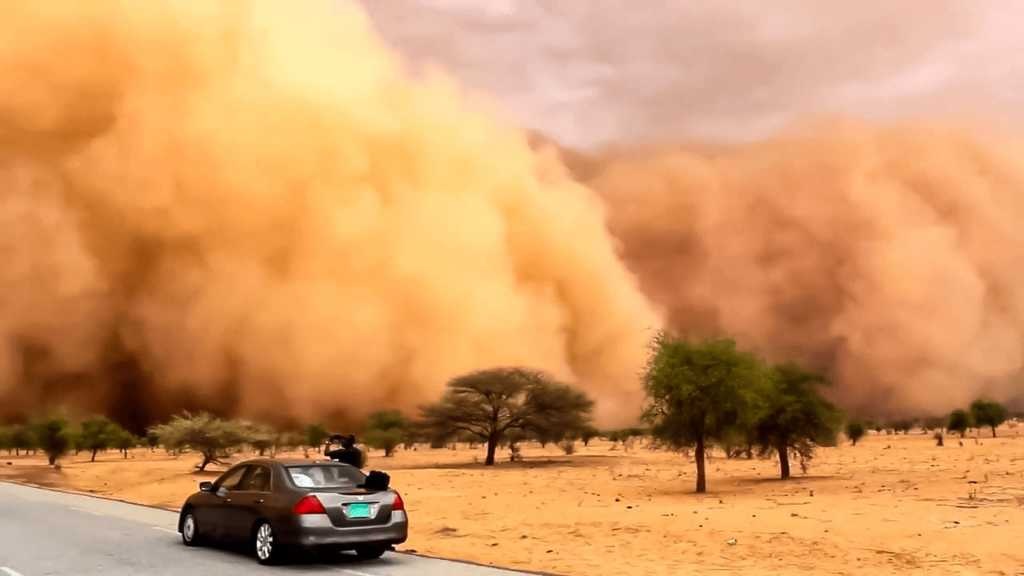
Mongolia’s National Agency for Meteorology and Environmental Monitoring has issued a stark warning, alerting citizens to brace themselves for the onslaught of strong winds and dust storms expected to sweep across the country’s southern Gobi desert provinces.

Advertisement

The forecast, spanning from Tuesday to Friday, particularly highlights regions such as Umnugovi, Dundgovi, and Dornogovi, where the impact is anticipated to be most severe.

With wind speeds projected to surpass 17 meters per second, equivalent to roughly 61 kilometers per hour, authorities are urging heightened vigilance, especially among drivers and nomadic herders.

The potential for disasters looms large in the face of such extreme weather conditions, prompting a call for proactive measures to mitigate risks and ensure the safety of all residents.

Mongolia’s rugged terrain and harsh continental climate make it particularly susceptible to the ravages of nature, with spring ushering in a season marked by strong winds, snowstorms, and the ominous threat of dust storms.

Advertisement

Climate change-induced desertification exacerbates these challenges, contributing significantly to the escalating frequency of dust storms witnessed in recent years, as highlighted by the country’s Ministry of Environment and Tourism.

The sobering reality of desertification and land degradation looms large over Mongolia, with official data revealing that a staggering 77 percent of the nation’s total territory has fallen victim to these environmental woes.

As swathes of land succumb to desertification, the repercussions reverberate throughout the country, impacting livelihoods, ecosystems, and the delicate balance of nature.

Amidst the looming threat of dust storms, Mongolia finds itself at a crossroads, grappling with the urgent need for sustainable solutions to combat climate change and preserve its natural heritage.

Advertisement

From proactive land management strategies to community-based initiatives aimed at promoting environmental stewardship, concerted efforts are underway to safeguard Mongolia’s fragile ecosystems and mitigate the adverse effects of desertification.

As the nation braces for the impending onslaught of dust storms, the call to action is clear: unity, resilience, and collective action are essential in navigating the challenges posed by climate change. By embracing a holistic approach to environmental conservation and fostering a culture of sustainability, Mongolia can forge a path towards a more resilient and vibrant future for generations to come.

Continue Reading
Advertisement

Foreign

Iran accuses US of violating ceasefire over past 48 hours

Published

on

By

ADVERTISEMENT
Zoom Ad
ADVERTISEMENT
Zoom Ad

Iran’s foreign ministry on Tuesday accused the United States of violating a fragile ceasefire during the past 48 hours in the southern coastal province of Hormozgan, without specifying the incident.

“The US terrorist army, continuing its illegal and unjustified actions since the ceasefire … has, in the past 48 hours, committed a gross violation of the ceasefire in the Hormozgan region,” the ministry said in a statement.

The US Central Command said forces had on Monday attacked missile sites and boats it said were trying to lay mines in the Gulf, while Iran’s Revolutionary Guards said it had fired at US aircraft attempting to enter the country’s airspace.

AFP

Advertisement
Continue Reading

Foreign

Iran president orders internet restored after war suspension

Published

on

By

ADVERTISEMENT
Zoom Ad
ADVERTISEMENT
Zoom Ad

Iranian President Masoud Pezeshkian has ordered the restoration of international internet access in Iran, which had been suspended since the United States and Israel launched attacks against the country, local media reported Monday.

“The decree aimed at restoring internet access to its pre-January state was communicated to the Ministry of Communications by the president,” Iranian news agencies Tasnim and Fars reported.

Authorities shut down the internet during large-scale anti-government protests that peaked in early January, then suspended it again on February 28 at the start of the Middle East war.

Since then, the population has only had access to domestic platforms and websites.

Advertisement

AFP

Continue Reading

Foreign

Trump says Iran deal ‘largely negotiated’ including reopening Strait of Hormuz

Published

on

By

ADVERTISEMENT
Zoom Ad
ADVERTISEMENT
Zoom Ad

US President Donald Trump says an agreement with Iran has been “largely negotiated” and details will be announced soon.

The deal would include the reopening of the Strait of Hormuz, he said on Saturday, without giving further details.

Iranian foreign ministry spokesman Esmaeil Baqaei earlier told state television that US and Iranian positions had been converging in the last week, but warned that did not mean agreements would be reached on key issues and accused the Americans of “contradictory statements”.

On social media, Trump said he had a “very good call” with the leaders of Saudi Arabia, the United Arab Emirates, Qatar, and others about a “Memorandum of Understanding pertaining to PEACE”.

Advertisement

“An agreement has been largely negotiated, subject to finalization between the United States of America, the Islamic Republic of Iran, and the various other Countries, as listed,” Trump said.

“Final aspects and details of the deal are currently being discussed, and will be announced shortly.”

He also said he had a call on Saturday with Israeli Prime Minister Benjamin Netanyahu, which “went very well”.

The president has not given any further details on the deal, but has insisted any agreement would “absolutely” prevent Iran from obtaining a nuclear weapon.

Advertisement

Later, Pakistan’s Prime Minister Shehbaz Sharif said: “I congratulate President Donald Trump on his extraordinary efforts to pursue peace,” and said the phone call had been “very useful and productive”.

Pakistan has been helping to negotiate a peace deal, serving as an intermediary.

“We hope to host the next round of talks very soon,” he wrote in the statement on X.

The US and Israel launched wide-ranging strikes on Iran on 28 February, sparking conflict across the Middle East. Iran responded by launching attacks on Israel and US-allied states in the Gulf.

Advertisement

A ceasefire in Iran was agreed in early April, and since then Washington and Tehran have engaged in talks over a long-term peace deal.

Speaking to state television on Saturday, Iranian foreign ministry spokesman Esmaeil Baqaei also described a “memorandum of understanding”, saying Iran’s intention was to reach an agreement “in the form of a framework, consisting of 14 points”.

Baqaei said they were in the process of finalising the memorandum, so further talks could be held within 30 to 60 days “and ultimately a final agreement can be reached”.

The new sense of momentum comes after the mood appeared to have soured in Washington, with anonymous officials briefing US media on Friday that the administration was preparing for a fresh round of military strikes, although no final decision had been made.

Advertisement

On Friday, the president posted on Truth Social that he would not attend his son Donald Jr’s wedding this weekend so he could remain in Washington DC “during this important period of time”.

Last week, Trump had said the truce was on “massive life support” after rejecting Tehran’s demands, labelling them “totally unacceptable”.

The US has blockaded Iranian ports since 13 April.

On Saturday, US Central Command (Centcom) said it had redirected 100 vessels, disabled four, and allowed 26 humanitarian aid ships to pass since the blockade began.

Advertisement

Centcom commander Admiral Brad Cooper said its forces had been “highly effective” in “allowing zero trade into and out of Iranian ports which has squeezed Iran economically”.

Meanwhile, Iran has claimed military control of an area around the Strait of Hormuz, and has said all transit through the strait “requires coordination with and authorisation from the Persian Gulf Strait Authority”.

The US and Gulf allies have repeatedly rejected Iranian attempts to assert control over the strait, and the US has told ships not to comply with Iran’s rules.

Advertisement
Continue Reading

Trending

Copyright © 2024 Naija Blitz News