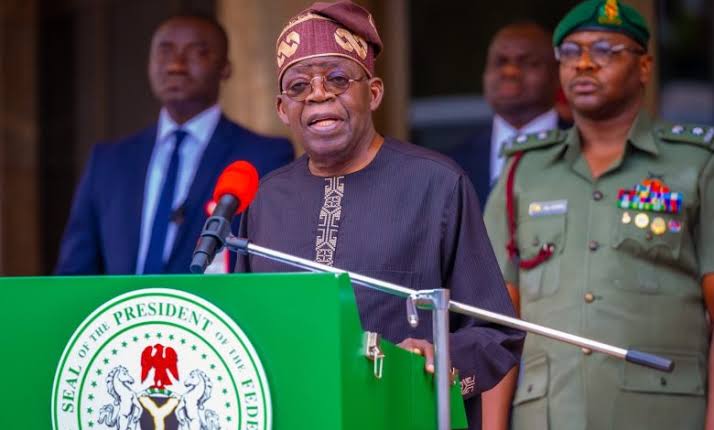
The Federal Government has reiterated its refusal to accept deportees from the United States, distancing itself from recent decisions by countries like Rwanda, Eswatini and South Sudan, to receive foreign nationals expelled from the United States of America.


The spokesperson for the Ministry of Foreign Affairs, Kimiebi Ebienfa, who confirmed the government’s stance to Saturday PUNCH in an interview, stressed that Nigeria remains firm in its position, citing national security and economic concerns.
The Minister of Foreign Affairs, Yusuf Tuggar, had in July, revealed that the President Donald Trump administration was mounting pressure on African countries to accept deportees convicted of crimes into African countries under his “third-country deportation” policy. 
“The US is mounting considerable pressure on African countries to accept Venezuelans to be deported from the US, some straight out of prisons,” Tugar said.
He described the move as “unacceptable” and warned that such a policy would unfairly burden countries like Nigeria, which are already grappling with their own internal challenges.
“It will be difficult for countries like Nigeria to accept Venezuelan prisoners into Nigeria. We have enough problems of our own; we cannot accept Venezuelan deportees to Nigeria for crying out loud. We already have 230 million people,” Tugar stressed.
Although Tugar did not reveal the details of the diplomatic pressure being mounted on African countries, the Trump administration had previously announced new visa policies for Nigeria and others.
In June, the U.S. Department of State revised its visa policy for Nigerian nationals, introducing more restrictive terms for most non-immigrant, non-diplomatic visas.
According to the new policy, most Nigerian citizens seeking to enter the US will be issued single-entry visas valid for just three months.
The change marked a significant shift in the U.S. visa reciprocity arrangement with Nigeria and comes as part of a broader effort by the U.S. government to align global visa standards with its immigration and security protocols.
The Trump administration has also been threatening countries that refuse to cooperate with US deportation efforts with visa sanctions under Section 243(d) of the Immigration and Nationality Act, which authorises the US to suspend visas to countries that obstruct deportations.
In April, the US threatened to revoke all visas held by South Sudanese passport holders and to restrict any further issuance to prevent entry into the country over the African country’s initial refusal to accept the return of its repatriated citizens.
The US Secretary of State, Marco Rubio, made the threat in a statement posted on his X (formerly Twitter) on Saturday, April 5, 2025.
“I am taking actions to revoke all visas held by South Sudanese passport holders and to restrict any further issuance to prevent entry into the United States, effective immediately, due to the failure of South Sudan’s transitional government to accept the return of its repatriated citizens in a timely manner,” he wrote.
Rubio also said that the US would “prevent further issuance to prevent entry into the United States by South Sudanese passport holders.”
Trump’s third-country deportation
The controversial “third-country deportation” policy was formally revived after a US Supreme Court ruling on June 23, 2025, which cleared the legal path for sending deportees to countries other than their own.
The policy allows the US to send deportees to foreign nations other than their own, particularly when the individual’s country of origin refuses to take them back.
According to the Institute for Security Studies, Africa, the US paid El Salvador US$5m in March to incarcerate over 250 Venezuelan deportees accused of gang affiliations, in a maximum-security prison notorious for human rights abuses.
Since then, the Trump administration has expanded this policy to Africa, with recent deportations of individuals from countries such as Vietnam, Jamaica and Yemen to South Sudan and Eswatini.
The Department of Homeland Security justified the decision by saying their home countries refused ‘to take them back.’
South Sudan was the first African country to accept deportees under Trump’s revived “third-country deportation” policy.
In July, the US Supreme Court approved the deportation of eight men, reportedly convicted of violent crimes and lacking US legal status, to South Sudan.
Eswatini, a Southern African country, followed shortly after, receiving five individuals from countries like Vietnam, Jamaica, Cuba, Yemen, and Laos.
Rwanda is the third country to strike a deal, agreeing to accept up to 250 deportees from the US while retaining discretion over whom to accept.
Rwandan government spokesperson, Yolande Makolo, confirmed the deal to CNN, disclosing that the East African nation had “agreed with the United States to accept up to 250 migrants,” in a deal that allows the government “to approve each individual proposed for resettlement.”
When approved, the migrants, she said, “will be provided with workforce training, health care, and accommodation support to jump start their lives in Rwanda,” allowing them to “contribute to one of the fastest growing economies in the world over the last decade.”
FG maintains stance
Speaking with Saturday PUNCH, Ebienfa described US demand as unrealistic and unsuitable for Nigeria, which is already facing economic, social, and security challenges.
Ebienfa said while countries like Rwanda, Eswatini and South Sudan had opted to cooperate with US deportation efforts, “Nigeria’s priorities differ”.
“Even if other African countries are accepting deportees from the US, Nigeria will not accept them.
“We are a sovereign country and we take decisions only after fully analysing the implications to our national security,” Ebienfa said.
According to Ebienfa, Nigeria is currently dealing with multiple domestic challenges and cannot afford to take on what it described as “additional baggage.”
“We have our own issues we are struggling with. We will not allow ourselves to be pressured into accepting deportees, regardless of what other nations are doing,” he told our correspondent.
He added that Nigeria holds significant economic and strategic value in its international partnerships, including ongoing projects such as the Nigeria-Morocco gas pipeline and its rare earth mineral deposits, which are of interest to global markets.
“Our national interest, as it stands now, is not favourably disposed to accepting deportees from the American government,” Ebienfa said.
Ex-diplomats back FG
Reacting to the development, retired diplomat Ambassador Ogbole Amedu-Ode questioned the rationale behind US deportation decisions, particularly reports that non-Nigerians may be deported to Nigeria.
“Why deport the citizens of a country, say Venezuela, to another country like Nigeria? The logic and rationale behind this are totally lost on me,” he said.
Amedu-Ode praised the position taken by the Minister of Foreign Affairs, Tuggar, calling it a “response with dignity.”
“There’s certainly no merit in Mr. Trump’s new visa regime when viewed from the principle of sovereign equality of states,” he said.
He added that, “Since diplomacy is largely a game of reciprocity, Nigerians should request an exchange agreement, receive Venezuelan deportees in exchange for repentant Boko Haram operatives to be ‘exported’ to them.
Also commenting on the matter, another retired ambassador, Rasheed Akinkuolie, noted that the decisions made by countries like Rwanda and South Sudan were internal matters.
“The decision of some African countries to accept deportees is an internal and private affair, which no other country can make logical comments on.
“The reasons these countries are taking this action are best known to them,” he said.
Akinkuolie emphasised that while Nigeria was prepared to accept its own nationals, it cannot admit individuals of unknown origin or background.
“Nigeria cannot take deportees of another nationality, whose identity and background are not known. What if these people are criminals?
“People who qualify are still being issued visas to the US. Those who do not meet certain criteria may be denied. Nigeria also does the same to undesirable people,” he said.
He pointed to a recent incident where foreigners were found to have entered Nigeria illegally and formed a criminal gang, stressing that such people were either deported or prosecuted.
“What the USA is doing may be in its national interest, who knows?” Akinkuolie concluded.
PUNCH