
News
NANS vows critical assets shutdown over ASUU strike threat

- /home/naijuinz/public_html/wp-content/plugins/mvp-social-buttons/mvp-social-buttons.php on line 27
https://naijablitznews.com/wp-content/uploads/2024/05/NANS.jpg&description=NANS vows critical assets shutdown over ASUU strike threat', 'pinterestShare', 'width=750,height=350'); return false;" title="Pin This Post">
- Share
- Tweet /home/naijuinz/public_html/wp-content/plugins/mvp-social-buttons/mvp-social-buttons.php on line 72
https://naijablitznews.com/wp-content/uploads/2024/05/NANS.jpg&description=NANS vows critical assets shutdown over ASUU strike threat', 'pinterestShare', 'width=750,height=350'); return false;" title="Pin This Post">


The National Association of Nigerian Students has threatened to shut down critical infrastructure nationwide if the Federal Government fails to meet the demands of the Academic Staff Union of Universities, which has again warned of a possible nationwide strike.
NANS Assistant General Secretary, Emmanuel Adejuwon, in an interview with The PUNCH on Monday in Abuja, expressed deep concern over ASUU’s latest threat, vowing that the union would “mobilise Nigerian students for massive nationwide protests that will shut down roads, airports, government offices, and critical infrastructure.”
“Let it be on record: if this strike is not averted, we will bring the country to a standstill until the future of Nigerian students is secured. The time for games is over. The Federal Government must act now. ASUU must act responsibly. And Nigerian students will not sit idle while our future is wasted,” the NANS leader said.
Adejuwon stressed that only the children of the masses are negatively impacted by ASUU strike, saying, “This strike must not be allowed to happen.”
“It is obvious that strike actions only inflict pain and suffering on the children of ordinary Nigerians, the masses who struggle day and night to keep their children in school. The politicians and government officials whose failures created this crisis are not affected; their children are comfortably schooling abroad or in expensive private universities. If the children of these politicians were in our public institutions, this issue would have been resolved immediately.”
He accused the Federal Government of endless promises and insincerity, saying students had grown weary of “being victims of leadership irresponsibility.”
“We demand that the Federal Government, without delay, meet its obligations to ASUU and resolve all outstanding issues. Enough of the endless promises, excuses, and insincerity. Nigerian students are tired of being victims of leadership irresponsibility,” he declared.
While demanding government action, Adejuwon also called on ASUU to rethink its tactics.
“At the same time, we call on ASUU leadership to reconsider the weaponisation of strike as the only tool of engagement. Every strike action destroys our academic calendar, elongates our years in school, and diminishes the quality of our education. The lecturers must understand that their struggle, no matter how just, should not become a weapon against the same students they claim to fight for,” he said.
ASUU presses demands
Meanwhile, ASUU branches across the country, on Monday, stressed their demands, threatening that another strike was imminent if the Federal Government failed to act.
In Ibadan, ASUU’s Zonal Coordinator, Prof. Biodun Olaniran, speaking at a news conference on Monday, urged the Federal Government to implement the recommendations of the Yayale Ahmed report submitted in February to avert another strike.
He said the report captured all contentious issues between the union and government and represented a consensus after years of negotiations, but had been left unimplemented.
“The true test of government’s sincerity lies in how it handles the Yayale Ahmed report,” Olaniran said. “Our members are frustrated with delay tactics and are no longer willing to be dragged along endlessly. Implementing this report is the surest way to restore confidence and industrial peace.”
Olaniran listed concerns including the 2009 ASUU-FGN Agreement on sustainable funding of universities, victimisation of union members in LASU, KSU and FUTO, outstanding 25–35 per cent salary awards, unpaid third-party deductions, and over four years of unpaid promotion arrears.
He faulted the continued use of the IPPIS platform for payment of members, which the union had long rejected, and lamented the non-payment of earned academic allowances.
“Many of our members cannot provide education for their wards and have turned to borrowing to meet obligations,” he said. “Poor funding, withheld salaries, non-payment of promotion arrears, and failure to mainstream earned academic allowances have worsened our plight and contributed to brain drain.”
On autonomy, Olaniran decried “the persistent erosion of university autonomy by the government with alarming impunity.”
“ASUU has strongly opposed the unlawful dissolution of Governing Councils in public universities, even where no misconduct has been reported and the councils had not completed their statutory tenure,” he added.
Chairpersons of ASUU branches from UI, UNILORIN, LAUTECH, UNIOSUN, KWASU and Emmanuel Alayande University of Education attended the briefing.
Also in Abuja, the ASUU Zonal Coordinator, Prof. Al-Amin Abdullahi, reiterated the union’s demand for the implementation of the 2009 Agreement and the release of three and a half months of withheld salaries.
“There is a crisis affecting universities in Nigeria, and it is not just a problem for ASUU; it is a problem for the entire country,” Abdullahi said. “The purposeful mortgage of a nation’s future and the endangerment of generations yet to be born is the result of a nation’s disregard of education.”
He listed the union’s demands to include payment of promotion arrears, release of third-party deductions, one year arrears of the 25/35 per cent salary award, and adoption of UTAS as the university payment system.
“It is impossible for a nation to advance beyond the standard of its university system. Yet successive governments have systematically underfunded universities, leaving overcrowded classrooms, inadequately equipped laboratories, and inhabitable hostels. This neglect has created unconducive learning environments and a decline in global ranking of Nigerian universities,” Abdullahi warned.
He said that in line with UNESCO’s convention, both federal and state governments must prioritise education through increased annual budgetary allocations.
In Uyo, the Calabar Zone of ASUU rejected the recently launched Tertiary Institution Staff Loan Scheme, describing it as “an insult to the sensibilities of tertiary workers and the height of mockery of the Nigerian university system.”
Zonal Coordinator, Dr. Ikechukwu Igwenyi of Ebonyi State University, said the government was using the scheme as a distraction from its failure to implement a new salary structure and honour agreements.
“It insults our sensibilities that a government that pays its workforce with an outdated salary structure adopted 17 years ago will refuse to renegotiate the same salary since 2012, refuse to pay third-party deductions for almost a year, and refuse to pay arrears of promotion—yet it comes up with an impossible and slavish loan in a depressed economy,” Igwenyi said.
He accused government of “puerile duplicity and infantile cunning,” dragging the union and public into believing in dialogues whose outcomes were never implemented.
“How can government owe its workforce and turn around to offer impoverished workers an impossible loan scheme? How can it impose loan recovery on staff unions as guarantors, as if we are employers of tertiary workers?” he asked.
“We therefore make bold to reject the Tertiary Institution Staff Support Loan and everything it represents because it has been described as a poison chalice.”
Igwenyi warned that the union’s planned meeting with the Federal Government on August 28, 2025, would be its last. “We cannot continue to spend our meagre resources attending meetings whose outcomes are not predictable,” he said.
With frustration building among both lecturers and students, ASUU and NANS have set the August 28 meeting as a decisive moment for government to act.
For NANS’ Adejuwon, the message is clear: “The time for games is over. The Federal Government must act now. ASUU must act responsibly. And Nigerian students will not sit idle while our future is wasted.”

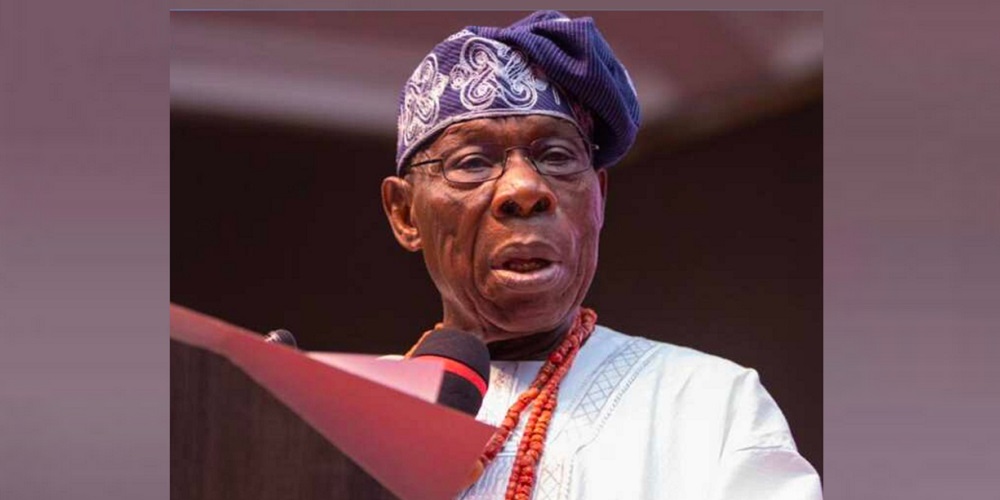
Ex-President Olusegun Obasanjo brought humour to the 60th birthday celebration of the Olota of Ota, Oba Professor Abdulkabir Obalanlege, as he jokingly promised to attend the monarch’s 70th birthday while asking to be excused from the 80th.
Obasanjo, who is 89, made the remark while speaking in Yoruba at the anniversary celebration held in honour of the traditional ruler.
The former president recalled calling Obalanlege earlier in the morning to pray for him before turning his attention to the monarch’s future milestone birthdays.
“Kabiyesi, I called you this morning and prayed for you,” Obasanjo said.
He then calculated his own age in relation to the monarch’s next major birthday celebrations, telling the gathering that he would be 99 when Obalanlege clocks 70 in 10 years.
“I’m here celebrating your 60th birthday. I’ll join you for your 70th birthday in 10 years,” he said.
However, Obasanjo joked that attending the monarch’s 80th birthday celebration 20 years from now might be beyond his reach.
“But for your 80th birthday, which is 20 years from now, ẹ yonda mi (you’ll excuse me); you’ll celebrate that one the way it pleases you,” he added.
The comment drew laughter from dignitaries, traditional rulers and other guests who gathered to celebrate the Olota’s diamond jubilee.
The celebration also featured a notable display of Yoruba cultural respect when Fuji musician, King Wasiu Ayinde, popularly known as K1 De Ultimate, prostrated fully before Obasanjo after coming on stage.
The gesture further added to the cultural significance of the event held to mark Oba Obalanlege’s 60th birthday.

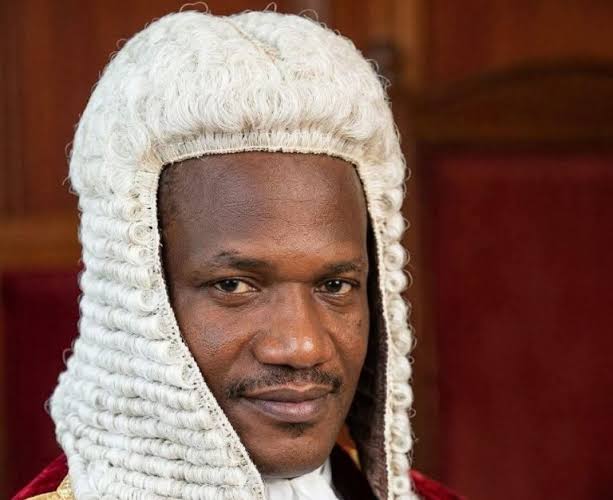
The judiciary has been thrown into mourning following the death of Hon. Justice Umaru Atu Kalgo, JSC (Rtd.), CON, a former Justice of the Supreme Court of Nigeria and distinguished jurist whose judicial career spanned several decades.
Justice Kalgo reportedly died at about 3:00 a.m. on Tuesday after a prolonged illness.
A resident of Kalgo community, who requested anonymity, said the retired Supreme Court Justice was buried at about 2:30 p.m. in Sokoto in accordance with Islamic rites.
His death marks the end of a distinguished legal career spanning nearly five decades, during which he contributed to legal practice, judicial service, law reform and the development of Nigerian jurisprudence.
Born on May 12, 1937, in Kalgo, present-day Kebbi State, then part of the old North-Western State, Justice Kalgo began his education at Elementary School, Kalgo. He later attended Middle School Sokoto, Middle School Birnin-Kebbi and Government College, Zaria, between 1953 and 1958.
He subsequently pursued legal studies at the Institute of Administration, Ahmadu Bello University, Zaria; the Council of Legal Education, London; the College of Law, Holborn, London; and the Nigerian Law School, Lagos. He was called to the Nigerian Bar in 1965.
Justice Kalgo began his public service career as an Administrative Officer in Northern Nigeria before moving into legal practice in government service. Between 1965 and 1972, he served as State Counsel and later rose to become Deputy Solicitor-General of the North-Western State.
His judicial career began in 1974 when he was appointed a Judge of the High Court of Kano and North-Western State. He subsequently served on the Sokoto State High Court Bench.
On January 1, 1981, Justice Kalgo was elevated to the position of Chief Judge of Sokoto State, a position he held until 1988.
In February 1988, he was appointed a Justice of the Court of Appeal, where he continued to contribute to the development of Nigeria’s appellate jurisprudence.
A decade later, on November 25, 1998, Justice Kalgo reached the pinnacle of his judicial career when he was elevated to the Supreme Court of Nigeria.
He served on the apex court until his statutory retirement at the age of 70 in May 2007.
During his years on the Court of Appeal and Supreme Court benches, Justice Kalgo delivered and participated in numerous judgments covering constitutional, civil and criminal law. His contributions formed part of the body of judicial precedents that continue to influence Nigerian jurisprudence.
Beyond the courtroom, the late jurist played significant roles in national law reform and constitutional development. He served on the Constitution Review Committee between 1987 and 1988, participated in the Constituent Assembly between 1988 and 1989, and was a member of the Law Revision Committee for the Laws of the Federation in 1990.
His public service therefore extended beyond adjudication to the broader development of Nigeria’s constitutional and legal framework.
Justice Kalgo was also recognised for his contributions to national service and was conferred with the national honour of Commander of the Order of the Niger, CON.
His passing brings to a close the life and career of a jurist whose professional journey took him from public administration and government legal service through the High Court and Court of Appeal to Nigeria’s highest court, leaving behind a significant legacy in the country’s legal and judicial history.
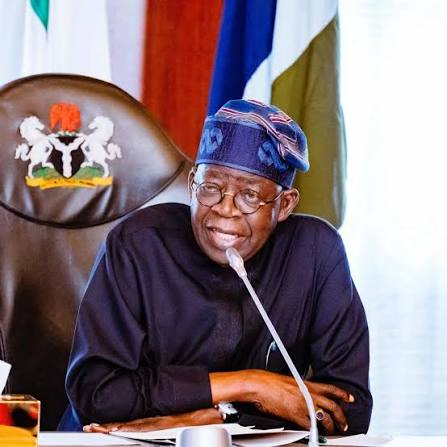
President Bola Tinubu has filed a challenge in a US court to prevent the U.S. Department of Justice, FBI and DEA from releasing records linked to allegations of drug trafficking.
The records are being sought by American transparency activist Aaron Greenspan, who filed a Freedom of Information Act (FOIA) lawsuit against several US government agencies seeking documents relating to investigations involving Tinubu.
Greenspan’s requests include the FBI’s entire file on Tinubu and FBI Form 302 interview records concerning the period between 1992 and 1993.
The case also involves an alleged record connected to a 1993 civil forfeiture proceeding in the United States involving about $460,000 linked to Tinubu.
Tinubu has denied wrongdoing.
According to the 16-page court documents shared with Channels Television by his lawyer and legal team, Christopher W. Carmichael, Victor P. Henderson, and Oluwole O. Afolabi, on Saturday, Tinubu argued that the release of the records could infringe on his privacy.
“Submitted in that proceeding, did not reveal the details of a possible criminal investigation (or its results) involving Intervenor. Other than by speculation or labels, Plaintiff does not point to an existing public record that contains details of a governmental criminal investigation or findings about Intervenor. (DE 85-3, No. 16.)
“The purpose of Plaintiff’s motion is to obtain such information because it is not public. Moreover, Plaintiff’s argument that the limited disclosures in connection with the forfeiture negates all privacy interests is not consistent with precedent. The Supreme Court explained that an individual retains a privacy interest in an entire file or document being produced, even where there are “scattered” disclosures of information from that same file. See Reporters Committee, 489 U.S. at 764-67 (“our cases have recognized the privacy interests inherent in the non-disclosure of certain information even where the information may have been public at one time.”).
“While some information may appear in portions of public records, an individual still retains a privacy interest in the details that remain undisclosed.
Applying Reporter’s Committee, this Court explained that an individual retains a privacy interest even if they were previously publicly associated with criminal activity. Judicial Watch, Inc. v. United States Dept. of Justice, 898 F.Supp.2d 93, 104-05 (D.D.C. 2012).
“Other decisions have likewise described the fact someone was under investigation as “distinct” from the contents of the investigative files. See Electronic Privacy Info. Center v. United States Dept. of Justice, 18 F.4d 712, 719 (D.C. Cir. 2021) (“Although the names of – 6 – Case 1:23-cv-01816-BAH Document 98 Filed 08/28/26 Page 7 of 16 Trump campaign officials appear in public portions of the Report, they retain a privacy interest in ‘avoiding disclosure of the details of the investigation.’”)
“Regardless of the prior disclosure in the forfeiture proceeding, Intervenor retains a privacy interest in potential disclosure of the investigative files sought by Plaintiff”, the document read in part.
“Plaintiff’s motion critiques the FBI’s search efforts, the DEA’s Vaughn Index, segregability, document specific withholdings, and the applicability of exemptions to deceased individuals and confidential sources. All of Plaintiff’s other critiques should be viewed in the context of Plaintiff’s overarching goal.
“Plaintiff’s filings, overwhelmingly, demonstrate that his singular focus is obtaining documents with Intervenor’s “name on them.” (See supra pgs. 1-3, 10, and 11.) Any other issues should – 14 – Case 1:23-cv-01816-BAH Document 98 Filed 08/28/26 Page 15 of 16 not allow Plaintiff to access documents that should otherwise be withheld or redacted under Exemption 7(C) or the Privacy Act.
“If this Court finds that Plaintiff cannot use FOIA to mine information in government files about a private individual, he should not be able to access documents with Intervenor’s “name on them.”
“Conclusion For all the foregoing reasons, Intervenor requests that the Court deny Plaintiff’s motion for summary judgment and allow the redactions or withholdings made by the FBI and DEA to stand”, Tinubu’s legal team further argued.

JAMB extends deadline for acceptance of previous admissions by 30 days

Obasanjo jokes at Olota’s 60th birthday, says I’ll attend your 70th, may miss 80th

SAD! Former Supreme Court Judge, Kalgo is dead




-

 News12 hours ago
Ugandan King Who Became Monarch At Age 3 Di£s Aged 34
-

 Metro12 hours ago
Police Parade Doctors, Others Over Alleged Organ Trafficking In Nasarawa
-

 News12 hours ago
NYSC sets September 7 for 2026 batch C registration
-
 News11 hours ago
FG moves to harmonise salaries of federal government workers
-
 News11 hours ago
Police-Led Joint Team Arrests Nine, Recovers Three AK-47 Rifles, Pump-Action Gun in Anambra
-

 News11 hours ago
2027 Presidency: Very Unlikely North Will Support Obi-Kwankwaso Ticket — Datti
-

 News11 hours ago
Osun @ 35: Gov Adeleke, Akande, Oyinlola, Aregbesola Discuss Reconciliation, Post-election Peace Over The Phone
-

 News6 hours ago
Confusion in Niger as gunfire, explosions rock presidential palace, airport
Warning: Undefined variable $user_ID in /home/naijuinz/public_html/wp-content/themes/zox-news/comments.php on line 49
You must be logged in to post a comment Login