
News
NNPC subsidiaries’ debt balloons 70% to N30tn

- /home/naijuinz/public_html/wp-content/plugins/mvp-social-buttons/mvp-social-buttons.php on line 27
https://naijablitznews.com/wp-content/uploads/2024/07/images.png&description=NNPC subsidiaries’ debt balloons 70% to N30tn', 'pinterestShare', 'width=750,height=350'); return false;" title="Pin This Post">
- Share
- Tweet /home/naijuinz/public_html/wp-content/plugins/mvp-social-buttons/mvp-social-buttons.php on line 72
https://naijablitznews.com/wp-content/uploads/2024/07/images.png&description=NNPC subsidiaries’ debt balloons 70% to N30tn', 'pinterestShare', 'width=750,height=350'); return false;" title="Pin This Post">


Despite its transition into a commercial entity, the Nigerian National Petroleum Company Limited is grappling with mounting financial pressure as unviable and underperforming subsidiaries deepen inter-company indebtedness, pushing outstanding obligations owed to the company to N30.30tn.
Latest findings from NNPC’s 2024 audited financial statements showed that debts owed by subsidiaries, joint ventures, and other related entities rose by 70.4 per cent, or N12.52tn, from N17.78tn in 2023 to N30.30tn as of December 31, 2024. The sharp increase has raised fresh concerns about the company’s liquidity management and long-term financial sustainability.
An analysis of the audited accounts, recently released by the oil firm, conducted on Sunday, revealed that several of the national oil company’s core operating subsidiaries—particularly its refineries, trading arms, and gas infrastructure units—accounted for the bulk of the ballooning intercompany receivables.
The report showed that while the national oil company operates 32 subsidiaries, only eight are not indebted to the parent company, leaving the majority burdened with varying levels of inter-company debt.
This development comes as NNPC continues to navigate concerns surrounding the write-off of substantial debts owed to the Federation and advances plans to divest non-core assets as part of its ongoing transformation into a profitable, commercially oriented national oil company.
Last week, The PUNCH exclusively reported that President Bola Tinubu approved the cancellation of a significant portion of the debts owed by NNPC to the Federation Account, wiping off about $1.42bn and N5.57tn after a reconciliation of records between both parties.
The company has also begun moves to sell stakes in some of its oil and gas assets.
Announcing the company’s 2024 financial results, Group Chief Executive Officer, Bashir Bayo Ojulari, said NNPC recorded a Profit After Tax of N5.4tn on the back of N45.1tn in revenue for the year, representing increases of 64 per cent and 88 per cent respectively over the 2023 figures.
Despite these strong headline numbers, the surge in inter-company debts to N30.30tn underscores the need for a rethink of liquidity strategy and balance-sheet management if the company is to sustain profitability and successfully execute its planned divestments and restructuring.
Topping the list of subsidiaries owing NNPC is the Port Harcourt Refining Company Limited, which posted inter-company debts of N4.22tn in 2024, up sharply from N2.00tn in 2023. This reflects the financial strain associated with years of rehabilitation spending and prolonged operational downtime.
Next was the Kaduna Refining and Petrochemical Company Limited, whose obligations rose to N2.39tn from N1.36tn a year earlier, while the Warri Refining and Petrochemical Company Limited owed N2.06tn, up from N1.17tn in 2023.
The PUNCH reports that although the Port Harcourt, Warri, and Kaduna refineries have undergone several rounds of turnaround maintenance aimed at boosting domestic refined petroleum output, they have yet to operate sustainably at commercially viable levels.
As a result, they remain largely dependent on continued financial support from the parent company, contributing significantly to rising inter-company debts reflected in NNPC’s 2024 accounts.
NNPC’s trading operations also featured prominently, with NNPC Trading SA owing the parent company N19.15tn, more than double the N8.57tn recorded in the previous year.
Smaller but notable receivables were recorded from NNPC Gas Infrastructure Company Limited (N847.98bn), Nigerian Pipelines and Storage Company Limited (N466.74bn), Maiduguri Emergency Power Plant (N179.33bn), NNPC Eighteen Operating Limited (N681m), NNPC Trading Services (UK) Limited (N1.97bn), Nidas Shipping Service Agency Limited (N1.26bn), Kaduna IPP Limited (N1.83bn), Kano IPP Limited (N1.47bn) and Hyson Nigeria Limited (Joint Venture) (N102m).
Other subsidiaries with outstanding balances include Petroleum Products Marketing Company Limited (N264.75bn), NNPC Medical Services Limited (N106.75bn), NNPC Shipping and Logistics Limited (N99.99bn), NNPC Gas Marketing Company Limited (N54.71bn), NNPC Engineering and Technical Company Limited (N50.86bn), Gwagwalada Power Limited (N326.58bn), National Petroleum Telecommunication Limited (N26.37bn), NNPC LNG Limited (N28.22bn), NNPC Properties Limited (N18.94bn), and NNPC New Energy Limited (N5.51bn).
In total, amounts owed by related parties climbed from N17.78tn in 2023 to N30.30tn in 2024, underscoring deepening liquidity pressures within the NNPC group structure.
Conversely, the report showed that NNPC’s obligations to its subsidiaries and related entities also increased, rising to N20.51tn in 2024 from N14.17tn in 2023, representing a 44.7 per cent year-on-year increase.
The bulk of this exposure relates to NNPC Trading Limited, to which the national oil company owed N16.36tn as of December 2024, up sharply from N6.70tn a year earlier.
Similarly, NNPC Exploration and Production Limited was owed N4.02tn, down from N4.85tn in 2023, while smaller balances were recorded for NNPC Retail Limited (N10.95bn), NNPC HMO (N3.47bn), Antan Producing Limited (N7.20bn) and NNPC Gas Infrastructure Company Limited (N106.97bn).
The sharp rise in inter-company balances reflects lingering financial complexities arising from NNPCL’s transition from a state corporation to a limited liability company under the Petroleum Industry Act.
The swelling debts come amid the company’s renewed push to divest non-core assets, improve liquidity and attract external capital. NNPCL has repeatedly signalled plans to sell stakes in refineries, pipelines, power plants and other infrastructure assets to strengthen its balance sheet.
Recently, the company confirmed it was reviewing its asset portfolio to unlock value, reduce debt exposure and reposition itself as a commercially viable national oil company capable of competing globally.
Energy experts say resolving inter-company receivables and payables will be critical if NNPC is to execute its asset-sale plans successfully and reassure potential investors of its financial discipline.
Commenting, petroleum economist Prof Wumi Iledare said NNPC must begin operating as a true commercial holding company by enforcing strict settlement timelines among subsidiaries and ending the practice of allowing inter-company obligations to linger indefinitely.
He warned that the N30.3tn inter-company debts recorded in NNPC’s 2024 audited accounts point to deep-rooted structural and governance weaknesses, rather than outright insolvency.
In a personal note reacting to The PUNCH report titled “NNPC’s N30.3tn Debt, A Simple Way to See It from PEWI’s Lens,” Iledare said the scale and pace of the debt build-up should raise red flags, particularly as it represents a 70 per cent increase within a single year.
“The audited report showing N30.3tn in debts between NNPC and its subsidiaries should worry us, not because NNPC is ‘bankrupt,’ but because it exposes a deep structural problem.
“Most of this debt is NNPC owing itself. That usually happens when subsidiaries keep operating without paying for crude, products, or services, while losses are quietly carried forward. But a 70 per cent jump in one year is a clear warning sign. It means inefficiencies are growing faster than reforms.
“Only eight out of 32 subsidiaries being debt-free tells us this is not bad luck; it is weak commercial discipline,” he said.
Iledare stressed that the issue could not be dismissed as operational misfortune, noting that the solution lies in enforcing strict commercial rules rather than writing off debts.
“Even internal debt affects operations. Cash that should go into maintenance, investments and growth is tied down. Profitable units end up subsidising weak ones. Over time, accountability disappears, and performance suffers. The real fix is not debt forgiveness.
“NNPC must act like a true commercial holding company: enforce settlement timelines between subsidiaries, restructure or merge non-viable entities, clearly separate legacy pre-PIA debts from new obligations, and hold subsidiary CEOs accountable for cash flow and profitability,” he added.
He concluded that the rising inter-company debt burden represents a defining moment for the restructured national oil company.
“Bottom line: this debt is a governance test, not just an accounting number. If tolerated, it will recreate the old NNPC problems under a new name. If confronted honestly, it can become the turning point toward a truly profitable, PIA-compliant NNPC.”
Also commenting, the Chief Executive Officer of Petroleumprice.ng, Jeremiah Olatide, said the 70 per cent increase from 2023 reflects “financial recklessness” within the national oil company. “The N30.3tn debt owed by NNPCL and its subsidiaries is quite alarming,” Olatide told The PUNCH.
“A 70 per cent increase from 2023 represents financial recklessness. This debt burden could have a largely negative impact on the company’s operations, given that 25 out of 33 subsidiaries are in debt.
“If not for the intervention of the Federal Government to cancel $1.42bn in legacy debts to ease financial pressure—which is commendable—NNPCL management would be under even greater strain. However, the cycle of debt must be urgently addressed, as it will be detrimental to future operations,” he said.
Olatide added that a strong debt-management framework is essential for NNPCL’s sustainability. “Going forward, proper debt management and restructuring, combined with regular audits and transparent reporting, will enhance accountability and help mitigate the recycling of debts within the group,” he said.
Meanwhile, NNPC’s borrowings more than doubled in 2024, rising from N55.7bn in 2023 to N122.8bn, according to the company’s audited financial statements. The increase, driven largely by new loan arrangements and accrued interest, reflects efforts to fund strategic projects such as the Gwagwalada Independent Power Project.
The report showed that the company added N44.36bn in new borrowings during the year, alongside N1.69bn in interest and an exchange adjustment of N4.02bn, bringing total borrowings to N122.76bn as of December 31, 2024.
Of this amount, N70.56bn was classified as current borrowings, while N52.20bn was non-current, highlighting repayment obligations extending beyond 12 months.
According to the report, loan facilities were extended by NNPC E&P Limited and The Wheel Insurance Company to fund the Gwagwalada IPP. NNPC E&P disbursed N92bn in 2023, repayable over four years with a one-year moratorium on principal repayment, while The Wheel Insurance provided N46bn in 2024, repayable over one year with a six-month moratorium. Interest on both facilities accrues at 30-day Term SOFR plus a four per cent margin, with an additional liquidity premium applied to the NNPC E&P loan.
The report also indicated that the consolidated group reported no borrowings in both 2023 and 2024, suggesting that these liabilities are company-level obligations and do not reflect debt at the subsidiary or joint-venture level.
The surge in loans comes as NNPCL continues to manage complex inter-company debt dynamics, with subsidiaries owing the parent company N30.3tn as of 2024, raising further questions about internal cash management and the financial sustainability of certain units within the group.
Punch

The Allied Peoples Movement (APM) has challenged President Bola Ahmed Tinubu, Minister of Defence, Gen. Christopher Musa (retd.), and other senior government officials to travel by road without armed security escorts if the administration’s claim of improved security reflects the reality across Nigeria.
The opposition party made the challenge on Saturday in Abuja while reacting to recent comments by Musa that the government had “defeated terrorists” and that kidnapping had increasingly become a social problem rather than a broader security threat.
The APM, through its National Publicity Secretary, Abubakar Yusuf, accused the Federal Government of downplaying the country’s security challenges and being disconnected from the experiences of Nigerians facing killings, abductions, displacement and ransom demands.
“If the security situation has truly improved as the administration claims, the APM challenges the President, the Minister of Defence and other senior officials of the Tinubu Presidency to travel by road without armed security details as other Nigerians must do,” the party said.
Musa had, during a television interview earlier in the week, said the government had made significant progress in its campaign against terrorism, arguing that attacks by Boko Haram, ISWAP and other terrorist groups were no longer as frequent.
“Frankly speaking, we have defeated terrorists because now, like I said, the attacks are not as rampant and it is now kidnapping,” the minister said.
He also described kidnapping as a separate form of criminality, citing instances in which family members allegedly abducted one another.
“Like I said, kidnapping is a social ill where you now see wives kidnapping husbands and husbands kidnapping children,” Musa said.
The minister maintained that the security situation had improved, saying the government’s strategy had forced criminal groups down the security spectrum from terrorism and insurgency towards abductions and kidnapping for ransom.
“I can tell you there is improved security. Maybe if you noticed, you don’t hear so much of Boko Haram attacks, ISWAP attacks and all these things here and there, maybe one-off,” he said.
According to Musa, the government’s military and security operations had disrupted the activities of terrorist groups.
“Now, I say, the trajectory is this: from criminality to kidnapping to terrorism, insurgency; once you are able to hit them, it goes back downwards.
“So, we are now back into the stage of abductions and kidnappings because that is the easiest way for them to try and raise money,” he added.
The APM, however, rejected the minister’s assessment, describing it as a “dangerous distortion of reality.”
Yusuf cited the Global Terrorism Index 2026, which he said ranked Nigeria fourth among the world’s most terrorism-affected countries, compared with sixth position in the previous edition.
He argued that the ranking, coupled with continuing reports of abductions and attacks, contradicted the government’s claim of significant improvement in national security.
“It is deeply disappointing that a minister of the Federal Republic could appear on national television to make such claims at a time when millions of innocent Nigerians are being killed, kidnapped, displaced and terrorised in various parts of the country,” Yusuf said.
The APM spokesman also accused the government of being insensitive to families affected by killings, rape, maiming, ransom-driven abductions and prolonged captivity.
He cited the reported abduction of hundreds of residents from communities in Niger State as an example of the continuing security challenges confronting Nigerians.
“Only last week, 600 Nigerians, mostly women, children and the elderly, were abducted from Dekera, Gidan-Zana and Sabon Gida villages in Niger State and are still languishing in captivity,” Yusuf said.
The party also referenced figures attributed to SBM Intelligence, claiming t
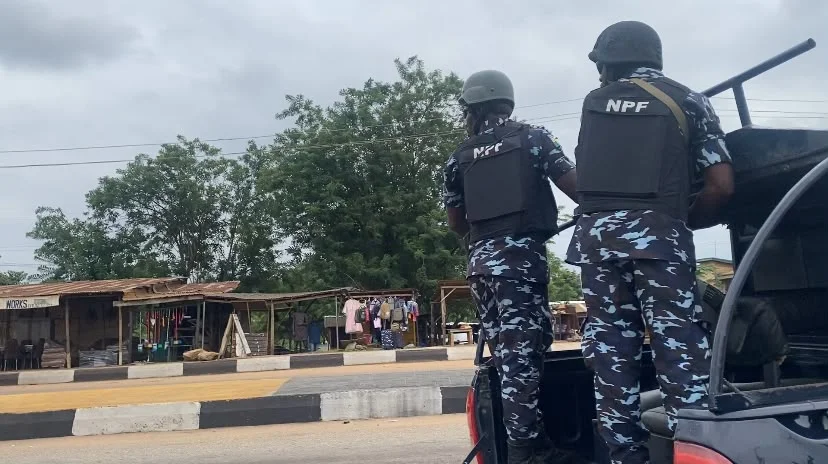
A 42-year-old pastor, Samson Ajayi, has been arrested by the Nigeria Police Force in Akure, Ondo State, for allegedly sexually abusing his 17-year-old daughter for about four years.
Ajayi, a father of five, was reportedly arrested at a prayer mountain in Akure after his wife allegedly caught him in the act at their residence in Igoba, Akure North Local Government Area of the state.
Police sources said the teenager’s mother raised the alarm and reported the incident at the Igoba Police Station after allegedly discovering what had been happening between her husband and daughter.
Preliminary investigations reportedly indicated that the alleged abuse had continued for approximately four years.
Following the report, detectives launched a search for the suspect and subsequently tracked him to a prayer mountain, where he was arrested without resistance.
During questioning, the pastor allegedly admitted to the offence but reportedly attributed his actions to what he described as a “generational curse.”
According to police sources, Ajayi claimed that his own father had allegedly sexually abused his sister, who is the suspect’s aunt. Investigators are expected to verify the claim as part of the ongoing inquiry.
The Ondo State Police Command confirmed that the suspect remains in custody and will be prosecuted after the completion of investigations.
The case has sparked outrage in the Igoba community, with residents and community leaders calling for swift justice and stronger measures to protect children from abuse.
The Ondo State Ministry of Women Affairs and Social Welfare has also been notified and is reportedly providing support to the teenager.
A senior police officer, who spoke on condition of anonymity because the investigation is ongoing, described the case as “very grievous” and assured that the suspect would face the law if found culpable.
The police urged members of the public with relevant information to assist investigators and encouraged victims of sexual abuse to report such cases to the police or appropriate government authorities.
Ajayi remains in detention pending the conclusion of investigations and his arraignment in court.

The Lagos State Police Command has launched an investigation into a viral video showing a physical confrontation between police officers and a group of youths in the Surulere area of the state.
The video, which circulated widely on social media on Saturday, September 5, 2026, captured a tense altercation involving a police officer and a young man who were seen grabbing each other’s shirts and struggling during the confrontation.
The circumstances that led to the incident were unclear as of the time of filing this report.
However, the command said it had commenced an investigation to establish what transpired and determine the circumstances surrounding the confrontation.
The Police Public Relations Officer, SP Abimbola Adebisi, confirmed the development in a statement posted on the command’s official X account.
Adebisi said the command had taken note of the video and immediately ordered an investigation into the incident.
She urged the individuals featured in the footage to appear before the police to provide information that could assist the inquiry.
“The Command has seen the video currently in circulation and has immediately commenced an investigation into the incident,” Adebisi said.
She added that those involved had been directed to report to the office of the Police Public Relations Officer at the Lagos State Police Command Headquarters, Ikeja, by 11 a.m. on Monday.
The command said their appearance would help investigators obtain necessary clarification and establish the facts surrounding the confrontation.
Police authorities have yet to disclose whether any arrests have been made or whether disciplinary measures have been taken against any of the officers involved.

APM Challenges Tinubu, Defence Minister to Travel Without Escorts Amid Security Claims

Pastor Arrested in Ondo for Allegedly Raping 17-Year-Old Daughter for Four Years

Lagos Police Probe Viral Clash Between Officers, Youths in Surulere



-
 Economy16 hours ago
FG Can’t Account For ₦33.75 Billion Cash Transfers To Vulnerable Nigerians – Auditor-General
-
 News9 hours ago
₦33.75bn cash transfer funds: Atiku promises to dig deep into missing money
-
 News16 hours ago
2027: Amaechi Chose Buhari Over Jonathan, We’ll Pay Him Back – Wike
-
 Economy16 hours ago
Details Of What You Should Know About Dangote Refinery Shares, Price, IPO Date And How To Buy
-

 News16 hours ago
British-Nigerian Businessman Dies After Penis Enlargement Procedure in Thailand
-

 News16 hours ago
At 71, Nigerian Man Enrolls at UI Law School: Here Is Why He Did It
-

 Sports16 hours ago
Isak brace fires Liverpool to first league win
-

 Foreign11 hours ago
Drug trafficking: Court sentences popular tv presenter, 11 others to death