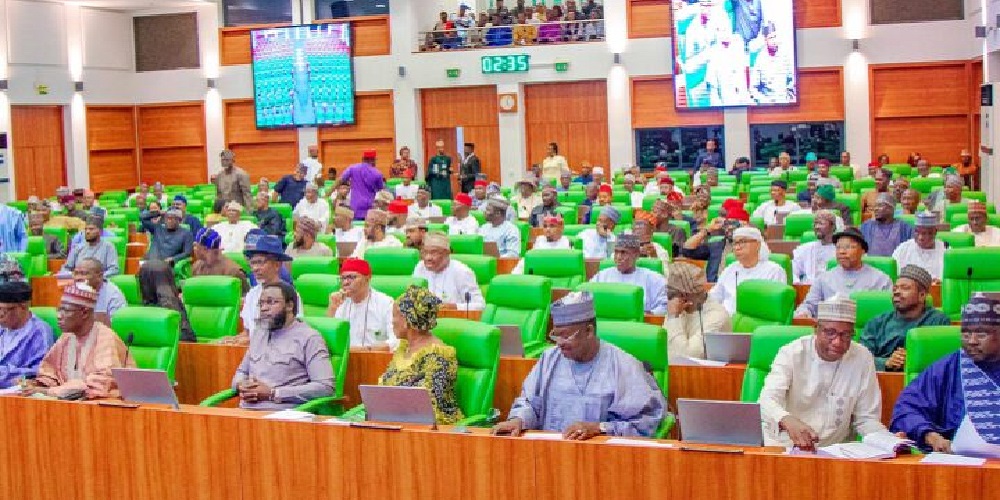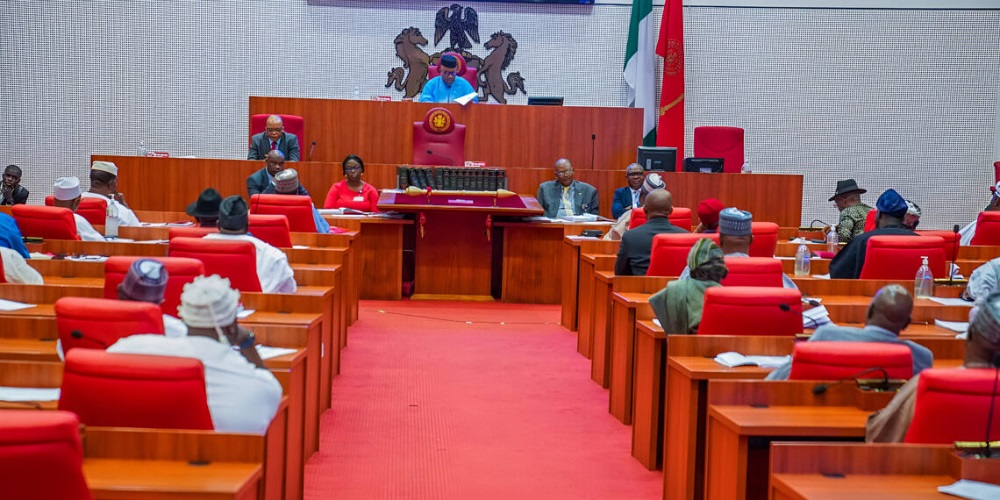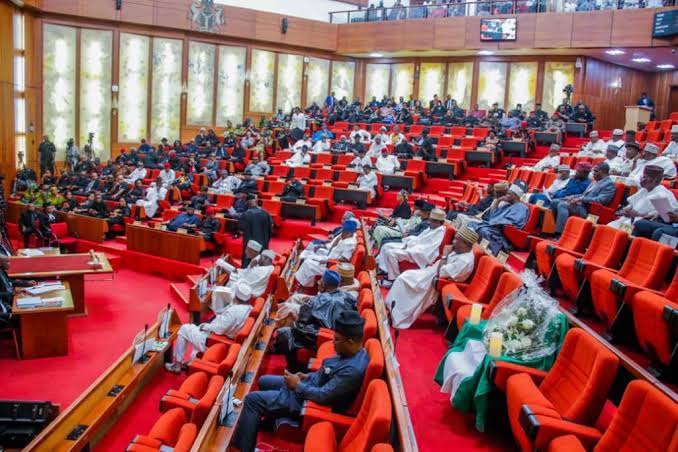
A bill seeking the amendment of the 1999 Constitution to empower governors to appoint state commissioners of police scaled second reading on the floor of the House of Representatives on Tuesday.


In the alteration to the constitution under consideration, a commissioner of police appointed from among the serving policemen in the state will head the proposed state police in a long-awaited move to decentralise the Nigeria Police Force which has failed to address the spiralling security crisis confronting the country.
The country has been under assault by bandits, kidnappers, and other nefarious characters that daily launch violent attacks on citizens, many of whom are kidnapped, killed, or maimed. 
Though the police authorities had initiated various security operations and also deployed more operatives across the country to tackle the insecurity, the crime wave had yet to abate as gunmen operated freely in several urban areas and rural communities.
Titled, ‘A Bill for an Act to alter the Constitution of the Federal Republic of Nigeria, 1999 to Provide for Establishment of State Police and Related Matters,’ the bill, sponsored by the Deputy Speaker of the House, Benjamin Kalu, and 14 others, put the police on the concurrent list.
In the 1999 Constitution, policing is on the exclusive legislative List and therefore, under the direct control of the Federal Government.
Leading the debate on the general principles of the bill, the co-sponsor and member representing Ilorin West/Asa Federal Constituency, Tolani Shagaya noted that the primary purpose of government as enshrined in section 14(2)(b) of the Constitution of the Federal Republic of Nigeria, 1999, is the security and welfare of the citizens.
He added that in the past few years, the nation’s collective security had been greatly challenged, noting that as a result, state police had become inevitable to augment the efforts of the Federal Government to make the country safe for all.
Highlighting some of the key innovations in the proposed alteration bill, he said, “The transfer of police from the exclusive legislative list to the concurrent list, a move that effectively empowers states to have state-controlled policing; the introduction of a comprehensive framework to ensure cohesion as well as accountability and uniform standards between the federal police and state police; the provision of prescribed rigorous safeguards preventing unwarranted interference by the federal police in state police affairs, emphasizing collaboration and intervention only under well-defined circumstances.’’
Shagaya further listed other key provisions of the bill to include the establishment of the state police service commissions as distinct from the Federal Police Service Commission with clearly defined roles and jurisdictions, a re-calibration of the National Police Council to include the chairmen of the state police service commissions, emphasising the collaborative and consultative nature of policing in our federal system.
Other provisions are the recognition of the possible financial challenges that may be faced by state police which would require the Federal Government to provide grants or aid, subject to the approval of the National Assembly, thus ensuring adequate resources for effective policing.
The proposed amendment also provides that the appointment of the state commissioner of police by the governor shall be on the recommendation of the Federal Police Service Commission and the state assembly’s approval.
CP’s removal
However, the CP can be removed by the governor on the recommendation of the Federal Police Service Commission, subject to two-thirds of the state assembly.
Section 215 (4) of the bill provides that, “A state police shall be headed by a commissioner of police who shall be appointed by the governor of the state on the advice of the Federal Police Service Commission from among serving members of the state police subject to confirmation by the state House of Assembly.’’
Section 216 (3) read, “A Commissioner of Police of a state shall only be removed by the governor upon the recommendation of the Federal Police Service Commission praying that he be so removed on the grounds of (a) misconduct in the performance of his official duties (b) breach of policing standards, law, regulation, and code of conduct (c) conviction of any offence involving fraud or dishonesty by a court of law or tribunal and (d) bankruptcy and mental incapacity.’’
It stated that the governor or commissioner under him may give the commissioner of police lawful directive but if considered illegal, the police commissioner may refer the order to the state service commission, which is empowered to take the final decision.
“The governor or such other commissioner of the government of the state as he may authorise on that behalf may give to the commissioner of police such lawful directions concerning the maintenance and securing of public safety and order as he may consider necessary, and the commissioner of police shall comply with those directions or cause them to be complied with.”
Furthermore, the National Assembly shall do certification of the state police service commission bi-annually to make sure it meets national standards.
Section 216 (b) of the bill empowers the state police to bear such arms as may be determined by an Act of the National Assembly.
In all, the proposal contains 18 clauses to alter sections 34, 35, 39, 42, 84, 89 and 129 of the Constitution of the Federal Republic of Nigeria (as altered).
The bill also seeks to alter sections 153, 197, 214, 215, and 216 as well as Chapter IV Part III, Second Schedule, Part II of the Third Schedule, and Part III of the Third Schedule of the Constitution.
Federal police
In the proposed legislation, section 214 of the Constitution (Establishment of Federal and State Police) is altered to distinguish the federal from the state police.
Section 214 (3a) reads, “The federal police shall be responsible for the maintenance of public security, preservation of public order and security of persons and property throughout the federation to the extent provided for under this Act or by an Act of the National Assembly; and
“(b) be responsible the maintenance of public security, preservation of public order and security of persons and property within a State to the extent that the State has power to make laws under this constitution.’’
Subject to the provisions of the constitution, the bill states that the federal police shall not interfere with the operations of any state police or the internal security affairs of any state except to contain serious threats to public order where it is shown that there is a complete breakdown of law and order within a state and the state police are unable to contain the threat.
The federal police can only intervene where the governor requests their intervention to prevent or contain a breakdown of law and order in the state.
Section 216 (1) of the Constitution was also altered to provide the basis for the removal from office of the Inspector General of Police.
Contributing in support of the bill, Ahmed Jaha representing Damboa, Gwoza/Chibok Federal Constituency, Borno State, stated, “It is not the responsibility of the military to help in the maintenance of internal security. They are involved because of the breakdown of our internal security mechanisms.’’
Also speaking, the member representing Ikorodu Federal Constituency, Lagos State, Babajimi Benson, noted that it is the job of the police to maintain law and order.
According to him, “The about 400, 000 policemen we have today cannot effectively cater for the over 200 million Nigerians. If the 36 states of the federation feel they have the funding, they should be allowed to establish state police provided such is not used to perpetrate political ambitions.’’
Other lawmakers who spoke in support of the bill included Aliyu Madaki (Kano) Ademorin Kuye (Lagos) and Bello Kumo (Gombe).
But the member representing Jibia/Kaita Federal Constituency, Sada Soli, expressed misgivings, citing the financial implication of state police at a time when many states were struggling to meet their financial responsibility to their workforce.
Ex-police commissioner
Speaking on the bill, a former Assistant Inspector General of Police, Ali Amodu, stated that while there were fears about the powers being granted to the governors to have control over the state police, it would strengthen the powers of the judiciary, noting that in the end, the citizens would benefit more from giving control of the police to the states.
He noted, “The constitution even provides that they are the Chief Security Officers of their states. If they should have control over the police, the judiciary will be so strengthened that if the governor wants to use the police against his opponents, his opponents will go to court and seek redress.
“My view is that we should not be afraid, we are having a lot of security challenges today, and we should not be afraid of testing this because it is happening in other countries. But of course, it will need an amendment of the Constitution.’’
Endorsing the control of state police by the governors as proposed by the lawmakers, Amodu said any abuse of the police could be addressed by the court.
“Yes, there is no doubt that there are going to be instances of abuse, but this abuse can be taken care of, if we seek redress in court. We have to experiment with this thing. You will see the advantages and disadvantages of anything you want to experiment with.
“But I say in conclusion that the advantages we are going to have from allowing the states to have control of their police, and provide them with equipment, the citizens tend to benefit more,” he said.
In his contribution, a retired Commissioner of Police, Emmanuel Ojukwu said, “State police or no state police, it is a matter of the constitution. Our constitution says that there shall be only one police force.
“If Nigeria wants to have state police, they should amend the constitution and they should go ahead and create the state police. But right now, every state has police of its own but they are not called police by law. That is why we have Amotekun, etc. If we amend the constitution and allow the state to call them by name, such as Kano State Police, etc, no problem.
“Governors already have these avenues working. A good number of them in the state are armed and licensed by the police to hold arms. If all they want is for state police that have been created to begin to have sophisticated weapons, no problem. It is all Nigeria.
“The Federal Police as of now is not as efficient as it should be because the Federal Government that is funding the police is not giving it what it needs. If the states create their police and give it what it needs, there will not be any problem.”
On its part, the Rivers State Government supported the bill on the state police.
The state Commissioner of Information and Communications, Joseph Johnson, in an interview with one of our correspondents on Tuesday, said the bill would strengthen policing and improve security.
He further said the state Governor, Siminalayi Fubara, was privy to the meeting with the President recently when the issue of state Police dominated discussions.