News
VP Shettima Reiterates FG Commitment To Tackle Challenges Of Power Sector

- /home/naijuinz/public_html/wp-content/plugins/mvp-social-buttons/mvp-social-buttons.php on line 27
https://naijablitznews.com/wp-content/uploads/2024/02/Kashim-Shettima.jpg&description=VP Shettima Reiterates FG Commitment To Tackle Challenges Of Power Sector', 'pinterestShare', 'width=750,height=350'); return false;" title="Pin This Post">
- Share
- Tweet /home/naijuinz/public_html/wp-content/plugins/mvp-social-buttons/mvp-social-buttons.php on line 72
https://naijablitznews.com/wp-content/uploads/2024/02/Kashim-Shettima.jpg&description=VP Shettima Reiterates FG Commitment To Tackle Challenges Of Power Sector', 'pinterestShare', 'width=750,height=350'); return false;" title="Pin This Post">
VP Shettima Reiterates FG Commitment To Tackle Challenges Of Power Sector

By Gloria Ikibah
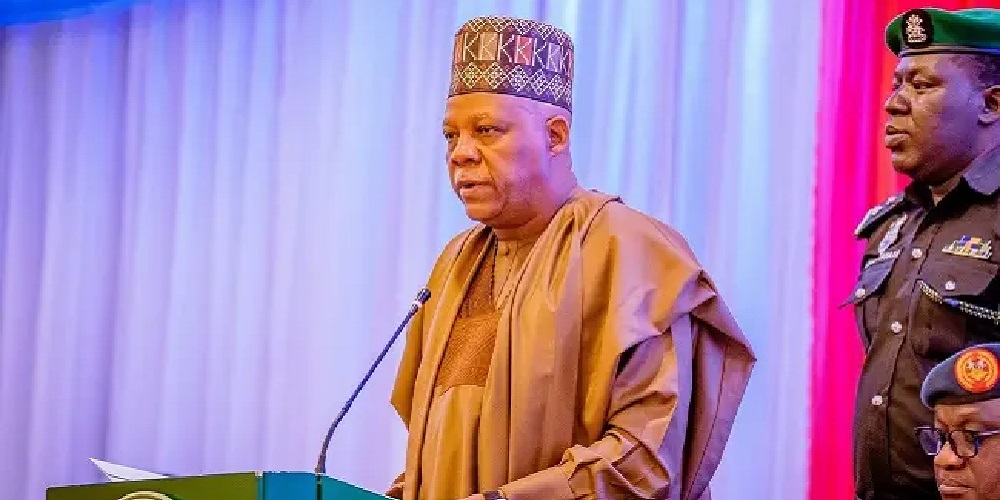
Nigeria’s Vice President, Kashim Shettima has said that in tackling the issues affecting the power sector, the Federal Government is committed to being a partner to the state governments and facilitating the shift towards increased state government participation in the electricity market as envisioned by law.

The Vice President stated this at a two-day power sector stakeholders interactive dialogue/workshop organised by the House of Representatives Committee on Power on Tuesday in Abuja, with the theme, “Confronting Nigeria’s Power Challenge As The Nation Migrates To A Multi-Tier Market: A Legislative Intervention”.
Shettima who was represented by Sadiq Wanka, said this will require an open channel of communication to adequately plan the transition, and respond to issues as they emerge.
He said: It will require a willingness to leverage all the knowledge that has been accumulated over the last decade of operating the current market structure, and to learn from the mistakes and successes therefrom. It will require a razor-eyed focus on the prize, which is energising Nigerian homes and businesses. The new structure must therefore prioritise providing an enabling environment at the state and wholesale market levels, and allow the private sector to lead the way across the value chain. And of course, it will require the federal and state governments to continue playing a balancing role, ensuring equity and keeping environmental considerations on the front burner.
Shettima who urged that the level of engagement of all stakeholders has to continue to be strong, as there are many issues yet to be resolve; therefore charged industry players to maintain a willingness to learn and adapt.
“In addition to the urgent need to adequately define what the new national electricity framework is, the introduction of new state electricity markets raises two prominent questions:
“The first is how do we ensure state readiness for the increased responsibility they are assuming in the new national electricity framework? While state governments can now regulate all electricity value chain activities within their borders, these new powers come with non-trivial responsibilities. Having the power to set tariff policy within state borders also comes with the responsibility of paying tariff shortfalls and subsidies that emanate from these policies. It comes with the responsibility of state governments guaranteeing payments to the national wholesale electricity market. Having the power to regulate electricity activities also means there is a need to build the capacity to ensure competent and independent regulators in each state market. It means states need to take a leading role in attracting investments to recapitalise distribution companies, and to ensure a steady flow of investments towards increasing electricity access.
“The second key question that becomes immediately apparent is how do we prioritise coordination and orderliness in the transition? It is important that investors have clarity and confidence in the roadmap and timelines for transition and for there to be a base level of standardisation across electricity markets so dealing with different regulatory bodies does not become too cumbersome and force investors to stay away.
“Similarly, there is need for us to maintain a level of flexibility in the transition process. For example, transitioning to state regulatory control requires distribution companies to set up state subsidiaries. But this is not a straightforward process. There are complex issues of asset delineation, equity negotiations with other investors in DISCOs and even infrastructure investments required to truly delineate the distribution network of one state from the other. There is a lot of re-organisation that needs to happen internally within DISCOs from a process and people perspective. All these among others require time and patience”, the VicePresidentstated.
He further said that with the wholesale structural shift that the Electricity Act 2023 (as amended) and the associated constitutional amendment usher in, it means there is the need to double down on ensuring an orderly transition to the new national electricity market framework.
“I congratulate the National Assembly for its steadfastness in leading the conversation through an orderly transition and for demonstrating a willingness to review the recently passed Electricity Act as needed.
According to him, the Electricity Act 2023 seeks to overhaul the structure of the Nigeria Electricity Supply Industry and proposes a structure that promotes more competition.
“The conversation we are having here today at this National Assembly event is very timely. At a moment that the energy quadrilemma is at the forefront of global discussions, in Nigeria, there is widespread recognition that we are underperforming across all four pillars of providing electricity supply that is reliable, affordable, environmentally sustainable and available to all Nigerians. Indeed, by some estimates, less than 20% of Nigerians have access to reliable energy of more than 12 hours per day. 45% of Nigerians have no access to any form of electricity. And as a result, households and industry have been dependent on self-generation that is both more expensive and more polluting.
“The Electricity Act 2023 that was passed by the National Assembly and signed into law by President Bola Ahmed Tinubu seeks to overhaul the structure of the Nigeria Electricity Supply Industry. It proposes a structure that promotes more competition and greater scope for tailoring power solutions to local needs, while transitioning to a market structure that would attract much needed investments and promote environmental sustainability.
“In this regard, I must congratulate the National Assembly for its steadfastness in leading the conversation on this orderly transition and for demonstrating a willingness to review the recently passed Electricity Act as needed. I would also like to congratulate the Honourable Minister of Power for his role in convening industry stakeholders towards the development of the Integrated National Electricity Policy and Strategic Implementation Plan, as envisioned by the new Act. Similarly, the Nigerian Electricity Regulatory Commission has continued to step up to the plate in translating the Electricity Act into enabling regulations that facilitate the transition to a new market structure. State governments have also demonstrated a unique sense of urgency and duty in playing their part towards domesticating the new Electricity Act and improving the energy situation for their populace”, he added.
Vice President Shettima asserted that there is a lot to be excited about with the new Electricity Act, which has the core elements of resolving the structural issues that have hindered investments in the sector – from liquidity challenges, to the inadequate legal framework.
He added that conversations are “key to ensure we are all adequately thinking through the implications of the new Act, and ensuring new structural issues are not being created”.

News
Nigerians granted visa-free entry to Grenada
The Consulate of Grenada in Nigeria has announced visa-free access for Nigerian passport holders as part of efforts to boost trade, tourism, and investment ties between the two countries.
Grenada’s Consul to Nigeria, Ambassador Abidemi Sonoiki, disclosed the development during an interactive session with journalists on Thursday.
He said the Caribbean nation has already approved free entry for Nigerians and is awaiting reciprocal action from the Nigerian government through diplomatic channels.
“I have a letter from Grenada’s foreign affairs authorities to Nigeria’s Ministry of Foreign Affairs. Grenada has approved free access for Nigerians, and we expect Nigeria to reciprocate the gesture,” Sonoiki stated.
The move aims to deepen economic relations.
Sonoiki highlighted investment opportunities for Nigerians in sectors including tourism, aviation, real estate, maritime services, education, agriculture, and financial technology.
Grenada, with a population of about 125,000, is described as a stable, investment-friendly destination with a low crime rate.
Its currency has remained stable since the country gained independence in 1974.
Tourism forms the backbone of its economy, attracting visitors for vacations, weddings, cultural events, and education.
The envoy disclosed that discussions were also ongoing to establish a direct air link between Nigeria and Grenada, with hopes that a permanent route could begin operations within the next six months.
Such connectivity would enhance tourism, trade, and people-to-people exchanges, positioning Grenada as a gateway to the wider Caribbean market of around 46 million people, while leveraging Nigeria’s role as a key entry point into Africa.
News
NUPRC Seeks Funding For Oil, Gas Operators
The Nigerian Upstream Petroleum Regulatory Commission (NUPRC) has appealed to financial institutions to increase funding for oil and gas operators as part of efforts to expand domestic production.
NUPRC chief executive, Oritsemeyiwa Eyesan, made the call during a visit by senior executives from Rand Merchant Bank (RMB) to the commission’s Abuja headquarters.
Eyesan emphasised the importance of collaboration between regulators, financiers and operators to unlock investment and accelerate growth in the country’s gas sector.
“One critical element will be financing, and we are hoping that you and the financial world will be there to support us. We will ensure that the industry operates in accordance with the Petroleum Industry Act and all other regulatory instruments,” Eyesan said.
She disclosed that the industry’s appetite for investment is very strong, as demonstrated by the interest in the ongoing 2025 licensing bid round, which witnessed almost 300 applications from IOCs and indigenous operators.
The NUPRC boss also highlighted ongoing initiatives around energy transition, including the issuance of Permits to Access Flare Gas (PAFG) to 28 firms and a target of 60 per cent reduction in fugitive methane emissions by 2031, among other initiatives aimed at promoting sustainable development in the upstream sector.
Responding, the head of Oil and Gas Coverage at Rand Merchant Bank, Jonathan Ross, said the bank is keen on supporting Nigeria’s efforts to grow oil and gas production, with a particular focus on gas development.
He described gas as a strategic priority for the bank, citing major infrastructure projects such as the OB3 Gas Pipeline as critical to unlocking the country’s vast gas potential.
The bank also acknowledged recent regulatory reforms and improvements in security in host communities, noting that Nigeria is in a stronger position to attract investment than in previous years.
News
Falana To FG: Recover $118.67bn, N66.4bn in Outstanding Oil Sector Funds
Human rights lawyer Femi Falana has urged the Attorney-General of the Federation and Minister of Justice, Lateef Fagbemi, to take immediate legal steps to recover over $120.5 billion and N66.4 billion owed to the federal government by the Nigerian National Petroleum Company Limited (NNPCL), international oil companies (IOCs), and other industry operators.
Falana, in a letter on behalf of the Alliance on Surviving Covid-19 and Beyond (ASCAB), stated that court rulings, government investigations, and federal agency reports confirm that these substantial amounts, comprising unpaid royalties, taxes, dividends, and other revenues, are still unpaid and must be remitted to the Federation Account.
The senior lawyer warned that if the Attorney-General does not initiate recovery actions within 14 days of receiving the letter, ASCAB would seek a court order compelling him to act in accordance with his constitutional and legal duties.
Falana identified five main categories of funds to be recovered.
The largest portion, he said, is $62 billion in unpaid royalties owed by international oil companies, due to the federal government’s failure to enforce the Deep Offshore and Inland Basin Production Sharing Contracts Act.
He explained that Section 16 of the law requires royalty increases when crude oil prices exceed $20 per barrel, but this was overlooked for 18 years, resulting in significant revenue loss.
Falana also stated in the letter that the governments of Akwa Ibom, Bayelsa, and Rivers approached the Supreme Court and that on October 20, 2018, the apex court issued a consent judgment instructing the federal government to recover these royalties and pay the states their 13% derivation entitlement.
The right advocate further stated that a committee set up by former Attorney-General Abubakar Malami concluded that $62 billion could be recovered from the international oil companies.
He also mentioned that the Federal High Court has issued judgments supporting Akwa Ibom, Rivers, and Bayelsa states’ claims to their share of the disputed royalties.
The lawyer further urged the government to recover $29 billion in proceeds from crude oil theft and undeclared exports.
He also pointed out that findings by lawyers hired by NIMASA reportedly showed that 60.2 million barrels of crude, worth about $12.7 billion, were discharged at the Port of Philadelphia, USA, between 2011 and 2014.
Falana also cited a House of Representatives ad hoc committee report that estimated that $17 billion in crude oil and LNG exports left Nigeria without proper records during the same period.
He called on the Attorney-General to direct the EFCC to recover the funds from the oil and shipping firms involved.
Regarding Nigeria LNG Limited (NLNG), Falana accused NNPCL of failing to remit $21.5 billion in dividends received on behalf of the federal government.
He pointed out that NLNG paid over $44 billion in dividends over 26 years, with NNPCL, holding a 49% stake, receiving about $21.5 billion, which has not been remitted to the Federation Account despite several recommendations and resolutions.
Falana also referenced NEITI’s 2022/2023 report, which identified $6.071 billion and N66.4 billion in outstanding revenues as of June 2024.
He criticised the National Assembly for approving a $2.1 billion external loan request in November 2024 amid these recoverable revenues.
The lawyer urged the Attorney-General to recover $2.9 billion spent on rehabilitating the Port Harcourt, Warri, and Kaduna refineries, noting contractual breaches by foreign contractors and operational issues, including refinery shutdowns.
He called for an EFCC investigation into the contracts and recovery of related funds.
He emphasised that recovering these sums would boost government revenue and lessen dependence on external borrowing.
“If the said sum is recovered, the Federal and state governments will avoid further external loans,” the letter stated.
Falana asserted that ASCAB has the legal standing to pursue legal action if necessary, citing its role in advocating amendments to the contracts law, which President Buhari signed into law in 2019.
As of now, neither the Office of the Attorney-General nor NNPCL has publicly responded to these claims and requests.
-
News22 hours agoVideo: FCT minister Wike embarks on final inspection of Kuje airport road
-
News23 hours agoNUPENG Deputy President Oladejo Felicitates Comrade Akinlaja at 76
-
News22 hours agoOyo Assembly Rejects Negotiation With Ogbomoso school children abductors
-
News21 hours agoBREAKING: House Erupts Over Minority Leader Race as Forgery, $50,000 Bribery Claims Trigger Uproar
-
News24 hours agoU3 Federal Constituency: Akpodiete Says Emarayo’s Multiple Party Membership Threatens PDP’s 2027 Chances
-
News16 hours agoSenate endorses Bill seeking to establish National Agency for Malaria elimination
-
News23 hours agoGov Aiyedatiwa reveals how youths plan to bomb govt house
-
Entertainment19 hours ago2026 Guber: I Will Be There To Defend Our Votes – Davido Assures Adeleke

Warning: Undefined variable $user_ID in /home/naijuinz/public_html/wp-content/themes/zox-news/comments.php on line 49
You must be logged in to post a comment Login