
News
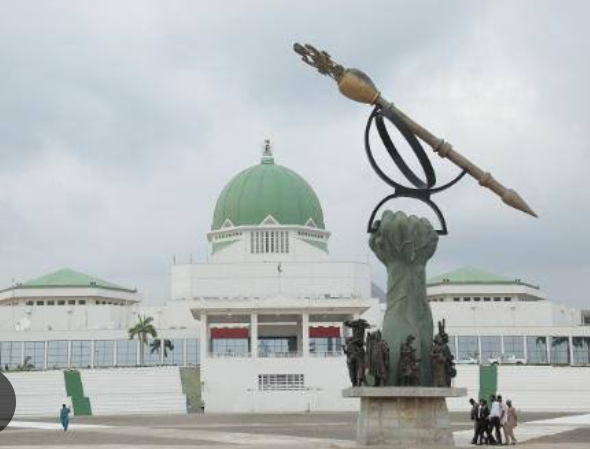
21 States Run Local Government Areas With Caretaker Committees

- /home/naijuinz/public_html/wp-content/plugins/mvp-social-buttons/mvp-social-buttons.php on line 27
https://naijablitznews.com/wp-content/uploads/2024/06/Screenshot_20240630-132931.png&description=21 States Run Local Government Areas With Caretaker Committees', 'pinterestShare', 'width=750,height=350'); return false;" title="Pin This Post">
- Share
- Tweet /home/naijuinz/public_html/wp-content/plugins/mvp-social-buttons/mvp-social-buttons.php on line 72
https://naijablitznews.com/wp-content/uploads/2024/06/Screenshot_20240630-132931.png&description=21 States Run Local Government Areas With Caretaker Committees', 'pinterestShare', 'width=750,height=350'); return false;" title="Pin This Post">


By Kayode Sanni-Arewa
These states are running the affairs of local government councils with caretaker committees appointed by state governors.
This is against the provisions of Section 7 of the 1999 Constitution which guarantees the operation of local government by democratically elected officials.
There are 774 local government areas in the country, but the efficiency of the third tier of government has been hampered by the actions of some governors who have been accused of mismanaging funds meant for the administration of local governments.
In the last few months, calls for local government autonomy have increased in Nigeria. President Bola Tinubu has also supported these calls. In May, the Federal Government approached the Supreme Court with a suit seeking to compel governors of the 36 states to grant full autonomy to the local governments in their domains.
Currently, the Federal Government receives 52.68 per cent, states receive 26.72 per cent, and LGs receive 20.60 per cent of the country’s monthly revenue allocated by the Revenue Mobilisation Allocation and Fiscal Commission, which is domiciled under the Presidency, and is disbursed by the Federation Account Allocation Committee.
LG funds are paid into a joint account operated by state governments and local governments in their domains.
A former National Chairman of the Peoples Democratic Party, Audu Ogbeh, who was recently interviewed on Channels Television, stated that the Federal Government should discontinue the payment of LG funds to such joint accounts, and move them to accounts solely operated by local government administrations.
“I cannot be sending you money that disappears. You don’t repair primary schools, you don’t do anything. The money vanishes and they say they are paying workers; for which work? Strolling around in the morning and drinking palm wine? These are the issues. Those failures are creating dangerous problems for the country,” he said.
He added that some governors appointed their stooges as caretaker chairmen for local governments, gave them stipends, and diverted large chunks of the money allocated for local government administration to questionable quarters.
On June 28, 2024, the government of Jigawa State dissolved the elected council chairmen of the 27 local governments in the state.
Earlier, the Jigawa State House of Assembly had amended the local government law, extending the time for fresh local council elections by one year and ordering the appointment of caretakers before the election.
Though the government has yet to provide further information regarding the issue, it is believed that based on the amendment by the assembly, the caretaker committee may take up the task.
Recently, the Governor of Rivers State, Siminalayi Fubara, appointed caretaker chairmen to take charge of LG councils in the state following a power tussle between him and the erstwhile governor of the state, Nyesom Wike.
On June 20, 2024, the Governor of Anambra State, Charles Soludo, through the state’s House of Assembly, confirmed the appointment of transition committee chairmen and councillors for the 21 local government areas of the state.
The assembly confirmed the appointment in line with Section 208 of the Local Government Law, 1999 as amended, as requested by Soludo.
The newly-appointed chairmen are Ifeanyi Chiweze (Anambra East), Fidelis Nnazo (Anambra West), Romanus Ibekwe (Anaocha), Chinedu Okafor (Awka South), Alphonsus Ofumele (Ayamelum), Chijioke Ozumba (Dunukofia), and Stanley Nkwoka (Idemili North).
Others are Chinedu Ononiba (Njikoka), Val Ezeogidi (Nnewi South), Franklin Nwadialu (Ogbaru), Anthony Nwaora (Onitsha North), Casimir Nwafor (Orumba North), and Shedrack Azubuike (Orumba South).
The state noted that the local government transition committee chairmen will serve for three months in the first instance.
In Imo State, the last council poll was conducted on August 25, 2018; and was the first LG election in seven years.
In Kwara State, the last council election was in November 2017, and caretaker committees had been in charge since 2020.
In Zamfara, the last grassroots poll was held on April 27, 2019, and the state returned to appointees after the chairmen’s tenures expired. In May 2024, the state assembly approved a six-month extension for the caretaker committee.
In Benue, however, elections are scheduled to be held on July 6, 2024, for LG council chairmen.
Other states affected include Bauchi, Plateau, Abia, Enugu, Katsina, Kano, Sokoto, Yobe, Ondo, Osun, Delta, Akwa-Ibom, and Cross River.
Speaking to our correspondent on the matter, the National President of the National Union of Local Government Employees, Hakeem Ambali, described the constitution of caretaker committees as illegal, adding that it went against the constitution of the Federal Republic of Nigeria.
“Caretaker committees remain illegal. State governments should therefore abide by the rule, especially with total respect to Section Seven, Subsection One of the 1999 Constitution. It further reinforces the correctness of the President Bola Tinubu-administration in taking a bold step in seeking legal intervention against the violation of the constitution with impunity by state political actors,” Ambali added.
Recall that the Attorney General of the Federation, Lateef Fagbemi, had dragged the 36 states to the Supreme Court over the issue of LG autonomy.
The suit, marked SC/CV/343/2024, was filed by the Attorney-General of the Federation and Minister of Justice, Lateef Fagbemi (SAN), on behalf of the Federal Government.
The Federal Government urged the apex court to issue “an order prohibiting state governors from the unilateral, arbitrary, and unlawful dissolution of democratically elected local government leaders for local governments.”
In the suit predicated on 27 grounds, the Federal Government accused the governors of gross misconduct and abuse of power.
The FG, in the originating summons, prayed the Supreme Court to make an order expressly stating that funds meant for local governments from the Federation Account should be paid directly to the local governments, rather than through the state governments.
The justice minister also prayed for “an order of injunction restraining the governors, their agents, and privies from receiving, spending, or tampering with funds released from the Federation Account for the benefit of local governments when no democratically elected local government system is in place in the states.”
The Federal Government further sought “an order stopping governors from constituting caretaker committees to run the affairs of local governments as against the constitutionally recognised and guaranteed democratic system.”

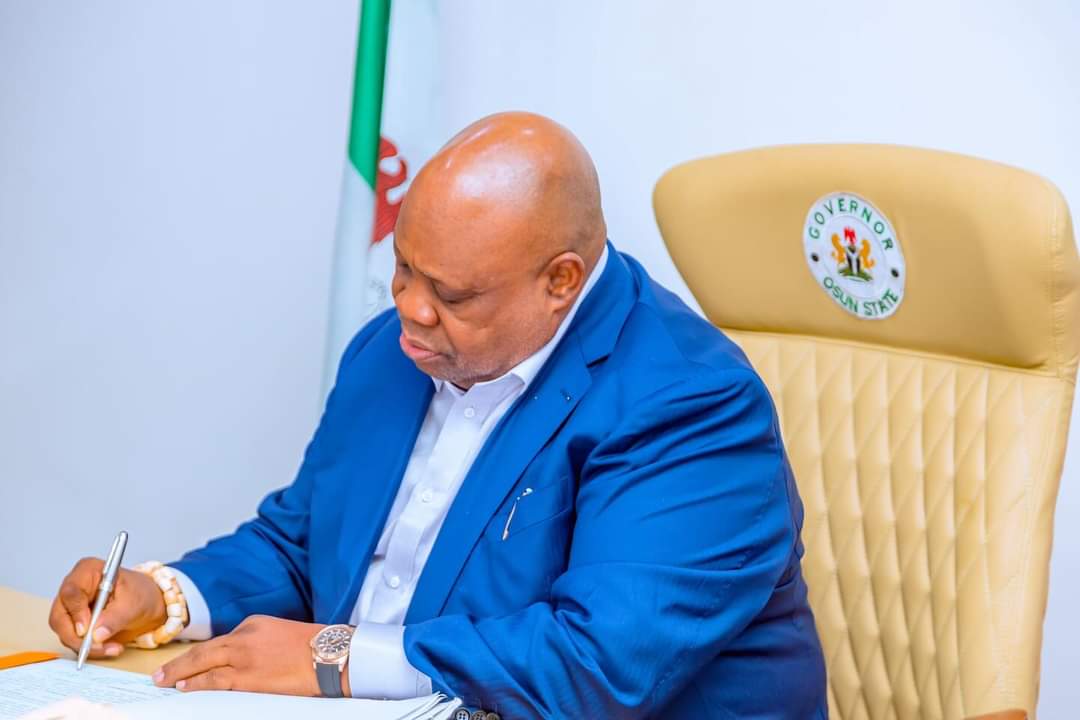
The Osun State Government has said it has filed an application before the Federal High Court in Lagos seeking to set aside the ex parte order restricting transactions on accounts operated by the state government over a $13.9 million arbitration award in favour of Gamji Nigeria Company Limited.
The government also assured the public that it had commenced necessary legal steps to vacate the order and protect the state’s interests through a judicial review of the arbitration award.
In a statement issued on Sunday and signed by the Commissioner for Information and Public Enlightenment, Kolapo Alimi, the government described the order as having been obtained through what it called non-disclosure of material facts to the court.
According to the statement, the arbitration award Gamji sought to enforce was also allegedly affected by several irregularities, prompting the state government’s legal team to approach the Lagos State High Court to challenge the award.
The government said the ex parte order of September 9, 2026 referenced an alleged arbitral award, but maintained that no such award was made against the state government in July 2024.
It clarified that the only arbitral award against the state government was issued in July 2026 and that the award was already being challenged by the government before the Lagos State High Court.
The government traced the dispute to a 2017 contract awarded during the administration of former Governor Adegboyega Oyetola. It said the administration rejected a variation request by Gamji, particularly over the company’s claim that the state was indebted to it in the sum of $15,982,638.22.
The matter subsequently proceeded to arbitration, which the state government alleged was improperly handled in favour of Gamji, while the state was denied a fair hearing and full participation in the process.
The government said its legal team had already filed a suit at the Lagos State High Court on September 1, 2026, seeking to set aside the arbitral award before Gamji approached the Federal High Court.
It added that a motion on notice seeking to suspend enforcement of the award pending the determination of the suit was also filed and served on Gamji and its counsel.
According to the state government, Gamji was therefore aware that the award was being challenged before a competent court when it approached the Federal High Court to seek enforcement.
The government further alleged that Gamji failed to disclose to the Federal High Court that the validity of the award was already being challenged before the Lagos State High Court and that the company had been served with an application seeking to suspend enforcement pending the determination of the case.
The state government disclosed that it had also filed a motion on notice seeking to set aside the September 9 order and informed the Federal High Court of the circumstances surrounding the arbitration proceedings and the pending challenge.
It, however, said it would refrain from making further comments on the merits of the case because the matter remains sub judice.

The 20 National Youth Service Corps (NYSC) members kidnapped by gunmen in Imo State have allegedly been subjected to physical ass@ult by their captors, with the kidn@ppers reportedly reducing their ransom demand to N5 million per victim.
The graduates were abducted on Thursday while travelling from Ibadan to their NYSC orientation camps in Abia and Akwa Ibom states. They were reportedly att@cked along the Owerri-Onitsha Road in Umunoha, Imo State, while travelling in two buses.
A relative of one of the victims, Alhaja Alimot Akande, said the abd¥ctors initially demanded N50 million for each victim but had now reduced it to N5 million.
“They are still demanding N5 million. They have come down to N5 million each,” she said.
Akande also alleged that the abductors had started beating the victims, including the women.
When I spoke to my sister, they started beating them since yesterday,” she said.
Asked if the female victims were also being assaulted, she replied: “They are not sparing anybody. They are beating all of them.”
She said one victim was also allowed to speak with his father, with the abd¥ctors reportedly monitoring the calls to assess the family’s ability to raise the ransom.
Meanwhile, the Oyo State Government said it was working with the Imo State Government and security agencies to secure the victims’ release.
Oyo State Commissioner for Information, Prince Dotun Oyelade, said the government was drawing on its experience from the recent Oriire abduction to assist efforts in Imo State.
“Oyo State Government had not and will not abandon its citizens. We will continue to work endlessly and desperately to secure the release of our children,” he said.

Tansian University, Umunya, Anambra State, has been thrown into mourning following the sudden death of its newly inaugurated substantive Vice-Chancellor, Professor Carter Dike Umeoduagu, barely 48 hours after assuming office.
Umeoduagu was formally sworn in as the substantive Vice-Chancellor of the university on Thursday, October 1, 2026, marking the commencement of his tenure.
However, the professor reportedly took ill on Saturday, October 3, two days after his assumption of office, and subsequently died.
His sudden death has sent shock waves through the university community, particularly coming at a time when the institution has been facing leadership challenges.
The development is also coming amid recent controversy over the leadership of the university, including disputes surrounding the tenure of the former Vice-Chancellor, Professor Eugene Okoye Nwadialor, and the emergence of an acting leadership structure.
The death of Umeoduagu, coming almost immediately after his formal assumption of office, has added a tragic dimension to the university’s recent leadership crisis.
Details of the circumstances surrounding his illness and death were not immediately available as of the time of filing this report.
The university community, academics, colleagues, family members and associates are expected to mourn the deceased academic and administrator, whose tenure as Vice-Chancellor ended almost as soon as it began.

BREAKING: Temi Nkem emerges winner of BBNaija 11th season

Osun Govt finally speaks As Court orders banks to freeze state accounts

Sad development as abductors beat up 20 corp members, reduce ransom from N50m to N5m each


-

 News20 hours ago
Imo Police Locate Kidnappers’ Camp, Reveal Why Abducted Corps Members Are Yet to Be Rescued
-

 News20 hours ago
Was Tinubu’s Speech AI-Generated? Elon Musk’s Grok AI Makes Strong Revelation
-
 News8 hours ago
Monarchs in Etche LGA presenting symbolic traditional kola to FCT minister Wike at ongoing interactive meeting with Ogbakor, other stakeholders (Video)
-

 News20 hours ago
Edo 2027: APC Chairman ‘AK-47’ threat – Amnesty International Makes Strong Demand
-
 News20 hours ago
How I Hired Cars To Get Drivers Abducted By My Gang, Kidnap Suspect Reveals
-

 Entertainment20 hours ago
My Penis Stopped Working When…— Commedian Julius Agwu
You must be logged in to post a comment Login