News
25 facts about Dangote Refinery
- Share
- Tweet /home/naijuinz/public_html/wp-content/plugins/mvp-social-buttons/mvp-social-buttons.php on line 72
https://naijablitznews.com/wp-content/uploads/2024/07/images-63.jpeg&description=25 facts about Dangote Refinery', 'pinterestShare', 'width=750,height=350'); return false;" title="Pin This Post">
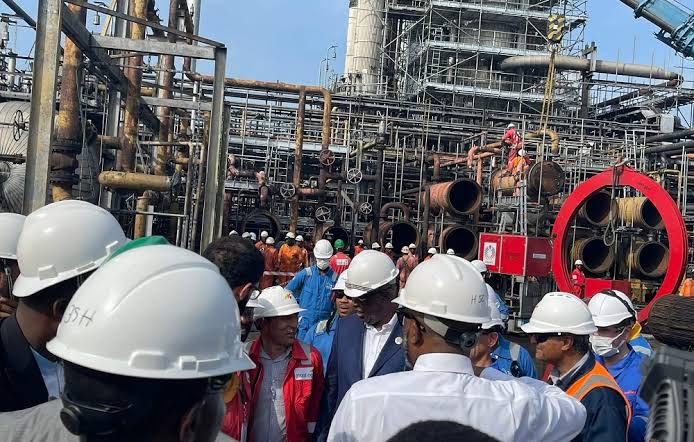
President of the Dangote Group, Alhaji Aliko Dangote led a large team of media and businessmen on a tour of the refinery last Sunday.

A lot has been written and said about the engineering marvel. President of the Guild of Editors, Eze Anaba simply described it as ‘monstrous’.
When I got close to him I asked “Must a refinery be this big?”

He smiled and said: “It’s the biggest in the world. It’s the first of its kind. The Dangote Petroleum Refinery Project is among our many initiatives toward supporting the transformation agenda of the Federal Government.
“Our goal is to produce, within Nigeria, most of the goods that were usually imported despite having abundant resources for domestic manufacturing of the same goods. We conceived Dangote Petroleum Refinery & Petrochemicals as an answer to the perennial shortage of premium motor spirit (PMS) in the country.”
Below are 25 facts about Dangote Refinery:
1. The Dangote Petroleum Refinery and Petrochemicals a subsidiary of Dangote Industries Limited, is the world’s largest single-train petroleum refinery.
2. The 650,000 barrels per day (bpd) crude oil refinery with 838 KTPA polypropylene plant, covers area of approximately 2,635 hectares and is located in the Dangote Industries Free Zone, Ibeju-Lekki, Lagos.
3. Total storage capacity of 4.5 billion liters which can cover: *20 days crude requirement *Product storage for 15 days of Nigeria’s gasoline consumption
4. The Dangote Petroleum Refinery is an industrial plant that transforms crude oil into various usable petroleum products such as diesel, gasoline (petrol), jet fuel, and kerosene.
5. The Refinery produces Euro-V quality gasoline and diesel, as well as jet fuel and polypropylene.
6. The Refinery is designed to process a large variety of crudes including many of the African Crudes, some of the Middle Eastern Crudes, and the US Light Tight Oil.
7. Dangote Petroleum Refinery can meet 100% of the Nigerian requirement of all liquid products (Gasoline, Diesel, Kerosene & Aviation Jet) and have surplus of each of these products for export.
8. The Refinery is designed to use the latest technology to comply with stringent guidelines and regulations to protect the local environment, and at the same time produce the latest environmentally friendly petroleum product for worldwide markets.
9. The Refinery design conforms to the World Bank, US EPA, EU, and Department of Petroleum Resources (DPR) emission/effluent norms.
10. The Refinery has its own dedicated steam and power generation system with adequate standby units for reliable/uninterrupted utility supply to operating plants.
11. It has a 435MW power plant that can meet the total power requirement of Ibadan Distribution Company, covering five states, including Oyo, Ogun, Osun, Kwara, and Ekiti.
12. Dangote is one of the few companies in the world executing a Petroleum Refinery and a Petrochemical complex directly as an Engineering, Procurement, and Construction (EPC) Contractor.
13. The Petrochemical Plant is designed to produce 77 different high-performance grades of polypropylene. Petrochemical is the source of raw materials for many manufacturing and assembling plants.
14. It maximizes Gasoline which is in high demand-53%of the production capacity compared to 22% of the existing refineries in Nigeria.
15. It maximizes value addition- Extract maximum value from every barrel of crude.
16. It minimizes low-value Fuel Oil.
17. The Refinery is estimated to generate an annual market value of US $21 billion for Nigerian crude oil, Foreign exchange savings/earnings of US $9.9 billion.
18. 56% of the production would be exported, with a foreign exchange generation of approx. $17 billion.
19. It ensures over $25 billion addition to the GDP, through massive value addition within the country.
20. Products from the plant will serve as raw materials for the production of polyvinyl chloride (PVC), which is used extensively across a broad range of industrial, technical and everyday applications including widespread use in building, transport, packaging, electrical/electronic and healthcare applications.
21. Dangote Industries developed a port and constructed quays with a load-bearing capacity of 25 tonnes/ sq meters to bring Over Dimensional Cargoes close to the site directly to handle liquid cargoes.
22. The Jetty is situated at a distance of 12.3 km from the refinery thereby effectively reducing the travel time.
23. The Refinery has capabilities for both land and sea evacuation to serve both domestic and export markets
Dedicated marine facilities for off-take of crude and loading of petroleum products.
24. • Self-sufficient marine facility with ability for freight optimization.
•Largest single order of 5 Single Point Mooring systems (SPMs) anywhere in the world.
•2 crude SPM for unloading ships up to ULCCs.
•3 products SPM for product exports up to Suez Max vessels.
•2 X 48″ sub sea crude pipelines with interconnection.
•3X24″subsea pipelines for products and imports.
•120 km subsea pipeline.
•Crude offloading capacity – 108,500 barrels/hour (17.25million liters /hr).
•Product loading capacity – 77,000 barrels/hour (12.32million liters/hr).
25. Dangote Petroleum Refinery maintains high standards for all its business practices, valuing health, safety, environment and rights for its employees, compliance with all applicable local and international laws, and being a committed partner to host communities, governments and also environment friendly.
News
Reps Demand Swift Action Over Abduction of 42 Pupils in Borno
…seek tougher protection measures for schools in high-risk communities
By Gloria Ikibah
The House of Representatives has called for the immediate rescue of 42 schoolchildren abducted from Mussa Ward in Askira-Uba Local Government Area of Borno State, as lawmakers renewed demands for stronger security around schools across Nigeria.
The resolution was sequel to the adoption of a Motion of Urgent Public Importance sponsored by Rep. Midala Balami during Tuesday’s plenary session.
Debating the motion, Rep. Balami described the abduction as a disturbing reminder of the persistent insecurity confronting communities in Borno State and other parts of the country. He emphasised that safeguarding students, teachers and educational institutions remains a core responsibility of government and warned that repeated attacks on schools continue to threaten access to education and undermine public confidence in security efforts.
The lawmaker recalled a series of high-profile abductions in the state, including the Chibok schoolgirls kidnapping, in which many of the victims are yet to be reunited with their families. He also referenced the mass abduction of more than 400 adults and children from Ngoshe, as well as several kidnappings reported along the Biu-Buratai Road and surrounding communities.
According to Balami, the recurring attacks have left families traumatised, disrupted livelihoods and contributed to declining school enrolment and attendance in vulnerable areas, as many parents fear for the safety of their children.
He argued that urgent and coordinated action is needed to secure the release of those still in captivity, restore public confidence and reassure communities that their safety remains a priority.
The lawmaker also noted growing frustration among residents who increasingly expect concrete results in the fight against insecurity rather than repeated promises.
Following deliberations, the House urged the Federal Government and security agencies to intensify efforts to rescue the 42 abducted pupils and all other victims currently being held by kidnappers or insurgents, with a view to reuniting them with their families as quickly as possible.
Lawmakers further called for enhanced protection of schools in Borno State and other vulnerable regions through increased deployment of security personnel, improved intelligence gathering and more effective rapid-response mechanisms.
The House maintained that ensuring the safety of children and protecting access to education must remain a national priority, particularly in communities that continue to face threats from criminal and insurgent groups.
In addition, the House encouraged the expansion of school protection initiatives, including early warning systems, community-based security arrangements, security awareness programmes and improved surveillance infrastructure around educational institutions.
The House further mandated its Committees on National Security, Defence, Basic Education and Legislative Compliance to engage with relevant security agencies and report back on measures being taken to secure the release of abductees and improve security around schools nationwide.
Lawmakers also urged the Federal Government to develop and implement a comprehensive Safe Schools Security Framework aimed at protecting students, teachers and educational institutions from future attacks.
News
Lawmakers Raise Alarm Over Ebola Risk, Demand Emergency Funds Support for NCDC
By Gloria Ikibah
The House of Representatives has urged the Federal Government to immediately release funds to the Nigerian Centre for Disease Control and Prevention, warning that Nigeria’s ability to respond to a potential Ebola outbreak could be undermined by persistent funding shortfalls.
This was sequel to the adoption of a motion moved by Rep. Amobi Ogah, who drew lawmakers’ attention to the recent outbreak of a rare strain of the Ebola virus in the Democratic Republic of the Congo, on Tuesday at plenary.
Debating the motion Rep. Ogah referenced reports by the Africa Centres for Disease Control and Prevention indicating that the outbreak was detected in Turi Province of the DRC on May 15, 2026.
He warned that Nigeria remains particularly vulnerable due to extensive cross-border movements and the country’s porous borders, factors that could increase the risk of disease importation.
Oga who is the Chairman House Committee on Malaria, HIV and Tuberculosis noted that on May 25, 2026, the Nigeria Centre for Disease Control and Prevention classified Nigeria as being at high risk of Ebola importation and activated emergency preparedness protocols, including placing the National Emergency Operations Centre on alert.
Despite these precautionary measures, Ogah expressed concern over what he described as a severe funding crisis affecting the agency.
According to him, the NCDC received no operational funding throughout 2025, while no capital releases had been made against its approved 2026 budget. He also stated that overhead releases to the agency had been irregular and inadequate.
The lawmaker argued that the funding constraints had significantly weakened the NCDC’s capacity to carry out essential public health functions, including disease surveillance, laboratory operations, outbreak response, logistics management and emergency preparedness activities.
“The preparedness of the Centre cannot be guaranteed under the current circumstances,” he said.
Ogah told lawmakers that the agency is currently grappling with multiple operational challenges, including unpaid contractors and vendors responsible for critical supplies and services.
He also highlighted delays in the construction of zonal laboratories, treatment centres and isolation facilities, as well as shortages of laboratory reagents and consumables needed for testing and diagnosis.
Other challenges identified include inadequate biosecurity infrastructure, limited intensive care and oxygen support systems, and insufficient resources for the training and deployment of rapid response teams across the country.
The lawmaker warned that failure to provide urgent financial support could leave Nigeria exposed to the renewed Ebola threat and other infectious disease outbreaks.
He stressed that strengthening the country’s disease surveillance and response capabilities was critical to safeguarding public health and preventing a repeat of previous epidemic emergencies.
Contributing to the debate, Rep. Billy Osawaru commended the sponsor of the motion and reminded Nigerians of the country’s successful containment of the 2014 Ebola outbreak after the virus was introduced by an infected traveller from Liberia.
He noted that Nigeria limited the outbreak to 20 cases and eight deaths through coordinated efforts by healthcare workers, emergency response agencies, the Federal Ministry of Health, the NCDC, and international partners.
Osawaru praised the courage and professionalism displayed by frontline health workers during the crisis, particularly the late Dr. Stella Adadevoh and other medical personnel whose actions helped prevent a wider outbreak.
The lawmaker, however, warned that Nigeria remains vulnerable due to its extensive land borders, heavy international travel and trade activities, and increasing regional mobility.
He expressed particular concern that the current outbreak is linked to the Bombali virus, a rare strain of Ebola for which there are currently no approved vaccines or specific treatments.
“The risk of importation remains real if proactive preventive measures are not strengthened and sustained,” he said while seconding the motion.
The House unanimously adopt the motion directed the Executive Arm of Government to immediately release funds appropriated for the NCDC to enable the agency settle outstanding liabilities and carry out its statutory responsibilities effectively.
The lawmakers also mandated the House Committee on Infectious Diseases to monitor the utilisation of the released funds and report back to the House for further legislative action.
In addition, the House called on relevant border and port authorities to intensify surveillance and screening activities at entry points across the country to prevent the importation of the disease, while the Committee on Legislative Compliance was tasked with ensuring full implementation of the resolutions.
The resolution comes amid growing concerns across Africa over the spread of infectious diseases and renewed calls for stronger investment in public health infrastructure and emergency preparedness systems.
News
Reps Demand Swift Rescue of Abducted Oyo Pupils, Renew Push for State Police
By Gloria Ikibah
The House of Representatives has intensified calls for urgent action to rescue schoolchildren and teachers abducted in Oyo State, while pressing for sweeping security reforms, including the establishment of state police and a dedicated protection framework for schools across the country.
Thus resolution was sequel to the adoption of a motion of urgent public importance sponsored by Olamijuwonlo Alao-Akala, who drew the attention of lawmakers to the deteriorating security situation in Ogbomoso and Orire communities and the abduction of more than 30 pupils and teachers from Baptist Nursery and Primary School, Yawota; Community Grammar School, Esiele; and L.A. Primary School on May 16, 2025.
Alao-Akala also mourned the death of mathematics teacher, Michael Oyedokun, who was reportedly killed while being held captive. He described the incident as a tragic reminder of the growing threat posed by kidnappers and armed criminal groups.
Presenting the motion, the lawmaker said residents of the affected communities had been living in fear as attacks linked to criminal elements operating around the Old Oyo National Park continued to escalate.
While acknowledging steps already taken by security agencies and the Federal Government, including the approval of 1,000 forest guards for the area, he argued that stronger and more sustainable interventions were needed to restore safety and prevent future attacks.
According to him, the vast forests surrounding the national park have increasingly become hideouts for criminal gangs and key transit routes for kidnappers and bandits moving across state boundaries.
Following deliberations, the House called for the immediate rescue of all remaining abductees and urged the Federal Government to establish a permanent military forward operating base in Orire Local Government Area. Lawmakers also endorsed a decentralised security structure incorporating state police, local government policing units, decentralised courts and integrated intelligence networks.
Contributing to the debate, Bamidele Salam commended Alao-Akala for bringing the issue before the House and expressed concern over the increasing frequency of school abductions nationwide.
He recalled that mass school kidnappings gained national attention during the Chibok schoolgirls kidnapping and warned that educational institutions were once again becoming vulnerable targets for criminal groups.
Salam emphasised that education remains one of the most effective pathways out of poverty and social deprivation, making attacks on schools particularly damaging to national development.
“The children of the poor attend our public schools, and we cannot afford to ignore the dangers they face,” he said.
The lawmaker urged the Federal Government to establish a specialised security architecture dedicated to safeguarding schools across the country. He noted that previous school protection initiatives had been weakened by inadequate funding and poor implementation.
He further argued that if government could provide security for thousands of public office holders, it should be able to guarantee the safety of schoolchildren and teachers.
Salam also called for support and reassurance for affected families while security agencies intensify efforts to secure the release of those still being held captive.
Also speaking, Benedict Etanabene described Nigeria’s security challenges as deeply troubling, saying many citizens now live under constant fear.
He maintained that the time had come for the country to move beyond debate and embrace state policing as a practical response to rising insecurity.
“We cannot keep procrastinating and believing the situation will improve on its own,” he said.
Etanabene argued that state governors will be better positioned to deploy local intelligence, technology and community-based resources to tackle security threats within their jurisdictions. He also urged President Bola Ahmed Tinubu to support reforms that would give states greater responsibility in maintaining security.
The lawmaker cautioned against turning insecurity into a partisan issue, warning that political divisions could weaken collective efforts to combat criminality. He also expressed sympathy for families whose loved ones remain in captivity, noting the emotional anguish endured by parents unable to secure the freedom of their children.
The House unanimously adopted the motion and referred it to the Committees on Defence, Interior, Police Affairs and National Security for further legislative action and oversight.
The committees were directed to monitor implementation of the resolutions and report back to the House within 30 days.
In a solemn conclusion to the debate, lawmakers observed a minute’s silence in honour of Michael Oyedokun, other victims of kidnapping and banditry across the country, and security personnel who lost their lives while serving the nation.
-
News14 hours ago2022 train attack: FG re-arraigns Tukur Mamu on amended terrorism charge
-
News14 hours agoKano lawmaker rejoins APC after losing return ticket in NDC
-
News15 hours agoMajor Border Offensive: Over 200 Terrorists Killed as Troops Crush Camps Along Nigeria-Benin Corridor
-
News5 hours agoWike Assures Protesting Teachers of Rescue Efforts, Warns Against Politicising Insecurity
-
News15 hours agoOyo Abduction: Tinubu inherited security challenges from PDP govt, says Nuhu Ribadu
-
News9 hours agoFG stops three-month Pre-retirement leave for civil servants
-
Economy14 hours agoMiddle East Tensions: Oil Prices Jump as Iran Suspends Peace Talks with US
-
Metro15 hours agoPanic in Ayegunle Bunu After Armed Bandits Launch Deadly Night Raid

Warning: Undefined variable $user_ID in /home/naijuinz/public_html/wp-content/themes/zox-news/comments.php on line 49
You must be logged in to post a comment Login