News
Nigeria emerges third-largest debtor to World Bank’s IDA, gets $2.2 billion under Tinubu
- /home/naijuinz/public_html/wp-content/plugins/mvp-social-buttons/mvp-social-buttons.php on line 27
https://naijablitznews.com/wp-content/uploads/2024/07/images-2024-07-24T100724.332.jpeg&description=Nigeria emerges third-largest debtor to World Bank’s IDA, gets $2.2 billion under Tinubu', 'pinterestShare', 'width=750,height=350'); return false;" title="Pin This Post">
- Share
- Tweet /home/naijuinz/public_html/wp-content/plugins/mvp-social-buttons/mvp-social-buttons.php on line 72
https://naijablitznews.com/wp-content/uploads/2024/07/images-2024-07-24T100724.332.jpeg&description=Nigeria emerges third-largest debtor to World Bank’s IDA, gets $2.2 billion under Tinubu', 'pinterestShare', 'width=750,height=350'); return false;" title="Pin This Post">
Nigeria has ascended to become the third-largest debtor to the World Bank’s International Development Association (IDA) as of June 30, 2024, reflecting a significant increase in the country’s borrowing from the institution.

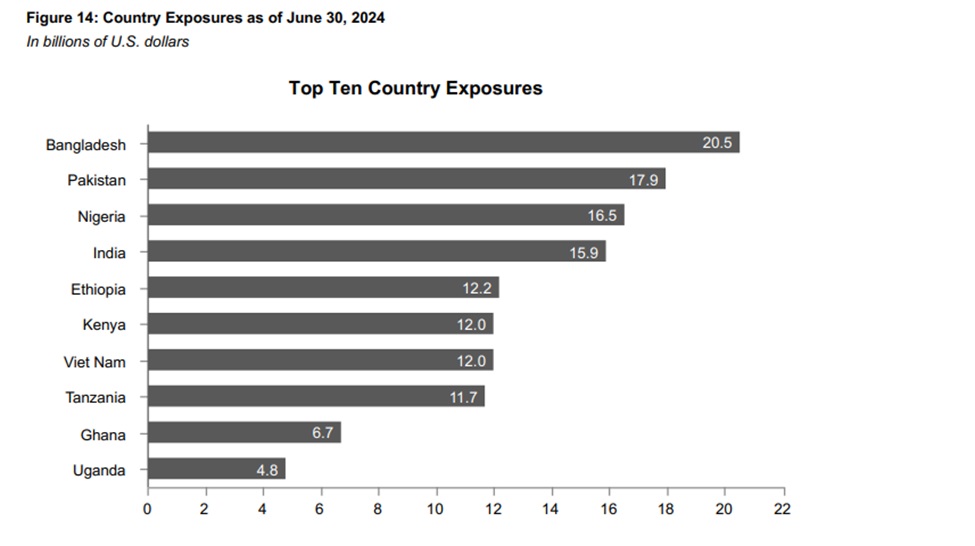
According to the World Bank’s financial statements, Nigeria’s exposure to the IDA rose by 14.4% from $14.3 billion in the fiscal year (FY) of 2023 to $16.5 billion in FY2024.
This $2.2 billion increase places Nigeria among the top three IDA debtors for the first time, a notable shift from its previous position as the fourth-largest borrower in 2023.

The fiscal year for 2024 runs from July 2023 to June 2024, which means that Nigeria has received at least $2.2 billion from the World Bank under the administration of President Bola Tinubu.
This debt is different from any outstanding loan from the World Bank’s International Bank for Reconstruction and Development (IBRD).
Other top debtors
Bangladesh remains the largest IDA debtor, with its exposure increasing from $19.3 billion in 2023 to $20.5 billion in 2024. Pakistan follows, maintaining its second position with a stable exposure of $17.9 billion over the same period.
India, which was previously the third-largest borrower in 2023 with $17.9 billion, saw a decrease in its IDA exposure to $15.9 billion in 2024, allowing Nigeria to surpass it.
Other significant IDA borrowers include Ethiopia, whose exposure grew from $11.6 billion in 2023 to $12.2 billion in 2024, and Kenya and Vietnam, both with $12.0 billion in 2024.
These countries, along with Tanzania, Ghana, and Uganda, comprise the top ten IDA debtors, collectively accounting for 63% of the IDA’s total exposure as of June 30, 2024.
The International Development Association (IDA) is a key arm of the World Bank, dedicated to providing concessional loans and grants to the world’s poorest countries.
These loans, characterized by low interest rates and long repayment periods, are designed to foster economic growth, reduce inequalities, and improve living conditions in developing countries.
Nairametrics earlier reported that Nigeria secured a total of $4.95 billion in loans from the World Bank under Tinubu amid concerns over the country’s rising external debt servicing costs.
However, Nigeria has received only about 16% of these fresh loans.
The World Bank may approve four loan projects totalling $2 billion for Nigeria this year.
Data from the external debt stock report of the Debt Management Office (DMO) shows that Nigeria owes the World Bank a total of $15.59 billion as of March 31, 2024.

News
Pro-Democracy Icons Honour Tinubu, Soyinka, Ajibulu, Others In Lagos
By Kayode Sanni-Arewa
At a historic gathering of Nigeria’s democratic forces in Lagos, President Bola Ahmed Tinubu, Nobel Laureate Wole Soyinka, and foremost democracy activist Chief Segun Ajibulu were among distinguished Nigerians honoured for their enduring contributions to the nation’s democratic journey.
The recognition was conferred during the public presentation of “NADECO Story,” a book authored by former National Democratic Coalition (NADECO) General Secretary and spokesman, Ayo Opadokun, at the MUSON Centre in Lagos. The event celebrated individuals and institutions that played courageous roles in resisting military dictatorship and restoring democratic governance after the annulment of the June 12, 1993 presidential election.
However, special attention was drawn to the unwavering sacrifices and continuing democratic engagement of Chief Segun Ajibulu, who was described by speakers and participants as one of the unsung pillars of the June 12 struggle.
According to Opadokun, Ajibulu’s commitment to democracy went beyond rhetoric and personal convenience. During the dark years of military repression, while based in the United States, he reportedly made several covert trips back to Nigeria to work closely with pro-democracy activists and strategists committed to ending military rule. These risky engagements, often undertaken at great personal danger, strengthened the international and local resistance against dictatorship.
Chief Ajibulu’s role was not limited to the historic NADECO era alone. Participants at the ceremony noted that he has remained actively committed to democratic ideals even in contemporary Nigeria through advocacy, grassroots mobilization, youth engagement, and support for initiatives promoting justice, good governance, national unity, and civic participation.
His longstanding contributions earned him the prestigious “Hero of Democracy Award,” a recognition many attendees described as long overdue for a man whose dedication to democratic values has remained consistent across decades.
Speakers at the event described Ajibulu as a steadfast democrat and bridge-builder whose influence helped sustain both local and diaspora support networks during one of Nigeria’s most turbulent political periods. They noted that while many democracy activists faced intimidation, exile, imprisonment, and economic hardship, Ajibulu remained resolute in championing constitutional governance and civil liberties.
The ceremony also honoured several other icons of Nigeria’s democratic struggle, including living and posthumous recipients such as Adekunle Ajasin, Abraham Adesanya, Ken Saro-Wiwa, Kudirat Abiola, Chima Ubani, and Bamidele Aturu.
Observers at the gathering said the recognition of Chief Segun Ajibulu sends a strong message to younger generations that democracy survives through courage, sacrifice, and sustained commitment. They added that his continued involvement in national development conversations demonstrates that the struggle for democracy does not end with the return to civilian rule, but continues through active participation in nation-building and the defense of democratic institutions.
The Lagos event ultimately served not only as a remembrance of the sacrifices of June 12 heroes, but also as a celebration of individuals like Chief Segun Ajibulu whose dedication to democracy continues to shape Nigeria’s political evolution today.
News
Centre faults suit against Chinda, says Rivers APC candidate complied with constitutional requirements
A pro-democracy group, the Centre for Constitutional Governance and Electoral Integrity (CCGEI), has dismissed attempts to stop Kingsley Chinda, member representing Obio/Akpor federal constituency, from participating in the All Progressives Congress (APC) governorship process in Rivers state, insisting that the lawmaker complied with all constitutional and party requirements before joining the race.
The group was reacting to a suit filed at the federal high court in Abuja by the Association of Legislative Drafting and Advocacy Practitioners (ALDRAP), which asked the court to stop the Independent National Electoral Commission (INEC) from recognising Chinda’s participation in the APC governorship primary.
Chinda, an ally of Nyesom Wike, minister of the Federal Capital Territory (FCT), emerged as the sole candidate in the APC governorship primary conducted on May 21 after Siminalayi Fubara, governor of Rivers state, withdrew from the contest hours before the exercise.
In a statement issued on Tuesday in Abuja, Ibrahim Danjuma, executive director of CCGEI, described the legal action as “misleading, politically motivated and lacking constitutional substance”.
According to the group, Chinda formally resigned from his leadership position in the house of representatives and ceased performing the functions of minority leader from April 2, 2026, well within the timeframe required under existing electoral guidelines.
“The facts are straightforward and verifiable. Hon. Kingsley Chinda stepped down from his role as minority leader on April 2 and effectively disengaged from the leadership structure of the PDP before participating in the APC governorship process,” the statement reads.
“To suggest otherwise is an attempt to distort both the law and the sequence of events for political advantage.”
The group argued that Chinda’s participation in the APC primary cannot be interpreted as a constitutional violation, noting that the lawmaker acted in accordance with provisions guiding political participation and party realignment.
CCGEI added that the suit appears designed to create unnecessary political tension in Rivers state rather than protect constitutional order.
“This is clearly an effort to weaponise litigation for political ends. Nigerians are aware that internal political realignments ahead of elections are common and must be assessed based on facts, not speculation,” Danjuma said.
The organisation further noted that Chinda neither concealed his political decision nor continued to exercise authority as minority leader after stepping down from the position.
It also maintained that the APC acted within its rights by allowing him to participate in the primary after fulfilling the necessary requirements.
The group urged the judiciary to resist political pressure and focus strictly on constitutional interpretation and documentary evidence before the court.
It added that attempts to invalidate Chinda’s candidacy through technical arguments would undermine democratic participation and the rights of political actors to freely associate and contest elections under the law.
News
Children’s Day: Senator Manu celebrates Nigerian kids, urges them to embrace education as catalyst for growth
The Senator representing Taraba Central Senatorial District Senator Haruna Manu has urged children in Nigeria and all over the world to embrace education as a catalyst for growth.
In a message to Taraba , Nigerian and kids all over the globe, Senator Manu advised kids not to toy with their educational pursuits as this will prepare them for the future.
He said the world is now a global village filled with advantages that can be tapped from any part of the world .
“As you celebrate this special day may God Almighty continue to serve as your pathfinder towards achieving your set goals on planet earth.
” I celebrate with you as a father that truly believes in education as it can catapult you to greater heights of success.
Happy Children’s Day!
-
News10 hours agoFG approves 50% discount on NRC train fares for Eid-el-Kabir
-
News20 hours agoADC Primary: Hayatu-Deen Pulls Out Of Results Announcement Alleged Irregularities
-
News10 hours agoPRP Affirms Senator Buba As Bauchi Governorship Candidate
-
News10 hours agoOtti approves ₦306m tech-business grant to boost job creation
-
News10 hours agoFemale Naval Officer Allegedly Dies during punishment Under the Sun At Lagos Navy Facility
-
Opinion9 hours agoO.K CHINDA: APC’S ICE BREAKER FOR RIVERS GOVERNORSHIP ELECTIONS
-
Opinion7 hours agoRivers Guber: Rep OK Chinda in the eye of the storm
-
News10 hours agoAmaechi rejects ADC presidential primary results

Warning: Undefined variable $user_ID in /home/naijuinz/public_html/wp-content/themes/zox-news/comments.php on line 49
You must be logged in to post a comment Login