…says Nigeria expired ten years ago
By Gloria Ikibah
A former Vice Chancellor , Professor Ango Abdullahi has said Nigeria made a fatal error by adopting the Presidential system of government.
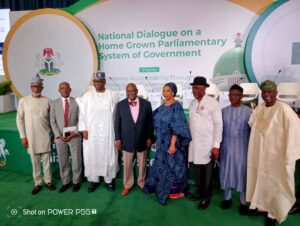
He made this assertion at the just National Dialogue on a Home Grown Parliamentary System of Government in Nigeria on Monday in Abuja.
The 86years old Professor also noted at the Dialogue that Nigeria expired in 2014, 100years after the Edict establishing Nigeria as an entity expired
“For me, that was our first mistake. For us to bring a system that did not fit our history, did not fit our traditions, did not fit our experience either as under colonial government or under our own independent state, we did not. Yet, we were not allowed to even discuss it.
“If I can remember here my classmate, a very eloquent sociologist, Dr. Ibrahim Tahir. Up to his death, he insisted that it was a mistake for us to bring in the American presidential system to Nigeria, because it did not work for us.
“And if the parliamentary system had not worked for us just after using it for five years, now we have experienced the presidential system for 24 years.
“The government is here to testify. 24 years. With due respect, I think our situation is worse than under the parliamentary system that we rejected just after trying it for four or five years.
He explained: “So, this dialogue here should really be as objective, as passionate as possible. Look at some of the things that we did wrongly. And one of the things we did wrongly was to bring in a system that did not fit our situation.
“And if we can, and we should, and we can, then we should work on something. It may not necessarily be the typical parliamentary system you find in our former colonial masters. It could be something else.
“Why? Why did you fail, if we failed at all? Why did the young boys who decided to uproot it, do so? And so on. These are the various questions that ought to be resolved very, very clearly, but unfortunately, for a number of reasons, this was not the case.
” The country almost broke up, and thanks to some elders and some soldiers, Nigeria remained after 1966, but without continuing a crisis that ended up in a civil war, which again, was eventually resolved.
“General Gowon, head of state for who led the country for nine years, did extremely well, together with elders in his cabinet, or rather, in his government, rather than cabinet, there are elders, Shifaholo, Malam Aminu Kano, and the rest of them, were working very closely with General Gowon, that made it possible for him to run this country for nine years, including the crisis we went through in the civil war.
“It is of interest to note that for those nine years, Nigeria did not borrow a couple from outside. You wonder why? But that’s not for me, but for the dialogue people to really reveal a lot of things that have gone wrong since then, never mind what happened.
“Then, after Gowon’s nine years, there was a decision to reverse to what people call democracy. Democracy has very elastic meaning. Every country in the world today claims democracy.
“America claims democracy. China claims democracy. Most countries claim democracy.
“So democracy must have multiple meanings, flexible meanings, and so on. So it’s right for us here to ask what kind of democracy do we want to have?
“And it’s also right to insist that we can have a homegrown democracy, and our children who are versed in a lot of things should be able to do so. But then, there was a transition between military and civil, and there was a disagreement in terms of how this would happen.
“To my mind, that was our first major mistake. I was a candidate. I was one of those who should have been in the constituent assembly of 1975-76 to discuss the constitution that would transition us from military rule to civil rule.
“I remember our elders, then Malam Aminu Kano and others, who gathered around in Lagos to say that the military leaders have insisted that there would be no discussion on parliamentary democracy.
“The constituent assembly was not to discuss parliamentary democracy. The constituent assembly should go and borrow or find a presidential system outside the country.
“I think what they had in mind, and I think up to now, the two parliamentary systems that fall over the place, the American and the French, and eventually we opted for the American presidential system.
“Well, to my mind, America has just had an election a few days ago, and to my mind, it did not demonstrate democracy. It demonstrated election, but it did not demonstrate democracy.
“For me, that was our first mistake. For us to bring a system that did not fit our history, did not fit our traditions, did not fit our experience either as under colonial government or under our own independent state, we did not. Yet, we were not allowed to even discuss it.

“If I can remember here my classmate, a very eloquent sociologist, Dr. Ibrahim Taher. Up to his death, he insisted that it was a mistake for us to bring in the American presidential system to Nigeria, because it did not work for us.
“And if the parliamentary system had not worked for us just after using it for five years, now we have experienced the presidential system for 24 years.
“The government is here to testify. 24 years. With due respect, I think our situation is worse than under the parliamentary system that we rejected just after trying it for four or five years.
“And if we can, and we should, and we can, then we should work on something. It may not necessarily be the typical parliamentary system you find in our former colonial masters. It could be something else.
“But definitely, the presidential system has not worked for us. And it should be possible for us to be less sentimental, more objective in really bringing this out clearly. And there are questions I would like to ask, especially those who would be on the panel to tell us yes or no.
“I will ask these questions later to illustrate the point that the presidential system has failed Nigeria over the last 24 years. And there is need for us to change to something else. Thank you very much.