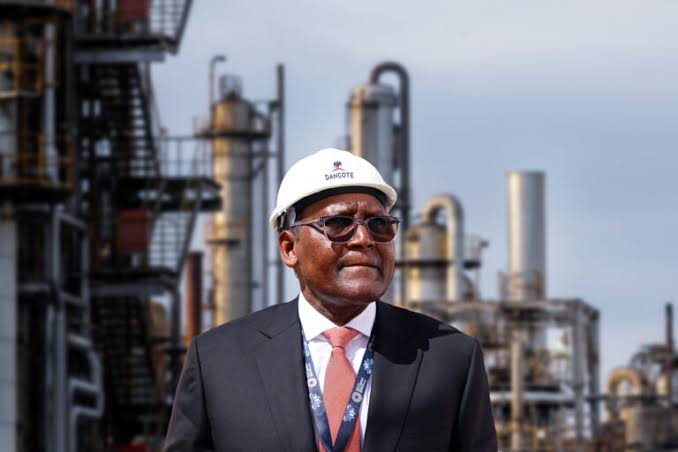
Dangote Petroleum Refinery has offered to supply 60 million litres of Premium Motor Spirit, popularly called petrol, to the Independent Petroleum Marketers Association of Nigeria weekly, which translates to 240 million litres monthly.


Dangote Refinery has offered to supply 60 Million Litres of Petrol to IPMAN weekly.
Dangote Petroleum Refinery has offered to supply 60 million litres of Premium Motor Spirit, popularly called petrol, to the Independent Petroleum Marketers Association of Nigeria weekly, which translates to 240 million litres monthly. 
This Nigeria news platform gathered from the association that the refinery agreed to give 60 million litres of PMS to IPMAN members weekly, depending on patronage.
This came as it was gathered that the $20bn Lekki-based refinery is aiming to raise billions of dollars to import crude oil and increase production.
Also on Sunday, oil dealers stated that petrol prices were declining following the competition occasioned by the deregulation of the sector, especially as the Nigerian National Petroleum Company Limited and other marketers imported over two billion litres of PMS in 42 days.
In an interview with The PUNCH, IPMAN National Publicity Secretary, Chinedu Ukadike, said members of the association can lift any quantity of PMS allocated to them by the Dangote refinery, stressing that independent marketers were the ones distributing the majority of the fuel imported into the country.
Recall that the association announced recently that it had signed an agreement with Dangote to lift PMS directly from the refinery without a middleman.
Giving an update, Ukadike said, “We are going to off-take the product in millions of litres. Before now, most of the imported products in Nigeria were distributed through IPMAN. So we can off-take the products, no matter the millions of litres that are produced.”
Asked whether there is an agreed volume that IPMAN would off-take from Dangote once independent marketers start loading petrol from the plant, the National Publicity Secretary replied, “We can take from 10 million litres and above and Dangote has offered to give us over 60 million litres depending on our patronage.
“The 60 million litres is to be given weekly. And we can take and distribute it across the country once we start lifting the product from the refinery.”
On when IPMAN would start lifting the product, Ukadike stated that this would be made public after both parties had concluded discussions on the deal.
He expressed confidence that the direct supply would begin before the end of November.
“We are finalising discussions. You know the meeting between IPMAN and the Dangote refinery was held last week and documentation is in process. So, there are still a few pieces of documentation that we are doing now. Once they are sorted, we will off-take PMS from the plant.
“This is going to happen before the end of this month. The Dangote Group has assured us that even if we want to start taking products from today, we should start,” he added.
Ukadike spoke further, “IPMAN has gathered its members and we have developed a Special Purpose Vehicle to off-take the products from the refinery. So, the issue of individuals going to buy one or two trucks has gone. IPMAN is now going to be a major distributor and our money will be guaranteed.
“The time has gone when some dealers will tell us they have products when they actually do not, and they will lock up our money in their system. So, we are taking this as a very effective measure to be able to ensure that the distribution value chain is efficient.”
Prices drop
Both IPMAN and major marketers confirmed that the pump prices of petrol have started reducing in many parts due to the competition that the deregulation of the downstream sector has caused.
The IPMAN spokesman said the agreement between IPMNAN and Dangote is gradually pushing down the price of PMS.
“By just the announcement that IPMAN and Dangote have met and are ready to transact business, the prices of products have crashed. You would have noticed the drop in prices by N10, N15, or so, and this is due to competition.
“Independent marketers are no longer buying from middlemen. We are going to be buying directly from the producer. So, the competition is setting in. I also want to tell you that before the end of this year, the price will not be as high as what you see now.
“You can see how our meeting with Dangote has significantly removed about N10 from the prices of refined petroleum products. It is a good development. We have not even started. Remember I once told you that prices would drop once IPMAN started lifting from Dangote,” Ukadike stated.
Also confirming the drop in prices, a major oil marketer stated that this was due to the deregulation of the downstream oil sector.
“People are not noticing that prices are going down, primarily because there are no big announcements. Deregulation is in full swing and competition is the order of the day,” the major oil marketer, who spoke in confidence due to lack of authorisation to speak on the matter, stated.
When told that the cost of petrol was still above N1,000/litre and was N1,070/litre in filling stations operated by his company, the dealer replied, “Last week it was N1,080 (in some filling stations) if you were observant.
“You may not see N900; that is below cost. Just stop expecting a permanent fixed price. It can come down and it can go up.”
Deregulation opens imports
While IPMAN has declared its resolve to patronise the Dangote refinery, some major marketers and NNPC are going ahead with the importation of refined products, though they patronise the plant when necessary.
Our correspondent reported on Saturday that within 42 days, the NNPC and other players imported 1.5 million metric tonnes of PMS, 414,018.764 metric tonnes of diesel, and 13,500 metric tonnes of jet fuel.
This is worth about N3tn or $1.8bn. One metric tonne of PMS is equal to 1,341 litres. This means 1.5 million metric tonnes represents 2.011 billion litres of petrol.
The importation of petroleum products continues even as the Federal Government tries to stop it through the naira-for-crude deal with Dangote and other local refineries.
The Organisation of Petroleum Exporting Countries said in a recent report that PMS imports into Nigeria surged in October compared to September.
The Dangote refinery began the sale of petrol in September, but it appears this has yet to reduce fuel imports, especially with the sector’s full deregulation.
A document that provided details of imported refined products during the review period showed that companies like Bovas, AA Rano, Matrix, Fatgbems, Deepwater, Raj, T-Time, Rainoil, Prudent, Chisco, Nepal, AYM Shafa, Northwest, Shorelink, and others received petrol from different vessels in Lagos, Warri, Calabar, and Port Harcourt.
In October, NNPCL and its partners imported a total of 994,446.438 metric tonnes of PMS, with Lagos receiving 555,121.617 metric tonnes, Warri 281,100 metric tonnes, Port Harcourt 94,224.821 metric tonnes, and Calabar 64,000 metric tonnes.
A total of 285,518.764 metric tonnes of diesel was also imported, with Lagos receiving 162,500 metric tonnes, Warri 58,500 metric tonnes, Port Harcourt 56,018.764 metric tonnes, and Calabar 8,500 metric tonnes.
Between November 1 and November 11; a further 358,083 metric tonnes of PMS, 112,500 metric tonnes of diesel, and 13,500 metric tonnes of aviation fuel were discharged at Nigerian ports.
N10bn equalisation fund
Meanwhile, the independent marketers have appealed to the Nigerian Midstream and Downstream Petroleum Regulatory Authority to pay their N10bn Petroleum Equalisation Fund after many failed promises.
Recently, the NMDPRA promised to pay N10bn to IPMAN members during a meeting with the Department of State Services and stakeholders in the downstream sector, including the Nigerian National Petroleum Company Limited.
In October, the National Vice President of IPMAN, Hammed Fashola, told our correspondent that the intervention of the DSS solved many of the problems facing marketers.
Fashola also confirmed that through the intervention, the NMDPRA agreed to pay the association’s outstanding N10bn.
However, barely a month later, the agency has yet to fulfill its promise.
Before deregulation, the Petroleum Equalisation Fund was set up by the Nigerian government to reimburse petroleum marketers for any losses they suffered arising from the sale of petroleum products at uniform prices throughout Nigeria. It was a form of subsidy managed by the defunct Petroleum Equalisation Fund Management Board.
Formed in 2021, the NMDPRA encompasses a merger of three defunct regulatory agencies: the Petroleum Products Pricing Regulatory Agency; the Petroleum Equalisation Fund Management Board; and the Midstream and Downstream Divisions of the Department of Petroleum Resources.
After President Bola Tinubu announced an end to the fuel subsidy regime, the Federal Government closed down the Petroleum Equalisation Fund, in line with the provisions of the Petroleum Industry Act.
Meetings were held with marketers in 2023 to reconcile accounts and pay those still owed by the government.
However, it was learnt that members of IPMAN still have an outstanding N10bn with the Federal Government.
Speaking with our correspondent, Fashola recalled that promises were made but not fulfilled.
“Our N10bn PEF outstanding is still with the government. They promised to pay us but they have not.
“That money was what the government used to pay to marketers to ensure we sell petrol at a uniform price. For example, if we all buy petrol at the same place, we cannot sell it at the same price due to the cost of transportation.
“The cost of selling fuel in the north will be expensive because of how much it will cost to convey the product to the far north. So, the Federal Government set up the PEF to pay the cost so that we can all sell petrol at the same rate. This was before the sector was deregulated,“ Fashola said.
He added that after President Bola Tinubu deregulated PMS in 2023, the equalisation fund was stopped, but IPMAN members still have N10bn unpaid by the defunct board.
IPMAN Publicity Secretary, Ukadike, said some marketers need the money to pay back their loans.
Ukadike appealed to the NMDPRA to ensure prompt payment of the N10bn for ease of doing business.
“We appreciate the NMDPRA for the intervention to pay the N10bn to marketers. This will ease marketers’ efforts to be in business and to buy more petroleum products. It will also encourage them to distribute petroleum products nationwide,” Ukadike said.
He disclosed that banks are running after some marketers over unpaid loans, pleading that the fund be paid soon.
“The banks are on us. So, if we get this money, it will help to ease the difficulties marketers are facing and also pay banks their loans. So we appeal that they (NMDPRA) should release this fund as quickly as possible,” the spokesperson requested.
The NMDPRA has not reacted to the matter. The spokesperson of the agency, George Ene-Ita, has yet to reply to messages seeking information about the fund.
Dangote seeks loan
The Dangote refinery is aiming to raise billions of dollars to import crude oil and increase production, according to new reports.
This comes despite the launch of the naira-for-crude deal last month, which resulted in the initial supply of four cargoes to the refinery.
A report by Financial Times, quoting officials familiar with the matter, on Sunday said the Chairman of Dangote Group, Aliko Dangote, is in talks with commercial lenders, development banks, oil traders and other industry participants to raise funds for crude supplies to turn into refined products.
Another official familiar with the matter said it would cost about $2bn every 90 days to secure a minimum supply of 300,000 b/d.
According to the report, the refinery needs to secure more crude to reach the refinery’s capacity of 650,000 barrels per day for the project tagged as a “game changer” for the country.
Earlier this year, a senior executive at the group, Devakumar Edwin, said the refinery bought crude from the US and Brazil and, in July, was in talks with African suppliers such as Libya and Angola to ramp up production.
Recall that last week, the refinery signed an off-taker agreement with IPMAN to lift petrol, diesel and other products directly from the refinery.
The plant began producing jet fuel and naphtha at the start of the year and petrol in September, raising hopes that Nigeria could finally end decades of reliance on imported fuel.
The report further noted that investors have expressed frustration at Dangote’s inability to gain a steady supply of crude, according to one banker involved in the fundraising.
Another added that there was also a major concern among potential financiers over exposure to Nigeria’s currency, the naira, which has fallen sharply following two devaluations over the past year.
“The refinery may never make a profit in real terms,” said the second banker. “It was built over budget, and the naira, which is a major currency of future revenue, has devalued massively.”
The Africa Finance Corporation, a pan-African development lender based in Nigeria that is already an investor in the project, is one of the institutions involved in the talks to raise money.
The AFC led a financing round in December for funds to source the initial capital to get the refinery up and running as a commercial operation.
Last month, the government, through the Technical Sub-Committee on Domestic Sales of Crude Oil in Local Currency, agreed to supply the refinery crude in naira for six months in the first instance, pending further review.
The deal will last six months in the first phase because crude oil, being an international product, is priced in dollars, sources confirmed to PUNCH.
But stakeholders including Dangote, have questioned NNPC’s ability to supply the crude the refinery needs because it has sold significant quantities of oil on forward contracts.
Even if NNPC comes through with the crude, Dangote would need another 185,000 b/d, or more than 5mn barrels a month, to meet his target of 550,000 b/d by January and more still once the refinery reaches full capacity.
NNPC has a 7.2 per cent stake in the refinery, which was watered down from 20 per cent after it failed to pay the balance of a deal worth $2.7bn. NNPC paid $1bn upfront in cash in 2021 and the other $1.76bn was supposed to be paid for in crude supplies.
Dangote Industries declined to comment further on the fundraising or the industrialist’s talks with the president.
NNPC did not respond to requests for comment on the fundraising or meeting.
The AFC declined to comment on the discussions over fundraising.