News
Failed lawyers, litigants responsible for attacks against judges — Justice Tsoho
- /home/naijuinz/public_html/wp-content/plugins/mvp-social-buttons/mvp-social-buttons.php on line 27
https://naijablitznews.com/wp-content/uploads/2024/06/images-64.jpeg&description=Failed lawyers, litigants responsible for attacks against judges — Justice Tsoho', 'pinterestShare', 'width=750,height=350'); return false;" title="Pin This Post">
- Share
- Tweet /home/naijuinz/public_html/wp-content/plugins/mvp-social-buttons/mvp-social-buttons.php on line 72
https://naijablitznews.com/wp-content/uploads/2024/06/images-64.jpeg&description=Failed lawyers, litigants responsible for attacks against judges — Justice Tsoho', 'pinterestShare', 'width=750,height=350'); return false;" title="Pin This Post">
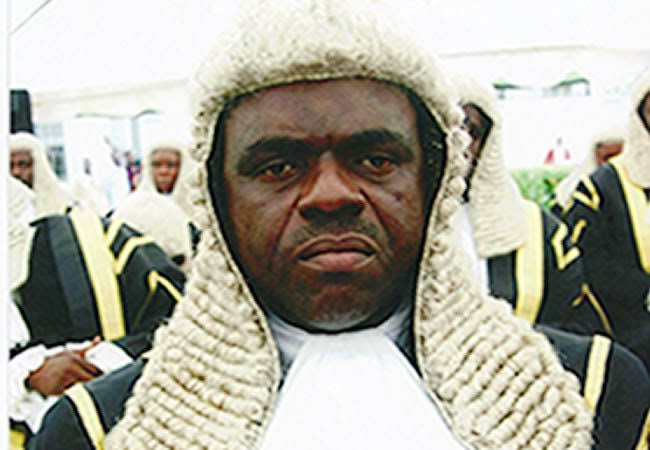
The Chief Judge of the Federal High Court of Nigeria, Justice John Tsoho, has said that failed lawyers and litigants are responsible for the recent virulent attacks against judges of the court across the country over their judgements.

He lamented that the court has been worse for the attacks on social media arising from its wide territorial and vast subject matter jurisdiction.
Speaking at the 2024 Conference of Federal High Court Judges and commencement of the new legal year on Monday in Abuja, Justice Tsoho warned those vilifying judges to desist in their own interests.

The Chief Judge, who expressed bitterness over the trend, called on the Nigeria Bar Association NBA to use the instrument of the Code of Professional Ethics to deal with the erring lawyers desecrating the temple of justice.
He said: “I am compelled to seriously deprecate the current pervading attitude of some lawyers, litigants and public commentators of launching virulent attacks in the media against judges and their decisions.
“The Federal High Court regrettably, has been worse for it, arising from its wide territorial and vast subject matter jurisdiction.
“This trend seems to have become a ready means of seeking fame, employed mostly by failed lawyers and litigants. They do not realise that the field of law and indeed adjudication, is not a pedestrian affair.
“I wish to use this rare opportunity of voicing out, which comes just once in a year, to comment at length on this canker, as it poses great danger, not only to the Nigerian Judiciary but to the Rule of Law generally.
“Firstly, we need to remind ourselves that courts of law are established by the Constitution of the Federal Republic of Nigeria, the Supreme Law of the Land and are vested with judicial powers by Section 6 thereof.
“Similarly, judges, particularly of the Superior Courts of record, are appointed pursuant to the provisions of the Constitution and are obligated to discharge their duties in accordance with the Constitution and enabling statutes.
“Secondly, there exists the hierarchy of courts, which serves to scrutinise the adjudicatory role of the courts in ascending order. Thus, appeals lie from the High Courts to the Court of Appeal and ultimately to the Supreme Court of Nigeria.
“Consequently, litigants who are dissatisfied with decisions of lower courts are expected and indeed required to express their grievance through the appeal process.
“The right of appeal is constitutionally guaranteed, with regard to both civil and criminal litigation. The essence of this narration is to demonstrate that the legitimate manner of challenging a court decision is through the appeal process.
“If, however, a litigant genuinely and strongly feels that a judge has misconducted himself in handling the case, such litigant may then quietly make a written complaint to the National Judicial Council (NJC) for redress.
“There is hence no room in law for holding press conferences to criticise judicial decisions. The implication therefore is that those who attack decisions of judges in the press are neither lawyers nor law-abiding, but violators of law.
“It is significant to stress the point that the existence of the appeal structure itself admits of the diverse nature of opinions and thoughts in society, which could occur in the decision-making process.
“Therefore, it is not a crime that there could be concurring or divergent views of superior courts on a decision made by a judge. That our decisions are not final is a blessing. With the industry and brilliance of our judges, appeals are welcome to test the veracity and tenacity that distinguish our judges.
“However, it is very concerning that the common situation these days is that some parties, after appealing the decision of a judge, proceed to petition the NJC on the same issue.
“The question then is: Which of the steps taken does that party accord priority to? This attitude reflects nothing else but malice. Judges will not be cowed by such antics. Worse still, some discuss pending cases in the media, notwithstanding that such cases are sub-judice.
“There can also be a cultural reflection on the growing attacks against courts and judges when it is realised that a good number of judges are aged above 60 years and are hence senior citizens in their own right.
“Yet, it is mostly youths in the age bracket between 25 and 30 years that come to the public arena to heap insults on these elders, some of whom are community leaders or from royal families.
‘This is an abominable act in refined cultural settings, as traditional society approves only of the dignified reproach of elders, even where they err.
“Thus, it is easily discernible that youths who indulge in such conduct display a lack of decent cultural background. It is, therefore, by their fruits that they are known.
“A situation where the legally recognised means of challenging court decisions is being increasingly sidelined in favour of approach by mob mentality is dangerous and worrisome.
“It is more so, as those promoting it are not well-informed but act in concert with some disgruntled lawyers. It is very sad that certain lawyers, with a few senior lawyers among them, have willingly offered themselves as errand boys to some politicians to malign judges.
“They secretly seek to influence judges but hypocritically turn around to condemn judges when their clandestine overtures to judges are rebuffed. In such situations, their supposition is that the judge must have been compromised by the opponent. They merely appear sanctimonious, while levelling unfounded allegations of bribery against judges in humongous sums of money.
“None of them has ever proven such allegations, but nevertheless, they succeed in inciting the gullible society against the maligned judges. It is bad enough that they mostly use faceless media platforms to orchestrate their malicious campaigns.
“They publicly advertise their ignorance by vociferously calling for the immediate ‘sack’ of judicial officers, as if the officers are mere domestic staff. They are oblivious that the appointment of Judicial Officers has a statutory flavour and they cannot be removed unless there is a proven case of serious misconduct.
“The ugly trend must be halted, if the judiciary is to survive. This is a task for well-meaning members of the legal profession, who owe their lives to the profession.
“For the greedy and shameless renegades, however, the collapse of the legal profession itself will not make any difference, as they would readily survive by touting.
“At this juncture, we call on the Nigerian Bar Association to scrutinise its ranks and uproot the misfits, who are causing incalculable damage to the legal profession.
“We wish to further draw attention to the fact that there are extant laws that can be called in aid to check the malicious tendency. Both the Criminal Code and the Penal Code provide punishment for malicious or injurious falsehood.
“For lawyers, the Rules of Professional Conduct can apply. On the part of judges, there is a crying need to revive the exercise of the power of contempt to protect the integrity of their persons and the courts.
“Their reluctance to employ this potent weapon should not be seen as a sign of ignorance or cowardice.
“In another vein, I consider it pertinent to briefly shed light on the commonly misconstrued phrase of “bail bond.” Most people interpret the “bond” entered into as a bail condition, to mean actual payment of money. When bail is “granted in the sum of N1 million,” for instance, it does not mean that the surety is there and then expected to deposit that sum of money with the Court.
“Rather, the surety is to enter into a bond, which is a promise, an undertaking or agreement, to the effect that the person undergoing trial would consistently attend court and would not escape until the trial is concluded.
“If however, the person escapes without satisfactory explanation, the surety will be held to pay the promised money (the value of the bond) to the court.
“This is a voluntary decision by the surety; hence, unless he is trusting of the person under trial, he is not obliged to execute the bail bond.
“It is therefore a matter of ignorance or mischief to ascribe a contrary interpretation to the matter of bail bond. This explanation is meant to enlighten the misinformed so that they will refrain from unduly vilifying Judges regarding the issue of bail bonds.
“As we reflect on the achievements of this past year, I extend my sincere gratitude to the National Judicial Council and the Federal Judicial Service Commission, all under the able leadership of His Lordship, The Honourable, The Chief Justice of Nigeria, Honourable Justice K. M. O. Kekere-Ekun, for their unwavering support.
“Your commitment in ensuring the smooth operation of our Judicial system has been invaluable. We are profoundly grateful to the Bi-Cameral Committees of the National Assembly on Judiciary, Human Rights and Legal Matters for their unflinching goodwill with regard to our budgetary interests.
“We equally appreciate the continued understanding and support in diverse ways, by the Honourable Attorney-General of the Federation and Minister of Justice.
“We also express deep gratitude to critical stakeholders for their ready collaboration with us in the area of training. These include: the National Judicial Institute (NJI), The British High Commission (BHC), the United Nations Office on Drugs and Crime (UNODC), the Nigerian Communications Commission (NCC), Nigerian Shippers Council, Asset Management Corporation of Nigeria (AMCON), National Deposit Insurance Corporation (NDIC), Federal Inland Revenue Service (FIRS), Economic and Financial Crimes Commission (EFCC), Central Bank of Nigeria (CBN) and several others.
“Your guidance, collaboration, and dedication to the principles of Justice have enabled us to navigate challenges and make significant progress in strengthening the rule of law in our nation.
“As we navigate the challenges confronting the judiciary and the Federal High Court in particular, it is imperative that we adhere to best practices in justice delivery.
“Judges must maintain the highest standards of impartiality and fairness in all their judicial functions. Decisions must be based solely on the law and the evidence presented, without fear or favour.
“We must strive to resolve cases expeditiously while ensuring that justice is not compromised. Delays in the administration of justice erode public confidence and undermine the rule of law.
“The judiciary must be transparent and accountable in all its operations. This includes providing access to court records and information and ensuring that judicial processes are open and accessible to the public on application.
“The protection and promotion of human rights are fundamental to the administration of justice. Judges must be vigilant in safeguarding the rights of all individuals, regardless of their background or status.
“In this new legal year, I call upon all judges and staff of the Federal High Court to rededicate themselves to the pursuit of justice. Let us work together to uphold the integrity and independence of the judiciary and to ensure that the Federal High Court remains a beacon of hope for all who seek justice before it.
“I also urge all stakeholders in the justice sector, including the bar, law enforcement agencies, and other agencies of government, to collaborate with us in our efforts to strengthen the wheels of justice in Nigeria.
“I am confident that with our collective commitment and dedication, the Federal High Court will continue to play a pivotal role in upholding the rule of law and promoting a just and equitable society for all Nigerians.”

News
SERAP presses FG over $460m CCTV project beneficiaries
The Socio-Economic Rights and Accountability Project has urged the Minister of Finance and Coordinating Minister of the Economy, Mr Taiwo Oyedele, to immediately disclose the identities of all local contractors, subcontractors, consultants and vendors that benefited from payments made under the controversial $460m Abuja CCTV Project.
SERAP’s demand followed recent disclosures by the Federal Ministry of Finance in response to contempt proceedings initiated by the organisation over alleged non-compliance with a Federal High Court judgment delivered in May 2023.
In a letter dated May 15, 2026 and signed by the Permanent Secretary of the Federal Ministry of Finance, R.O. Omachi, the ministry stated that records from the Ministry of Police Affairs showed that “while local subcontractors may have been engaged, there is an absence of detailed subcontracting records identifying specific local companies that received funds directly from the Chinese loan.”
Reacting in a letter dated May 23, 2026, and signed by its Deputy Director, Kolawole Oluwadare, SERAP expressed concern over what it described as delayed and partial compliance with the court order.
“We are concerned that although the judgment was delivered in May 2023, the Ministry only released some information after we commenced contempt proceedings and served a Notice to Show Cause in January 2026,” SERAP said.
According to the organisation, “Nigerians still do not know the exact names of local contractors for the project.
“The absence of this information raises serious concerns about record-keeping, transparency and accountability, and whether the project was implemented in a manner consistent with the public interest.”
SERAP recalled that Justice Emeka Nwite of the Federal High Court, Abuja, had on May 15, 2023 ordered the Ministry of Finance to disclose the total amount paid under the $460m Abuja CCTV loan, the identities of local and Chinese contractors who received the funds, the implementation status of the project, and details relating to the N1.5bn reportedly paid for the Code of Conduct Bureau headquarters project.
The organisation stated that the information released so far amounted to only partial compliance with the judgment.
“The details provided amount to only partial compliance with Justice Emeka Nwite’s judgment. Key questions remain unanswered, and further clarification is needed to ensure full and effective compliance with the judgment,” SERAP stated.
It warned that failure to provide the outstanding details within 48 hours would lead to the continuation of contempt proceedings against the ministry.
“We would be grateful if the requested details are provided within 48 hours of the receipt and/or publication of this letter. If we have not heard from you by then, SERAP shall proceed with our contempt proceedings against the Federal Ministry of Finance for failure to fully and effectively comply with the judgment of the Federal High Court,” the letter added.
SERAP acknowledged that the ministry had provided some information regarding the Chinese loan drawdown, counterpart funding arrangements and records relating to equipment deliveries connected with the project.
However, the organisation said critical issues remained unresolved, particularly concerning 6,035 items reportedly not delivered under the project.
“There is still no explanation regarding the missing 6,035 items as part of the status of implementation of the project. It remains unclear whether the items were subsequently delivered, whether payment was made for them, whether the contractor defaulted, whether Nigeria suffered any financial loss, and whether any steps were taken to recover public funds,” SERAP said.
The organisation also questioned the operational status of the CCTV infrastructure.
“The ministry lists items reportedly delivered in 2013.
However, it has failed to clarify how many cameras were installed, if any; where they were installed; whether the cameras are currently operational; and whether the project delivered value for money,” it said.
SERAP stressed that the project, which was financed through public borrowing, required full transparency.
“For a project financed through public borrowing, debt Nigerians continue to repay, full transparency over all beneficiaries, foreign and domestic, is essential. Nigerians have the right to know how public funds were spent, who received them, and what was delivered in return,” the organisation stated.
The group further noted that compliance with court judgments was fundamental to the rule of law and democratic accountability.
“Government agencies cannot selectively comply with judicial orders or release partial information while withholding records central to public accountability,” SERAP said.
The organisation linked the demand for accountability to the prevailing insecurity across the country, particularly in Abuja.
“The urgency of full disclosure is heightened by the continuing security crisis across Nigeria, including persistent insecurity in Abuja, where the project was specifically intended to strengthen surveillance, public safety, and emergency response,” it stated.
According to SERAP, Nigerians deserve to know whether the massive investment in the CCTV project translated into improved security outcomes.
“Residents of the Federal Capital Territory and several states, including Benue and Oyo, continue to face abductions, violent crime and other serious threats to safety, while communities across the country grapple with widespread insecurity and loss of lives.”
“Against this backdrop, Nigerians are entitled to know whether the Abuja CCTV project was fully delivered, whether it became operational, whether the infrastructure is functional, and whether the huge public investment achieved the promised security outcomes,” the organisation said.
SERAP also disclosed details contained in the ministry’s response, including that the Federal Government received $399.5m from the Export-Import Bank of China for the National Public Security Communication System project, popularly known as the Abuja CCTV Project.
The ministry reportedly stated that the funds were drawn in 10 instalments between March 2011 and December 2013, while the Federal Government contributed an additional $70.5m as counterpart funding, representing 15 per cent of the total project cost of $470m.
According to SERAP, the ministry further disclosed that the naira equivalent of the counterpart funding was N10.68bn at an exchange rate of N150 to one dollar, including a one per cent Central Bank of Nigeria commission.
The organisation also noted that the principal contractor for the project was identified as ZTE Corporation of China, with payments made through the Bank of China, Shenzhen Branch.
“According to the ministry, several equipment items, including GOTA phones, data cards, PC servers, LED monitors, cables and related communications infrastructure were delivered. Inventory records show 61,970 units delivered out of 68,005 expected, leaving 6,035 units outstanding,” SERAP stated.
The ministry also reportedly clarified that the N1.5bn mobilisation payment for the Code of Conduct Bureau headquarters project was not part of the Chinese loan arrangement.
SERAP urged the Federal Government to fully implement the court judgment by publishing the names of all Nigerian companies, subcontractors, consultants and vendors involved in the project, disclosing the amount paid to each entity and the nature of work performed, and releasing certificates of completion alongside a detailed account of the undelivered project items.
News
Coup trial: Detained officers’ wives warn against convictions without evidence
Wives of detained military officers facing alleged coup-related charges have appealed to President Bola Tinubu to ensure fairness and transparency in the ongoing military trial, warning against the conviction of suspects without credible evidence.
The plea was contained in a letter addressed to the President on Friday and titled, “A Humble Appeal for Fairness, Transparency, and Justice in the Ongoing Military Trial.”
The correspondence from spouses of the detained officers was exclusively obtained by The PUNCH.
The signatories are Shafa’atu Ali Agbo, Fatima Dauda, Josephine Enemona, Nana Aisha, Zara Abba, Helen Sunday, Khadija Aminu, Aisha Abubakar, Aisha Yusuf, Hauwa’u Aliyu, Firdausi Ibrahim and Zuzu Igbaseimokumo.
In the letter, the women acknowledged Tinubu’s approval for the commencement of the military trial, describing it as “an important step toward accountability, clarity, and the pursuit of justice.”
They, however, expressed fears that the process could be tainted by bias, coercion and institutional prejudice.
“As citizens, we understand the importance of discipline within the armed forces and the sensitive responsibility placed upon the military in safeguarding national security.
“We also recognise that allegations relating to mutiny, coup plotting, or acts capable of undermining military authority are grave matters that must never be treated lightly.
“However, it is precisely because of the seriousness of these allegations that the process through which justice is pursued must itself remain just, transparent, impartial, and free from every appearance of prejudice,” the letter read.
The wives recalled past controversial military trials in Nigeria, saying some later became subjects of “national reflection and regret.”
It added, “From past allegations of ‘phantom coups’ to disputed dismissals and prolonged detentions of officers, many Nigerians have witnessed instances where prosecution appeared, in the eyes of the public, to drift dangerously toward persecution.”
The women also raised concerns over the prolonged detention of the accused officers and allegations of inhumane treatment.
According to them, reports suggesting that confessional statements may have been obtained under coercion had further heightened public anxiety over the integrity of the proceedings.
“The prolonged detention of the accused officers, the reports of inhumane treatment, and concerns that the case relies heavily on statements allegedly obtained under coercion and severe pressure have raised serious questions in the minds of many Nigerians,” the letter added.
They argued that justice must not only be done but must also be seen to be done, stressing that the credibility of the trial would depend on the fairness of the process and the independence of the tribunal.
“No individual should be condemned without credible and independently verifiable evidence.
“No confession extracted through fear, torture, or inhumane treatment should become the foundation upon which lives, careers, and families are destroyed. Justice loses its moral authority the moment it appears predetermined,” they wrote.
The wives urged Tinubu, as Commander-in-Chief, to ensure that the proceedings do not become “another painful chapter” in Nigeria’s history.
“We pray that under your leadership, Nigeria will continue to move toward a future where no citizen fears persecution disguised as prosecution, and where the law remains stronger than suspicion, fear, or institutional pressure,” the letter concluded.
The arrest of the indicted officers was first announced on October 4, 2025, by the then Director of Defence Information, Brig Gen Tukur Gusau, who disclosed that 16 officers were taken into custody for alleged breaches of military regulations and acts of indiscipline.
However, an interim investigation later suggested the existence of a clandestine network of officers allegedly coordinated by a senior Army officer, which had begun preliminary planning for a coup.
According to the report, the alleged plot involved surveillance of key national assets, including the Presidential Villa, Armed Forces Complex, Niger Barracks in Abuja and major international airports, with October 25, 2025, scheduled as the planned date for the operation.
Those reportedly in custody include Brig Gen M. A. Sadiq, Col M. A. Ma’aji, Lt Col S. Bappah, Lt Col A. A. Hayatu, Lt Col P. Dangnap, Lt Col M. Almakura, Maj A. J. Ibrahim, Maj M. M. Jiddah, Maj M. A. Usman, Maj D. Yusuf, Capt I. Bello, Capt A. A. Yusuf, Lt S. S. Felix, Lt Cdr D. B. Abdullahi, Sqn Ldr S. B. Adamu and Maj I. Dauda.
The alleged plot, according to findings, targeted senior government officials, including President Tinubu and Vice President Kashim Shettima.
The appeal comes barely two weeks after a Federal High Court in Abuja admitted as exhibits the extra-judicial statements of six persons standing trial over an alleged plot to overthrow the Tinubu government, as the court commenced a trial-within-trial to determine whether the statements were voluntarily made.
Justice Joyce Abdulmalik admitted the statements and video recordings during proceedings aimed at resolving objections raised by the defendants over the admissibility of the evidence.
The defendants had earlier challenged the statements, alleging that they were obtained through coercion, torture, inducement and in violation of provisions of the Administration of Criminal Justice Act and the Anti-Torture Act.
The Federal Government is prosecuting retired Maj-Gen Mohammed Ibrahim Gana; retired Navy Capt Erasmus Ochegobia Victor; police inspector Ahmed Ibrahim; Presidential Villa electrician Umoru Zekeri; Bukar Kashim Goni; and a Zaria-based Islamic cleric, Sheikh Abdulkadir Sani, on charges bordering on treason, terrorism and conspiracy to stage a coup.
At the previous proceedings, the court played a video recording in which Sani allegedly told investigators that he warned the suspected plotters that the coup plan “would fail” and that members of the group would eventually betray themselves.
Following objections by defence lawyers to the admissibility of the defendants’ statements, Justice Abdulmalik ordered a joint trial-within-trial to determine whether the statements were voluntarily made.
News
Nigeria-Vietnam Relations Growing in Trade and Investment — Amb. Bako
Nigeria’s pioneer Head of Mission to the Socialist Republic of Vietnam, Ambassador Sani Bako, has stated that diplomatic relations between the two post-colonial states, which began as political solidarity 50 years ago, have evolved into a partnership delivering results in trade, investment, and cultural exchange.
The partnership deepened with the establishment of resident missions. Nigeria opened its Embassy in Hanoi, the administrative capital, in 2007, and Vietnam reciprocated by opening an Embassy in Abuja in the same year.
Reflecting on the 50th anniversary of Nigeria-Vietnam relations, which took effect on 25th May 1976, Ambassador Bako noted that the volume of trade between the two countries stood at $1 billion as of 2024.
“Vietnam currently exports electronics, garments, textiles, and other consumer goods to Nigeria, while importing crude oil, cashew nuts, and several raw materials,” he said. “Interestingly, the trade balance favours Nigeria.”
He stressed that the time has come for economic ties between both countries to evolve into a partnership that would lead to technology transfer, manufacturing, and agricultural investment. He added that Vietnam has expertise in modern agriculture that Nigeria could leverage.
Ambassador Bako, who is the Chairman of the Nigeria-Vietnam Trade and Cultural Association (NVETCA), added that the association is facilitating private sector engagement to deliver visible partnerships in farming, manufacturing, and other ventures that will strengthen economic ties in the near future.
He recalled that President Bola Ahmed Tinubu, in a recent meeting with Vietnamese Ambassador Bui Quoc Hung, emphasized that Nigeria is open for business with Vietnam. “Vietnam is a partner we want to grow with,” the President stressed.
Ambassador Bako also noted that Ambassador Hung has called on Nigeria to address lingering visa obstacles affecting officials and business travelers. He pointed out that a 2019 visa waiver agreement reached by both countries has not been fully implemented, adding that resolving this would be critical to sustaining momentum in bilateral relations.
-
News4 hours agoNigeria-Vietnam Relations Growing in Trade and Investment — Amb. Bako
-
News5 hours agoCP condemns killing of 3 worshippers, abduction of 15 others in Kwara
-
Opinion23 hours agoThe Insecurity Triad: Azikiwe, Awolowo, and Chinweizu — Nigeria’s Elite Class of Framework Builders
-
Sports4 hours agoArsenal coach, Arteta names world’s best manager, team in EPL history
-
Sports4 hours agoEPL final day: Guardiola, Salah make history as they leave Man City, Liverpool
-
News16 hours agoSad: Bandits storm Kwara Prayer Ground, kill three worshippers, abduct 15 others
-
News24 hours agoJust in: Ex-HoR spokesperson Zakari Mohammed emerges Kwara ADC primary consensus guber candidate
-
News19 hours agoNDLEA nabs Chinese grandma with large illicit drug consignment at Lagos airport(Photos)

Warning: Undefined variable $user_ID in /home/naijuinz/public_html/wp-content/themes/zox-news/comments.php on line 49
You must be logged in to post a comment Login