Connect with us

Foreign

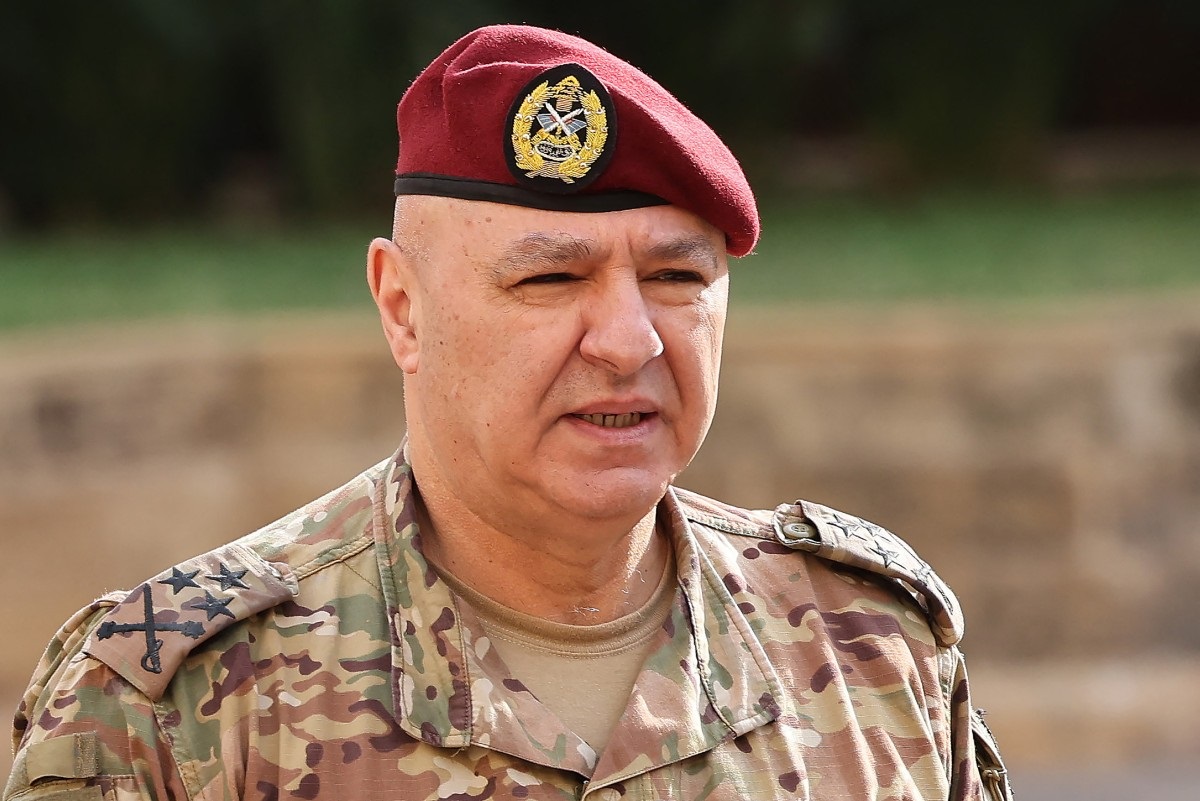
Gen Joseph Aoun emerges president of Lebanon

Published

on

ADVERTISEMENT
Zoom Ad
ADVERTISEMENT
Zoom Ad

Lebanon’s army chief, Gen. Joseph Aoun, was elected president on Thursday after a more than two-year vacuum at the top position in the country amid deepening political rivalries, economic and financial strains and growing instability.


Aoun, who has been commander of the Lebanese Armed Forces since 2017, secured 99 votes out of 128 during the second round of a parliament session called by its speaker, Nabih Berri. During the first round of voting earlier on Thursday, Aoun received 71 votes, short of the 86 required to become president.

Article 49 of the Lebanese constitution prohibits serving government employees and members of the armed forces from running for president unless they secure two-thirds majority of the vote. Aoun therefore required a minimum of 86 parliamentary votes and not just a simple majority (65) to circumvent this rule.

In his first speech to the parliament as president, Aoun pledged to uphold Lebanon’s unity and sovereignty while asserting the state’s exclusive authority over all weapons in the country. “My mandate will emphasize the state’s right to monopolize arms,” he said, without mentioning the Iran-backed Lebanese militant group Hezbollah by name.

Advertisement

The breakthrough followed intense regional and international diplomacy led by the United States, Saudi Arabia, Egypt and others. Thursday’s session followed the implementation of a 60-day ceasefire between Lebanon and Israel brokered by the United States, which took effect on Nov. 27, 2024. The ceasefire, which is up for renewal on Jan. 25, ended a 13-month conflict between Israel and Hezbollah. The Lebanese military plays a central role in implementing the arrangement.

Lebanon has been without a president since October 2022, when the term of Hezbollah-backed President Michel Aoun (no relation) concluded. Since then, the country’s fractured parliament has failed in 12 attempts to elect a new president, leaving Lebanon with a caretaker government operating with limited powers.

Regional and international actors, including Saudi Arabia and the United States, have ramped up diplomatic efforts in an apparent bid to secure the election of Aoun.

As the head of Lebanon’s army, Aoun has built a reputation for personal integrity. Many view him as incorruptible and a stabilizing figure for the nation.

Advertisement

Who is Joseph Aoun?

Aoun was born to a Maronite Christian family in 1964 in the Sin el-Fil suburb of the Metn district, east of the capital Beirut. His family hails from the town of Aishiye in south Lebanon, making him the first president in the history of the republic from that region.

He holds a bachelor’s degree in political science with a focus in international affairs from the Lebanese American University and another bachelor’s in military science, according to the LAF website. In addition to his native Arabic language, Aoun is fluent in English and French.

He is married to Nehmat Nehmeh and together they have two children, Khalil and Nour. The family attended the second round of the vote on Thursday.

Advertisement

Aoun’s military journey began in 1983, when he first enlisted in the army. He was subsequently promoted until he reached the rank of general and was then appointed as the LAF commander in March 2017, succeeding Gen. Jean Kahwaji.

He has had his mandate extended twice: In December 2023, the Lebanese Parliament approved a one-year extension of Aoun’s term. He was scheduled to retire in January 2024. Again, on Nov. 28, 2024, weeks before his tenure was set to expire on Jan. 10, 2025, Aoun’s term was renewed for an additional year.

Aoun underwent intensive military training both in Lebanon and abroad. In 1996, he went to Syria to receive commando training, and then again between October 2002 and April 2003 he trained in the neighboring country to become a battalion commander.

He also attended an international defense management course in the United States in 1999 and another international counter terrorism program between 2008 and 2009.

Advertisement

Military achievements

Aoun’s military career gained prominence in 2015, when he was appointed commander of the 9th Brigade, tasked with operations along the border with Israel. Just a year later, he was reassigned to eastern Lebanon, near the Syrian border, where Islamist militants had established strongholds.

Under his leadership, the LAF led in August 2017 the so-called Fajr al-Joroud battle against the Islamic State and Jabhat al-Nusra in the barren lands (joroud) of Ras Baalbeck and al-Qaa in eastern Lebanon along the border with Syria.

The swift operation, which lasted less than two weeks, saw the killing of more than 150 jihadists, according to the army. A total of seven soldiers were killed in the battles, while the remains of eight soldiers who were kidnapped in 2014 and later executed by ISIS were found in the outskirts of Arsal. Aoun at the time said the military achieved a “decisive victory against terrorism.”

Advertisement

More recently, during the cross-border hostilities between Israel and Hezbollah that erupted on Oct. 8, 2023, the Lebanese Armed Forces maintained a neutral stance. Despite this, the LAF faced attacks on its positions and personnel in southern Lebanon, resulting in the deaths of at least 40 soldiers. The conflict claimed nearly 4,000 lives and left over 16,500 people injured, according to the Lebanese Health Ministry.
Foreign

Strikes on Iran to continue until ‘I say it’s enough’ – President Trump declares

Published

on

By

ADVERTISEMENT
Zoom Ad
ADVERTISEMENT
Zoom Ad

US President Donald Trump has vowed that American military strikes on Iran will continue until he personally decides they have achieved their objectives, declaring that the campaign will not stop “until I say it’s enough.”

Speaking with Fox  News on Tuesday, July 24, Trump said the US forces would ‘hit them very hard tonight, very hard tomorrow night’ in a brutal campaign that won’t stop until he says ‘enough.’

‘I’ll save the energy targets for last, but ultimately we’ll hit energy targets,’ Trump warned.

‘We’re going to hit them very hard the night after, and then next week it gets really bad for them because next week comes the power plants.’

Advertisement

Trump also said the US would target bridges next week unless Iran was willing to negotiate a peace deal that included giving up their nuclear ambitions.

He vowed the attacks will continue ‘until I say it’s enough.’

In an update late on Tuesday night, CENTCOM advised another round of strikes had been completed, hitting dozens of military targets near the Strait of Hormuz and Iranian coastal areas.

‘US fighter aircraft, drones, and naval vessels launched precision munitions against Iranian missile and drone sites, naval capabilities, and coastal defense systems during the seven-hour wave to further degrade Iran’s ability to threaten commercial shipping and civilian crews,’ the update said.

Advertisement

US forces resumed the naval blockade against vessels transiting to or from Iranian ports and coastal areas.

The latest US bombing comes after Trump notified Congress that the war would resume after Iran breached the memorandum of understanding by targeting commercial ships in the Strait of Hormuz.

Trump did not rule out using US ground forces to ensure that his key objectives are met, especially when it comes to removing Iran’s enriched uranium.

US forces had been careful not to harm Iran’s civilian population with strikes, but Trump warned Iran that everything was on the table.

Advertisement

‘You better make a deal, or you’re not going to have anything left,’ he said.

The President also likened Iran to ‘a great boxer’ that needed to be put to the mat.

‘You think you have them beat, then they’ll come back and give you a shot,’ Trump said.

Trump suggested later in the interview with Fox News that he wasn’t interested in continuing negotiations  with Iran because ‘they lie.’

Advertisement

He also said the last contact he had with negotiators was an hour ago.

The President praised his Cabinet for its work on the Iran issue, including Pete Hegseth, as he said ‘oil is flowing like never before.’

He also announced he was replacing the 20 percent fee the US was charging on the Strait of Hormuz to various Gulf States.

Advertisement
Continue Reading

Foreign

UK announces social media curfew for 16, 17-year-olds

Published

on

By

ADVERTISEMENT
Zoom Ad
ADVERTISEMENT
Zoom Ad

Children aged 16 and 17-year-olds in the UK will face a voluntary overnight social media curfew, alongside a shutdown of infinite scrolling and mandatory breaks in AI chatbot use, under new plans announced by Technology Secretary Liz Kendall.

According to a report by The Independent UK on Tuesday, the measures form part of the government’s wider restrictions on children’s social media use, and will see default settings block access for older teenagers between midnight and 6 am.

Kendall, in a statement, said, “These measures will be crucial in helping young people get the sleep they need, focus on school and college, and spend more quality time with family and friends, all of which are fundamental to building a happy, healthy and fulfilling adult life.

“We want young people to enjoy the benefits of technology while having the tools to make the online world a place where they can thrive.”

Advertisement

The Independent said features designed to keep users engaged, such as never-ending video reels and algorithmic feeds, will also be automatically switched off under the new defaults.

However, the report noted that critics have questioned how effective the measures will be, given that 16 and 17-year-olds will be able to turn off these default settings themselves.

The curfew plan follows last month’s announcement of a broader social media ban for under-16s by Prime Minister Sir Keir Starmer’s government, expected to cover platforms including Snapchat, TikTok, YouTube, Instagram, Facebook and X, but not messaging services such as WhatsApp and Signal, from next spring, according to the newspaper.

The report added that responsibility for working out key details of the policy will fall to Andy Burnham, who is set to become prime minister after winning the Makerfield by-election.

Advertisement

Kendall is also reportedly pushing new safeguards for children using artificial intelligence, including requiring under-18s to take regular breaks while using chatbots, and a crackdown on AI services that give dangerous, misleading or unverified mental health advice.

Ministers are said to be considering banning chatbots deemed a serious threat to children.

Conservative shadow education secretary Laura Trott reportedly criticised the plan, describing it as “another dog’s dinner from Labour” and arguing that curfews teenagers can simply switch off “won’t achieve anything.”

Advertisement
Continue Reading

Foreign

South Africa Confirms Visa-Free Entry for 22 African Countries, Excludes Nigeria

Published

on

By

ADVERTISEMENT
Zoom Ad
ADVERTISEMENT
Zoom Ad

The South African government has reaffirmed its visa exemption policy, allowing citizens of 22 African countries to enter the country without obtaining a visa in advance, subject to the permitted duration of stay and applicable entry conditions.

According to the country’s official visa exemption policy, eligible travellers may enter South Africa for periods ranging from 30 to 90 days, depending on their nationality.

The African countries currently eligible for visa-free entry include:

Algeria – up to 30 days
Benin – 30 days or less
Botswana – up to 90 days
Cabo Verde (Cape Verde) – 30 days or less
Comoros – up to 90 days
Côte d’Ivoire (Ivory Coast) – up to 30 days
Gabon – 30 days or less
Guinea – up to 90 days
Kenya – up to 30 days
Lesotho – 30 days or less
Madagascar – up to 30 days
Malawi – 30 days or less
Mauritius – 30 days or less
Mozambique – up to 90 days
Namibia – 30 days or less
Rwanda – up to 30 days
Seychelles – 30 days or less
Eswatini – 30 days or less
Tanzania – up to 90 days for ordinary passport holders
Tunisia – up to 90 days
Zambia – 30 days or less
Zimbabwe – up to 90 days

Advertisement

South Africa also grants visa-free entry to holders of the African Union Laissez-Passer and the Southern African Development Community (SADC) Laissez-Passer under its exemption policy.

Authorities, however, noted that visa-free access for some countries, including Kenya, Benin and Gabon, is subject to specific conditions. Travellers are therefore advised to confirm the latest entry requirements with South African authorities before making travel arrangements.

Notably, Nigeria is not among the countries currently eligible for visa-free entry into South Africa, meaning Nigerian passport holders are still required to obtain a visa before travelling.

Advertisement
Continue Reading

Trending

Copyright © 2024 Naija Blitz News