Connect with us

Foreign

Jimmy Carter’s funeral brings together 5 current and former US presidents to honor one of their own

Published

on

ADVERTISEMENT
Zoom Ad
ADVERTISEMENT
Zoom Ad

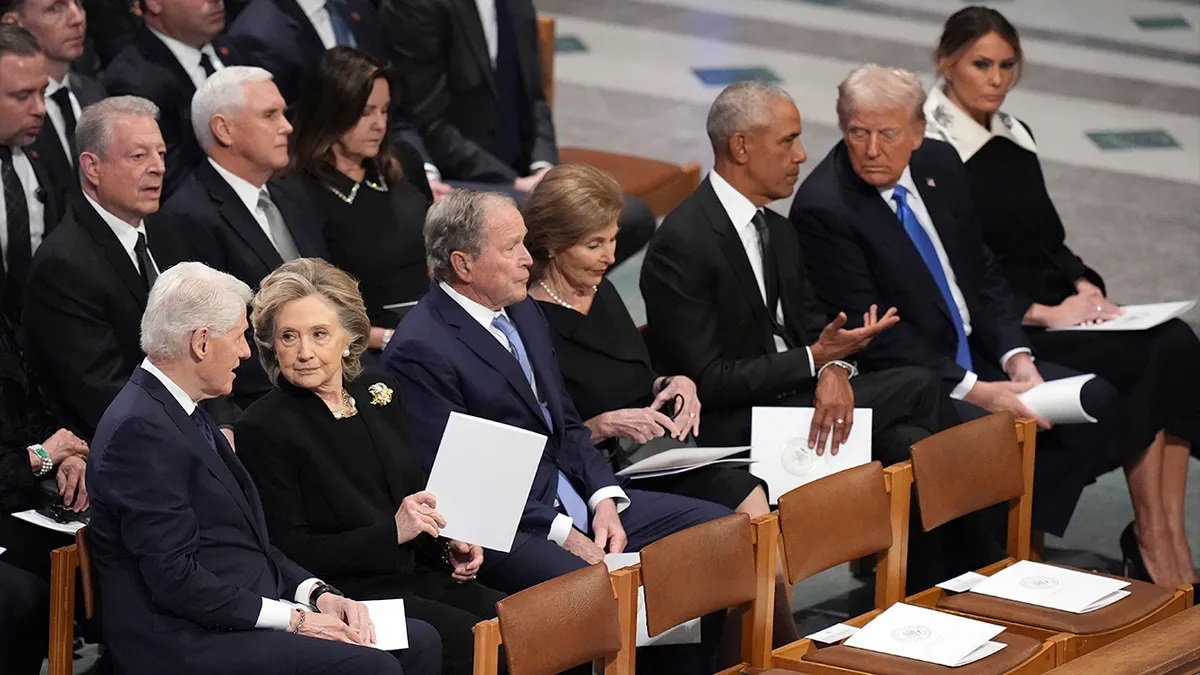
As they filed into the front pews at Washington National Cathedral, wearing dark suits and mostly solemn faces, five current and former presidents came together for Jimmy Carter’s funeral. During a service that stretched more than an hour, the feuding, grievances and enmity that had marked their rival campaigns and divergent politics gave way to a reverential moment for one of their own.


Barack Obama and Donald Trump, the first two of the group to take their seats Thursday, shook hands and chatted at length. Trump, the former president who will retake the Oval Office in 11 days, leaned in and listened intently to his predecessor, notwithstanding the political chasm between them. At times, the two flashed smiles.

Trump later returned to his Mar-a-Lago club in Florida Thursday night to meet with Republican governors and refused to say what he and Obama discussed, but joked, “It did look very friendly, I must say.”

“I didn’t realize how friendly it looked. I said, ‘Boy they look like two people who like each other and we probably do,” he said. “We have little different philosophies, right, but we probably do.”

Advertisement

The president-elect added, “I don’t know. We just got along. But I got along with just about everybody.”

Obama, who attended Carter’s funeral without his wife, Michelle, shared a second-row pew with former presidents George W. Bush and Bill Clinton, along with their spouses. President Joe Biden and first lady Jill Biden arrived last and sat in the pew just in front of them.
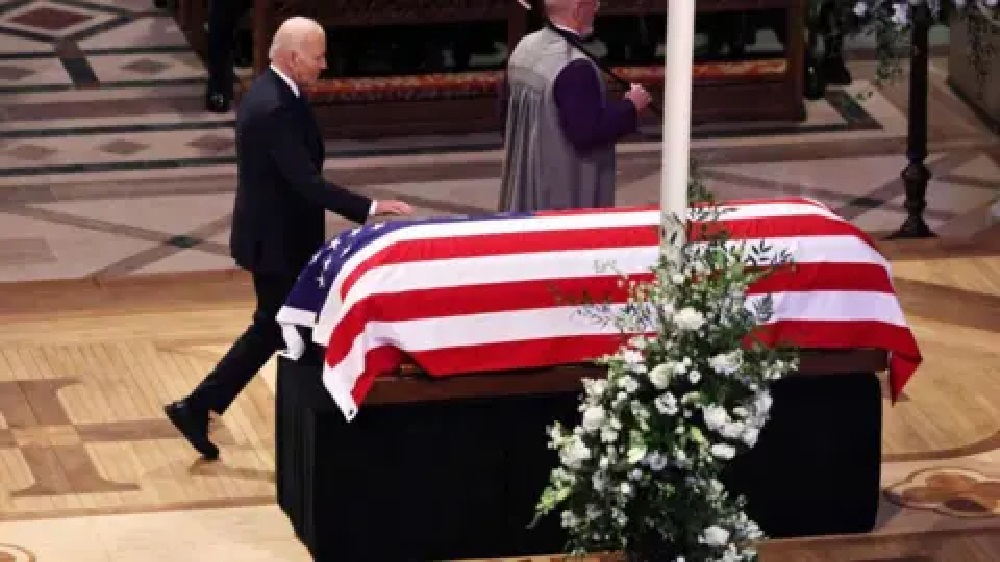
Members of the exclusive presidents’ club were on their best behavior. Bonded by the presidency, they rarely criticize one another or the White House’s current occupant — though Trump has flouted those rules frequently. He has both praised and criticized Carter in recent days, and he complained that flags will still be at half-staff to honor the deceased president during his inauguration.

In one seemingly chilly moment, Trump looked up when Vice President Kamala Harris — whom he defeated in November’s hard-fought election — entered the cathedral, but he didn’t move to greet her as she and husband Doug Emhoff took seats directly in front of him and Melania Trump. Nor did Harris acknowledge him.

After the service, Emhoff made a point to turn around and shake hands with Trump.

Advertisement

Obama, with Trump on his left, also turned to his right to chat with Bush. Clinton, with wife Hillary, was the last of the ex-presidents to take a seat and got in some chatter with Bush as well.

The White House said the former presidents also met privately before taking their seats. There was no word on what was said then, though Trump said later of its participants, “We all got along very well.”

Funerals are among the few events that bring members of the presidents’ club together. In a way, former President Gerald Ford was there, too: Ford’s son Steven read a eulogy for Carter that Ford had written before he died in 2006.

Busy with personal pursuits, charitable endeavors and sometimes lucrative speaking gigs, the former leaders don’t mingle often. They all know the protocol of state funerals well — each has been involved in planning his own.

Advertisement

During the 2018 funeral for George H.W. Bush, then-President Trump sat with his predecessors and their spouses, including the Carters, and the interactions were stiff and sometimes awkward.

This time, Trump also didn’t appear to interact with Hillary Clinton, whom he defeated in the 2016 election.

Trump was seated in the pew in front of his former vice president, Mike Pence — one of the few times they have coincided at events since Pence refused to overturn the results of the 2020 election after Trump lost to Biden. The two shook hands but didn’t speak much beyond that. Pence’s wife, Karen, appeared to avoid engaging with the president-elect.

Trump, who largely avoided contact with the former presidents during his first term — and pointedly did not seek their advice — has been critical of Republican former presidents, particularly the Bush family, which made him an uneasy member of the former presidents’ club. Carter himself didn’t particularly relish being a member of the club, at times criticizing its staid traditions.

Advertisement

Many past presidents have built relationships with their predecessors, including Bill Clinton, who reached out to Richard Nixon for advice on Russian policy, and Harry S. Truman, who sought counsel from Herbert Hoover.

One of the first calls Obama made after U.S. forces killed Osama bin Laden in 2011 was to George W. Bush to spread the word that the mission had been accomplished, said Kate Andersen Brower, author of “Team of Five: The Presidents Club in the Age of Trump.”

“It’s the loneliest job in the world, so usually they reach out and rely on each other,” said Andersen Brower. “But Trump didn’t have that the first term, so this will just be another four years where he doesn’t depend on anyone who came before him.”

She noted that Carter spent years as a proud Washington outsider and skipped the unveiling of his own portrait to avoid being in the same room with the man who beat him in 1980, President Ronald Reagan.

Advertisement

“Carter and Trump, even though they have the least in common about everything else, are similar,” Andersen Brower said, “in just how they approach telling what they actually think.”
Foreign

Trump Extends Ceasefire To Give Iran More Time To Negotiate

Published

on

By

ADVERTISEMENT
Zoom Ad
ADVERTISEMENT
Zoom Ad

President Donald Trump on Tuesday said he was extending a ceasefire with Iran to give more time for negotiations but would maintain a US naval blockade of the country’s ports.

Trump posted on social media that he would “extend the ceasefire” until Iran came up with a proposal to end the conflict. However, he “directed our military to continue the blockade.”

Trump’s ceasefire extension came hours before it was believed to be set to expire.

It also came as the White House said Vice President JD Vance would not be going to Pakistan for what had been expected to be a second round of peace talks.

Advertisement

“The trip to Pakistan will not be happening today. Any further updates on in-person meetings will be announced by the White House,” a White House official said in a statement.

The US president cast the breakdown in more talks as resulting from Iranian infighting, adding that Pakistan’s leaders had asked him to extend the truce.

“Based on the fact that the government of Iran is seriously fractured, not unexpectedly so and, upon the request of Field Marshal Asim Munir, and Prime Minister Shehbaz Sharif, of Pakistan, we have been asked to hold our attack on the country of Iran until their leaders and representatives can come up with a unified proposal,” Trump posted on his Truth Social site.

But the blockade of ports on Iran’s coast in the Strait of Hormuz will remain in place, Trump said, while the US military will “in all other respects, remain ready and able.”

Advertisement

The ceasefire, he said, will be extended “until such time as their proposal is submitted, and discussions are concluded, one way or the other.”

Continue Reading

Foreign

Iranian arrested in US for trafficking drones, bombs to Sudan

Published

on

By

ADVERTISEMENT
Zoom Ad
ADVERTISEMENT
Zoom Ad

US federal prosecutors said Sunday an Iranian national was arrested at Los Angeles International Airport for allegedly trafficking arms to Sudan on behalf of Tehran.

Shamim Mafi, 44, is charged with “brokering the sale of drones, bombs, bomb fuses and millions of rounds of ammunition manufactured by Iran and sold to Sudan,” US Attorney Bill Essayli wrote in an X post.

A resident of the Los Angeles suburb of Woodland Hills, Mafi “is an Iranian national who became a lawful permanent resident of the United States in 2016,” the prosecutor said.

Mafi was arrested Saturday and faces a maximum sentence of 20 years in federal prison if convicted.

Advertisement

The post was accompanied by images of a woman presumed to be Mafi surrounded by federal agents at the airport, a large drone on a tarmac, a woman’s ID image and bundles of cash.

The United Nations recently warned that Sudan is at risk of slipping into “full-scale famine and collapse,” as the war between the army and the paramilitary Rapid Support Forces (RSF) enters its fourth year.

The UN Sudan chief, Denise Brown, told AFP Thursday that Sudan is facing the world’s largest humanitarian crisis, and weapons from outside sources deserve part of the blame.

The UN has repeatedly called on foreign powers to stop fueling the war, but has not accused specific states.

Advertisement

On one side, the Sudanese army has been backed by Egypt and Saudi Arabia, and deployed Turkish and Iranian-made drones.

However, most of the blame has been pointed at the United Arab Emirates, which denies evidence that it has funnelled arms to the RSF, who have been accused of genocide.

AFP

Advertisement
Continue Reading

Foreign

Trump Says Iran Agrees To Hand Over Nuclear Dust Amid Strait of Hormuz Blockade

Published

on

By

ADVERTISEMENT
Zoom Ad
ADVERTISEMENT
Zoom Ad

United States President Donald Trump has claimed that Iran has agreed to hand over its remaining stockpile of enriched uranium and abandon ambitions for a nuclear weapon, describing negotiations as being on the verge of a major breakthrough.

Speaking to reporters at the White House on Thursday before departing for Las Vegas, Trump said: “We’re very close to making a deal with Iran. We had to make sure that Iran never gets a nuclear weapon… They’ve totally agreed to that. They’ve agreed to almost everything.”

He added that Iran had consented to return its enriched uranium, which he has repeatedly called “nuclear dust”, material believed to be buried deep underground following earlier U.S. and Israeli strikes on Iranian nuclear facilities.

“They’ve agreed to give us back the nuclear dust,” Trump stated. He also suggested that the next round of talks could take place over the weekend and expressed uncertainty about whether the current fragile ceasefire would need extension.

Advertisement

The comments come amid efforts to end six weeks of conflict in the Middle East that has disrupted global energy supplies and raised fears over the Strait of Hormuz, a vital chokepoint for oil exports.

However, Iran has not publicly confirmed Trump’s assertions. Multiple reports indicate that Tehran has previously pushed back against similar claims, describing them as exaggerated.

Recent direct talks in Islamabad on April 11-12 collapsed without agreement, with core disputes remaining over the future of uranium enrichment inside Iran and the removal of existing stockpiles.

The White House has been discussing a possible second round of negotiations in Pakistan, with officials expressing optimism.

Advertisement

A U.S. naval blockade of Iranian ports remains in place, adding pressure on Tehran.

Analysts caution that any final deal would require strict verification mechanisms, especially given the deeply buried nature of the material in question.

For Nigeria and other oil-producing nations, progress toward de-escalation could help stabilise crude prices, which have spiked due to fears of prolonged disruption in the Strait of Hormuz.

A lasting agreement might also open the door for sanctions relief on Iran, potentially shifting global energy dynamics.

Advertisement

Trump has maintained that preventing Iran from acquiring nuclear weapons is a non-negotiable red line, while offering the prospect of broader regional stability in return for Iranian concessions.

No immediate reaction from Iranian officials was available as of press time. Further developments are expected in the coming days as diplomatic channels continue.

Continue Reading

Trending

Copyright © 2024 Naija Blitz News