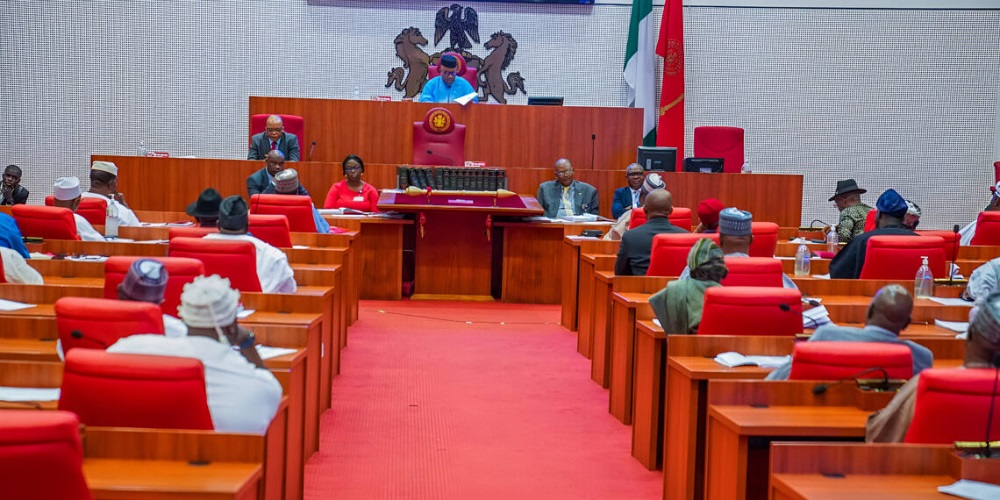
The Senate Committee on Housing yesterday deferred its budget defence session with the Minister of State for Housing and Urban Development, Yusuf Abdullahi-Ata.


This followed the minister’s confession that he was unaware of the difference between the National Housing Scheme and the Renewed Hope Agenda Housing Scheme initiated by President Bola Ahmed Tinubu’s administration.
At the beginning of his presentation, the minister of state told the committee that he was delegated by the main minister, Ahmed Dangiwa, who was out of the country on a trip with President Tinubu. 
In the course of the session, two members of the committee – Senators Abdul Ningi and Jimoh Ibrahim – disagreed about the sites of the Renewed Hope Housing Schemes across the states of the federation.
Abdullahi-Ata said the ministry was building 7,522 housing units under the National Housing Programme, out of which 3,388 had been completed.
Members of the committee, which is chaired by Aminu Tambuwal, wanted to know the implementation status of the Renewed Hope Agenda Housing Scheme and how it was different from the ongoing National Housing Programme of the Federal Government.
Abdullahi-Ata replied: “I am still yet to understand the difference between the two.”
The minister of state, a former Speaker of the Kano State House of Assembly, joined the Tinubu cabinet last October, following a reshuffle.
On the status of the Renewed Hope Housing Scheme and Cities Programme and National Housing Programme, he said “7,522 housing units spread across the 35 states of federation and the Federal Capital Territory (FCT) are under construction, out of which 3,388 have been completed, while 4,134 units are still ongoing”.
The senators queried the visibility of the projects the minister listed in his presentation.
But he confessed that neither himself nor the permanent secretary in the ministry could give details about the projects because they were both new in the ministry.
Abdullahi-Ata appealed for a postponement of the budget defence to enable him have more time to prepare for it.
Tambuwal told the minister to “go and come back on Tuesday” next week.
Also, the Managing Director and Chief Executive of the Federal Mortgage Bank, Shehu Usman Ossidi, told the committee that out of the proposed N5 billion capital base for the bank, only N2.56 billion had been fully paid up.
Of the paid-up capital, he said the Federal Government contributed N2.5 billion while the Central Bank of Nigeria (CBN) contributed only N60 million out of its N1.5 billion share capital.
The bank chief said the Nigeria Social Insurance Trust Fund (NSITF) had also not contributed contribute its N1 billion share capital to the bank.
He urged the committee to intervene to ensure that the seed capital was not only met but that the bank recapitalised to meet the dynamics in the sector.
Also yesterday, Interior Minister Olubunmi Tunji-Ojo yesterday said the ministry successfully executed multi-billion naira capital projects in 2024, despite not receiving any capital allocation.
The ministry achieved the feat by reviewing and enforcing existing contracts and by compelling contractors to fulfill their obligations, as stipulated in their agreements.
Speaking during the 2025 budget defence session before the National Assembly’s Joint Committee on Interior, Tunji-Ojo said some of the contracts dated as far back as 1999 and that they had been abandoned by contractors, either in breach of the contract terms or under Public Private Partnership (PPP) or concession agreements.
“We were able to complete automation e-gates, the command and control centre, resource centres, visa approval centres, solar farms, and other projects by thinking outside the box,” he said.
Tunji-Ojo stressed that the ministry achieved the milestones without incurring additional costs to the government.
“We didn’t spend a kobo of government money to do some of these things. What we did was avoid entering into new contracts. Instead, we reviewed existing ones and implemented value proposition management to ensure contractors fulfilled their obligations.
“For example, someone with a contract for issuing visa approval centres (VACs) hadn’t built a VAC centre. We had to ensure they delivered. Another contractor providing border control solutions implemented the software component but failed to deliver the hardware, which is essential for e-gate solutions. I made it clear that contracts cannot be implemented partially but that they must be executed holistically,” he said.
Following his presentation, the Chairman of the Senate Committee on Interior, Adams Oshiomhole, and his House of Representatives counterpart, Abdullahi Aliyu, praised Tunji-Ojo for surpassing the 2024 revenue target, despite the zero capital allocation.
But when a committee member alluded to an omission of tender fees in the budget proposal, the minister apologised and promised to provide the details promptly.
Also yesterday, the House of Representatives Committee on Public Accounts has said weaknesses in the nation’s auditing and accounting systems fuel corruption in the public finances.
Speaking at the budget defence of the Office of the Auditor General for the Federation (OAuGF), the Chairman of the Committee, Bamidele Salam (PDP, Osun), noted that as a result of the weaknesses, pervasive corruption was depriving government of revenue to function and deliver the needed development in the country.
The lawmaker was reacting to the budget presentation by the Auditor General for the Federation, Shaakaa Kanyitor Chira.
The AuGF informed the committee that there were various challenges hindering the operations of the office.
Chira said the office was grossly underfunded and understaffed to discharge its enormous responsibilities resulting in late compilation and submission of the annual reports.
Responding, Salam said: “There is a lot of money that ought to accrue to government that we are losing as a result of weaknesses in our accounting systems, weaknesses in auditing, weaknesses in general financial management architecture. This also has been reflected even in the budget performance of the Auditor General’s office.
“The committee raised a few observations also on the need for the Auditor General to expand its coverage of major Ministries, Departments and Agencies (MDAs) of government in a manner that will put greater attention on the places that have more of the revenue.
“There are some major agencies of government that have not been well audited in the last couple of years. If you don’t audit properly, you are giving an indication that there is less attention on certain agencies and that may promote a lot of impunity happening in those agencies.
“Even though the Auditor General has limitations because of budgetary constraints, because of personnel constraints, the office is mandated to audit almost 1,000 Ministries, Departments and Agencies of government, do periodic audits, appoint auditors for those that they are not going to audit directly.
“All this will require a lot of resources and manpower. We saw these gaps again in the presentation made today, and we are going to work as a parliament in cooperation with our sister committees that directly oversight some of these agencies in a manner that will make the work of the Auditor General to be more impactful, to be more result-oriented.”
The National Assembly Joint Committee on Finance yesterday set a revenue target of N25 trillion for the Federal Inland Revenue Service (FIRS) for the 2025 fiscal year.
The committee hailed the agency’s Executive Chairman, Dr. Zaccheus Adedeji, for raking in N21.6 trillion above its target of N19.4 trillion in 2024.
The resolution of the committee was announced during an interactive session with Adedeji and his management team in Abuja.
Following Adedeji’s presentation, the Deputy Chairman of the House of Representatives Committee on Finance, Saidu Musa Abdullahi, described the performance as unprecedented.
“The feat attained by FIRS on revenue collection or generation in 2024 was unprecedented and wonderful; it’s worthy of commendation.
“That you surpassed the target set for the agency in the 2024 Appropriation Act from N19.4 trillion to N21.6 trillion is very cheering and encouraging,” Abdullahi said.
He urged the FIRS chairman to understudy the South African template, saying it helped the country to generate revenue from tax collections far above that of Nigeria, despite having a smaller population of about 45 million to 54 million people, compared to Nigeria’s estimated over 200 million population.
“We shall give you total support on your tax reforms, but you need to bring in more number of taxable citizens into the net from the informal sector,” he said.
Also, Senator Joel Onowakpo Thomas (PDP, Delta South) hailed Adedeji and his team.
He said focusing more on tax is the way to go, adding that this was why FIRS must deepen the process through targeted reforms.
Also yesterday, the National Assembly Joint Committee on Basic Education Bodies queried the National Examinations Council (NECO) for spending the revenue it generated from selling Senior School Certificate Examination (SSCE) registration forms without permission in 2024.
The committee issued the query when the NECO Registrar, Prof. Ibrahim Wushishi, appeared before the panel to defend the 2024 budget performance and 2025 proposal.
The committee stepped down the examination body’s budget defence due to discrepancies in its presentation.
Wushishi told the committee that NECO realised over N22 billion from the sales of the registration forms at the rate of N22,250 to over 1.3 million candidates for the examination in 2024.
The registrar said of the revenue, the Federal Government deducted N9.5 billion and the balance was spent on the overhead cost of the agency.
But the committee said this did not add up, as the registrar noted that the government deducts 50 per cent, leading the lawmakers to query how it would amount to N9.5 billion.
Wushishi said: “Because of the fiscal policy of the government to deduct 50 per cent directly from source, the government has taken N9.5 billion from the same account, which makes NECO difficult to operate.
“We are still reconciling and following up with the Office of the Accountant General of the Federation to see how we can reconcile and put our house in order and submit.
Following the development, the committee adopted a motion to step down the budget defence due to insufficient documents and the inability of the NECO registrar to give satisfactory explanation on the 2024 budget performance.
President Bola Ahmed Tinubu has approved the recruitment of 5,000 personnel to tackle overcrowding and strengthen the Nigerian Correctional Service (NCoS).
The acting Comptroller General of the service, Sylvester Nwakuche Ndidi, announced this during a presentation to the House of Representatives Committee on Reformatory Institutions, chaired by Chinedu Ogar.
Ndidi said though the President granted the approval in August 2024, the recruitment process was delayed due to funding constraints.
He assured the lawmakers that the recruitment would start once the Civil Defence, Correctional, Fire, and Immigration Services Board (CDCFIB) approved the funding in the 2025 budget.
During the presentation, the committee members expressed frustration over the delay, stressing the need to address overcrowding in correctional facilities.
A member of the committee, Victor Ogene, called for transparency in the recruitment process, stressing the essence of timely action.
Ndidi presented the NCS’s proposed 2025 budget, amounting to N183.6 billion.
Key allocations included personnel costs of N127 billion, overhead costs of N45.8 billion and capital expenditure of N13.4 billion.
He said a significant portion — N38 billion — was earmarked for feeding the country’s 91,100 inmates at a daily cost of N1,125 per inmate.
The acting CG raised concerns about the reduction in capital expenditure by N762 million and called for an additional N70.4 billion to modernise custodial facilities, enhance security, and digitise inmate management.
The Group Chief Executive Officer (GCEO) of the Nigerian National Petroleum Company Limited (NNPCL), Dr. Mele Kyari, has said the company remitted N10 trillion to the Federation Account last September.
He also claimed that NNPCL “is the only company in Nigeria that publishes 100 per cent of its account on a yearly basis”.
Kyari spoke during his presentation on revenue generation and performance of the NNPCL in 2024 and its projection for 2025 before the National Assembly Joint Committee on Finance in Abuja.
The GCEO described the NNPCL as the highest tax payer in the country as well as highest payer of royalty and dividends.
He announced that the company wanted a forensic audit to be conducted on the money it spent to stabilise the price of petrol from January to September 2024 and for uninterrupted supply of petroleum products.
“Until October 1, 2024, NNPCL, as mandated by the Petroleum Industry Act (PIA), acted as the supply of last resort on fuel supply, which requires forensic audit to know how much NNPCL is being owed or owing any agency.
“Our transactional account is very transparent, which is published on yearly basis, making NNPCL the only company in Nigeria noted for that and also the highest tax payer in the country as well as highest payer of royalty and dividends to shareholders as a commercial national oil company,” he said.
Kyari told the joint committee that the company’s revenue projection for 2025 would be made after the meeting of its board of directors in two weeks.
The National Assembly Joint Committee on Finance yesterday exonerated the Joint Admission and Matriculation Board (JAMB) over alleged financial impropriety the lawmakers made against it during its presentation on Monday.
JAMB’s Registrar, Prof. Ishaq Oloyede, had said the examination body spent N1.1 billion on meals, N850 million for fumigation, among others.
But Senator Adams Oshiomhole (APC, Edo North) queried the board over its spending and asked the registrar to justify N850 million allegedly spent on security, cleaning, and fumigation in 2024.
But in a statement yesterday in Abuja, 48 hours after the session, the Chairman of the National Assembly Joint Committee on Finance, Senator Sani Musa (APC, Niger East), said the JAMB registrar was wrongly accused of reckless spending based on the latest documents submitted to the committee by the examination body.
The statement, titled: Clarification on the JAMB Report on Revenue, reads: “For the purpose of clarity, the comprehensive report provided by JAMB indicates that the line items mentioned during Monday’s hearing on revenue do not suggest any mismanagement or misuse of the board’s funds.
“On the contrary, the report highlights the responsible and prudent use of resources under the leadership of the Registrar.
“The Registrar of JAMB, Professor Is-haq Oloyede, deserves commendation for demonstrating financial discipline and accountability in managing the board’s resources effectively.
“This level of stewardship serves as a model for public institutions across the nation.”