
News
Tik Tok still swims against the tide in the USA



By Sonny Aragba-Akpore
President Donald Trump muted a ban on Tik Tok in 2020 in the dying days of his first White House residency but strangely after signing the Executive Order in his second coming on January 20,2025,to stay action on the enforcement of the Supreme Court ban,he was asked by a reporter why he’s had a change of heart since trying to ban TikTok in 2020, his response was “Because I got to use it.”
He floated the possibility of a joint venture running the company, saying he was seeking a 50-50 partnership between “the United States” and its Chinese owner ByteDance. But he did not give any further details on how that might work.
Trump also said he may impose new trade tariffs on China if a deal for the platform is not struck.
He was quoted as saying If Beijing rejected a deal “it would be somewhat of a hostile act”,
In the year 2020, Trump issued an executive order citing TikTok’s ability to capture vast amounts of user data as a significant national security threat. The order sought to prohibit certain transactions involving ByteDance but was blocked by federal courts.
Subsequently, the Trump Administration directed ByteDance to divest its U.S. TikTok operations and user data, but these efforts were stalled as negotiations with the president Joe Biden Administration aimed at a nondivestiture agreement failed to resolve the government’s concerns.
ByteDance’s proposed national security agreement was ultimately deemed insufficient to mitigate risks posed by Chinese control. Against this backdrop, Congress enacted the sale-or-ban law, further targeting TikTok and similar applications.
According to the Supreme Court’s finding, TikTok’s ultimate parent company, ByteDance, is a privately held company that has operations in China. ByteDance owns TikTok’s proprietary algorithm, which is developed and maintained in China.
The company is subject to Chinese laws that require it to assist or cooperate with the Chinese government’s intelligence work and to ensure that the Chinese government has the power to access and control private data that the company holds.
Underscored in the decision, TikTok’s extensive data collection from more than 170 million U.S. users could be exploited for surveillance, public influence campaigns or other harmful purposes that threaten national security. The Act and the holding reflect Congress’ and the Supreme Court’s efforts to address growing concerns over foreign adversary-controlled applications through the access to sensitive data of U.S. nationals and the resulting potential risks to U.S. national security.
With President Trump,s Executive Order to maintain the status quo on Tik Tok for 75 days,and the likely acquisition of 50% ownership in ByteDance,by Americans,Tik Tok still swims against the tide.
Tik Tok had gone to the Supreme Court to appeal against the April 24,2024 “Protecting Americans Against Foreign Adversary Controlled Application Act”but in a much-anticipated decision, the U.S. Supreme Court on Jan. 17, 2025, rejected TikTok’s appeal and upheld the Protecting Americans from Foreign Adversary Controlled Applications Act (Act).
The Act which was signed into law on April 24, 2024, gave ByteDance Ltd., the TikTok app’s Chinese parent company, nine months to divest the popular U.S. company or be banned from operating in the U.S.
ByteDance mounted a First Amendment challenge to the Act but was unsuccessful at the high court.
Starting on Jan. 19, 2025, one day before the inauguration of President Donald Trump, the Act effectively banned TikTok unless its U.S. operations are divested from ByteDance.
The platform went off air for 24 hours but after the Executive Order,it has 75 days to rejig its operations and determine the status of its operations in line with the subsisting Act.
In TikTok’s case, as established by the Supreme Court’s decision, the app is classified as a foreign adversary-controlled application due to its ownership and control by ByteDance.
Accordingly, the Act bans the distribution, maintenance or updates of TikTok in the U.S. unless ByteDance completes a qualified divestiture.
This divestiture would require ByteDance to relinquish all direct and indirect control over TikTok’s U.S. operations, ensuring its operational independence and preventing any future ties with ByteDance or other entities designated as foreign adversaries.
Should ByteDance refuse to divest its holdings in TikTok, the app would face a nationwide ban. The ban would not result in the immediate removal of the app from users’ devices. Instead, the ban would be enforced through penalties targeting companies that provide services to banned entities, such as internet hosting providers and app store operators such as Apple and Google.
These companies would be prohibited from distributing or updating TikTok on their platforms, leading to a gradual degradation of the app. Over time, without updates or maintenance, TikTok would likely become obsolete and unusable.
The Act prohibits any company from distributing, maintaining or updating an entity classified as a foreign adversary-controlled application within the U.S. Such an application is defined as one operated by a company that’s controlled by a foreign adversary and deemed by the president to pose a significant threat to U.S. national security. Violations of these restrictions can result in civil enforcement actions and significant monetary penalties.
The Act provides an exception for foreign adversary-controlled applications if they undergo a qualified divestiture. A qualified divestiture requires a presidential determination that the application is no longer under the control of a foreign adversary. Furthermore, the divestiture must ensure that no operational relationships remain between the U.S. operations of the application and any former entities affiliated with a foreign adversary.
The Act was signed with broad support from Republicans and Democrats.
Although some lawmakers had urged President Joe Biden to grant a reprieve to prevent TikTok from going dark in the U.S. as soon as Jan. 19,2025 ,the TikTok ban had already resulted in a number of “TikTok refugees” who moved to another Chinese app, RedNote, short for “Little Red Book.” RedNote became the most downloaded app in Apple’s app store in the U.S. the week leading up to the Supreme Court’s decision.
If this trend continues, this “migration” to a similarly situated app might defeat the purpose of the Act. The TikTok ban illustrates how U.S. regulatory actions are designed to mitigate potential threats posed by foreign adversaries, significantly increasing compliance requirements for cross-border investments and technology operations.
Particularly, the Supreme Court’s decision upholding the TikTok ban underlines the trend of intensifying scrutiny of foreign-controlled entities that collect or handle sensitive data in the U.S.
Although it’s not clear whether there will be a reprieve for Tik Tok,there are strong indications that the Trump administration needs more time to understand the situation and perhaps to be the one to implement the ban.
TikTok has 1,925 billion users globally, with 170 million monthly active users in the United States.
The average daily time spent on TikTok has more than doubled from 27 minutes in 2019 to 58 minutes in 2024.
The most popular categories on TikTok are Entertainment, Dance, and Pranks, with billions of views each.
Top influencers on TikTok include Charli D’Amelio, Khabane Lame, and Addison Rae, each with tens of millions of followers.
TikTok’s user base has grown exponentially from 133 million in 2018 to over 1,925 billion in 2024.
Daily active users on TikTok have skyrocketed into the millions, reflecting the platform’s ability to engage users on a daily basis.








The Independent National Electoral Commission, INEC, has announced adjustment for the campaign period ahead of the Osun State governorship election.
The adjusted schedule for the election was announced in a statement issued on Thursday by Mohammed Kudu Haruna, National Commissioner and Chairman, Information and Voter Education Committee.
“The Independent National Electoral Commission (INEC) issued the Revised Timetable and Schedule of Activities for the 2027 General Election and adjusted the Osun State Governorship Election forward by one week from the 8th of August 2026 to the 15th.
“As a result of this adjustment, the last day for political parties’ campaigns in the state is now midnight on Thursday, August 13, 2026, in line with Section 98(1) of the Electoral Act 2026, which provides that campaigns shall end 24 hours prior to election day.
“The Commission urges all political parties, candidates, and stakeholders to strictly adhere to the revised timeline.
“INEC remains committed to the conduct of free, fair, credible and inclusive elections,” the statement read.

Fresh allegations have surfaced against former Zamfara State Governor and current senator representing Zamfara West, Abdulaziz Yari, accusing him of engaging in large-scale financial inducements aimed at influencing political figures and advancing his ambition to become Nigeria’s Vice President.
According to claims attributed to unnamed sources, Yari is allegedly distributing billions of naira to politicians and influential individuals, while reportedly keeping detailed records of such transactions for potential leverage. The allegations suggest that these actions are part of a broader effort to position himself as a possible running mate to President Bola Ahmed Tinubu, should there be any change involving current Vice President Kashim Shettima.
The report further alleges that Yari has made substantial monthly payments to key political figures, including APC National Chairman Abdullahi Ganduje and First Lady Oluremi Tinubu, as well as providing funds to presidential aides to secure access and influence.
In addition, Yari is said to have targeted individuals within the inner circle of the President, including associates and family members. One claim alleges that he distributed millions of dollars during a recent birthday event for Gilbert Chagoury.
The senator is also reportedly linked to the establishment of a political support group, the Renewed Hope Network, allegedly funded with billions of naira and coordinated through political ally James Abiodun Faleke.
Further allegations tie Yari to past financial dealings involving late former President Muhammadu Buhari and former First Lady Aisha Buhari, with claims that funds were exchanged and later referenced during investigations into alleged fraud cases.
Sources also claim that Yari’s wealth is partly derived from illegal gold mining activities in Zamfara State, alongside consultancy payments reportedly received from the Federal Government.
As of the time of filing this report, there has been no official response from Yari or the individuals named in the allegations. The claims also remain unverified, and no formal charges or independent confirmations have been publicly established.
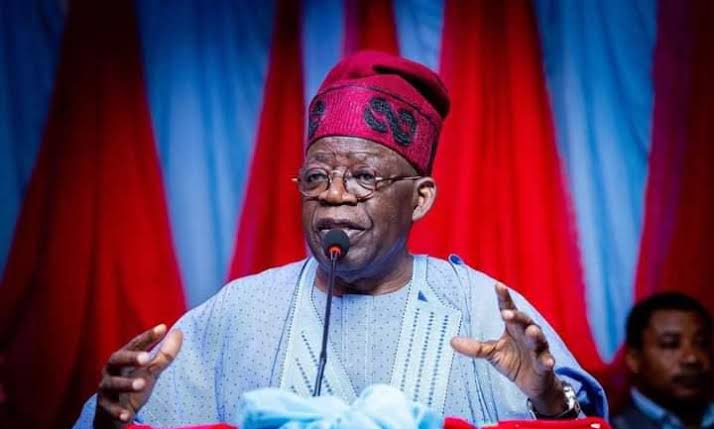
President Bola Tinubu on Thursday declared that he is ready to contest the 2027 election to seek a second term in office as Nigeria’s leader.
According to him, he is ready to break the shackles of ignorance and poverty, put freedom in the hearts of Nigerians and ensure democracy survives.
Taking a swipe at opposition parties, President Tinubu said he wants to give something different from the rascality or noise-making of a street convention.
According to him, the country must submit to the principles of separation of powers and respect the judiciary even when rulings don’t favour a particular group.
Naija News reports that Tinubu made the declaration when he met with the leadership and coordinators of the Renewed Hope Ambassadors at the Presidential Villa, Abuja.
Tinubu added that he can’t be intimidated by the antics of opposition parties and politicians, declaring that he was once in their shoes and understands the game.
“They want to scare me off? It’s a lie. I have been through this path before, and if I have to come back over and over again, I will do the same thing,” he added.
Meanwhile, the Special Adviser to President Bola Tinubu on Information and Strategy, Bayo Onanuga, has berated former Vice President Atiku Abubakar over his interest in the 2027 presidency.
Onanuga argued that Atiku is simply pursuing a self-serving interest without regard for zoning or Nigeria’s power rotation arrangement, which gives preference to a southern candidate for the 2027 presidency.
According to the presidential media aide, Atiku has constantly disregarded zoning arrangements in his previous ambitions for the presidency, leading to a crisis in the Peoples Democratic Party (PDP).
He added that Atiku’s open declaration of intent to contest the 2027 presidency is following the same route and may plunge the African Democratic Congress (ADC) into similar troubles.
Onanuga, however, predicted that Atiku would suffer a resounding defeat at the polls, describing him as a man who never learns.
INEC adjusts Osun governorship election campaign period

Nigerian stocks rally again as investors gain N1.66tn, market cap crosses N136tn

Trump Says Iran Agrees To Hand Over Nuclear Dust Amid Strait of Hormuz Blockade




-

 News19 hours ago
PDP approved appointment of Wike as minister – APC
-

 News19 hours ago
See Black Market Dollar To Naira Exchange Rate Today 16th April 2026
-

 News14 hours ago
BREAKING : Gunmen kidnap JAMB candidates, others in Benue
-

 News20 hours ago
Terrorists plotting massive attacks on Abuja International Airport, Correctional Centres, military detention centre — AP Report
-
 News19 hours ago
BBC to fire 2,000 workers to make £500m savings
-

 News19 hours ago
Presidency mocks Atiku over 2027 ambition, calls him serial loser, advises Obi to leave ADC
-

 Opinion16 hours ago
DIAMOND DISTINCTIONS FOR THE PEOPLE’S MAN; DR. CHIDO ONUMAH
-

 News15 hours ago
Wike: Atiku a serial contestant, loser, he will still contest in 2031 (PHOTO)
You must be logged in to post a comment Login