
Foreign
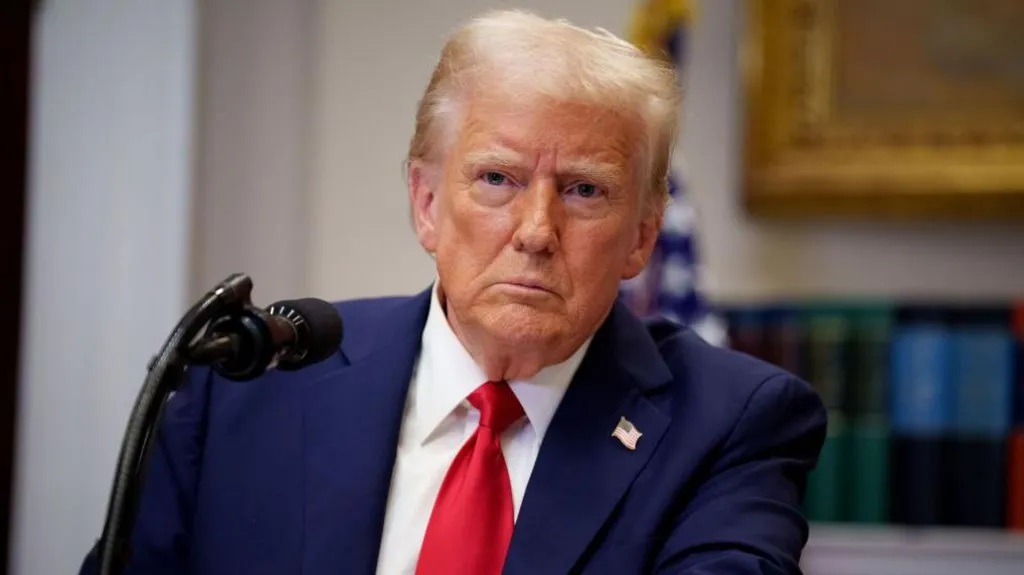
Trump administration seeks legislative backing to terminate vaccine funding

- /home/naijuinz/public_html/wp-content/plugins/mvp-social-buttons/mvp-social-buttons.php on line 27
https://naijablitznews.com/wp-content/uploads/2025/01/Donald-Trump-1-1000x575.jpg&description=Trump administration seeks legislative backing to terminate vaccine funding', 'pinterestShare', 'width=750,height=350'); return false;" title="Pin This Post">
- Share
- Tweet /home/naijuinz/public_html/wp-content/plugins/mvp-social-buttons/mvp-social-buttons.php on line 72
https://naijablitznews.com/wp-content/uploads/2025/01/Donald-Trump-1-1000x575.jpg&description=Trump administration seeks legislative backing to terminate vaccine funding', 'pinterestShare', 'width=750,height=350'); return false;" title="Pin This Post">


The President Donald Trump administration plans to terminate the United States’ financial support for the Global Alliance for Vaccine and Immunisation, the organization that has helped purchase critical vaccines for children in developing countries.
Some other programs terminated is funding for the United Nations Food and Agriculture Organization, which conducts surveillance for diseases that can be transmitted from animals to humans, including bird flu, in 49 countries. Some major programs to track and fight malaria, one of the world’s top killers of children, have also been ended.
Those decisions are included in a 281-page spreadsheet that the United States Agency for International Development sent to the US Congress, listing the foreign aid projects it plans to continue and to terminate.
The New York Times obtained a copy of the spreadsheet and other documents describing the plans.
For many years, developing countries have relied on GAVI support to combat malaria.
Gavi is estimated to have saved the lives of 19 million children since it was set up 25 years ago. The United States contributes 13 percent of its budget.
The terminated grant to Gavi was worth $2.6 billion through 2030.
By Gavi’s own estimate, the loss of U.S. support may mean 75 million children do not receive routine vaccinations in the next five years, with more than 1.2 million children dying as a result.
The U.S. has been among the top donors to the organization since its creation, and became the largest during the Covid-19 pandemic.
Gavi was counting on a pledge made last year by President Joseph R. Biden Jr. for its next funding cycle.
New vaccines with the promise to save millions of lives in low-income countries, such as one to protect children from severe malaria and another to protect teenage girls against the virus that causes cervical cancer, have recently become available, and Gavi was expanding the portfolio of support it could give those countries.
The loss of U.S. funds may set back the organization’s ability to continue to provide its basic range of services — such as immunization for measles and polio — to a growing population of children in the poorest countries, let alone expand to include new vaccines.
While European countries have historically provided significant funding, many are now reducing foreign aid spending as they grapple with the change in U.S. policy on Ukraine and the U.S. demand that they increase their defense spending.
Japan, another major Gavi donor, is struggling with a depreciating currency.
GAVI’s chief executive, Dr. Sania Nishtar said that she hoped the Trump administration would reconsider the decision to end its support. “Gavi’s work keeps people everywhere, including Americans, safe. In addition to protecting individual children, vaccination reduces the possibility of large outbreaks. The organization maintains global stockpiles for vaccines against diseases such as Ebola and cholera, deploying them in rapid response efforts for epidemics,” she said.
Gavi’s structure requires countries to pay part of the cost of vaccines, with their share growing as income levels rise; middle-income countries are weaned from support.
The Trump administration, according to the letter has decided to continue 898 U.S. Agency for International Development Awards and to end 5,341.
It says the remaining programs are worth up to $78 billion.
But only $8.3 billion of that is unobligated funds — money still available to disburse, because the amount covers awards that run several years into the future.
The figure shows a massive reduction in the $40 billion that U.S.A.I.D. used to spend annually.
The administration has decided to continue some key grants for medications to treat H.I.V. and tuberculosis, and food aid to countries facing civil wars and natural disasters.
The cover letter details the skeletal remains of U.S.A.I.D. after the cuts, with most of its funding eliminated, and only 869 of more than 6,000 employees still on active duty.
The memo says that 869 U.S.A.I.D. personnel were working as of last Friday, while 3,848 were on administrative leave and 1,602 are in the process of being laid off.
Of 300 probationary employees who were initially fired, 270 have returned to work following a court order prohibiting their dismissal.
A spokesperson for the State Department, which now runs what is left of U.S.A.I.D., confirmed the terminations on the list were accurate and said that “each award terminated was reviewed individually for alignment with agency and administration priorities, and terminations were executed where Secretary Rubio determined the award was inconsistent with the national interest or agency policy priorities.”
Although the administration has repeatedly said publicly that its foreign assistance review process has been concluded, the information in the documents suggests that there is still some fluidity in which programs will survive.
Staff members of one major malaria program that was terminated weeks ago, and which appears on the list of canceled projects sent to Congress, for example, were informed on Monday that it is being restored.
Nevertheless, cuts to malaria response are deep. While awards that fund the bulk purchase of bednets and malaria treatments have been preserved, many of the programs to deliver these and other malaria control efforts in individual countries such as Cameroon and Tanzania — among the most affected in the world — have been terminated.
Some organizations with awards that have not been officially canceled have received no funds for more than two months, and have folded. Without them, there is no one to take treatments from ports to local clinics, or deliver them to children.

The United States has offered rewards of up to $18 million for information leading to the identification or location of two key leaders of the Islamic State Khorasan Province, ISIS-K.
The US Department of State’s Rewards for Justice programme announced the offers in a notice posted on its X handle on Tuesday.
The programme is offering up to $8 million for information on ISIS-K leader, Shahab al-Muhajir, also known as Sanaullah Ghafari.
According to Rewards for Justice, ISIS’ core leadership appointed Ghafari, who was born in Afghanistan in 1994, as leader of ISIS-K in June 2020.
An ISIS communiqué announcing his appointment described him as an experienced military leader and one of ISIS-K’s “urban lions” in Kabul who had been involved in guerrilla operations and the planning of suicide and complex attacks.
Rewards for Justice is offering a reward of up to $8 million for information on Ghafari,” who is responsible for approving ISIS-K operations throughout Afghanistan and arranging funding for the group’s activities, the programme said.
In another notice, the programme said Obaidullah, also known as Salahuddin and Maulawi Rajab, helps plan ISIS-K attacks and operations, commands groups conducting terrorist attacks and helps manage the group’s finances through its al-Siddiq Office.
The al-Siddiq Office, according to Rewards for Justice, is a regional ISIS directorate responsible for overseeing ISIS activities in Asia and providing financial support to ISIS branches and networks.
The programme said Obaidullah is a close associate of ISIS-K emir Sanaullah Ghafari, also known as Shahab al-Muhajir.
“Rewards for Justice is offering a reward of up to $10 million for information on Obaidullah, a key leader of the Islamic State Khorasan Province (ISIS-K), a U.S.-designated Foreign Terrorist Organization,” the programme said.
It added that Obaidullah was also connected to multiple ISIS-K terrorist plots targeting US, European and Middle Eastern interests.
Rewards for Justice said individuals associated with Obaidullah killed 145 people with gunfire and explosives in the March 2024 attack on the Crocus City Hall music venue in Russia, which was subsequently destroyed by fire.
The programme said ISIS-K is an Afghanistan-based terrorist group that conducts operations in Afghanistan and Pakistan.
It said the group, composed primarily of former members of Tehrik-e Taliban Pakistan and the Islamic Movement of Uzbekistan, pledged allegiance to ISIS in 2015.
Rewards for Justice also linked ISIS-K to several attacks, including the July 2016 bombing of a peaceful protest in Kabul, which it said killed nearly 80 people and wounded about 230 others.
The programme said ISIS-K claimed responsibility for a May 2020 attack on a Kabul maternity hospital that killed 24 people, including newborn babies and their mothers.
It also said the group claimed responsibility for the August 2021 suicide bombing at Hamid Karzai International Airport in Kabul, in which 13 US military personnel and about 160 civilians were killed during the evacuation operation.
The US Department of State designated ISIS-K as a Foreign Terrorist Organisation in January 2016 and previously designated it as a Specially Designated Global Terrorist organisation in September 2015.
The department designated Obaidullah as a Specially Designated Global Terrorist in November 2021.
Rewards for Justice urged individuals with information on the two men to submit tips through its reporting channels.
Foreign
American Man Arrested, Sentenced to 10 Years After Using ChatGPT to Plan Bank Robbery Attack

A 23-year-old Omaha, Nebraska man who used ChatGPT to plan a bank robbery has been sentenced to 121 months in federal prison after he robbed a bank at gunpoint and threatened two employees with death.
Deron Lewis-Payne was sentenced on August 13, 2026, according to the United States Attorney’s Office for the District of Nebraska in a statement published on August 19 and cited by our correspondent on Monday.
The US Justice Department said Lewis-Payne received 37 months for bank robbery and another 84 months for brandishing a firearm during a crime of violence, with the sentences to run consecutively. He will also serve five years of supervised release after his imprisonment.
Advertisement
The incident occurred on February 10, when Lewis-Payne entered i3Bank in Omaha carrying a black semi-automatic handgun and demanded money from two employees.
“He pointed the handgun at the tellers and told them he would kill them if they did not comply,” the Justice Department said, adding that he ordered the employees to empty their cash drawers and warned them “not to include any dye packs with the cash.”
The tellers complied, allowing Lewis-Payne to escape with approximately $`9,175 in cash.
Investigators later used surveillance footage from the bank and nearby residential cameras to identify the suspect and the vehicle allegedly used in the robbery.
“i3 Bank surveillance captured his unmasked face and distinctive outfit, including red Nike slides,” the department said.
It added that residential surveillance cameras also captured the vehicle, including its registration plate and “distinctive features to include a toolbox and particular rust spots.”
The investigation took another turn after officers examined Lewis-Payne’s phone, with investigators finding that he had used ChatGPT while preparing for the robbery.
“Officers examined the contents and determined Lewis-Payne used ChatGPT to plan the robbery,” the department said.
According to the Justice Department, his queries included advice on “law enforcement response times,” how to “strip and repair a Llama Mini-Max .45 handgun” and how to obtain ammunition despite being a felon.
His Google Maps history also showed that he had most recently searched for directions to i3Bank.
After the robbery, investigators said Lewis-Payne went on a shopping spree at Westroads Mall, using cash to purchase shoes and clothing.
When officers later located him near one of his residences, he fled, “abandoning banded cash in his wake,” according to the department.
A search of his residences uncovered another currency band, the vehicle allegedly used in the robbery and most of the clothing he wore during the incident, including the red Nike slides.
Lewis-Payne admitted to driving the vehicle but denied participating in the robbery.
The handgun used in the robbery was never recovered, while investigators recovered $2,397 of the $9,175 stolen from the bank.
The case was investigated by the Federal Bureau of Investigation. The US Justice Department noted that there is no parole in the federal prison system.
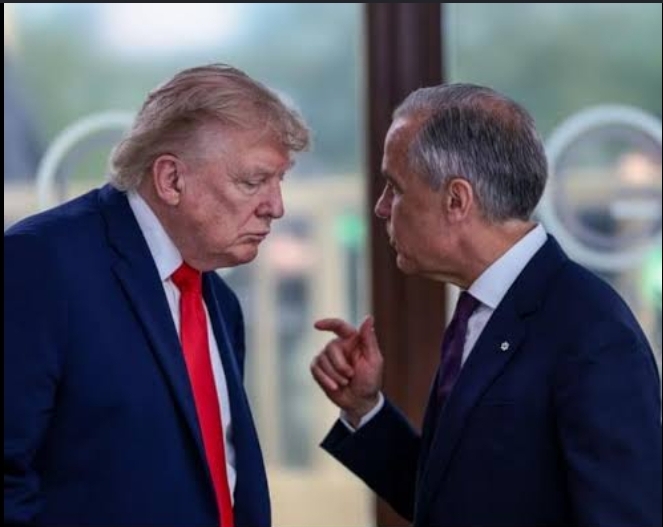
Canada has suspended trade negotiations with the United States after talks broke down, with Prime Minister Mark Carney warning that Ottawa will respond to new US tariffs with dollar-for-dollar measures.
The decision came shortly before a deadline for reaching a deal, following weeks of negotiations aimed at easing tensions between the two major trading partners.
Mr Carney said significant progress had been made, but it was not enough to meet Canada’s objectives. He criticised last-minute changes to the US proposals, describing them as unfair and economically damaging.
Last-minute changes in the US proposed terms were unfair, uneconomic, and called into question the reliability of any deal,” he said.
The breakdown means a new wave of US tariffs will now affect a range of Canadian products. The 50% levies apply to about 5% of Canadian exports, including wine, dairy products, cement, clothing and hockey equipment.
The new tariffs come on top of existing US duties on Canadian steel, aluminium, cars and lumber.
Canada sends about 70% of its exports to the US, making the country particularly vulnerable to a prolonged trade dispute.
Mr Carney said Canada would impose reciprocal tariffs on American goods, matching the value of the US measures “dollar for dollar”.
The announcement marks a sharp change in tone after officials from both countries had expressed optimism earlier in the week that a trade agreement was close.
US Trade Representative Jamieson Greer accused Canada of backing away from commitments reached during negotiations.
Tonight, Canada declined to finalise the trade deal under the terms agreed earlier this week,” he said.
The negotiations had reportedly included discussions over reducing US tariffs on Canadian steel and aluminium from 50% to 25%, while tariffs on Canadian vehicles could have fallen from 25% to 15%.
In return, the US had sought concessions from Canada, including greater access for American dairy products and the removal of restrictions on US alcohol sales in Canadian provinces.
Canadian businesses have warned that the tariffs could cause significant economic damage.
The Canadian Chamber of Commerce described the new measures as a “body blow to North American competitiveness”, warning that smaller exporters could struggle to maintain orders, payrolls and jobs.
Economists have estimated that Canada could lose about 90,000 jobs if the tariffs remain in place, while financial analysts have projected that the measures could reduce Canada’s gross domestic product by between 0.3% and 0.6%.
Ontario Premier Doug Ford backed the federal government’s response, calling for “tariff for tariff, dollar for dollar”.
The latest dispute adds to growing tensions between the two countries since US President Donald Trump returned to office and introduced a broad programme of tariffs.

Akpabio sad over demise of Dotun Oladipo, says he was a courageous journalist

SGF sets up presidential security committee, demands professionalism, urgency

How Late Nollywood actor Ogogo donated N2.5m to mosque renovation while on sick bed – Muslim community




-

 Entertainment20 hours ago
All you need to know about popular US singer Dolly Parton who just died
-

 News15 hours ago
Dangote Refinery raises fuel price by N15
-
Entertainment21 hours ago
Popular crooner of coats of many colours, Dolly Parton dies at 80
-

 Entertainment20 hours ago
Fola, Omah Lay, Ayra Starr Lead 2026 Headies Nominations [FULL LIST]
-

 Economy20 hours ago
Again, NNPC jerks up price of fuel
-

 Metro20 hours ago
Police uncover secondary school student selling nude videos to classmates for N500,000
-

 News20 hours ago
2027: Vote For President Tinubu, Other APC Candidates Or Relocate From Our Local Govt, Kuje LG Chairman Tells Residents
-
 News15 hours ago
ADC Kicks Against Endorsement of Tinubu by 500+ Jigawa Islamic Scholars
Warning: Undefined variable $user_ID in /home/naijuinz/public_html/wp-content/themes/zox-news/comments.php on line 49
You must be logged in to post a comment Login