Economy
NNPCL may sell Warri, Port Harcourt, Kaduna refineries after 2025 review – Ojulari
- /home/naijuinz/public_html/wp-content/plugins/mvp-social-buttons/mvp-social-buttons.php on line 27
https://naijablitznews.com/wp-content/uploads/2025/07/Bayo-Ojulari.jpg&description=NNPCL may sell Warri, Port Harcourt, Kaduna refineries after 2025 review – Ojulari', 'pinterestShare', 'width=750,height=350'); return false;" title="Pin This Post">
- Share
- Tweet /home/naijuinz/public_html/wp-content/plugins/mvp-social-buttons/mvp-social-buttons.php on line 72
https://naijablitznews.com/wp-content/uploads/2025/07/Bayo-Ojulari.jpg&description=NNPCL may sell Warri, Port Harcourt, Kaduna refineries after 2025 review – Ojulari', 'pinterestShare', 'width=750,height=350'); return false;" title="Pin This Post">
The Group Chief Executive Officer of the Nigerian National Petroleum Company Limited (NNPCL), Bayo Ojulari, has stated that the sale of the country’s non-performing refineries, including those in Warri, Port Harcourt, and Kaduna, remains a possibility as the company undertakes a full review of its downstream operations.

Ojulari made this known in an interview with Bloomberg on the sidelines of the 9th Organisation of Petroleum Exporting Countries International Seminar in Vienna on Thursday.
He said, “We’ve made quite a lot of investments in our refineries over the last several years and brought in a lot of technology. We’ve been challenged – some of those technologies have not worked as expected so far. But also, as you know, when you are refining a very old refinery that has been abandoned for some time, what we found is that they are a little bit more complicated.

“So, we are reviewing all our refinery strategies now. We hope that before the end of the year, we will conclude that review. That review will lead us to doing things slightly differently.”
When asked about the possible sale of the old refineries, Ojulari said, “I can’t say that now. But what we are saying is that sale is not out of the question. But all the options are on the table. But that decision will be based on the outcome of the review.”
The NNPC boss explained that the government had to overhaul crude infrastructure security, working closely with government agencies and local community surveillance groups to safeguard critical oil infrastructure.
Ojulari insisted that the new model, which replaced the former reliance on policing, had yielded more sustainable results in pipeline availability.
He added, “I can give a lot of assurances concerning our pipelines because where we are, we have come a long way. It wasn’t a quick fix. It took several years to get the government’s policies aligned. We have now gotten government security agencies also working with local surveillance groups, who are from the communities, providing sustainability and jobs for the community.
“What we have now is a bit more sustainable. In the past, it was around the use of policing, and it was very clear that policing alone wasn’t going to work. We needed to create a sustainable means of livelihood and interdependency with the community. So my confidence is built on the premise that today’s security is driven by the communities, far more than what we had before. So, I am quite optimistic.”
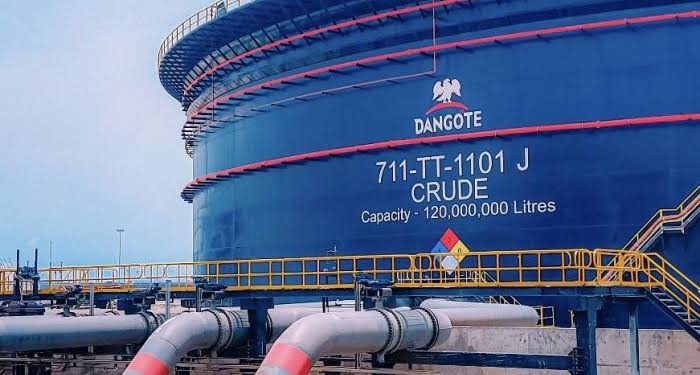
The NNPC helmsman also addressed questions on crude supply to the Dangote Refinery. According to him, the company will not be compelled to buy local crude by government policy, stressing that all transactions would remain commercial.
“First of all, Dangote refinery is a commercial investment, and I think it is very important to keep that in mind. It is a commercial investment and not a national investment. So, the refinery has the flexibility to be able to import crude for its survival and also has the flexibility to serve all customers.
“If we look at it commercially, yes, we will have to do more to ensure that there is a balance in terms of the crude coming from Nigeria. We are working on that, and it will improve. But what we want to do is move away from government domination of private sector businesses. We want the private sector to have freedom, and that is what the government has been doing. So, if Nigeria is going to supply more crude to the Dangote refinery, it will be on a commercially willing buyer, willing seller basis and not because it is a policy.”
Ojulari said Nigeria was ramping up production with a medium-term goal to hit 2.06 million barrels per day by 2027.
According to him, in March, the country produced about 1.56 million barrels per day and now at 1.63 million, including condensates.
He stated that by the end of 2025, the NNPCL is hoping to clock 1.9 million barrels daily.
On gas production, he added that Nigeria also plans to raise output from 7 billion cubic feet to 10 billion cubic feet by 2027.
The Kaduna, Port Harcourt, and Warri refineries are Nigeria’s state-owned refineries.
The lack of functional refineries has compelled the country to depend heavily on imported refined petroleum products, significantly impacting the national economy.
In May 2023, Africa’s largest oil refinery, the Dangote Refinery, was commissioned in Nigeria, with hopes that it would help alleviate the country’s chronic fuel shortages.
Economy
Nigeria exceeds OPEC quota as crude production hits 11-month high
Nigeria’s crude oil production surged to an 11-month high in May 2026, with the country exceeding its Organisation of the Petroleum Exporting Countries (OPEC) production quota.
The average crude oil production recorded during May represents 102 per cent of Nigeria’s 1.5mbpd of production quota allocated by OPEC.
The production report released by the Nigerian Upstream Petroleum Regulatory Commission (NUPRC) on Thursday disclosed that Nigeria’s oil production averages 1,530,354 barrels of crude oil and 170,446 barrels of condensates per day (bpd).
According to the report, this brings the total combined production to 1,700,800 barrels per day and consolidates Nigeria’s position as Africa’s largest oil producer.
The report said the production performance during the review period remained robust, with combined crude oil and condensate output ranging from a low of 1.51 million bpd to a peak of 1.86 million bpd.
It said the May 2026 production figures represented the highest recorded by Nigeria since July 2025, when output surged to 1,712,282.
“In strict crude oil terms (excluding condensates), the 1.53 million barrels recorded in May 2026 represents the highest Nigeria has witnessed since January 2025, when crude oil production hit 1.538mbpd.
“The latest crude oil production statistics thus represent a 15-month high on a month-on-month basis, production rose by 2.77 per cent in May 2026 as against 1.48mbpd in April,” it said.
The report said the broader production trend over the last five months had also remained positive.
It said combined crude oil and condensate output increased from 1.48 million bpd in February to 1.54 million bpd in March, 1.66 million bpd in April, and 1.7 million bpd in May, underscoring sustained growth in Nigeria’s hydrocarbon production.
According to the report, among production streams, Bonny Terminal led the pack with a total blend of 293,870 bpd, closely followed by Forcados Terminal at 289,900 bpd, Qua Iboe ranked third with 173,360 bpd, while Escravos Oil Terminal contributed 135,470 bpd.
It said the Odudu (Amenam Blend) accounted for 63,250 bpd across the top five production streams during the month under review.
The NUPRC attributed the rise in production to sustained positive momentum, as operations remained stable throughout the reporting period, with no significant pipeline or facility outages recorded.
It added that all previously scheduled turnaround maintenance activities had been completed, thereby improving operational reliability and production efficiency.
(NAN)
Economy
CBN proposes stricter regulation of banks, affiliated companies’ business dealings
The Central Bank of Nigeria (CBN) has issued draft guidelines that would impose stricter controls on transactions between banks, financial institutions and their affiliated entities as part of efforts to protect depositors’ funds, strengthen consumer protection and reduce risks within the financial system.
The proposed ‘Guidelines on Ring-Fencing Operations of Closely Linked Entities in the Nigerian Financial System’ seek to establish clear operational and functional boundaries among entities under the same corporate group and prevent the commingling of activities across different licence categories.
In a circular signed by the Director of the Financial Policy and Regulation Department, Dr Rita Sike, the apex bank said the framework was developed to promote a safe, sound and stable financial system, safeguard consumer interests and strengthen regulatory oversight.
According to the CBN, the guidelines prescribe requirements relating to governance, intra-group transactions, segregation of customer funds and data, operational independence, recovery and resolution planning, and consolidated supervision.
“The guidelines are intended to strengthen consumer protection, enhance transparency and accountability, mitigate contagion risks among closely linked entities, and preserve financial stability while supporting innovation and fair competition within the financial services sector,” the bank stated.
Under the proposed framework, boards of closely linked entities would be required to ensure that such entities operate independently and maintain separate governance, risk management and control structures. Each entity would also be expected to have a dedicated board and establish policies that ring-fence its operations from those of affiliated companies.
The CBN also proposed limits on overlapping leadership roles within financial groups, stating that the number of directors serving simultaneously on the boards of closely linked entities should not exceed 20 per cent of the total board membership.
To strengthen oversight, the draft guidelines require external auditors to certify annually the effectiveness of board-approved policies and processes designed to ensure operational independence.
The apex bank further proposed that all intra-group transactions must be conducted on arm’s-length terms and reported to the regulator on a quarterly basis.
It also stated that no closely linked entity should extend a loan to, or guarantee the obligations of, another affiliated entity without prior written approval from the CBN.
“The boards of closely linked entities shall ensure that transactions between such entities are conducted at arm’s length and are properly documented,” the draft stated.
The guidelines place significant emphasis on customer onboarding and consumer protection. Where customers choose services offered by an affiliated company, the receiving entity would be required to establish a direct business relationship with the customer, conduct its own KYC verification and provide account or wallet details where necessary.
The draft also requires affiliated entities to remain adequately capitalised at all times and ensure that critical functions are managed independently.
To reduce operational risks, the CBN proposed restrictions on the use of shared technology infrastructure , as entities would not be allowed to use their information technology platforms to offer services outside the scope of their licences or process transactions on behalf of affiliated entities.
The regulator said it could require the separation of data centres where necessary to reduce contagion risks and ensure that each entity can operate independently.
The framework further seeks to protect customer funds by requiring strict separation of accounts belonging to affiliated entities and daily reconciliation of balances, with discrepancies corrected within 24 hours.
Customer funds would not be permitted for intra-group lending, servicing debts, proprietary trading activities, external borrowings or operational expenses of related entities.
The CBN also proposed tighter controls on customer data, requiring data to be stored independently and prohibiting its sharing among affiliated entities without the explicit consent of customers, except as permitted under the Nigeria Data Protection Act.
“Sharing of customer data between closely linked entities without explicit consent of the customer is prohibited,” the draft guidelines stated.
The proposed framework further requires promoters of closely linked entities to establish a non-operating holding company structure. Such holding companies would be required to maintain regulatory capital at least 20 per cent above the combined minimum capital requirements of their subsidiaries.
However, shareholders unwilling to establish a holding company may choose to merge affiliated entities into a single business, subject to regulatory conditions, including the surrender of excess licences.
The CBN has exposed the draft guidelines for public review and invited stakeholders to submit comments before July 9, 2026.
Economy
Cardoso formally receives Central Bank of the Year Award in London
Akpo Ojo
The Governor of the Central Bank of Nigeria (CBN), Mr. Olayemi Cardoso, formally received the Central Bank of the Year Award at the Central Banking Awards ceremony held in London on Wednesday, June 10, 2026.
He dedicated the honour to the board, management, and staff of the CBN for their steadfast commitment to institutional reform and economic stability.
Also, Cardoso expressed appreciation to the Central Banking Publications and the award judges for the recognition, while congratulating fellow institutions and individuals honoured during the event.
The CBN governor stressed that the award is not a personal achievement but a testament to the collective efforts of the entire CBN, particularly the professionals whose dedication, integrity, and expertise – often exercised away from public attention – have strengthened the apex bank and reinforced confidence in Nigeria’s economy.
“I accept this award on behalf of the board, management and staff of the Central Bank of Nigeria,” Cardoso said.
“Above all, it belongs to the many dedicated professionals who serve our institution with integrity, expertise, and an unwavering commitment to the public good.”
Reflecting on the global economic landscape, Cardoso noted that recent years had presented significant challenges for central banks worldwide, with Nigeria facing its own share of economic pressures and policy tests.
He highlighted several difficult but necessary measures undertaken by the CBN, including efforts to address elevated inflation, implement major reforms in the foreign exchange market, and invest in critical digital and financial infrastructure to support the country’s long-term economic development.
Cardoso also pointed to key milestones achieved during the period, including Nigeria’s removal from the Financial Action Task Force (FATF) grey list and the successful completion of the banking sector recapitalisation exercise.
He noted that these accomplishments reflect the collaborative efforts of multiple institutions and stakeholders.
According to the CBN governor, the apex bank’s reform agenda has been guided by a clear objective: restoring confidence, strengthening institutional resilience and policy credibility, and laying a solid foundation for sustainable economic growth.
While acknowledging that significant work remains ahead, Cardoso expressed optimism about the progress made so far and the renewed confidence emerging across the economy.
He attributed these gains to the support of the federal government, market participants, development partners, and, most importantly, the resilience and confidence of the Nigerian people.
“We receive this recognition with humility,” he said. “We see it not as a destination, but as encouragement to continue the important work ahead.”
Cardoso reaffirmed the CBN’s commitment to preserving public confidence, safeguarding financial and monetary stability, and fulfilling its mandate with integrity, professionalism, and accountability.
The award represents significant international recognition for the Central Bank of Nigeria at a time when monetary and financial sector reforms remain central to the country’s economic recovery and long-term growth agenda.
-
News21 hours agoDemocracy Day: Senate President Akpabio Urges Unity, Resilience, Citizen Participation
-
News21 hours ago2026 World Cup: Why we lost 2-0 to Mexico – South Africa coach, Broos
-
Economy21 hours agoCardoso formally receives Central Bank of the Year Award in London
-
Economy21 hours agoCBN proposes stricter regulation of banks, affiliated companies’ business dealings
-
Economy21 hours agoNigeria exceeds OPEC quota as crude production hits 11-month high
-
News21 hours agoTroops kill ISWAP leader Khalifa, 2 commanders surrender in Borno
-
Metro21 hours agoPolice to impound vehicles without number plates in Lagos
-
News21 hours agoSenate Extends 2025 Capital Budget Implementation to September

Warning: Undefined variable $user_ID in /home/naijuinz/public_html/wp-content/themes/zox-news/comments.php on line 49
You must be logged in to post a comment Login