Foreign
U.S. Restores Five-Year Multiple-Entry Visas for Ghanaians Amid Diplomatic Breakthrough
- /home/naijuinz/public_html/wp-content/plugins/mvp-social-buttons/mvp-social-buttons.php on line 27
https://naijablitznews.com/wp-content/uploads/2025/02/US-visa.jpg&description=U.S. Restores Five-Year Multiple-Entry Visas for Ghanaians Amid Diplomatic Breakthrough', 'pinterestShare', 'width=750,height=350'); return false;" title="Pin This Post">
- Share
- Tweet /home/naijuinz/public_html/wp-content/plugins/mvp-social-buttons/mvp-social-buttons.php on line 72
https://naijablitznews.com/wp-content/uploads/2025/02/US-visa.jpg&description=U.S. Restores Five-Year Multiple-Entry Visas for Ghanaians Amid Diplomatic Breakthrough', 'pinterestShare', 'width=750,height=350'); return false;" title="Pin This Post">
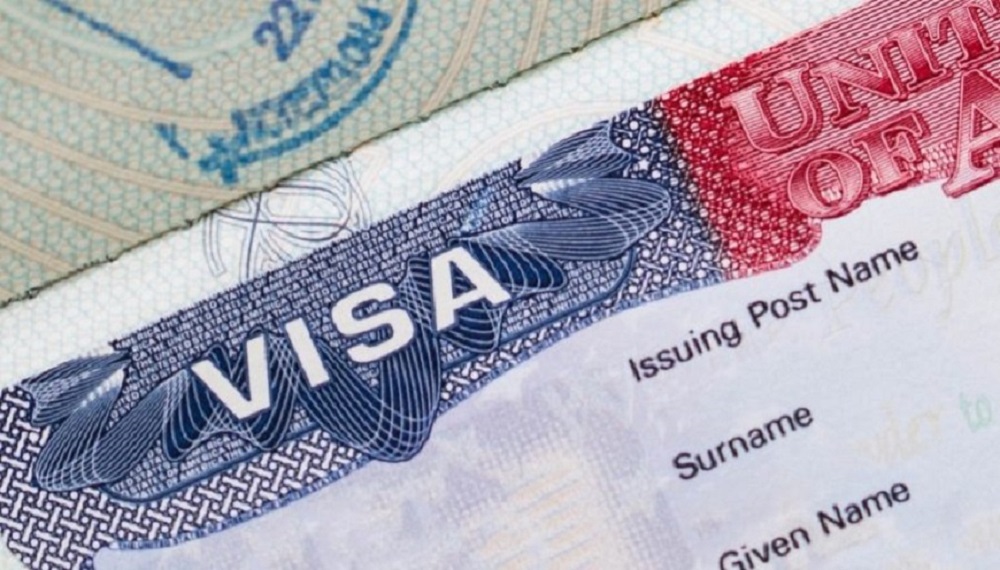
The United States has officially lifted visa restrictions on Ghana, restoring five-year multiple-entry visas and granting expanded consular privileges for Ghanaian nationals. The development, announced on Friday, September 26, 2025, represents a major diplomatic win for Accra following months of tense negotiations with Washington.

Ghana’s Foreign Minister, Samuel Okudzeto Ablakwa, who confirmed the breakthrough, described the agreement as a testament to persistent high-level engagement. “I am really pleased that months of diplomatic dialogue have led to this successful outcome,” Ablakwa said, hailing the decision as a “big win for Ghana.”
The announcement was formally conveyed by U.S. Under Secretary of State for Political Affairs, Allison Hooker, during a bilateral meeting on the sidelines of the United Nations General Assembly in New York. According to diplomats present, the restored visa privileges are expected to boost travel, academic exchange, and business opportunities for Ghanaian citizens.

Ablakwa emphasized that the move demonstrates a renewed spirit of partnership between Accra and Washington. “It’s good to see healthier and stronger Ghana-USA relations. For God and Country,” he remarked.
While the decision is being celebrated in Ghana, it comes amid controversy tied to U.S. immigration policies under President Donald Trump. Ghana has recently faced criticism for cooperating with Washington in accepting West African deportees, including some individuals with no direct familial or national ties to the country.
Since early September, at least 14 West Africans have been flown to Ghana from the United States. Some of them had previously secured temporary protection from U.S. immigration courts, yet were deported regardless. Ghanaian officials later repatriated at least four of these individuals to their countries of origin.
President John Mahama defended Ghana’s role by citing the ECOWAS protocol on free movement, which allows West Africans to enter Ghana without a visa. However, critics argue that Accra risks being used as a “third-country deportation hub” for U.S. immigration enforcement.
Human rights groups have expressed alarm over the treatment of deportees. Meredyth Yoon, a U.S.-based attorney, told AFP that between eight and ten individuals were detained under military guard in Ghana before being abruptly transferred to Togo, where they were reportedly abandoned without adequate support. Another U.S. chartered deportation flight arrived in Accra this week, though the number of passengers remains unclear.
Ghanaian authorities insist their actions are humanitarian and not an endorsement of Washington’s hardline immigration agenda. Nonetheless, the developments highlight the delicate balancing act Accra must perform maintaining cordial ties with Washington while safeguarding its image within Africa and upholding human rights.
Despite these complexities, the lifting of visa restrictions underscores Ghana’s diplomatic resilience. Analysts believe the restored consular privileges will encourage smoother travel, strengthen business links, and expand educational opportunities for Ghanaians in the United States.
As Ablakwa noted, “This outcome signals not just restored visa access, but a stronger and more cooperative relationship between Ghana and the United States.”

Foreign
Iran cautions, says Middle East war will expand geographically If US falls for zionists deception
Iran’s army has warned that the conflict in the Middle East could expand further if the United States launches additional attacks on the Islamic Republic, ahead of Israeli Prime Minister Benjamin Netanyahu’s visit to Washington this week.
Army spokesman Mohammad Akraminia issued the warning during an interview with Iranian state television on Sunday, July 26, saying any renewed US military action would widen the geographical scope of the conflict.
“I believe that if the Americans once again fall for the Zionists’ deception, or move in line with them, and insist on continuing the war, particularly through air strikes, geographically this will expand further,” he said.
Akraminia claimed the conflict had already spread to the Bab al-Mandab Strait at the entrance to the Red Sea, referring to the recent escalation involving Yemen’s Iran-backed Houthi movement and Saudi Arabia. “The scope of our operations now encompasses the entire region, from US bases in Jordan to the countries along the Persian Gulf,” he said.
He added that the United States now faced an increasingly unstable security environment in the Middle East and suggested Washington was reassessing its approach. “The situation in the Middle East for the United States is difficult and unsettled,” he said, adding that the US was looking “for a new strategy.” “We are prepared for each of the options and scenarios that appear likely.” The comments come ahead of Netanyahu’s scheduled meeting with US President Donald Trump at the White House on Tuesday.
According to the Israeli prime minister’s office, Netanyahu will depart for Washington on Monday before meeting Trump and attending the funeral service of Senator Lindsey Graham, whom the statement described as “a friend of Israel.” Since Trump’s return to office last year, the two leaders have met six times, most recently in Washington on February 11.
While Trump and Netanyahu initially presented a united front following the launch of military operations against Iran in late February, reports suggest differences have since emerged over whether to continue military action or pursue diplomatic efforts.
Netanyahu has previously described Trump as “the greatest friend” Israel has ever had in the White House. Earlier this month, Trump also spoke about their relationship during an interview with Axios. “We get along very good. (Netanyahu) knows who the boss is,” Trump said.
Relations between the two leaders reportedly came under strain during ceasefire negotiations between the United States and Iran in April. The ceasefire has since collapsed.
Foreign
Iranian Commander Issues “One-for-One” Threat to US Over Citizen Deaths
A senior Iranian military commander has threatened that one US soldier would be killed for every Iranian citizen killed in US attacks, marking a sharp escalation in rhetoric as tensions between Tehran and Washington continue to intensify.
Ali Abdollahi, commander of Iran’s Khatam al-Anbiya Headquarters, said on Friday that what he described as a principle previously demonstrated on the battlefield would now become an official equation governing Iran’s response.
According to Abdollahi, any US attack resulting in the death of an Iranian citizen would trigger a direct response against American forces.
“For every martyr from the proud people of the Islamic Republic of Iran, one American force will be eliminated,” he said.
He concluded his message with a strongly worded warning directed at US forces, saying they had been issued what he described as “a one-way ticket to hell.”
The remarks come as military tensions between Tehran and Washington continue across the region, with both sides exchanging threats amid the ongoing conflict.
Separately, Iranian Foreign Minister Abbas Araghchi said Tehran would not accept a temporary ceasefire under any circumstances unless its demands regarding the Strait of Hormuz are met.
Araghchi said the current dispute with Washington is not the result of a lack of mediators, noting that Pakistan and Qatar continue to play mediation roles. Instead, he argued that the core issue lies in US policies, which he said must change.
Responding to a question about discussions with counterparts from Russia, China, Ukraine, and Pakistan, Araghchi said Iran maintains continuous and organized consultations with Moscow and Beijing and engages in dialogue whenever opportunities arise.
He added that recent meetings with Chinese Foreign Minister Wang Yi and Russian Foreign Minister Sergey Lavrov provided an opportunity to discuss the conflict in greater detail.
Regarding Pakistan, Araghchi said it was natural to discuss mediation initiatives and proposals with Islamabad but reiterated that the fundamental problem between Tehran and Washington is not the absence of mediators but US policy.
Araghchi also stressed that Iran would not yield to what he described as American pressure or intimidation.
“Iran has shown that it will not bow to US coercion. We do not respond to the language of force, pressure, or threats. We are not afraid of threats, we do not submit to pressure, and we do not accept the language of intimidation,” he said.
He reaffirmed that protecting the Iranian people and safeguarding Iran’s interests in the Strait of Hormuz remain fundamental and non-negotiable principles for Tehran, adding that Iran would maintain its current position until what he described as the legitimate demands of the Iranian people are achieved.
Foreign
Biya’s Long Absence Raises Fresh Questions In Cameroon
Cameroon is facing renewed political debate as President Paul Biya remains outside the country for 48 days, raising concerns among opposition leaders and many citizens over delays in government decisions and the country’s leadership.
Biya, 93, who has ruled Cameroon for more than four decades and is the world’s oldest serving head of state, left the country on June 7 for what officials described as a brief private visit to Europe with his wife, Chantal Biya.
Since then, he has remained in Switzerland, where he has frequently travelled over the years.
His prolonged stay has again led to rumours about his health. Earlier reports claimed he had been admitted to a clinic in Geneva, but Cameroon’s Communication Minister, Rene Emmanuel Sadi, denied the reports on June 18, insisting that the president had not been hospitalised.
Despite the government’s assurance, opposition parties say Biya’s continued absence has left the country without active leadership.
Mamadou Mota, vice-president of the Cameroon Renaissance Movement (MRC), said the situation reflects a clear gap in the country’s institutions.
The leader of the Cameroon Democratic Union (UDC), Patricia Tomaino Ndam Njoya, also called on the government to create a clear legal process for determining when a president is temporarily or permanently unable to carry out official duties.
The ruling party has rejected claims that the country lacks leadership. Higher Education Minister Jacques Fame Ndongo said President Biya remains fully involved in government work and continues to receive and review official documents wherever he is staying.
This is not the first time Biya’s absence has attracted public attention. In late 2024, he also spent about 50 days outside Cameroon, leading to similar concerns.
The opposition Social Democratic Front (SDF) described the country as operating without active direction, saying government activities appear to be continuing without proper leadership.
Many Cameroonians have also expressed frustration over the slow pace of government decisions. Viviane Ondoua Biwole, a public management professor at the University of Yaounde, said many people are tired of waiting for changes. She noted that the current government has remained in office for eight years, while many citizens expected a cabinet reshuffle after the last election.
Biya secured an eighth presidential term in the October election, but the result sparked protests across the country. Security forces moved against demonstrators, and the government later confirmed that several dozen people died during the unrest, although it did not release a full casualty figure. Opposition parties rejected the election outcome, while several Western embassies reacted with caution.
In his New Year’s address on December 31, Biya promised to appoint a new government in the coming days. More than seven months later, no new cabinet has been announced.
At the same time, municipal and parliamentary elections have been postponed several times, allowing current office holders to remain in their positions beyond their expected terms.
Although Cameroon has introduced some constitutional and institutional changes, including replacing the heads of both chambers of parliament in March and creating the office of vice-president through constitutional reforms in May, no one has yet been appointed to fill the new position.
The uncertainty has also encouraged the spread of false information. In June, fake documents made to resemble an official presidential decree were sent to a state-owned radio station in the capital, claiming that a vice-president had been appointed. Journalists verified that the documents were not genuine and refused to broadcast the claim.
As questions continue over who could eventually succeed Biya, political observers say there are reports of disagreements among people close to the president.
According to political analyst Stephane Akoa, different groups within Biya’s inner circle are competing for influence, while First Lady Chantal Biya is becoming more involved in government matters and is increasingly mentioned in discussions about appointments and key decisions.
Under Cameroon’s constitution, if the presidency becomes vacant and no vice-president has been appointed, Senate President Aboubakary Abdoulaye would take over temporarily until a new presidential election is held.
-
News6 hours agoUK Eases Student Visa Rules for Three African Nations
-
News17 hours agoFugitive drug kingpin, ex-int’l footballer bag 24 years jail term for cocaine importation(Photos)
-
News15 hours agoJust in: Ahead 2027, Kano NDC Senators Meet Tinubu over Planned Defection to APC
-
News18 hours agoReps Order IGP to Produce Alleged Fake Presidential Council DG as Probe Uncovers Fresh Forgery Claims
-
News17 hours agoAGF Reveals Alleged Hijacked State House Letter Helped Fake Agency Get Recognition
-
News6 hours agoStolen BVAS, PVCs Will Be Replaced, Osun Election Safe – INEC
-
News21 hours agoWe don’t have current negotiations with US — Iran
-
News6 hours agoNigeria, South Africa Set for Fresh Diplomatic Talks Amid Xenophobia Concerns