
News
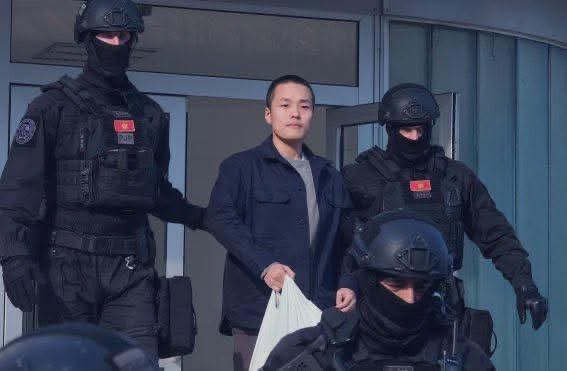
Just in: Terra Luna Founder Do Kwon Sentenced To 15 Years in Prison

- /home/naijuinz/public_html/wp-content/plugins/mvp-social-buttons/mvp-social-buttons.php on line 27
https://naijablitznews.com/wp-content/uploads/2025/12/IMG_1657.jpeg&description=Just in: Terra Luna Founder Do Kwon Sentenced To 15 Years in Prison', 'pinterestShare', 'width=750,height=350'); return false;" title="Pin This Post">
- Share
- Tweet /home/naijuinz/public_html/wp-content/plugins/mvp-social-buttons/mvp-social-buttons.php on line 72
https://naijablitznews.com/wp-content/uploads/2025/12/IMG_1657.jpeg&description=Just in: Terra Luna Founder Do Kwon Sentenced To 15 Years in Prison', 'pinterestShare', 'width=750,height=350'); return false;" title="Pin This Post">


Terra Luna Founder Do Kwon has been sentenced to 15 Years in Prison over the sudden collapse of the TerraUSD (UST) market.
BrandNewsDay reports that the United States has officially sentenced Terraform Labs founder Do Kwon to 15 years in federal prison over the historic collapse of TerraUSD (UST) and LUNA, a disaster that wiped out an estimated $40bn in market value and triggered a global crypto meltdown.
Court documents show that Kwon pleaded guilty earlier this year to fraud-related charges after prosecutors revealed he misled investors about the stability of $UST and secretly propped up the token’s price using hidden trading support.
The judge condemned the scheme as one of the most damaging in #crypto history, noting billions in losses and life-changing financial harm suffered by victims worldwide.
Do Kwon was also ordered to forfeit over $19M, with potential additional actions still pending in South Korea.
This sentencing marks a major milestone in crypto regulation, sending a clear message that accountability in the blockchain space is no longer optional.


Despite the Federal Government’s latest Gross Domestic Product (GDP) growth figures, the organised labour said that the reported expansion had yet to translate into improved economic wellbeing for civil servants, whose purchasing power continues to weaken amid rising petrol prices and high cost of living.
National President, Association of Senior Civil Servants of Nigeria (ASCSN), Shehu Mohammed, who spoke in Lagos yesterday, on the state of the economy and workers’ welfare, during the South-West zonal workshop of the association, themed “A Shift from Confrontation to Collaboration,” said the contradiction was evident in the fact that civil servants remained central to economic activity while their earnings were being steadily eroded by inflation and rising living costs.
“We are the engine room. We lubricate the economy. Unfortunately, what we are facing today is that as we are lubricating, we are also drying up,” he said.
He said that the quality of economic growth should not be measured solely by increases in GDP, but whether such growth translates into improved disposable income and purchasing power for workers and households.
According to him, the N70,000 national minimum wage has already lost substantial purchasing power to inflation, even before its full implementation across the country.
The labour leader said this had made the next review of the national minimum wage particularly important, stressing that preparations must begin ahead of the 2027 negotiations.
He said that the organised labour would need credible economic data to support its demands at the negotiating table.
Mohammed warned that further increase of fuel price would deepen hardship..
MEANWHILE, the Federal Workers Forum (FWF) has called on the Federal Government to immediately review the salaries of federal workers, demanding a minimum wage of N300,000 and a maximum salary of N1.5 million for officers on Grade Level 17.
The forum also demanded the full implementation of the N70,000 minimum wage, payment of outstanding wage-related arrears and the introduction of additional welfare measures to cushion the impact of the rising cost of living on federal workers.
National Coordinator of the FWF, Andrew Emelieze, and General Secretary, Ogundele Ayodele, made the demands in a statement yesterday and addressed to the Senate President, Speaker of the House of Representatives, President Bola Tinubu, Chief Justice of Nigeria and Head of the Civil Service of the Federation.

Corporal Yusuf Aliyu, a police officer attached to Dambam Division, Bauchi State Command has tendered his resignation from the Nigeria Police Force, citing two years of unresolved salary issues that have left him in severe financial hardship.
In a resignation letter dated August 30, 2026, and addressed to the Inspector-General of Police through the Bauchi Commissioner of Police, Aliyu with Force No. 524180 said he will exit the force effective September 30, 2026.
A copy of the letter is currently circulating on X.
Aliyu said although his salary “has been processed and reflected,” he has been “unable to access or withdraw it despite several efforts made through the appropriate channels.”
“I have reported the matter on numerous occasions and followed all the necessary procedures, yet the issue remains unresolved,” he wrote.
The corporal said the situation has made it “extremely difficult” to meet personal and family responsibilities.
“This situation has caused me severe financial hardship and has made it extremely difficult for me to meet my personal and family responsibilities. Consequently, I have lost confidence in the system and have decided to resign from the Nigeria Police Force,” he stated.
Aliyu appreciated the opportunity to serve and pledged to return all government property in his possession before his departure.
He also requested guidance on clearance and disengagement procedures.
The Economic and Financial Crimes Commission has disclosed how public funds were moved from a local government account to a private company before being transferred into cryptocurrency wallets.
The EFCC Chairman, Ola Olukoyede, disclosed on Monday while addressing media executives and journalists in Abuja, stressing that the commission could not ignore the suspicious movement of public funds.
Olukoyede, however, did not disclose the local government, company or state involved in the transaction.
He said the commission’s Fraud Risk Assessment and Control Department had detected the suspicious transactions and intervened by freezing the funds for 72 hours to establish their destination and purpose.
Olukoyede, however, expressed his displeasure over people who called for his head as a result of the action taken by his agency.
He said, “When we see money moving suspiciously, we move in and freeze it in the interim. I know some of you are calling for my head. The account was frozen for 72 hours. Okay, come and show where this money is going? Why are you moving money? We saw money being moved from the local government account to a company. Apart from that phase, we discovered that the money has gone into cryptocurrency wallets.
“Is that the road to build? Is that the power to generate cryptocurrency wallets for your people? Are you asking me to close my eyes and not do something like that? Then you don’t need me in this office.”
The EFCC boss said the development underscored the need for law enforcement agencies to shift from waiting for public funds to be stolen before taking action to preventing suspicious transactions from being completed.
“Why must we be waiting for money to be stolen? Why can’t we change the narrative? And that’s the main thing we need to bring to the office,” he said.
The disclosure comes against the backdrop of an outcry earlier in the month after the EFCC froze an account belonging to the Osun State Government, days before the August 15 governorship election.
However, Olukoyede did not link the transaction he cited to Osun State or any other particular state.
Olukoyede also said cybercrime had evolved beyond the traditional perception of “Yahoo Yahoo,” noting that some young people were being used as fronts by public officials to move allegedly stolen funds through cryptocurrency wallets.
He said, “We have gotten to a stage in Nigeria now that public officials steal money and they put it in cryptocurrency wallets.
“Most of the directors we are investigating now, you can’t trace tangible assets to them. They steal this money, give it to students, give it to young people. They open cryptocurrency wallets all over the world. They plunder the money there within 24 hours.
“The money moves abroad. They buy a house anywhere in the world, buy luxury items. Those are the recent trends.”
The EFCC boss also disclosed that the commission had developed the capacity to trace cryptocurrency wallets, particularly those linked to virtual asset platforms registered in Nigeria.
According to him, about 40 virtual asset platforms had been licensed, following regulatory measures introduced to strengthen oversight of the sector.
“Now we also have the capacity to trace cryptocurrency wallets now, at least with those that are registered in Nigeria, and we are doing that,” he said.
Reeling out the achievements of the commission in the last three years, Olukoyede said the commission had also recovered virtual assets in connection with the CBEX fraud, but identified the management of confiscated cryptocurrency as a challenge that had previously created accountability concerns.
“When you recover virtual assets, where do you put them? No accountability. That’s why we can’t continue like this,” he said.
He disclosed that the Federal Government had consequently approved the establishment of a national confiscation wallet where virtual assets recovered by law enforcement agencies would be kept.
“Today, now we have a national confiscation wallet. So if I confiscate virtual assets now, it’s a national wallet that we put into those,” he said.
Olukoyede further warned that the increasing use of cryptocurrency to move illicit funds required stronger technological capacity among financial and law enforcement institutions.
He said, “When we are talking about cybercrime, please cooperate with us, understand the scope. Not just Yahoo. Some of the people you are calling Yahoo, see your young children; they are stealing on behalf of London, on behalf of public servants.”
Olukoyede said the commission’s anti-corruption activities had also contributed significantly to revenue mobilisation, with federal and state tax recoveries amounting to approximately N288.1bn during the period under review.
He said the figure comprised about N173.2bn in federal tax recoveries and N114.9bn attributed to State Internal Revenue Services.
Oluyede also said more than 40 of its personnel were dismissed for alleged corruption and financial malpractice in the past two and a half to three years.
He added that some of the dismissed officials were already facing prosecution, while case files involving others were being prepared for prosecution.

Nepal flood: Death toll hits 1,222, 4,875 missing

We’re central to economic activity, workers tell FG

See Photos As US Releases $1 Coins Featuring President Trump


-
 News22 hours ago
“Go Back and Repair Our Road!” — Enugu Residents Turn APC Campaign Ground Into Assessment Session(Video)
-
 Politics14 hours ago
Wike: ‘You want me to fold my hands for Atiku to win? No way!’
-

 News21 hours ago
ADC gives reasons why Atiku was absent at G100 opposition summit
-
 News15 hours ago
Demolish financial structures of drug cartels, Marwa tasks NDLEA investigators(Photos)
-
 News15 hours ago
Wike’s media chat more words on marble
-

 Opinion21 hours ago
90,000 km fiber and the digital divide
-
 News17 hours ago
All Tinubu-era FCT Projects’ll be Completed Before End Of Tenure – Wike
-

 News17 hours ago
FCT minister Nyesom Wike’s words on marble