News
Reps Demand Full Revenue Breakdown as Customs Defends Performance
…as lawmakers seek detailed auction, export and contractor records amid push to curb borrowing

By Gloria Ikibah
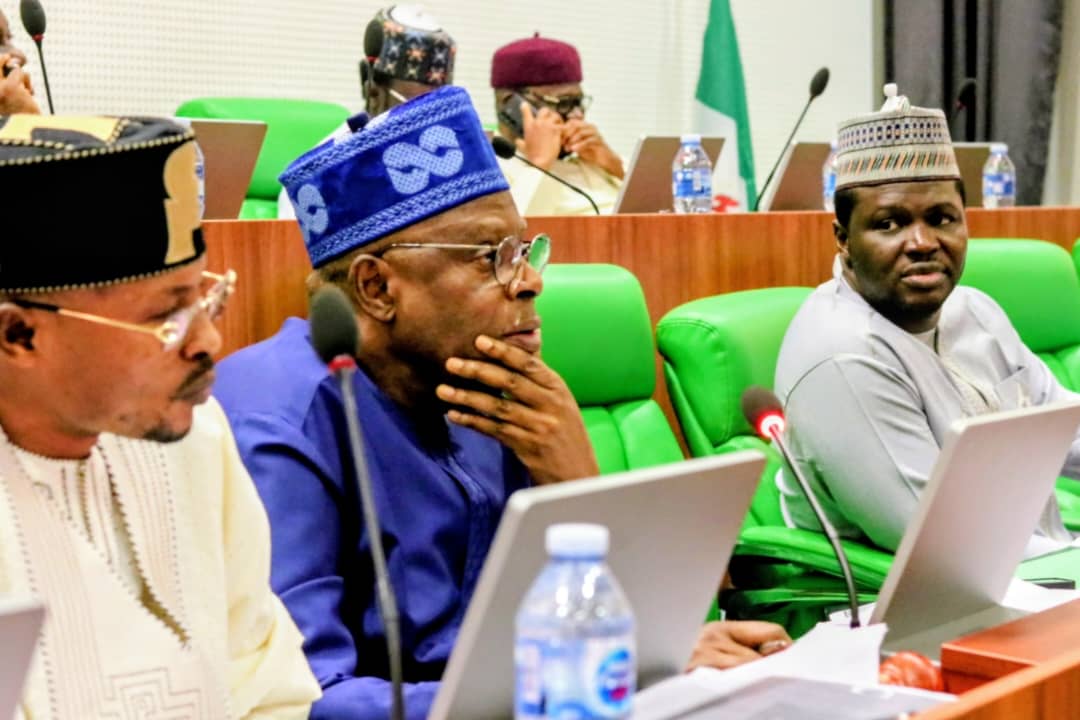
The House of Representatives Committee on Finance on Tuesday put the Nigeria Customs Service under close scrutiny over its revenue performance from 2023 to 2025, asking for comprehensive details on auction proceeds, contractor registrations and export documentation.

The session, chaired by Rep. James Faleke, centred on how to strengthen revenue generation at a time when federal resources are under strain.
“We are looking at revenue. How do we shore up more money for this country? We are tired of borrowing. We don’t want to borrow anymore,” the Chairman said.
Presenting the agency’s figures, the Comptroller-General of Customs, Bashir Adeniyi, explained that the Service earns revenue from three main sources: import duty, excise duty and fees.
“As a kind of background, the revenue base for the Nigeria Customs Service are basically three heads. We have import duty, we have excise duty, and then we have various fees that are collected from different services,” he explained.
He disclosed that in 2023, Customs generated N3.2 trillion against a target of N3.67 trillion.
“In 2023, we collected total revenue of N3.2 trillion as against a target of N3.67 trillion,” he said, putting performance at roughly 87 per cent.
According to him, the first half of 2023 was challenging due to economic headwinds, including the currency redesign, election-related slowdowns and exchange rate volatility. But revenue improved significantly in the latter half of the year.
For 2024, however, the story was different. Adeniyi said the Service surpassed its target of N5.079 trillion, generating N6.1 trillion within the fiscal year.
“For 2024, our target was N5.079 trillion. Our revenue for 2024 was N6.1 trillion. The details are as provided,” he told lawmakers, referring to documents already submitted.
He attributed the stronger performance to policy measures and operational reforms initiated in 2023, including efforts to decongest the ports.
“We took actions in 2023 which helped to produce results in 2024. One of them was the effort to decongest the ports. Old containers were removed and we had better space for operations in 2024,” he said.
The Customs chief also revealed that presidential approval was obtained to review certain small consignments that often entered informally. A compliance window created for that purpose generated about N325 billion in 2024.
“We are at the end of the exercise. We made about N325 billion in 2024 from that intervention,” he said.
He acknowledged that the 2024 target was nearly double that of 2023, requiring deliberate planning and stricter enforcement.
On digitalisation, Adeniyi told lawmakers that while significant progress had been made, the system was not yet fully automated.
“In terms of automation, pre-arrival documentation is 100 per cent automated. Payment of customs duty has been automated. Transmission of manifests has been automated. Declarations have been automated. Release processes are automated,” he said.
He estimated overall automation at between 60 and 70 per cent.
“I would say we’ve done something in the region of 60 to 70 per cent,” he stated, noting that full automation depends on integration with shipping companies, terminal operators, banks and other government agencies.
Looking ahead, he said Customs is targeting N6.5 trillion in revenue for 2025, with discussions ongoing around a proposed N11 trillion target for 2026. However, he cautioned that unresolved fiscal policy issues could affect projections.
He pointed to three suspended revenue lines: excise on certain carbonated drinks, excise on single-use plastics (PSP), and duties on some telecommunications products. Together, these were projected to yield about N3 trillion annually.
“The aspect that says we should have N3 trillion from excise addition of some products to excise has not been done. Collection of duty on PSP has not been done. Collection of duty on telecom products has not been done.
“If the fiscal policy remains the same and collection is suspended, then we should not project revenue on those items,” he told lawmakers.
Members of the committee also demanded a detailed account of auctioned goods and the revenue realised from them between 2023 and 2025.
“We want specific details for 2023 and all the other subsequent years — all of the auctions done, items and total generated revenue from the auction,” a member demanded.
In response, the Comptroller-General clarified that auction proceeds form only part of the revenue recorded under fees.
“It is not only the revenue we get from auctions that makes up the fees. If we issue licences, they come under fees. If we raise DNAs and penalties are paid, it comes under fees,” he explained.
He added that itemised auction records could be provided upon formal request, as the committee continues its oversight of revenue-generating agencies.
The Customs boss reaffirmed that agricultural and mineral exports attract no duty, in line with federal policy.
Responding to lawmakers’ questions on export earnings, he stressed that the zero-duty regime is deliberate.
“As a way of encouraging development of exports, federal government has made it a deliberate policy to make exports zero-rated. So no duty is collected on exports,” he said.
He added that while no duty is charged, Customs works closely with relevant agencies to ensure exporters comply with royalty payments and other regulatory requirements.
Adeniyi also revealed that the Service recently signed a Memorandum of Understanding with the United Nations Office on Drugs and Crime (UNODC) to strengthen officers’ capacity in identifying precious minerals and tackling illicit financial flows.
Members of the House Committee further raised concerns about figures relating to contractor registration fees and rental income from government-owned properties.
On contractor registration, the Customs chief explained that once contractors have been properly vetted and registered, they are not required to repeat the process.
Regarding rental income, he clarified that the funds come from properties owned by the Service, including aviation hangars leased to private operators.
Addressing questions about airport operations, the Comptroller-General said Customs does not keep passenger manifests but records cases involving undeclared items and related infractions.
He acknowledged that there had been territorial disagreements among agencies operating at airports in the past. However, he noted that cooperation has improved considerably, especially in scanner deployment and intelligence sharing.
At the close of the session, the committee directed Customs to submit detailed documentation covering auction records and full revenue breakdowns from 2023 to 2025, as part of its ongoing oversight of revenue-generating agencies.
News
NELFUND extends loan application portal for some institutions
The Nigerian Education Loan Fund (NELFUND) has approved an extension of its student loan application portal for institutions that formally requested additional time for the 2025/2026 academic session.
The Fund disclosed this in a statement issued in Abuja, on Thursday by its Director of Strategic Communications, Mrs Oseyemi Oluwatuyi.
According to the fund, the extension applies strictly to institutions that submitted official requests to enable their eligible students to complete applications on the NELFUND student loan portal.
Oluwatuyi quoted the Managing Director and Chief Executive Officer of NELFUND, Akintunde Sawyerr, to have said that the extension was part of the fund’s efforts to ensure wider access to the student loan scheme.
Sawyerr reaffirmed the organisation’s commitment to ensuring that eligible students across participating institutions benefit from the programme.
“NELFUND remains committed to ensuring that eligible students across participating institutions have the opportunity to access the student loan programme,” he said.
He urged eligible students in the affected institutions to take advantage of the extension and complete their applications through the official portal.
Sawyerr also reiterated the Fund’s commitment to transparency, accountability and the provision of sustainable student financing solutions aimed at removing financial barriers to higher education in the country.
(NAN)
News
Gov Mbah rejects claims of high taxation in Enugu
Governor of Enugu State, Dr. Peter Mbah, has rejected the claims of high taxation in the state, describing them as ‘a pathetic misconception promoted by the opposition and beneficiaries of the old order, who manipulated revenue collection to fatten their private pockets.’
Mbah insisted that his administration has grown the state’s Internally Generated Revenue (IGR), by widening the tax net to bring in more taxable persons, blocked revenue leakages, and tackled sharp practices that drained public revenues by introducing Consolidated Demand Notice, e-ticketing, recovery, optimisation, and monetisation of the state’s assets.
He stressed that the Enugu State Government doesn’t have the power to increase or reduce taxes under the 1999 Constitution, as it is the exclusive preserve of the federal government.
The governor provided the clarifications in an interview aired by Afia Television this week.
“First, as a state, we are not able to legislate on taxation. It is in the exclusive legislative list, which can only be legislated on by the National Assembly. Whether it is your Personal Income Tax, your Company Income Tax, your Value Added Tax or your Withholding Tax, those taxes can only be legislated on by the National Assembly,” he clarified.
Mbah said that those framing the false narratives could not come to terms that his administration could scale up the state’s IGR from N26.8bn the state recorded in 2022 to N37.4bn by the end of 2023, N180.5bn in 2024, and N406.7bn in 2025.
“I think for those framing this false narrative, it is beyond their imagination that we could optimise our dormant assets and grow our revenue exponentially.
“They fail or refuse to take note of the fact that in 2025, for instance, tax revenue accounted for only N51.5bn or 12.6 per cent of the N406.7bn IGR, while non-tax revenue was N355.2bn or 87.4 per cent,” the governor added.
As for the areas within the states’ competence, such as rates and levies, Mbah explained that his administration has already taken steps to crash the payable amounts for certain services provided by Enugu State Government.
“For those rates and fees, we constituted a committee that also included market leaders, organised labour, Chamber of Commerce and Industry, among others, which went around to get what the other states within the South East were charging. It turned out that Enugu is the lowest in the South East. But that notwithstanding, we crashed that rates even further by 70 per cent especiallyin land sectors,” he stated.
He, however, acknowledged the activities of illegal revenue collectors, saying the recently passed Enugu State Harmornised Taxes and Levies (Approved List for Collection) Law, 2026, would finally eliminate road blocks and unauthorised collections that have burdened residents of the State. He added that the government will up enforcement and public enlightenment to checkmate the activities of extortionists.
“Under our laws, we have consolidated all these services and you only just have one payment that you make and you are done with all the services that the government provides.
“Some people still go about extorting money from helpless citizens because this is a practice that has gone on over the years. But we have constituted a standing task force to track and bring them to book. We also want the citizens to report them. We now have several toll-free lines where citizens can call freely. They do not have to have airtime to place such calls,” he concluded.
News
FG to sanction six airlines over alleged airfare hikes, FCCPC says
The Federal Competition and Consumer Protection Commission (FCCPC) has disclosed that six domestic airlines may face sanctions over alleged arbitrary increases in airfares during the Christmas travel period.
Executive Vice Chairman of the commission, Tunji Bello, made the disclosure during the “Meet the Press” briefing organised by the Presidential Communications Team at the State House in Abuja.
Bello said investigations by the commission found indications of coordinated fare increases during the festive period and that the affected airlines could be required to refund excess charges to passengers once the final report is released.
According to him, ticket prices that previously ranged between ₦145,000 and ₦150,000 reportedly rose sharply to between ₦450,000 and ₦670,000 during the period under review.
“We have completed investigations into complaints that airlines fixed prices during the Christmas period. The final report will detail the penalties, and we are considering requiring refunds to affected passengers,” he said.
The FCCPC boss also revealed that the commission has recovered more than ₦10 billion for consumers through complaints resolved between March and August 2025.
He noted that over 9,000 consumer complaints were handled within the period and urged Nigerians to make use of the commission’s formal complaint channels rather than expressing dissatisfaction informally.
“Our work is evidence-based. Consumers must lodge complaints so we can investigate and ensure justice,” Bello said, adding that the commission’s digital platform allows consumers to submit complaints and track their progress.
He also disclosed that the commission is monitoring commodity prices nationwide amid tensions in the Middle East to ensure businesses do not exploit global developments to justify arbitrary price increases.
According to him, the FCCPC has activated a monitoring mechanism across critical sectors of the economy to track pricing trends and discourage anti-competitive practices.
Bello said the commission is working with agencies including the Nigerian Upstream Petroleum Regulatory Commission to monitor developments in the petroleum sector.
On rising cement prices, the FCCPC boss confirmed that the Federal Government has set up an investigative committee to examine the situation following public concerns.
He explained that while the commission does not directly control prices, it is empowered under the Federal Competition and Consumer Protection Act 2018 to investigate and prosecute anti-competitive practices such as price fixing.
Bello added that the commission has already prosecuted more than 55 cases under the law, with additional cases currently pending.
-
Economy20 hours agoDollar, Pound, Euro Rates in Nigeria Today – See Full Exchange for March 12, 2026
-
News18 hours agoFormer House Of Reps Speaker Dumps Party, Joins ADC
-
News18 hours agoWoman Writes Billionaire Femi Otedola, Wants Permission to Marry His Son Fewa
-
News16 hours agoCeding oil wells: FG losing 780 hectares of maritime water to corruption -CSOs(Video/Photos)
-
News16 hours agoJust in: Nine senators dump their parties for ADC
-
News17 hours agoPakistan Sends Naval warships to protect commercial ships in Strait of Hormuz
-
News17 hours agoGroup Defends Pipeline Surveillance Contracts
-
News14 hours agoJust in: ADC Wuse Ward suspends FCT Senator, Kingibe