Connect with us

Foreign

North Korea test-fires 10 missiles as South Korea, U.S. stage war games

Published

on

ADVERTISEMENT
Zoom Ad
ADVERTISEMENT
Zoom Ad

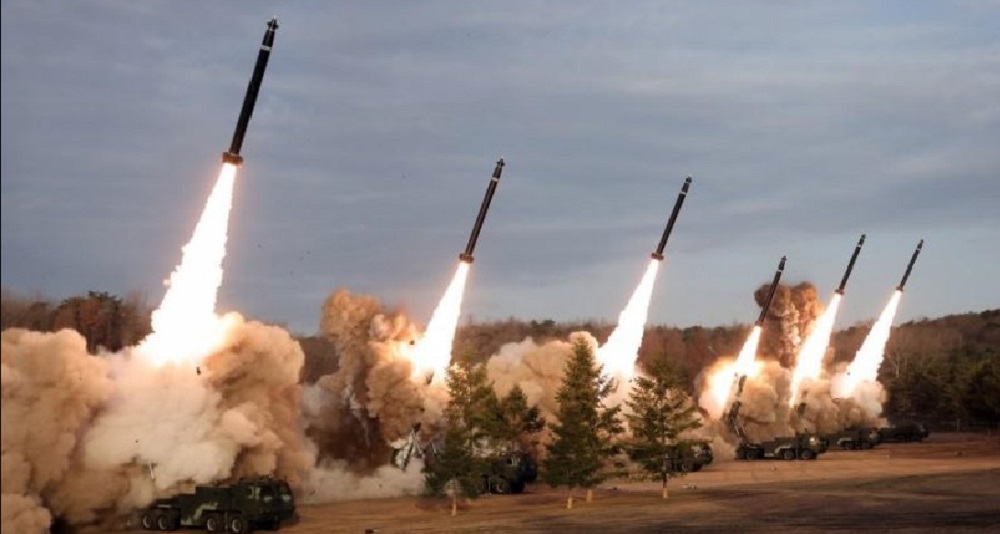
North Korea test-fired 10 short-range ballistic missiles into the Sea of Japan at the weekend, five days after South Korea and its U.S. allies kicked off their annual spring war games.


Seoul’s Joint Chiefs of Staff said they detected the launches at around 1:20 p.m.

“Our military maintains a firm readiness posture while closely sharing North Korean ballistic missile information with the U.S. and Japanese sides amid a heightened surveillance posture against additional launches,” Seoul’s Joint Chiefs said, per Yonhap News Agency, in a template statement.

The missiles splashed in the Sea of Japan, east of the peninsula.

Advertisement

For tests of ballistic missiles, Pyongyang follows common global protocols, firing them on a west-east trajectory so the Earth’s rotation grants them extra boost.

Experts say North Korea conducts test firings for two reasons. One is to gather technical data; one is to make political points.

Currently, North Korea is highly likely to be gathering data from live war. Since January, it has been firing tube and rocket artillery from Russia’s Kursk Oblast into Ukraine.

Saturday’s missile shoot followed angry rhetoric aimed at the annual “Freedom Shield” drills by Kim Yo-jong, the sister of North Korean leader Kim Jong-un. Pyongyang insists that the exercises, which Washington calls “defensive in nature,” are actually practice for an invasion.

Advertisement

Ms. Kim warned, in a statement in state media on Tuesday, the day following the drills’ commencement, that they could “lead to terrible consequences that are unimaginable.”

Her fortunes rose in February at the once-every-five-years Workers Party Congress, where she was promoted director of the party’s General Affairs Department.

Though the powerful Ms. Kim, who frequently pens bylined columns on inter-Korean relations, warned that Freedom Shield “will further destroy regional stability,” life in South Korea continues as usual.

The population has long been immunized to North Korean threats, and all three actions — the start of spring military drills by the two allies, followed by the North’s response in the form of barrages of rhetoric and missiles — had been predicted.

Advertisement

Events follow the same course virtually every year, though this spring, the drills take place against the backdrop of an ongoing Israeli-U.S. aerial campaign against Iran.

Indo-Pacific-based U.S. assets — missile interceptors in South Korea and U.S. Marines in Okinawa — are currently redeploying to the Middle East, where Iran’s will to fight remains unbroken.

The redeployments have raised quiet concerns about the U.S. ability to fight a two-front war, and come at a time when a major power shift is underway in the defense of the Korean Peninsula.

The all-domain drills encompass both computer simulations and “Warrior Shield” field exercises. Some 18,000 troops are engaged, with training running from March 9 through March 19.

Advertisement

While the “Allies drill-North Korea responds angrily” scenario was predictable, a new dynamic is animating the war games this year.

The Spring 2026 drills are being used to stress-test South Korea’s domestic capabilities, notably in sophisticated areas such as long-range strike, command and control, and intelligence, reconnaissance and surveillance.

The assessments, made by the U.S. side, are part of the planned conditions-based transfer of wartime operational control of South Korean troops from U.S. to South Korean command.

The Lee Jae-myung administration, which took office in summer 2025, has announced that it wants wartime “OPCON Transfer” to take place by the end of its term, 2030.

Advertisement

The concept has a long history, but current Seoul-Washington policy stances suggest it may, finally, happen.

OPCON transfer was first brokered by the liberal Roh Moo-hyun administration (2003-2008), which sought sovereign control of its own forces.

However, it was subsequently slow-walked by successive conservative administrations in Seoul, who feared it would greenlight reduced U.S. commitments to the peninsula.

As matters stand, Korean troops would fight under the orders of the Combined Forces Command, a joint structure led by an American four-star general, with a South Korean deputy.

Advertisement

Exactly how OPCON transfer — the exact conditions to be met have never been made fully public — would proceed, and what might happen to CFC if and when it does, is unclear. Whether U.S. troops would fight under Seoul’s wartime command is another concern that gives Korean conservatives the vapours.

Regardless, OPCON transfer’s stars are aligning on both sides of the Pacific.

In South Korea, the liberal Mr. Lee occupies the presidential Blue House, while his party comfortably controls the National Assembly. This leaves the conservative opposition largely impotent.

Meanwhile, the Trump administration is pressuring allies worldwide to increase defence spending and upgrade capabilities. It has made clear it wants Seoul to take an increasing share of the conventional defense burden, while sheltering Korea under the U.S. nuclear umbrella.

Advertisement

What is unknown is how far South Korea’s military is proceeding toward satisfying U.S.-set conditions.

“The main thing here is the conditions,” U.S. Forces Commanding General Xavier Brunson said during a webinar organized by the Korea Defense Veterans Association and the Korea-U.S. Alliance Foundation last December. “We cannot say we’re going to slide away from the conditions just so that we can get this done in time.”

Continue Reading
Advertisement

Foreign

Second Tragedy in Two Days: Student Gunman Kills Four at Middle School

Published

on

By

ADVERTISEMENT
Zoom Ad
ADVERTISEMENT
Zoom Ad

A devastating shooting at a middle school in southeastern Turkey on Wednesday has left at least four people dead and 20 others wounded. The incident, which occurred in the province of Kahramanmaras, marks a harrowing second day of educational violence in the region, an anomaly in a country where school shootings are exceedingly rare.

The local governor, Mukerrem Unluer, confirmed to reporters that the fatalities included three pupils and one teacher. The perpetrator, identified as an eighth-grade student at the school, also died during the attack.

According to Governor Unluer, the assailant, typically aged 13 or 14 arrived at the institution concealing an arsenal within his backpack. The weapons, which authorities believe belonged to his father, a retired police officer, included five firearms and seven ammunition magazines.

“An eighth-grade student entered two classrooms occupied by fifth-grade students and opened fire indiscriminately,” Governor Unluer stated. The victims in the fifth grade are generally between the ages of 10 and 11.

Advertisement

The Governor further disclosed that four of the wounded are currently in critical condition and are undergoing emergency surgery.

Television footage from the site depicted a harrowing scene as police cordoned off the school gates while frantic crowds gathered nearby. Ambulances were seen transporting at least two victims from the premises as emergency services worked to stabilise the survivors.

The Justice Minister, Akin Gurlek, announced via the social media platform X that a formal investigation has been launched into the circumstances surrounding the massacre. Authorities are expected to scrutinise how the minor gained access to his father’s service weapons.

This tragedy follows a similar incident on Tuesday in the neighbouring province of Sanliurfa, where a former student opened fire at a school, wounding 16 individuals including staff and pupils before taking his own life.

Advertisement

The back-to-back attacks have sent shockwaves through the Turkish nation, prompting urgent discussions regarding firearm security and the safety of academic environments.

Continue Reading

Foreign

Magyar slams Orbán for shunning Hungarians, calls Russia ‘security risk’

Published

on

By

ADVERTISEMENT
Zoom Ad
ADVERTISEMENT
Zoom Ad

Prime Minister of Hungary Péter Magyar on Monday scolded Viktor Orbán for not paying attention to the problems affecting Hungarians while focusing on issues in other countries.

In a speech after the electoral victory, Magyar assured his administration would refrain from interfering in the domestic affairs of other nations, urging foreign governments to do the same.

The prime minister noted that Orbán played a five-dimensional chess game, saying the attitude was probably one of the reasons for his defeat at the polls.

According to Magyar, his predecessor often talked about Ukraine, Russia, Iran, the Iranian Shah, the Iranian Ayatollah, and the United States presidential election.

Advertisement

“If he had been woken from his sleep, he would have said that he won the US presidential election, not Donald Trump,” the PM mocked.

Magyar criticized the Kremlin and advised Europe to prepare to protect itself. “The Russian state is a security risk,” he declared, recalling Hungary “felt the Russian bear before.”

The leader vowed his government will do “everything for diversification” of Hungary and Russia, but clarified that Budapest will not “decouple” relations with Moscow.

The PM, however, expressed opposition to Ukraine’s accelerated accession to the EU: “It is absolutely absurd for a country at war to be admitted to the European Union.”

Advertisement

Magyar also said he will not initiate a phone conversation with President Donald Trump and President Vladimir Putin but will respond if the leaders or their officials reach out.

Russian Foreign Minister Sergey Lavrov on Monday declined a detailed response to Magyar’s comment that he will not engage in negotiations with Russia

“We are ready to build relations with the new government,” the diplomat told reporters. “Much will depend on how it defines and pursues its national interests.”

Advertisement
Continue Reading

Foreign

Facing Backlash Trump Deletes AI Jesus-Like Image

Published

on

By

ADVERTISEMENT
Zoom Ad
ADVERTISEMENT
Zoom Ad

U.S. President Donald Trump has removed an artificial intelligence-generated image of himself from social media after it sparked widespread backlash from religious groups and commentators who described it as offensive and inappropriate.

The image, originally shared on his Truth Social account late Sunday, portrayed Trump in flowing robes with a glowing hand placed on a seemingly ill individual, while other figures appeared to look on in reverence. An American flag was also visible in the background of the scene.

The post was deleted on Monday following growing criticism, including strong reactions from Christian leaders who accused the president of crossing a line with religious symbolism.

Responding to questions about the image, Trump denied any intent to portray himself as Jesus Christ. “I did post it, and I thought it was me as a doctor and had to do Red Cross,” he told reporters. “It’s supposed to be me as a doctor, making people better. And I do make people better. I make people a lot better.”

Advertisement

However, the explanation did little to calm concerns, as several religious commentators and conservative Christian voices within his political base condemned the post as disrespectful.

Among the critics was journalist Megan Basham, who described the image as “OUTRAGEOUS blasphemy” and called for an immediate apology. She further urged the president to retract the post and seek forgiveness.

The controversy also drew a formal response from the Knights Templar, which publicly condemned the image and demanded an apology, arguing that the depiction disrespected core Christian beliefs.

This is not the first time Trump has faced scrutiny over religious-themed imagery. In previous instances, he has shared or been associated with posts placing him alongside biblical figures or in symbolic religious settings, often drawing mixed reactions from supporters and critics alike.

Advertisement

Some of his close allies have also previously used religious comparisons in describing his political role, further intensifying debates about the intersection of politics, personality, and religious symbolism in his public communications.

The latest incident has reignited discussion over the use of AI-generated imagery in political messaging and the boundaries of religious representation in modern digital campaigning.

Continue Reading

Trending

Copyright © 2024 Naija Blitz News